
Examinations
Safe burglary: how does an examiner tell whether a safe was forced, drilled or opened with the combination?
An examination of a safe after a theft answers how it was opened: by force on the door or body, by drilling, or with the combination or key. The answer can decide an insurance claim: the policy the Arkansas Supreme Court read in 1931 required visible marks of force and excluded loss by key or manipulation. Manipulation leaves essentially no forensic evidence, while drilling and prying leave toolmarks.
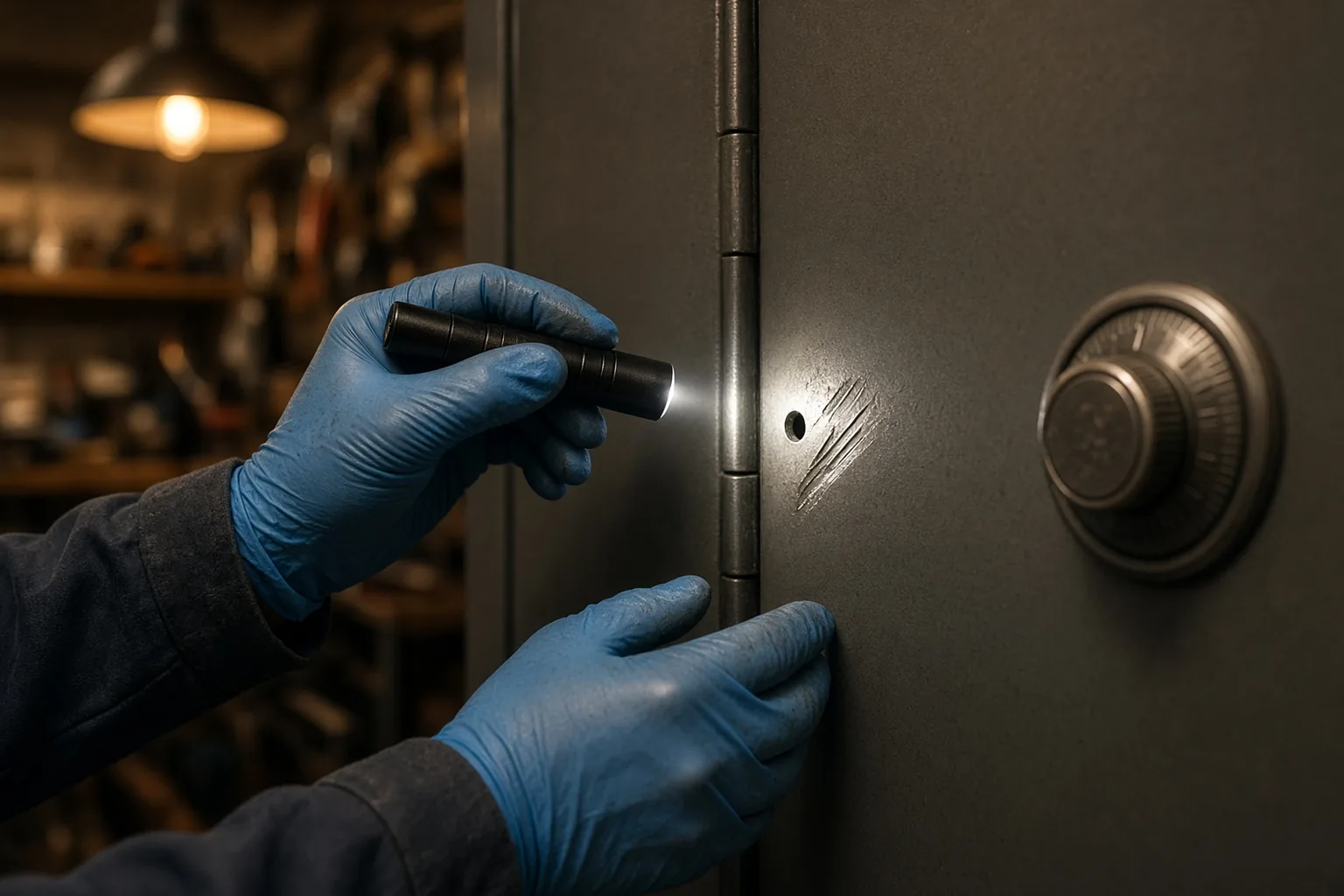
What does a forensic examination of a safe answer?
How the safe was opened and whether its marks belong to the theft. The examiner looks for force on the door and body, drill holes and repairs, the state of the lock and boltwork, and compares toolmarks with a tool.
Three answers are possible, and each leads somewhere different. A safe opened by force carries marks of tools on the door, the hinges or the body. A safe opened by drilling has holes, sometimes plugged and painted over. A safe opened with the combination or a key may look untouched, and the question then moves to who knew the combination or held the key.
The examiner also asks when the marks were made. Old pry marks from a previous attempt, a hole drilled by a technician to open a locked-out safe, and damage made by the police or the owner after the theft are all marks that the examiner separates from the attack itself.
Toolmarks on lock cylinders and on safe doors are compared with test marks made by the suspect tool. If a pry bar or a drill bit broke during the attack, the broken pieces can be examined for a fracture fit, a conclusion that the Department of Justice's fracture examination ULTR, effective August 16, 2023, lets its examiners report.
How are burglary-resistant safes rated, and what does the rating say?
UL 687 classifies combination locked safes as TL-15, TL-30, TRTL-30 and similar classes, with X6 classes for attacks on the door and the body. Matt Blaze notes that the best UL categories are for only 15, 30 and 60 minutes.
UL 687, Standard for Burglary-Resistant Safes, states in section 1.1 that its requirements "cover combination locked burglary-resistant safes." The classes for attack on the door and front face are TL-15, Deposit Safe, TL-30 and TRTL-30; the classes for attack on the door and body are TL-15X6, TL-30X6, TRTL-15X6, TRTL-30X6, TRTL-60X6 and TXTL-60X6. Night depositories are excluded and covered by UL 771.
Matt Blaze of the University of Pennsylvania, in "Safecracking for the computer scientist" (December 2004), writes that "the best UL rating categories are for only 15, 30 and 60 minutes," and that the ratings are guidelines intended mainly for comparison rather than true bounds on security. The number in the class is time under attack, not a promise that the safe cannot be opened.
The locks are rated separately. Blaze describes UL Group 1 locks as "intended to resist expert manipulation for at least twenty hours," Group 1R as also resistant to radiological analysis, Group 2 as giving moderate resistance, and Group 2M locks as resisting expert manipulation "for up to two hours." The rating label on the safe and the lock model are the first facts an examiner records.
Which ways of opening a safe leave marks, and which leave none?
Manipulation of a combination lock leaves essentially no forensic evidence, according to Matt Blaze. Drilling leaves holes that may escape casual notice once repaired, and forced attacks that breach an unprotected side leave visible damage.
Blaze describes manipulation as inferring the combination from feedback through the dial, needing "no elaborate tools (beyond a pencil and paper)," and states that it leaves "essentially no forensic evidence." A safe opened that way looks the same as a safe opened by someone who knew the combination.
Drilling is used to release the boltwork or to decode the combination through an inspection hole, sometimes with a borescope that lets the operator view the wheel pack. Blaze notes that covert attacks of this kind may escape casual notice once repaired, although there may be evidence of the opening. An examiner who looks only at the dial and the handle can miss a plugged hole on the side or the back of the door.
Forced attacks, in Blaze's description, often do not aim to open the door but to breach an unprotected side. Relockers are built to detect punching attacks, in which the back of the door is damaged. A fired relocker, a breached side or a punched spindle are physical findings that the examiner photographs before anything is moved.
Why do insurers ask whether there are visible marks of force?
Because some safe burglary policies cover loss only after a forced entry with visible marks and exclude loss by key or manipulation. The Arkansas Supreme Court applied such a policy in Aetna Casualty and Surety Co. v. Sengel in 1931.
The policy in Sengel covered loss "after entry into such safe or vault has been effected by force and violence," by the use of tools, explosives, electricity, gas or other chemicals "directly upon the exterior thereof," "of which force and violence there shall be visible marks." Paragraph 9 excluded "any loss effected by opening any safe or vault insured hereunder by the use of any key or by the manipulation of any lock."
The safe was fireproof, not burglar-proof, with an outer door locked by a combination and a small inner chest with a thin steel door and a key lock, which held the cash. The burglars opened the outer door by working the combination, using no force, then forced the inner chest door with a tool, leaving visible marks, and took the cash.
The court held the insurer liable. It read the clauses as protecting the insured "from loss from a forcible felonious entry, where marks of such are visible upon any of the doors" that the thief had to pass on the way in, and, quoting an earlier decision, said that an insurer wishing to limit its liability in that way "should have done so." Policies differ, and the wording of the policy in each claim decides the question; the examiner supplies the facts about each door.
Why does the examiner check every door, drawer and inner compartment?
Because the location of the force can decide coverage and the charge. In Sengel the outer door was opened without force and the inner chest was forced, and the visible marks on the inner door were enough for liability.
A safe can have more than one barrier: an outer door, an inner door, a locked drawer or a deposit chute. A report that says only that the safe was opened without force, after looking at the outer door, does not answer the question the policy in Sengel posed about "any of the doors through which entry from the outside was necessary."
The examiner records each barrier separately: its lock, its condition, any toolmarks and where they are. Marks on an inner door made with a screwdriver or a pry bar are compared with test marks from the suspect tool, like any other toolmark.
The same record serves a criminal case. Whether the thief knew the combination, forced the outer door or broke only the inner chest changes what the investigators look for next: the people who knew the combination, or the tool and the person who carried it.
What evidence can a safe burglary leave on the burglar?
Safe insulation, among other traces. A 1974 FBI Law Enforcement Bulletin article noted that insulation material on a suspect's clothing or shoes can, with other circumstances, provide strong evidence, and that laboratories can compare particles with a specific safe.
The NCJRS abstract of "Safe Insulation and Its Value in Crime Detection," FBI Law Enforcement Bulletin, volume 43, issue 11, November 1974 (NCJ 15917), states: "The presence of safe insulation material on the clothing or shoes of a suspect can, with other circumstances provide strong evidence of guilt." The annotation adds that laboratory analysis can identify the brand of safe a particle came from and whether particles match a specific burglarized safe.
The article's wording sets the limit: insulation on a suspect is strong evidence together with other circumstances, not by itself.
D. G. Webb's 1975 investigator's guide, "Investigation of Safe and Money Chest Burglary" (NCJ 25734, 116 pages), covers the construction of safes, novice and expert methods of attack, collection of evidence and investigation reports. The comparison of particles goes to a materials examiner, the comparison of toolmarks to a toolmark examiner.
What should the examination of a safe record?
The rating label and lock model, photographs before anything is moved, each barrier and its condition, every hole, repair, toolmark and relocker state, and the tools and test marks used for comparison. Conclusions stay within what the marks show.
The record starts before the safe is touched: photographs of the safe in place, of the dial, the handle, the hinges, the sides and the back. The rating label and the lock model are copied from the safe, because they set what attacks the safe and lock were built to resist.
Each finding is located and measured: the position and size of any hole, any filler or paint over it, the direction of pry marks, the state of the relocker, the condition of the boltwork. Where a suspect tool exists, the examiner makes test marks with it on suitable material and compares them with the marks on the safe.
The conclusion separates what the safe shows from what it does not. That the safe bears no marks of force is a finding; that the owner opened it is not, because manipulation leaves essentially no forensic evidence. The DOJ ULTR documents bar their examiners from claiming absolute certainty or exclusion of all other sources, and Rule 702 of the Federal Rules of Evidence asks forensic experts to avoid assertions of absolute certainty when the method is subjective.
What should a party send to the examiner?
Access to the safe in its post-theft condition, unrepaired, photographs taken at discovery, the police report, the insurer's report if any, the safe's rating and lock documents, service records, and the list of people who held keys or the combination.
The safe itself comes first. A safe that has been repaired, repainted or replaced leaves only photographs, and the review of photographs depends on whether they show the sides, the back and the inner compartments at close range.
The documents come next: the purchase or rating documents, the lock model and service records, any record of earlier lockouts or drill-openings by a technician, and the policy wording if the claim is insured. A technician's earlier repair hole is a mark that has to be explained before any other hole is attributed to the theft.
The list of people who knew the combination or held a key, with dates of any combination change, is not a forensic object, but the examiner needs it to frame the conclusion: a safe without marks of force points the inquiry toward those people.
What does IAE do when a safe or a lock is disputed?
IAE prepares expert reports on the client's questions and reviews of the opposing examiner's report on whether a lock or seal was defeated, for US criminal defense and cargo loss cases, in up to 5 business days.
The questions cover whether a shoe, a tire or a tool could have left the mark, how strong the association is and whether a lock or seal was defeated. Toolmarks on lock cylinders and seals are compared with test marks made by the suspect tool, and each question is tied to the ANSI/ASB or ISO standard for that kind of mark. IAE confirms the questions with the client before work starts.
The secretariat confirms receipt the same day. IAE then confirms the format, the cost, the deadline and the specialist from its registry, and the client approves the candidate and the CV before work starts. Cases with tight deadlines have a 48-hour rush.
Every specialist is a member of the public IAE registry and can be verified by Member ID or QR code, and confirms in the document that he or she has no interest in the outcome of the case. IAE is not a law firm and does not advise on case strategy or on coverage under an insurance policy. A report is evidence that the court weighs with the rest of the record, and neither IAE nor the examiner guarantees the outcome.
Sources
- Blaze M. Safecracking for the computer scientist. University of Pennsylvania, draft, December 2004
- UL 687, Standard for Burglary-Resistant Safes, catalog page (GlobalSpec)
- Aetna Casualty and Surety Co. v. Sengel, 183 Ark. 151 (Ark. Feb. 9, 1931) (opinions.arcourts.gov)
- NCJRS abstract: Safe Insulation and Its Value in Crime Detection. FBI Law Enforcement Bulletin 43(11), November 1974, NCJ 15917
- NCJRS abstract: Webb D. G. Investigation of Safe and Money Chest Burglary, 1975, NCJ 25734
- U.S. Department of Justice, ULTR for the Firearms/Toolmarks Discipline, Fracture Examination, effective August 16, 2023
- Federal Rules of Evidence, Rule 702, Testimony by Expert Witnesses, with committee notes (Office of the Law Revision Counsel, uscode.house.gov)
Read also
All articles
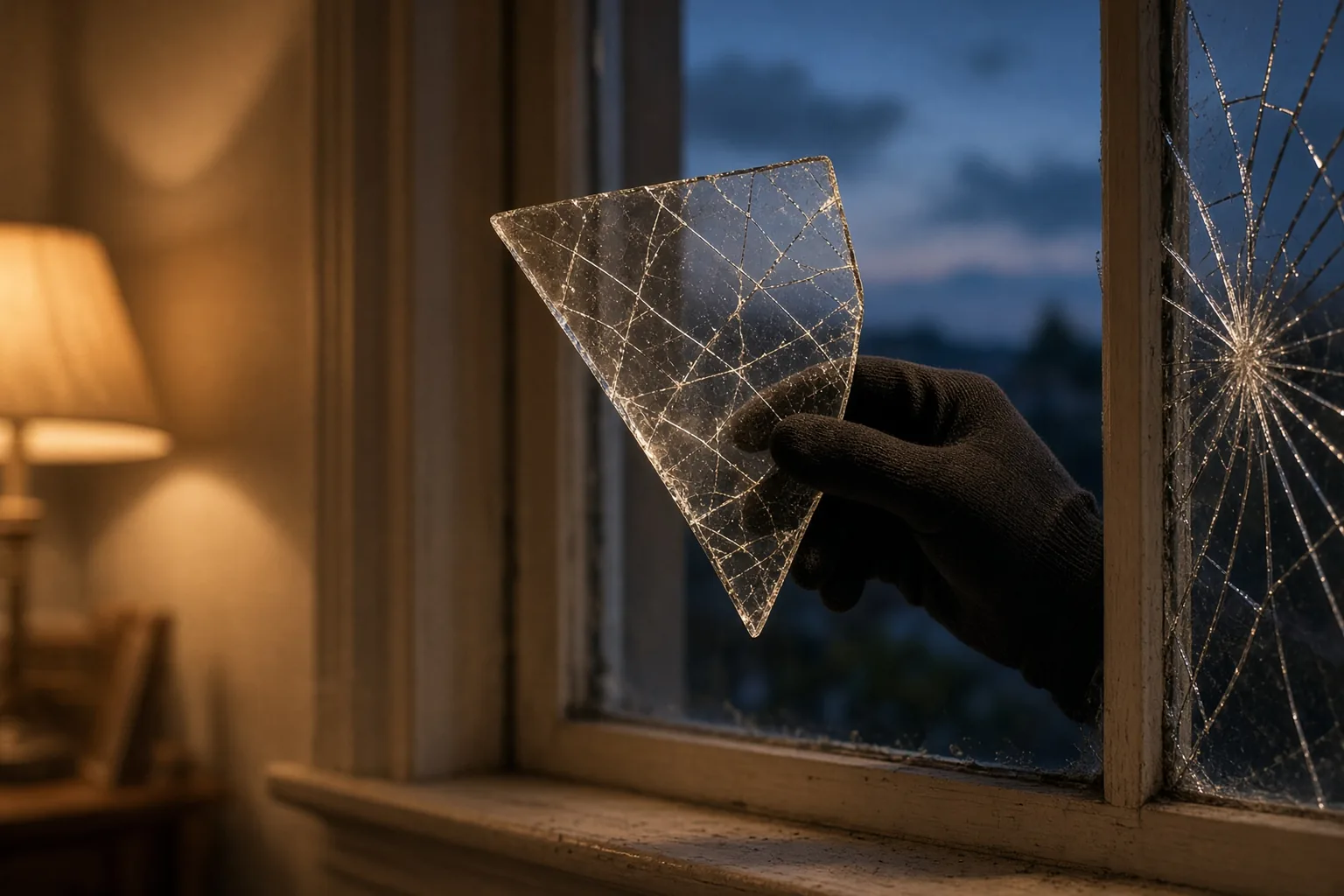
Was the window broken from inside or outside? How does a glass fracture examination answer, and how far can the answer be trusted?
After a reported burglary, a shooting or a fire, one broken pane can decide which account is true: forced entry or a staged scene, a shot fired into Sergei Voronin
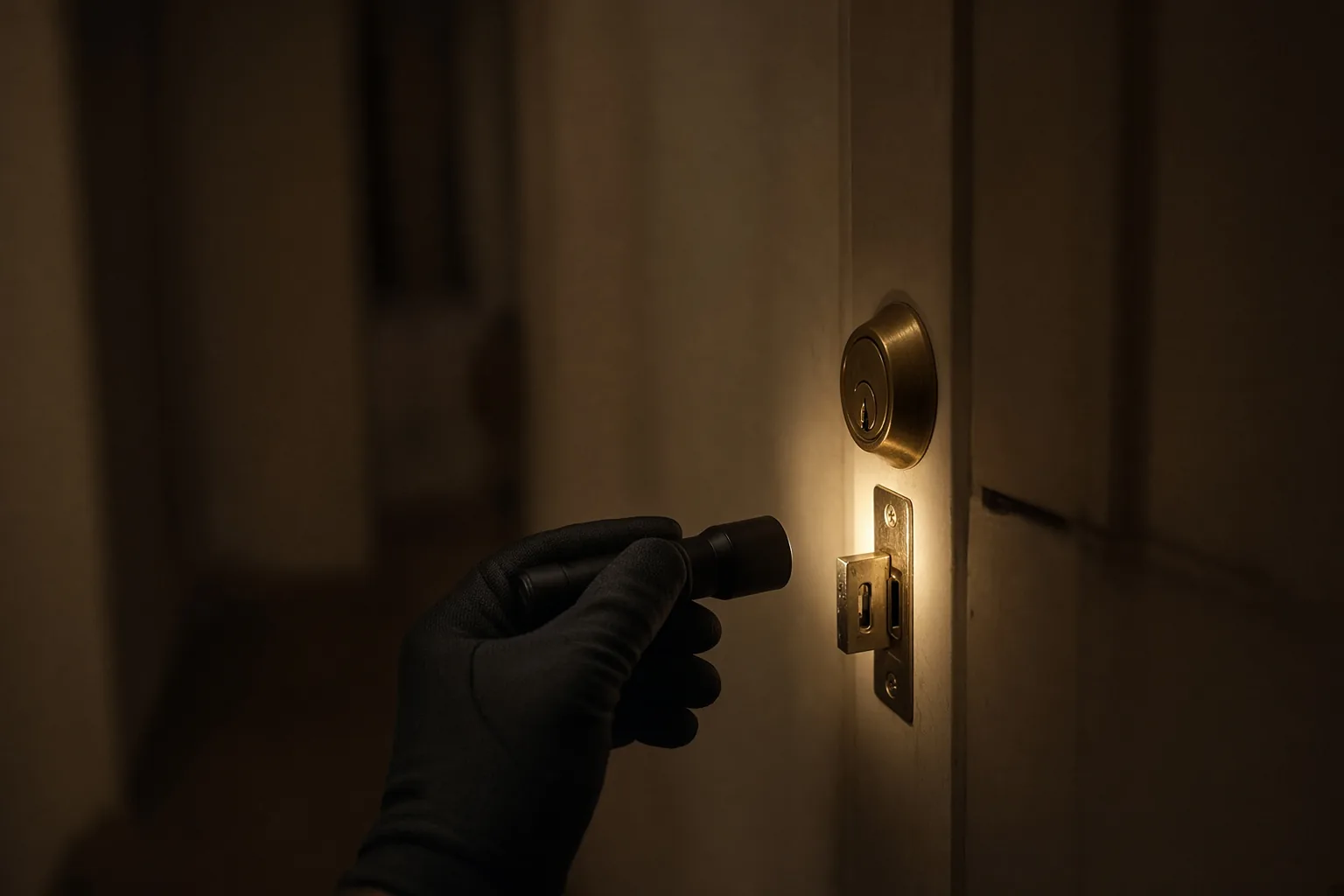
No signs of forced entry: how is a door, lock or window examined after a reported burglary?
Some commercial burglary policies pay only for entry by force that leaves visible marks, and police reports often carry the line "no signs of forcedSergei Voronin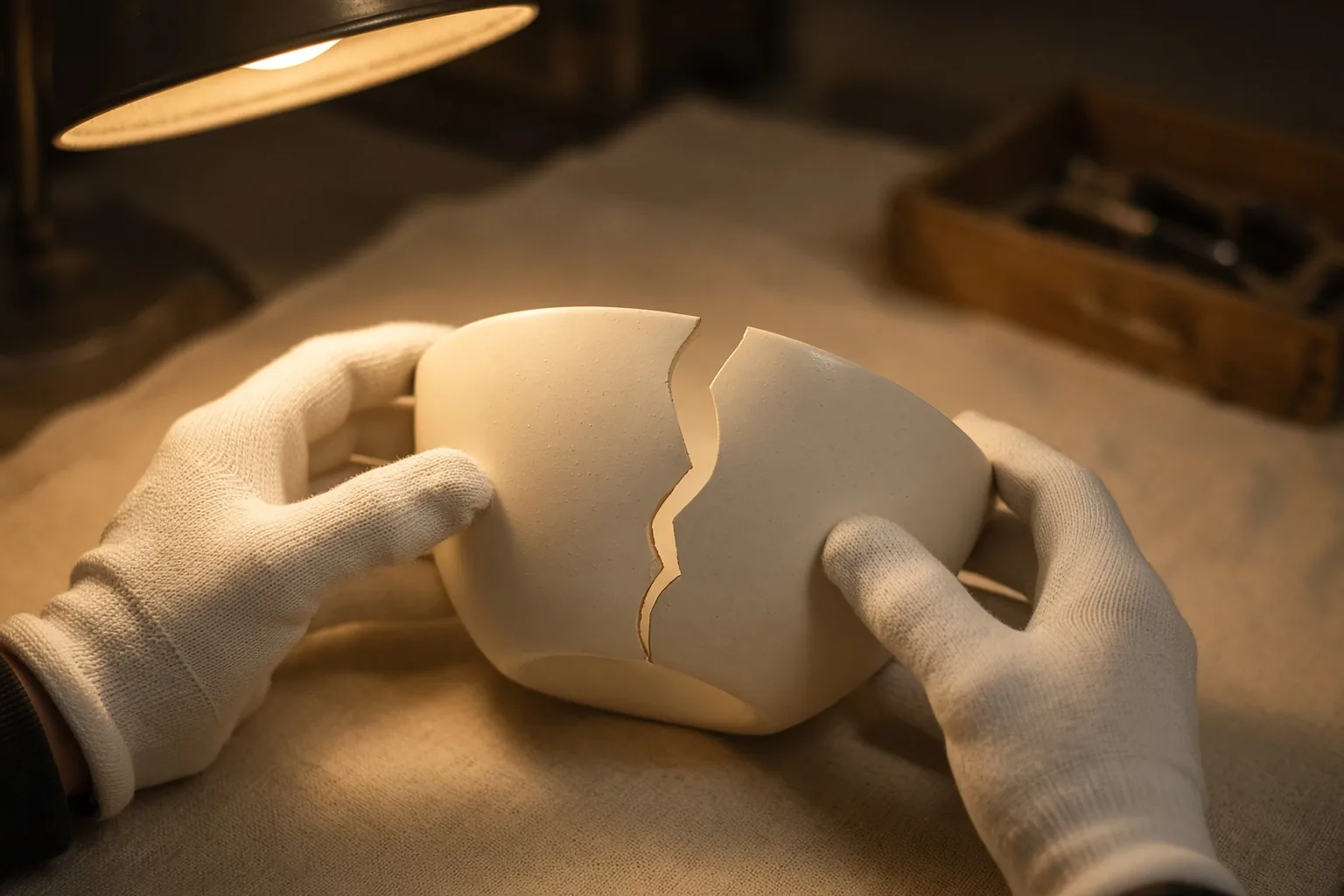
Physical fit examination: can a broken or torn piece be shown to come from one object?
A physical fit examination answers whether broken, torn or separated pieces were once joined together as one object. ASTM E3392-24, publishedSergei VoroninExpert examinations
Ready to discuss your case?
Send the materials: the secretariat will confirm the format, cost, deadline and the specialist within one business day.
