
Examinations
Forensic audio authentication: how does an examiner check a recording for edits?
An audio examiner checks whether a recording is consistent with an original made the way its owner says: on that device, at that time, without edits. SWGDE Best Practices for Digital Audio Authentication, version 1.3 of September 20, 2018, sets the order of work: the examiner hashes the first copy of the data, works on a copy and reports one of three outcomes. Federal Rule of Evidence 901 sets what a court needs before it admits the recording.
What is forensic audio authentication?
An examination of whether a recording's claimed history is true. SWGDE defines authentication as the process of substantiating that the asserted provenance of data is true, and its guide applies that process to digital audio files.
The Scientific Working Group on Digital Evidence (SWGDE) published document 15-a-001, Best Practices for Digital Audio Authentication, in version 1.3 on September 20, 2018. It takes its definition from the SWGDE and SWGIT glossary: authentication is "the process of substantiating that the asserted provenance of data is true." Provenance, in the same guide, is "the true history of a physical item and the recordings stored or encoded on or within it."
The guide defines an original recording as "the first manifestation of sound in a recoverable stored format." A file converted into another format is a different object: "Transcoded or re-encoded versions of an original recording are not original recordings." A WAV file saved again as an MP3 belongs to that second group, and so does any export from an editing program.
The guide covers digital files only. It states that it "does not address the authentication of analog audio recordings/media," so cassette and microcassette tapes fall outside it.
Authentication in the forensic sense is narrower than authentication under the rules of evidence. A court asks whether the recording is what its proponent claims it is. The examiner answers technical questions: whether the file structure, the metadata and the sound match the device and the circumstances described, and whether anything in the signal points to an edit.
What does a court require before it admits a recording?
Evidence sufficient to support a finding that the recording is what its proponent claims, under Federal Rule of Evidence 901(a). A witness who knows the voice, a description of the recording system or an examiner can supply it.
Rule 901(a) reads: "To satisfy the requirement of authenticating or identifying an item of evidence, the proponent must produce evidence sufficient to support a finding that the item is what the proponent claims it is." The rule sets a threshold of sufficiency, and Rule 901(b) lists examples of evidence that meets it.
Two of those examples concern recordings. Rule 901(b)(5) permits an opinion identifying a person's voice, "whether heard firsthand or through mechanical or electronic transmission or recording," if it is "based on hearing the voice at any time under circumstances that connect it with the alleged speaker." Rule 901(b)(9) covers "evidence describing a process or system and showing that it produces an accurate result." Testimony about the recorder and about each copy made of the file is evidence of the second kind.
The advisory committee note to example (6), on telephone conversations, states that "a mere assertion of his identity by a person talking on the telephone is not sufficient evidence of the authenticity of the conversation" and that "additional evidence of his identity is required." For a call recording, the proponent supplies it through the content of the call, a witness who knows the voice under Rule 901(b)(5) or an examiner's comparison.
When the other side says the file was edited, the dispute turns to facts that need specialized knowledge. Rule 901 sets no technical test for edits. The test comes from the examiner's method, and the court reviews the method under Rule 702.
Does the examiner need the original file or the recording device?
The original file, and the recorder when it can be produced. SWGDE has the examiner compare the file with test recordings made on the submitted recorder, and Rule 1003 admits a duplicate only absent a genuine question about authenticity.
Section 4.4.2 of the SWGDE guide says the file structure "should be compared with exemplar recordings made from submitted recorders or other test recordings." The examiner makes test files on the same device, or on the same make and model, with the settings found in the questioned file, and looks for differences. Under section 4.4.1, metadata "could include: recorder make/model, serial number, settings applied during the recording."
The first item the examiner receives is protected before any work starts. The guide says "the first removable instance of the original data should be protected from modification," by write-blocking or over-record protection, and hashed if possible. In the sample case of Appendix A, the laboratory hashes the submitted CD and makes two bit-stream images: one goes to the archive with the submitted evidence, and the other becomes the working copy.
Rule 1003 reads: "A duplicate is admissible to the same extent as the original unless a genuine question is raised about the original's authenticity or the circumstances make it unfair to admit the duplicate." The House Judiciary Committee report on the rule (No. 93-650) said courts would be expected to be liberal in finding that a genuine question is raised. A party that disputes a copy raises it with specific facts, for example an examiner's findings about breaks in the sound or about metadata.
Rule 902(14), added in 2017, covers "data copied from an electronic device, storage medium, or file, if authenticated by a process of digital identification, as shown by a certification of a qualified person." The proponent must give the adverse party reasonable written notice before the trial or hearing under Rule 902(11). The committee note describes the hash value as a number "produced by an algorithm based upon the digital contents of a drive, medium, or file," and adds that a certification "can only establish that the proffered item is authentic." A matching hash proves that the copy equals the file that was hashed. It says nothing about whether that file had been edited before it was hashed.
In discovery, Rule 34(a)(1)(A) reaches "sound recordings" among electronically stored information, and Rule 34(a)(1) lets a party "inspect, copy, test, or sample" the items it covers. Under Rule 34(b)(1)(C), a request "may specify the form or forms in which electronically stored information is to be produced." Counsel who need the native file with its metadata name that form in the request and ask to inspect the device.
Who retains the examiner, and what must the report disclose?
Each party may retain its own examiner, whose report must contain the six items of Rule 26(a)(2)(B). A court may also appoint an expert of its own under Federal Rule of Evidence 706.
Rule 26(a)(2)(B) requires a written report "prepared and signed by the witness" from a witness retained or specially employed to give expert testimony. The report contains a complete statement of all opinions with their basis and reasons, the facts or data considered, the exhibits, the witness's qualifications with a list of publications from the previous 10 years, a list of cases with testimony at trial or by deposition in the previous 4 years, and the compensation.
For an audio report, the facts or data considered include the file examined, its hash and metadata, the exemplar recordings, the software and the settings of each measurement. SWGDE section 5.3 asks for the same items: a "description of the evidence and its chain of custody" and the "data and reasoning relied upon to come to conclusion(s)." It points to ASTM Practice E620 for reporting opinions of scientific or technical experts.
Rule 706(a) lets the court act "on a party's motion or on its own." The court "may ask the parties to submit nominations" and "may appoint any expert that the parties agree on and any of its own choosing," but only someone who "consents to act." Rule 706(e) adds: "This rule does not limit a party in calling its own experts."
What does the examiner check to find edits?
Critical listening, metadata and file structure, the waveform, the spectrogram and, where present, the electric network frequency. The SWGDE guide says not every test fits every case and no single analysis is relied on alone.
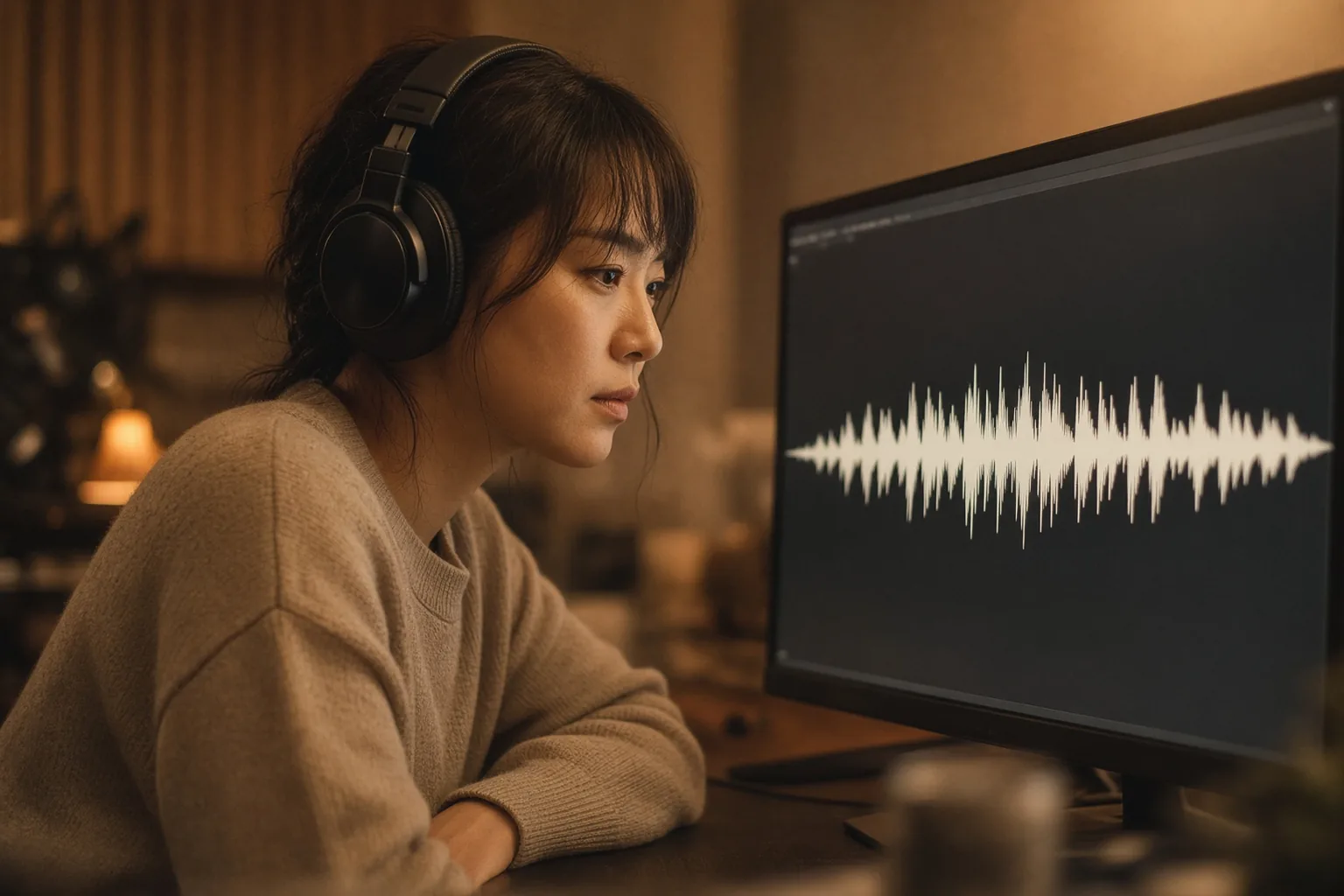
Section 4.3 of the guide starts with listening: "Critical aural review of the submitted recording, without applying any processing, can yield information." The guide lists what the examiner listens for, with repeated playback: voices, acoustic events, changes in background noise, sounds of equipment malfunction and possible record or edit events.
Sections 4.4.1 and 4.4.2 cover the container. The examiner reads the metadata and the internal structure of the file and compares them with exemplar recordings from the same recorder. The comparison looks for differences between the questioned file and the files the device is known to produce, and the report lists each difference found.
Section 4.5.1 describes the waveform, which "displays the relationship between time and amplitude," and section 4.5.3 the spectrogram, which displays "audio content in a frequency vs. time representation." According to the guide, the waveform can show dropouts, clipping and other amplitude events heard during listening, and the spectrogram can show filtering, background sounds, transmission characteristics and power-line components.
Section 4.4.8 adds the electric network frequency: "The ENF of a power grid can be induced in some recordings leaving a trace signal." The guide describes two kinds of ENF work: observing the ENF components in the recording and measuring them against a reference database. Accuracy depends on the quality of the signal, distortion and the extraction method.
The guide warns against relying on one test: "Not all tests will be applicable in each case, nor shall any single analysis be relied upon solely." It gives an example: "The global average DC offset alone is not typically enough for a conclusive examination." Section 4.1 applies to every test: "the test plan, procedures, data, and results shall be documented."
What can an authentication report conclude?
One of three outcomes listed in the SWGDE guide: consistent with an original, inconclusive, or inconsistent with an original. The guide adds that no scientific inquiry produces a result of absolute certainty.
Section 5.2 lists the outcomes: "Consistent with an original," "Inconclusive," or "Inconsistent with an original." Each one describes whether the file agrees with the history claimed for it. None of the three says who made the recording or why it was changed.
The guide limits the language of certainty: "No scientific inquiry, including those in forensics, produce a result of absolute certainty." Language implying 100% certainty "should be avoided unless speaking about known alterations or deletions." A finding that no signs of editing were detected and a finding that the file was never edited are two different statements, and the second claims the certainty that the guide tells examiners to avoid.
The 2023 amendment to Rule 702 put a similar limit into the federal rules. The committee note says that "each expert opinion must stay within the bounds of what can be concluded from a reliable application of the expert's basis and methodology," and that forensic experts "should avoid assertions of absolute or one hundred percent certainty" if the methodology is subjective and thus potentially subject to error.
Under Rule 702, the party offering the examiner must persuade the court that it is more likely than not that the expert's knowledge will help the trier of fact, that the testimony is based on sufficient facts or data, that it is the product of reliable principles and methods, and that the opinion applies those methods reliably to the facts of the case.
How is the other side's authentication report challenged?
With a rebuttal report, due within 30 days after the other side's expert disclosure unless a stipulation or court order sets another date, and with an objection under Rule 702 aimed at the data, the method or its application.
Under Rule 26(a)(2)(D)(ii), evidence "intended solely to contradict or rebut evidence on the same subject matter" is disclosed "within 30 days after the other party's disclosure." The 30 days include finding a reviewer, obtaining the file the opposing examiner used and receiving a signed report.
The reviewer reads the opposing report against the list of facts or data considered under Rule 26(a)(2)(B)(ii). The reviewer asks which file was examined, the original or a copy; whether its hash and metadata are listed; whether exemplar recordings were made on the submitted device; whether the conclusion rests on one test; and whether the report claims more certainty than the method supports.
Rule 26(b)(4)(C) protects communications between counsel and a reporting expert, except communications about compensation, facts or data that counsel provided and the expert considered, and assumptions that counsel provided and the expert relied on. If counsel told the opposing examiner which file to treat as the original, that instruction is an assumption the other side can discover.
Whether the opposing examiner is excluded, limited or heard in full is for the court to decide.
What does IAE do when the authenticity of a recording is disputed?
IAE prepares an expert report on the client's questions about a recording, or a review of the opposing audio examiner's report, for a federal or state case. The document is issued in up to 5 business days.
The forensic audio page lists three groups of questions: whose voice is on the recording, whether the file was edited and what was said. For authenticity, the examiner checks the file for breaks in background noise, metadata that does not match the device, signs of re-recording and gaps in the chain of copies. Enhancement is done on a working copy with every filter and setting logged, and transcripts mark speakers, time codes and unintelligible passages against the original file.
The client sends the recording or the opposing report with the case materials and describes the task, and IAE confirms the questions with the client before work starts. The secretariat confirms receipt the same day. Within one business day IAE confirms the format, the cost, the deadline and the examiner from its registry, and the client approves the candidate and the CV. The signed PDF is issued in up to 5 business days after the format and cost are confirmed, and cases with tight deadlines have a 48-hour rush.
Every examiner is a member of the public IAE registry, and the Member ID in the document opens the examiner's category, specialization and attestation date on the status check page or by QR code. The examiner states in the document that he or she has no interest in the outcome of the case. A report is evidence that the court weighs with the other evidence, and neither IAE nor the examiner guarantees the outcome. IAE is not a law firm and does not advise on case strategy.
Sources
- SWGDE Best Practices for Digital Audio Authentication, document 15-a-001, version 1.3, September 20, 2018
- Federal Rules of Evidence, Rule 901, Authenticating or Identifying Evidence, with Committee Notes (LII)
- Federal Rules of Evidence, Rule 902, Evidence That Is Self-Authenticating, with Committee Notes (LII)
- Federal Rules of Evidence, Rule 1003, Admissibility of Duplicates (LII)
- Federal Rules of Civil Procedure, Rule 34, Producing Documents, Electronically Stored Information, and Tangible Things (LII)
- Federal Rules of Civil Procedure, Rule 26, Duty to Disclose; General Provisions Governing Discovery (LII)
- Federal Rules of Evidence, Rule 702, Testimony by Expert Witnesses, with Committee Notes (LII)
- Federal Rules of Evidence, Rule 706, Court-Appointed Expert Witnesses (LII)
Read also
All articles

Can a voice recording prove a verbal agreement in court, and what does the recording have to show?
In California all contracts may be oral, except those that a statute requires to be in writing: that is Civil Code section 1622. A recording is Sergei Voronin
Is voice stress analysis admissible in court, and can an audio expert tell from a recording whether someone lied?
Voice stress analysis results are kept from juries as proof that a person lied. In a study funded by the National Institute of Justice, twoSergei Voronin
The court transcript does not match the audio recording: how is the record corrected, and what can a forensic transcript add?
When the official transcript of a federal hearing differs from what the audio recording shows, the transcript is presumed correct until the courtSergei VoroninExpert examinations
Ready to discuss your case?
Send the materials: the secretariat will confirm the format, cost, deadline and the specialist within one business day.
