
Examinations
Forensic locksmith examination: was the lock picked, bumped or opened with a key?
A forensic locksmith examines a lock and its keys to answer how the lock was opened: with the right key, a copy, a pick, a bump key or force. Insurers rely on the answer when they decide vehicle and property theft claims. A method for finding pick marks was published in 1975, while the claim that an examiner can tell which key operated a lock last has no published method behind it.
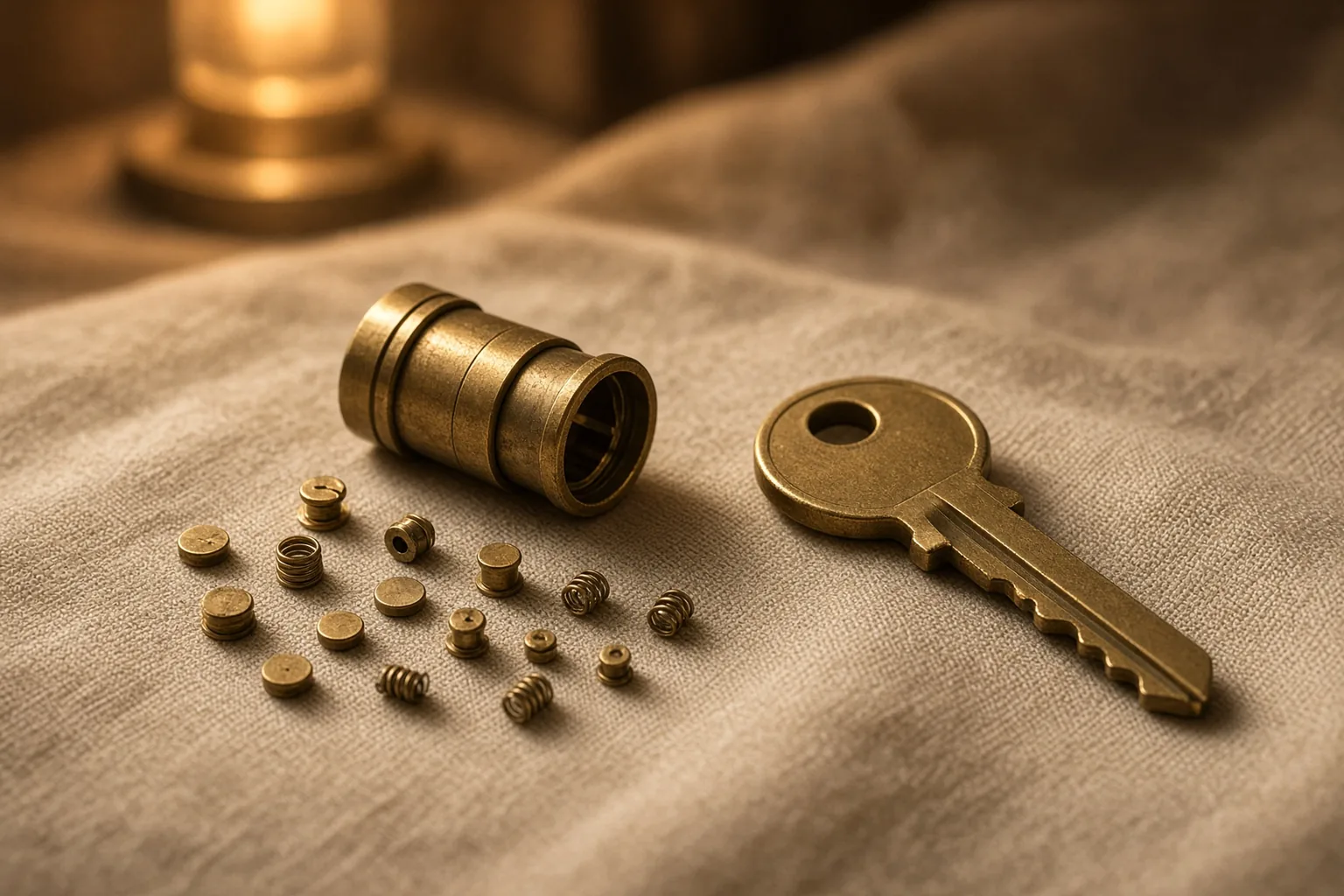
What does a forensic locksmith examine?
The lock, its keys and the scene: marks on the face, keyway, plug, pins and cam, the origin and wear of each key, and how the lock was installed and used. The aim is to establish the method of entry.
"The task of a forensic locksmith is to determine how an action occurred," Locksmith Ledger wrote in a November 15, 2004 article on the profession. The article gives two typical assignments: an office burglarized and a safe opened, where the locksmith investigates how access could have been gained, and a vehicle moved without the owner's authorization. The clients it lists are a business, an insurance company, an attorney or a government agency.
A presentation on lockpicking forensics at Black Hat USA 2009, given by a researcher under the name datagram, sets out the goals as "Determine method of entry," "Identify evidence, tool marks, techniques" and "Provide expert testimony." The work runs in four stages: crime scene investigation, laboratory examination, an investigative report and testimony. The first questions concern the lock's history: when it was bought and installed, how it was used every day, its security rating, who had keys, and whether it was repaired or replaced.
The same slides rank destructive entry first among methods of entry: "Destructive entry still #1!" They date forensic locksmithing to 1976 and to Art Paholke of the Chicago Police Department.
What marks do picking, bumping and impressioning leave?
Each method touches the pins, plug, cam and keyway in its own way. Picking leaves scratches around the face of the lock and at the bottom of the keyway, and tool marks on the softer metal inside.
Chad A. Hester's note in the Cleveland State Law Review, volume 49 (2001), pages 357-383, lists the signs of picking as "scratch marks around the face of the lock" and "scratch marks at the bottom of the keyway." Picks, the note says, "often leave tool marks on the softer metal inside the lock." Hester calls W. G. Plumtree's 1975 article "The Examination of Disc and Pin Tumbler Locks for Tool Marks Made by Lock Picks" "a controlling authority on the procedure of examining locks."
The Black Hat slides treat picking, pick guns, key bumping and impressioning as separate methods with separate evidence on the pins, the plug, the cam and the key. For impressioning they add residue under ultraviolet light. For decoding they list manipulation, visual or optical, thermal and radiological methods and disassembly.
Marks are read against known samples. The slides describe toolmark comparison on locks and keys to determine the tools and techniques used, documentation of material transfer, and a report that includes mirrored tests of locks that were picked, bumped and impressioned.
How is a lock examined, and why does the order of steps matter?
The examiner photographs the lock before touching it, inspects the keyway with a borescope or microscope, then disassembles the cylinder and examines the pins under magnification. Disassembly destroys the original state of the lock.
Hester describes the inspection of the lock interior with microscopes, including "a microscope known as a borescope," whose use he calls "a standard procedure in the field." After that "the lock cylinder is then dissected" and the tumblers are examined under a microscope.
The Black Hat slides list the handling steps: photograph and sketch the scene, get permission, preserve the evidence and keep the chain of custody. The examination takes place in a separate clean workspace with clean or new tools such as tweezers, followers, shims and saws. Disassembly is marked "Destructive." On cleaning parts before examination the advice is "Always look first!" because cleaning risks evidence destruction and the creation of false evidence.
Because a dissected cylinder cannot be put back in its original state, the timing of the other side's inspection matters. In federal civil cases Rule 34(a)(1)(B) of the Federal Rules of Civil Procedure covers "any designated tangible things," and the party served must respond in writing within 30 days after service (Rule 34(b)(2)(A)). Under Rule 34(c) a nonparty, such as a garage or a landlord holding the lock, may be compelled through a Rule 45 subpoena.
Can the examiner tell an original key from a copy?
The examiner checks the key's material, keyway, cuts and codes, plating, stylus striae, file and cutting-wheel marks and any residue of clay, wax or UV marker. Wear patterns separate a key in daily use from a spare.
The Black Hat slides list these questions about a key: original or duplicate, hand cut or machined, and whether it was recently cut or copied. The indicators they name are plating, stylus striae, file and cutting-wheel marks, and residue from clay, wax or UV markers.
Hester describes the same step: the examiner determines "whether it is an original key" or a duplicate and looks at wear patterns that show whether a key was carried every day or kept as a spare.
In the vehicle theft claims Hester examined, the insurer's locksmith typically testified that the car was driven off "with the use of a key" and that the ignition "was not defeated or tampered with." The slides list key distribution among the first questions about a lock.
Can an examiner say which key last operated the lock?
No published method supports that opinion. A 2001 law review note found no publication or standard for key pathway analysis, and the chief of the FBI's firearms and toolmark unit said the last key used cannot be determined.
Hester's note describes the claim made in deposition by a forensic locksmith that "he can tell which key was used last to operate a vehicle" through what he called "Key Pathway Analysis." The method compares the latest tool marks on the tumblers with striations on the keys tested; if it works, "the tool marks on the tumblers correspond with striations on the tested keys."
The note found that "no publication of the procedure exists for review" and that "there is no known procedure or standard to guide those" who use it. It quotes Jim Cadigan, chief of the FBI's firearms and toolmark unit, from Mark Hansen's article in the ABA Journal of March 2000: it is "not possible to tell whether it was the last key used." Cadigan called the practice "something akin to the Psychic Friends Network."
Hester concluded that forensic locksmiths "may be qualified as experts under Rule 702" but "should not necessarily be qualified to testify as to which key started a vehicle last," and that they "should be limited in their conclusions to established principles and methodology" of the field. Opinions confined to whether a lock was defeated or opened with a proper key, he wrote, are more likely to pass Rule 702 review.
Why do insurers retain forensic locksmiths, and what is the risk?
To test whether a theft claim describes a real theft. If the opinion behind a denial would not survive Rule 702, the insurer carries the bad faith exposure, which Hester's note called too great to accept.
Hester's note describes insurers' special investigation units, which several states require, and their practice of hiring forensic locksmiths as expert witnesses to examine a vehicle's lock and decide whether a real thief was responsible. A finding that the ignition was not defeated is then used to deny the claim.
The note advises insurers to check whether the locksmith's technique can be tested, has undergone peer review and is widely accepted among practitioners before relying on it. Its reason is the bad faith exposure: a denial built on testimony that Rule 702 would not admit leaves the insurer open to a bad faith claim.
For the insured the same questions work in reverse. A review of the insurer's lock report checks whether each conclusion follows from documented marks and comparison tests, and whether any last-key opinion appears in it.
How do courts test a forensic locksmith's opinion?
Under Rule 702 as read in Kumho Tire: the proponent must show the opinion more likely than not rests on sufficient facts and a reliable method reliably applied, and experience-based experts face the same test.
Since December 1, 2023, Federal Rule of Evidence 702 admits expert testimony only if the proponent shows the court that it is more likely than not that the expert's knowledge will help the trier of fact, the testimony is based on sufficient facts or data, it is the product of reliable principles and methods, and the expert applied them reliably to the facts of the case. The Supreme Court transmitted the amendment to Congress on April 24, 2023.
In Kumho Tire Co. v. Carmichael, 526 U.S. 137, decided March 23, 1999, the Supreme Court held that the Daubert gatekeeping obligation applies to testimony based on "technical" and "other specialized" knowledge. Justice Breyer wrote that the trial judge must make certain the expert "employs in the courtroom the same level of intellectual rigor that characterizes the practice of an expert in the relevant field." The Court upheld the exclusion of a tire failure analyst who relied mainly on visual and tactile inspection. Hester's note applies that test to forensic locksmiths.
According to the 2004 Locksmith Ledger article, the International Association of Investigative Locksmiths had developed a certification program leading to the designation Certified Forensic Locksmith (CFL), and applicants had to have been IAIL members for at least one year before applying to take the examination. The Black Hat slides name IAIL under licensing and certification and end with the advice "Do your homework!"
What should a forensic locksmith's report contain?
Under Rule 26(a)(2)(B): every opinion with its basis and reasons, the facts or data considered, exhibits, qualifications with publications from the previous 10 years, testimony from the previous 4 years, and compensation.
Rule 26(a)(2)(B) of the Federal Rules of Civil Procedure applies to a retained expert in civil litigation, including insurance coverage suits. Absent a stipulation or court order, the disclosure is due at least 90 days before trial, and a report that only rebuts the other side's expert is due within 30 days after that disclosure (Rule 26(a)(2)(D)).
For a lock the exhibits are the photographs taken before and during disassembly, images of the marks under magnification and the comparison tests. The Black Hat slides list findings, supporting photographs and mirrored tests of locks picked, bumped and impressioned as the parts of the report.
A review of an opposing report checks the same items: whether the lock was photographed before anyone touched it, whether the chain of custody is recorded, whether test locks were used and documented, and whether the conclusions stay within what the marks support, such as picked or opened with a key, or go on to say which key was used last.
What does IAE do in a lock examination case?
IAE prepares an expert report on the client's questions or a review of the opposing examiner's report on whether a lock was defeated, in up to 5 business days, with a 48-hour rush for tight deadlines.
The trace evidence service answers whether a shoe, tire or tool could have left a mark, how strong the association is, and whether a lock or seal was defeated. Toolmarks on lock cylinders and seals are compared with test marks made by the suspect tool. IAE confirms the questions with the client before work starts.
The client sends the report or the case materials, such as photographs of the lock and keys, the inspection record and the opposing report, and describes the task. The secretariat confirms receipt the same day. Within one business day IAE confirms the format, the cost, the deadline and the specialist from its registry, and the client approves the candidate and the CV before work starts. The signed PDF is issued in up to 5 business days.
Every specialist is a member of the public IAE registry and passed the council's attestation under the published Criteria Matrix. The Member ID in the document opens the specialist's category, specialization, attestation date and record status on the status check page or by QR code. The specialist confirms in the document that he or she has no interest in the outcome of the case. Neither IAE nor the examiner guarantees the outcome, and IAE is not a law firm.
Sources
- Chad A. Hester, Are Forensic Locksmiths Really Qualified to Testify as Experts in Cases of Insurance Fraud: An Examination of the Admissibility of Forensic Locksmith Opinions under Rule 702, 49 Clev. St. L. Rev. 357 (2001)
- datagram, Lockpicking Forensics, Black Hat USA 2009, slides
- What is a Forensic Locksmith?, Locksmith Ledger, November 15, 2004
- Kumho Tire Co. v. Carmichael, 526 U.S. 137 (1999)
- Federal Rule of Evidence 702 and 2023 committee note
- Supreme Court of the United States, amendments to the Federal Rules of Evidence transmitted April 24, 2023
- Federal Rule of Civil Procedure 26
- Federal Rule of Civil Procedure 34
Read also
All articles
Was the window broken from inside or outside? How does a glass fracture examination answer, and how far can the answer be trusted?
After a reported burglary, a shooting or a fire, one broken pane can decide which account is true: forced entry or a staged scene, a shot fired into Sergei Voronin
No signs of forced entry: how is a door, lock or window examined after a reported burglary?
Some commercial burglary policies pay only for entry by force that leaves visible marks, and police reports often carry the line "no signs of forcedSergei Voronin
Safe burglary: how does an examiner tell whether a safe was forced, drilled or opened with the combination?
An examination of a safe after a theft answers how it was opened: by force on the door or body, by drilling, or with the combination or keySergei VoroninExpert examinations
Ready to discuss your case?
Send the materials: the secretariat will confirm the format, cost, deadline and the specialist within one business day.
