
Examinations
Physical fit examination: can a broken or torn piece be shown to come from one object?
A physical fit examination answers whether broken, torn or separated pieces were once joined together as one object. ASTM E3392-24, published in January 2024, describes the examination for glass, polymers, tapes, textiles and other materials. Department of Justice examiners may report a fracture fit, an exclusion or an inconclusive result, and published studies of duct tape fits report accuracy between 84.9 percent and over 99 percent.
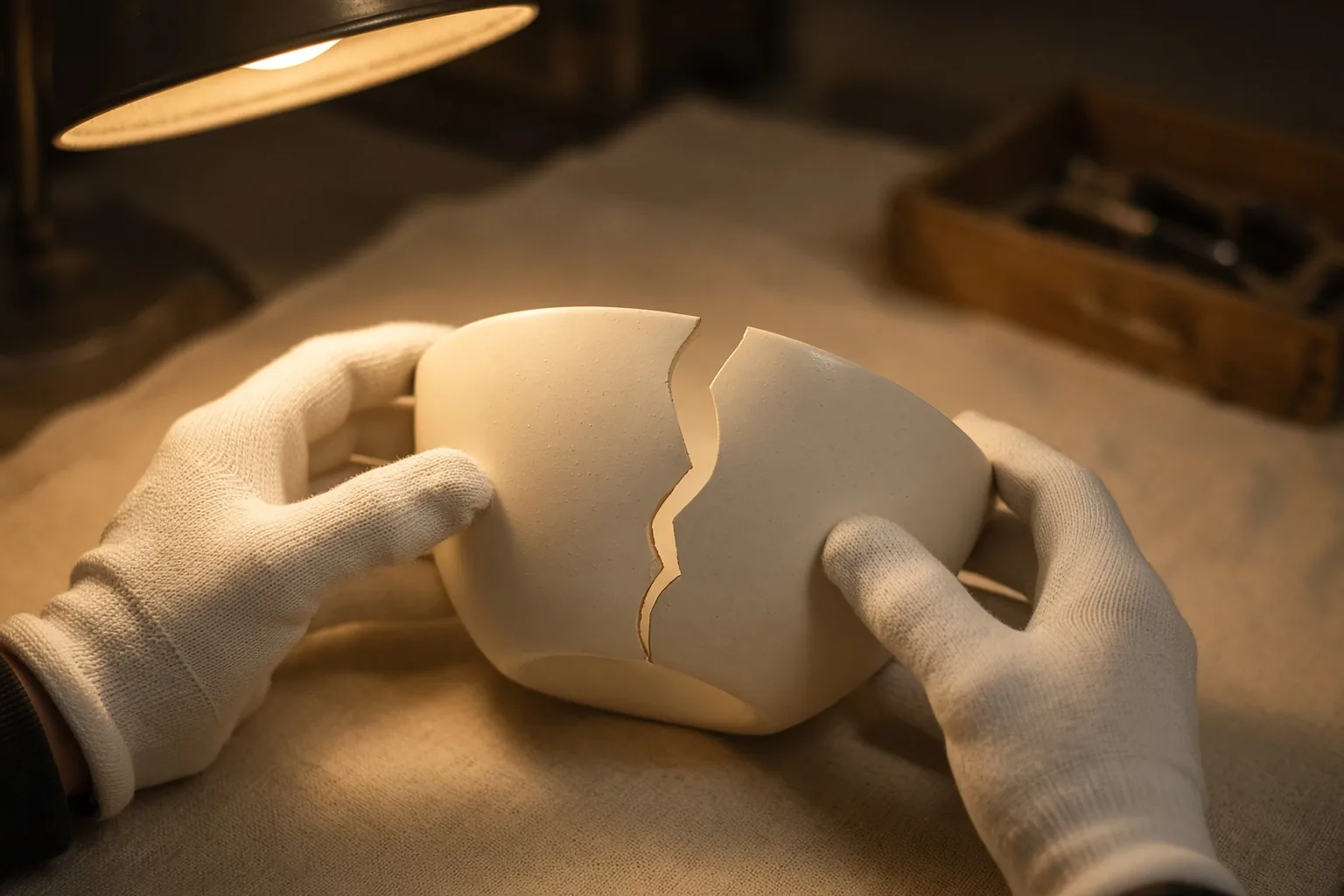
What does a physical fit examination answer?
Whether two or more broken, torn or separated items were once joined together to form a single object. ASTM E3392-24 defines a physical fit as an association based on the realignment of two or more items.
ASTM E3392-24, Standard Guide for Forensic Physical Fit Examination, was approved on January 1, 2024 by Subcommittee E30.01 on Criminalistics. Section 1.1 states that it covers "the macroscopical and microscopical examinations of broken, torn, or separated materials" to determine "whether or not they were once joined together to form a single object." Section 1.2 addresses it to "competent forensic science practitioners with the requisite formal education."
Section 3.2.4 defines a physical fit as "an association based upon the realignment of two or more items." Section 4.1 states the premise behind the examination: separation events are not reproducible.
The question differs from a toolmark comparison. A toolmark examiner asks whether a tool made a mark; a physical fit examiner asks whether two pieces were one. In a burglary both questions can arise at once, for example when the tip of a screwdriver breaks off in a door frame and a screwdriver with a broken tip is found on a suspect.
Where does physical fit evidence come up?
In break-ins, thefts, hit-and-run cases and cargo disputes. The American Society of Trace Evidence Examiners lists glass, metal, wood, plastic, paint and tape among the materials, with glass in breaking and entering and metal in forced entry as examples.
The page on fracture match analysis published by the American Society of Trace Evidence Examiners (ASTEE), attributed to Troy Nowak, describes the examination as showing "the realignment of two or more objects." It names glass, metal, wood, plastic materials, paint and tape, and gives examples: glass in breaking and entering cases, metal in forced entry, paint in hit-and-run incidents.
ASTM E3392-24 adds special considerations in section 5.2 for glass, skeletal material, polymers, tapes and textiles. A research poster from West Virginia University by Paige Schmitt, Meghan Prusinowski and Tatiana Trejos lists "tapes, glass, plastics, textiles, and other polymers" among the materials examined this way.
For a party, the practical cases are concrete: a broken piece of a tool left in a lock, a cut seal cable whose ends are found in two places, a strip of tape on a bound victim and a roll in a car, a fragment of a headlight at a crash scene. Each can be the subject of a physical fit question.
How is a physical fit examination done?
The examiner evaluates the edges and surfaces of the pieces, in two or three dimensions, with microscopes, light sources and measuring tools, documents the features that align and interprets them. ASTM E3392-24 calls evaluation, documentation and interpretation the important parts.
Section 4.2 of ASTM E3392-24 notes that several pieces may be reassembled before a questioned sample is compared with a possible known source. Section 4.3 states that fits may be viewed in two or three dimensions. Section 5.1 names evaluation, documentation and interpretation as important parts of the examination and says that the type and size of the material affect the steps and equipment.
Section 7 lists equipment that varies by material and case, with microscopes, light sources and a micrometer as examples. Section 8.1 requires sample handling that meets or exceeds ASTM Practice E1492 and Guide E1459. Section 6.1 ties quality assurance to proficiency tests and technical audits, with ISO/IEC 17025 as general guidance.
Section 4.4 warns against a common shortcut: "The absence of edge detail or material loss does not always rule out the possibility of a physical fit." A fit can still rest on features that run across the break, such as striations or wood grain. A report that rejects a fit only because the edges look smooth has not considered those features.
Why does ASTM discourage the word match?
Because it can mislead lay people. Section 3.2.4.1 of ASTM E3392-24 states that the term match is not recommended for that reason, and section 3.2.8 rates blind verification by a second examiner above open verification.
Section 3.2.4.1 of ASTM E3392-24 says that the term match "is not recommended to be used as it can be misleading to the layperson." The standard uses physical fit instead, and the Department of Justice uses fracture fit and physical fit in its own documents.
The same section on terms defines verification as an independent review by a second examiner, and section 3.2.8.2 rates blind verification above open verification.
For a reviewer the two definitions give two questions: does the report say match where the standard says physical fit, and was the conclusion verified, by whom and whether blind or open.
What may a Department of Justice examiner conclude?
A fracture fit, an exclusion or an inconclusive result under the firearms and toolmarks fracture examination ULTR, effective August 16, 2023. For glass, the ULTR effective May 8, 2024 adds physical fit to inclusion, exclusion and inconclusive.
The fracture examination ULTR applies to DOJ examiners who decide whether two or more items were originally joined together. A fracture fit is the conclusion that fractured items were once joined, and it requires that the items physically fit or that a comparison of their corresponding surfaces reveals a fit. Exclusion is the conclusion that they were not joined. Inconclusive means "no determination can be reached" on whether they could have been joined.
The glass ULTR defines physical fit as "an examiner's conclusion that two or more glass fragments were once part of the same broken glass object" and permits it only when the fragments physically fit together. Its other conclusions, inclusion and exclusion, rest on physical properties, refractive index and elemental composition rather than on fit.
Both documents bar the same statements. An examiner may not base a fit on uniqueness, may not call it individualization, may not state that items share a source to the exclusion of all other sources, may not give statistics without relevant and appropriate data, and may not claim absolute or 100 percent certainty. The examiner's number of examinations may describe experience, not accuracy.
Do practitioners agree on how strong a physical fit is?
No. The ASTEE page calls a fracture match a positive form of identification that can associate items to the exclusion of all others, while DOJ rules bar examiners from claiming exclusion of all other sources.
The ASTEE page states that fracture matches can be "a positive form of identification" and that one item can be associated with another "to the exclusion of all others." It lists conditions: the items must be broken and detached, physically realignable, fit together like a lock and key, and be unique, and all three dimensions of a separation should be examined.
The DOJ ULTR documents take the opposite position for DOJ examiners, who may not claim exclusion of all other sources or base a fit on uniqueness. ASTM E3392-24 defines individual characteristics in section 3.2.3 as attributes that establish a single source.
The 2023 committee note to Rule 702 of the Federal Rules of Evidence states that forensic experts "should avoid assertions of absolute or one hundred percent certainty" when the method is subjective and potentially subject to error. A report that uses the ASTEE wording can be compared with the DOJ text and the Rule 702 note in a motion or on cross-examination.
How accurate are physical fit examinations?
For duct tape, a 2020 validation of 2,280 comparisons reported accuracy between 84.9 percent and over 99 percent with no false positives, and a 2023 study of 38 practitioners in 23 laboratories reported 95 and 99 percent accuracy.
Meghan Prusinowski, Evie Brooks and Tatiana Trejos published "Development and validation of a systematic approach for the quantitative assessment of the quality of duct tape physical fits" in Forensic Science International, volume 307, February 2020 (NCJ 310629). The method scores tape end features with an edge similarity score (ESS). In 2,280 duct tape end comparisons, "the accuracy ranged from 84.9 % (higher quality hand-torn set) to over 99 %," and "no false positives were reported for any of the sets examined."
An interlaboratory evaluation by Prusinowski, Brooks, Cedric Neumann and Trejos appeared in Forensic Chemistry, volume 34, in July 2023 (NCJ 306529). Thirty-eight forensic practitioners from 23 laboratories each analyzed seven duct tape pairs, for 266 examinations. Accuracy across all participants was 95 percent in the first exercise and 99 percent in the second, and the error rate against the consensus score was 9.3 percent in the first exercise and 5.5 percent in the second.
The NIJ-funded FITS project, presented by Tatiana Trejos on June 4, 2024, extended the work to textiles and automotive plastics with a database of nearly 9,000 samples, an edge similarity score that estimates the quality of a fit and a feature prominence score for the weight of each feature. These figures come from tape, textile and polymer research; a report on a broken metal tool or a glass fragment cannot borrow them as its own error rate.
What should a physical fit report show?
Photographs of both pieces and of the aligned edges at magnification, the features that align across the break, the equipment used, how the items were handled, who verified the conclusion and whether blind, and wording within published limits.
ASTM E3392-24 makes documentation part of the examination (section 5.1). A report should let another examiner see the aligned edges and the features that run across them, and should record the equipment, the handling of the items under the referenced ASTM practices and the result of verification.
The wording is the second part. A report that says the pieces match, or that one item shares a source with another to the exclusion of all others, uses terms that ASTM discourages and DOJ bars for its examiners. A report that says the pieces were once joined, with the basis stated, uses the terms of the standard.
The duct tape studies show that a score such as the ESS can be calculated and checked by another examiner. Where a laboratory uses one, the report should state it and the method.
How is a physical fit conclusion tested by the other side?
By obtaining the pieces or the photographs, checking the features the examiner relied on, asking for the verification record and proficiency tests, and comparing the wording with ASTM and DOJ limits under Rule 702.
In a federal criminal case the government's disclosure under Rule 16(a)(1)(G)(iii) of the Federal Rules of Criminal Procedure states all opinions with their bases and reasons and the examiner's qualifications, and the examiner signs it. The disclosure tells the defense which features the examiner relied on and who the examiner is.
A defense examiner then looks at the pieces or at photographs that show the edges at magnification. The questions are concrete: do the features align across the whole break or only part of it, were both sides examined in three dimensions, was the conclusion verified blind, what proficiency tests has the laboratory passed in this material.
If the opposing report finds no fit, section 4.4 of ASTM E3392-24 applies in the other direction: the absence of edge detail does not always rule out a fit. A defense review can therefore support or challenge either conclusion, and the report it produces states which features were checked and what they show.
What does IAE do when broken pieces, a lock or a seal are disputed?
IAE prepares expert reports on the client's questions and reviews of the opposing examiner's report on toolmarks, locks and seals and on shoe and tire impressions, for US criminal defense and cargo loss cases, in up to 5 business days.
The questions cover whether a shoe, a tire or a tool could have left the mark, how strong the association is and whether a lock or seal was defeated. Toolmarks on lock cylinders and seals are compared with test marks made by the suspect tool, freight container seals are classified under ISO 17712:2013, and each question is tied to the ANSI/ASB or ISO standard for that kind of mark. IAE confirms the questions with the client before work starts.
The secretariat confirms receipt the same day. Within one business day IAE confirms the format, the cost, the deadline and the specialist from its registry, and the client approves the candidate and the CV before work starts. Cases with tight deadlines have a 48-hour rush.
Every specialist is a member of the public IAE registry and can be verified by Member ID or QR code, and confirms in the document that he or she has no interest in the outcome of the case. IAE is not a law firm and does not advise on case strategy. A report is evidence that the court weighs with the rest of the record, and neither IAE nor the examiner guarantees the outcome.
Sources
- ASTM E3392-24, Standard Guide for Forensic Physical Fit Examination, sample (iTeh Standards)
- U.S. Department of Justice, ULTR for the Firearms/Toolmarks Discipline, Fracture Examination, effective August 16, 2023
- U.S. Department of Justice, ULTR for the Forensic Glass Discipline, effective May 8, 2024
- American Society of Trace Evidence Examiners, Physical Fit / Fracture Match Analysis (T. Nowak)
- NCJRS abstract: Development and validation of a systematic approach for the quantitative assessment of the quality of duct tape physical fits. Forensic Science International 307 (2020), NCJ 310629
- NCJRS abstract: Prusinowski M., Brooks E., Neumann C., Trejos T. Forensic interlaboratory evaluations of a systematic method for examining, documenting, and interpreting duct tape physical fits. Forensic Chemistry 34 (2023), NCJ 306529
- National Institute of Justice, FITS: Functional Implementation of Thorough and Systematic Approaches for Fracture Examinations, webinar, June 4, 2024
- Forensic Technology Center of Excellence, webinar: FITS, Fracture Examinations, presented by Tatiana Trejos, June 4, 2024
- Schmitt P., Prusinowski M., Trejos T. The Physical Fit Analysis of Duct Tapes and its Relevance to Forensic Anthropology (West Virginia University)
- Federal Rules of Evidence, Rule 702, Testimony by Expert Witnesses, with committee notes (Office of the Law Revision Counsel, uscode.house.gov)
- Federal Rules of Criminal Procedure, Rule 16 (LII, Cornell Law School)
- National Institute of Justice, publication record: Prusinowski M., Brooks E., Trejos T., Forensic Science International 307 (2020), NCJ 310629
Read also
All articles
Was the window broken from inside or outside? How does a glass fracture examination answer, and how far can the answer be trusted?
After a reported burglary, a shooting or a fire, one broken pane can decide which account is true: forced entry or a staged scene, a shot fired into Sergei Voronin
No signs of forced entry: how is a door, lock or window examined after a reported burglary?
Some commercial burglary policies pay only for entry by force that leaves visible marks, and police reports often carry the line "no signs of forcedSergei Voronin
Safe burglary: how does an examiner tell whether a safe was forced, drilled or opened with the combination?
An examination of a safe after a theft answers how it was opened: by force on the door or body, by drilling, or with the combination or keySergei VoroninExpert examinations
Ready to discuss your case?
Send the materials: the secretariat will confirm the format, cost, deadline and the specialist within one business day.
