
Examinations
How do you legalize unpermitted work on a house, and what does an expert's report document?
Most building departments treat unpermitted work as a new project: the owner applies for a permit, the work is checked against the codes in force today and hidden parts are opened for the inspector. San Jose says so in Bulletin #202 of January 25, 2023, and Boulder and Sonoma County apply the same rule. An expert's report records what was built, where it misses the code and what the correction costs.
What does it mean to legalize unpermitted work?
It means obtaining a permit after the work is built. The building official reviews and inspects it like new construction and then approves it or requires the owner to remove it.
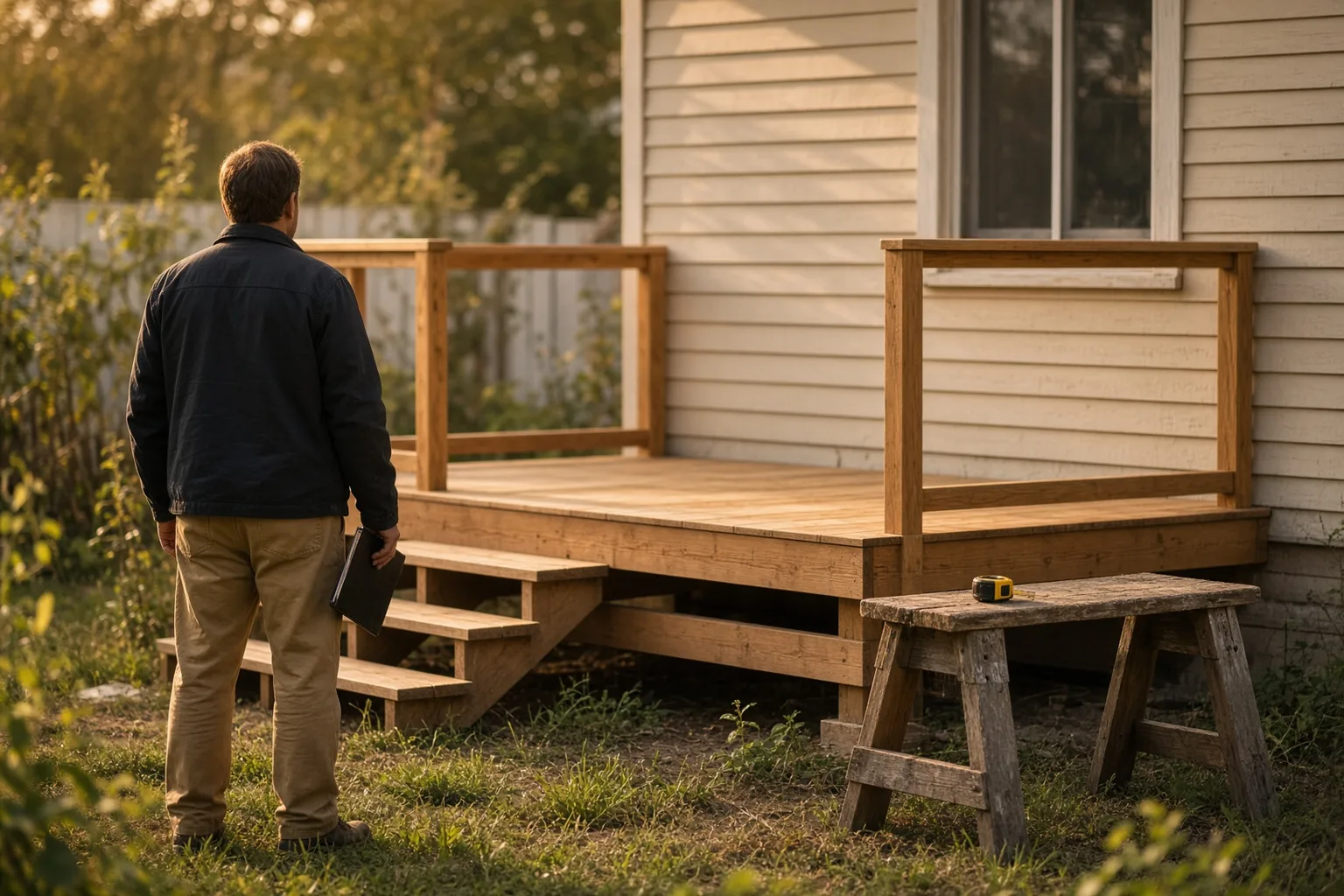
Unpermitted work is construction that needed a permit and was built without one. The pages quoted in this article deal with decks, detached accessory dwelling units, plumbing behind a closet wall and whole undocumented dwelling units. Legalizing such work means bringing it into the permit system after the fact.
The Village of Pleasantville in New York puts the choice in one line: "Work performed without proper permits may be required to be removed or legalized." The building inspector's assessment decides which of the two applies. A project that can be legalized pays the permit fee and a $1,000 legalization fee before a certificate of occupancy is issued.
San Jose's Bulletin #202 tells owners whose work can be easily inspected to "obtain a building permit as if it were a new project." Work hidden behind finishes starts differently: the owner first schedules a code enforcement inspection by calling the number in the bulletin.
Sonoma County's policy 9-4-19, "Permits to Remove or Legalize Unpermitted Work", covers both outcomes. The owner submits a complete building permit application package with plans as needed, and Building Inspection staff verify compliance with the approved drawings.
Is the work judged by today's code or by the code in force when it was built?
In the departments quoted here, by today's code. San Jose, Boulder and Sonoma County require compliance with current codes, and Alameda's amnesty program adds that the work must also have been legal when it was done.
The three rules are written almost identically. San Jose: "Construction work done without permits will need to comply with current zoning, building, and energy codes." Boulder: "unpermitted work needs to be brought into compliance with all currently adopted codes." Sonoma County: "Unpermitted work being legalized shall meet all policies and current codes."
For the owner this means that a deck or an addition built years ago is measured against the codes in force now, not against those of the year it was built. Boulder warns that "modifications will probably be necessary to meet current land use code standards" and that energy code forms and worksheets are needed where the energy code applies to the work.
Alameda's Building Official, Gregory J. McFann, describes an amnesty program that the city has offered since 1998 to owners who come forward voluntarily, before a code enforcement complaint is filed. Its condition has two parts: "the undocumented construction is required to have been legal at the time the work was originally done and the work and materials must comply with all minimum Code requirements." The article's example is an unpermitted third or fourth unit built before the city's Measure A.
A report written for a legalization file therefore answers two questions where the jurisdiction asks both: was the work lawful under the rules of the year it was built, and what does it lack under the code in force now.
Will walls and ceilings have to be opened for the inspector?
Often, where the work is concealed. Boulder says drywall, tile and trim will need to be removed to allow inspection, and Alameda's inspector may ask the owner to open small areas to verify code compliance.
Boulder's page is specific. Inside the house, "components such as drywall, tile, trim, etc., will need to be removed to allow for inspection." Outside, "trim materials, siding, and/or insulation may need to be removed to allow structural inspection." In one of its examples the city agreed to the removal of drywall in a closet so that the inspector could see a mixing valve behind it.
Openings have limits. For underground plumbing Boulder will accept a letter from a licensed Colorado plumber stating that the plumber has scoped the work. Alameda's Building Official writes that "Disruption of your property will be kept to a minimum."
Boulder also asks for pictures of the existing conditions with a retroactive permit application, together with a Retroactive Permit Disclosure Form. An existing conditions report by an engineer or another construction expert gives the department those photographs with a plan of what lies behind each finish. The openings can then be placed where the inspection needs them, at a beam bearing, a new header or a plumbing connection, and the owner knows in advance which finishes will be lost.
What does legalizing cost in fees and penalties?
Local fees apply. Washoe County charges an investigation fee of twice the permit fee, Alameda charges four times the permit fee on code enforcement cases, and San Jose may issue a $1,000 citation.
Washoe County in Nevada collects the investigation fee in advance, "whether or not a permit is then or subsequently issued." The fee is twice the permit fee from the county's fee tables. The Building Official may waive or reduce it when the permit application has been pursued in a timely manner and in good faith and the reduction is in the best interest of the jurisdiction.
The same page lets the Building Official raise the fee up to four times the permit fee when "a licensed contractor or other licensed professional commences work before a permit is issued." The amount is capped at $4,000 for residential construction and $50,000 for all other construction. The Building Official may also make the person who worked without a permit pay for a third party inspection, so that the project is completed in accordance with the applicable code and approved plans.
Alameda charges investigation fees "equal to four times the normal permit fees" on all code enforcement cases. An owner who enters the amnesty program pays a $40 application fee, and the investigation fees are waived whether the project is approved or denied. A project accepted for amnesty pays an additional $210 inspection fee.
San Jose's bulletin states that the city "has authority to issue a $1,000 citation for unpermitted work". It adds that all permit fees and construction costs required to bring the property up to code apply.
When does the owner need an engineer, architect or other expert?
When the department needs drawings and verification that no permit file contains. Sonoma County asks for plans as needed and verifies structural compliance, and Washoe County may require a third party inspection at the owner's cost.
Legalization starts without the documents that a permitted project has: no approved plans and no inspection record. Sonoma County's policy has the owner submit the application package with plans as needed, and plan check verifies structural compliance for items that were altered or removed. Boulder asks for construction drawings that contain the information needed to check energy code compliance.
Those drawings describe the work as it exists. The expert measures the rooms, records the framing, connections, openings and services that are visible and marks the parts that are concealed. None of the policies quoted here says in which cases the drawings or calculations must carry a licensed engineer's or architect's seal. The department's checklist for the particular work decides that.
The same survey feeds the decision that Sonoma County and Pleasantville put to the owner: legalize or remove. A report that lists each item, the code requirement it misses, the correction and its cost lets the owner compare the price of legalization with the price of removal and restoration before applying.
What happens if the work cannot be legalized?
It has to be removed. Sonoma County requires the owner to remove the unpermitted improvements and restore the structure to its permitted use, and Boulder says a deck that cannot be brought into compliance will need to be removed.
Sonoma County's policy addresses the owner who concludes that the work cannot be legalized. In that case "the property owner is required to remove the unpermitted improvements and restore the structure to its permitted use." The same policy identifies when removal itself needs a demolition or building permit.
Boulder gives two examples of work that can stay only after changes. A deck that cannot be brought into compliance must be removed. A detached accessory dwelling unit needs a fire suppression system installed.
Removal is also construction. Taking out a bathroom or a wall that now carries load changes the building again, and the result has to return the structure to its permitted use, in Sonoma County's words. An expert who documents the existing work before removal records what was there, which matters if the cost later becomes part of a claim against a seller or a contractor.
What if the contractor started the work without a permit?
In Florida that is a prohibited act under section 489.127(1)(h) of the Florida Statutes. An unlicensed person who violates subsection (1) commits a first-degree misdemeanor, and code enforcement officers may issue citations.
Section 489.127(1) of the 2026 Florida Statutes lists acts that no person shall commit. Paragraph (h) is to "Commence or perform work for which a building permit is required pursuant to part IV of chapter 553 without such building permit being in effect."
Under subsection (2)(a), any unlicensed person who violates subsection (1) commits a misdemeanor of the first degree. Under (2)(c), a violation during a state of emergency declared by executive order of the Governor is a felony of the third degree.
Local enforcement runs in parallel. Under subsection (5)(a) a designated code enforcement officer may issue a citation for any violation of subsection (1). Under (5)(f) the board or special magistrate may order a civil penalty of not less than the amount on the citation and not more than $2,500 per day for each violation.
None of this takes the work out of the building department's file. The owner still has to legalize or remove it. A claim against the contractor for that cost turns on facts an expert documents: what was built, which code requirements it misses, what has to be opened, rebuilt or removed and what each step costs.
What must the expert's report contain if the dispute goes to court?
In federal court a retained expert's report follows Rule 26(a)(2)(B): opinions with basis and reasons, facts or data considered, exhibits, qualifications, prior testimony and compensation. The opinion must also meet Rule 702.
Rule 26(a)(2)(B) of the Federal Rules of Civil Procedure requires a written report prepared and signed by the witness. It contains a complete statement of all opinions and the basis and reasons for them, the facts or data considered, the exhibits that will summarize or support them, the witness's qualifications with publications authored in the previous 10 years, the cases in which the witness testified in the previous 4 years and the compensation for the study and testimony.
Rule 702 of the Federal Rules of Evidence admits the opinion of a witness qualified "by knowledge, skill, experience, training, or education" if the proponent shows the court that it is more likely than not that the testimony rests on sufficient facts or data, comes from reliable principles and methods and applies them reliably to the facts of the case. In a dispute over unpermitted work the facts or data are the photographs, measurements, openings and tests, together with the department's correction notices.
A report intended solely to contradict or rebut the other side's expert on the same subject is due within 30 days after that side's disclosure under Rule 26(a)(2)(D)(ii), unless the parties stipulate or the court orders otherwise.
What does IAE do when unpermitted work has to be legalized or is in dispute?
IAE prepares a construction expert report on the client's questions, including whether the work meets the code and what the correction costs, and reviews the opposing expert's report. Delivery in up to 5 business days.
The IAE construction defects page covers four questions: where the water came in, whether the work meets the contract and the code, whether the structure is sound and what the repair will cost. The expert answers the questions agreed with the client, working from the documents, the photos and the site inspection record. The expert documents cracks, deflection, settlement and failed finishes and compares the work with the plans, the specifications and the code edition in force at permit. For legalization, San Jose, Boulder and Sonoma County require the codes in force today. For the cost, the expert lists each element, measures quantities on site or from photos and prices the correction line by line, with defect repair kept apart from upgrades.
The client sends the materials, such as photographs, any drawings, the department's notices and correction lists and the contract with the builder, and describes the task. The secretariat confirms receipt the same day. Within one business day IAE confirms the format, the cost, the deadline and the specialist from its registry, and the client approves the candidate and the CV before work starts. The document is issued in up to 5 business days after the format and cost are confirmed, and cases with tight deadlines have a 48-hour rush.
Every specialist is a member of the public IAE registry and can be verified by Member ID or QR code. The specialist confirms in the document that he or she has no interest in the outcome of the case. IAE is not a law firm and does not advise on case strategy. The building official decides whether the work is legalized, the court weighs an expert report with the other evidence, and neither IAE nor the expert guarantees the outcome.
Sources
- City of San Jose, Bulletin #202 "How to Legalize Unpermitted Work" (01/25/2023)
- City of Boulder, Legalizing Existing Unpermitted Work
- Permit Sonoma, Policy 9-4-19 Permits to Remove or Legalize Unpermitted Work
- City of Alameda, I Didn't Get a Permit, Now What?
- Washoe County Building, Work Done Without A Permit
- Village of Pleasantville, How can I legalize work done without a permit?
- Florida Statutes, section 489.127 Prohibitions; penalties (2026)
- Federal Rules of Civil Procedure, Rule 26 (LII, Cornell Law School)
- Federal Rules of Evidence, Rule 702 (LII, Cornell Law School)
Read also
All articles
Who is responsible for balcony repairs in a condo, and what does the inspector's or expert's report decide?
In a California condominium the answer starts with the declaration. If it is silent, Civil Code section 4775 makes the association responsible Sergei Voronin
A neighbor's grading or paving sends water onto my property: who is responsible, and how does an expert prove the drainage change?
Whether a neighbor answers for water that runs onto your land depends on the surface water rule of the state. California asks whether each ownerSergei Voronin
Roof leaking after a roof replacement: how does an expert prove that the roofer's work caused it?
A roof that leaks a few weeks after it was replaced does not prove by itself that the roofer did bad work. The owner has to show where the waterSergei VoroninExpert examinations
Ready to discuss your case?
Send the materials: the secretariat will confirm the format, cost, deadline and the specialist within one business day.
