
Examinations
A neighbor's grading or paving sends water onto my property: who is responsible, and how does an expert prove the drainage change?
Whether a neighbor answers for water that runs onto your land depends on the surface water rule of the state. California asks whether each owner acted reasonably and, if both did, places the loss on the upper owner who changed the natural drainage: Keys v. Romley (1966). New Jersey applies a reasonable use test, and Texas has a statute. In each of them the owner needs proof of what the neighbor changed and where the water went.
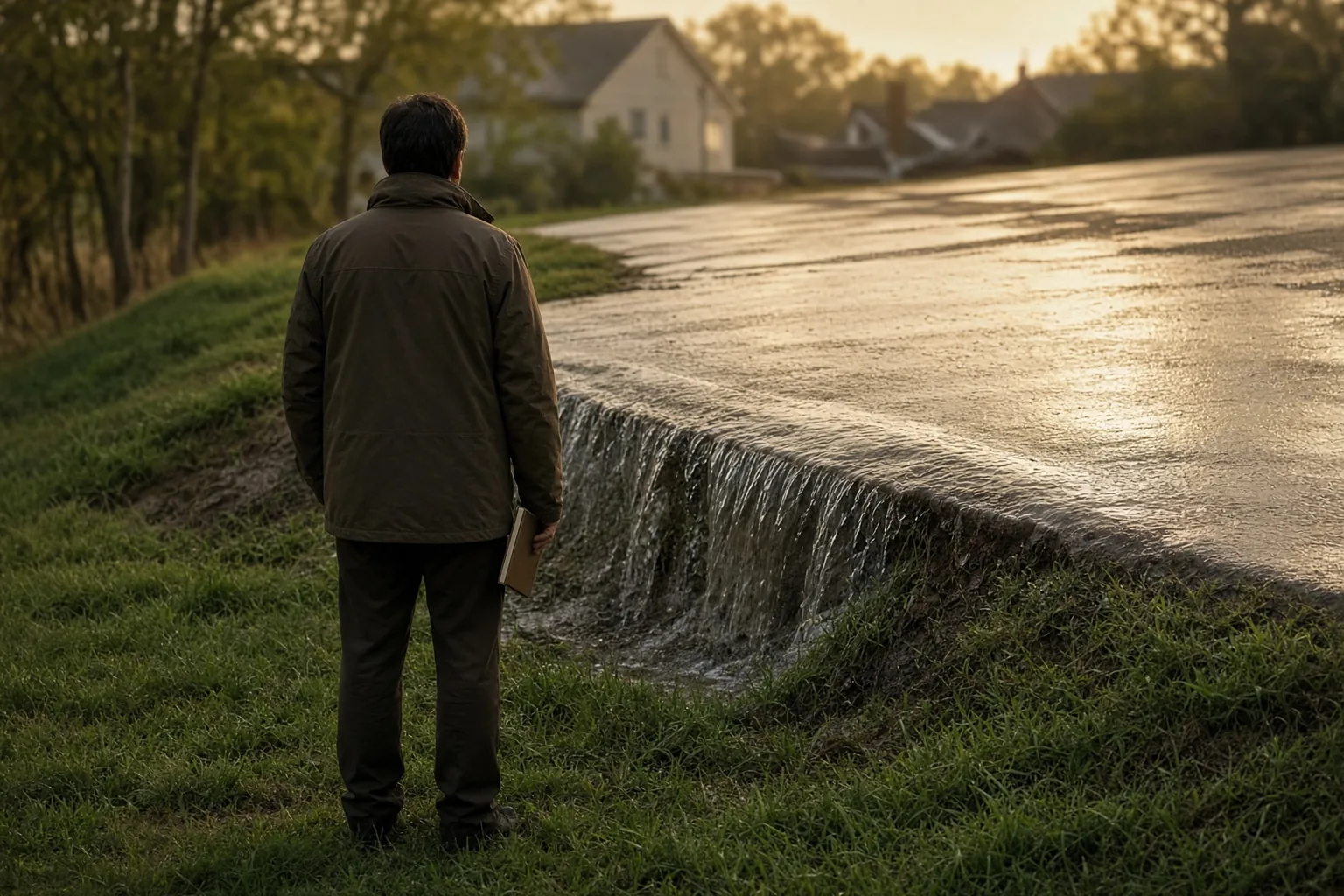
Is a neighbor liable for water that drains onto my property?
It depends on the state's surface water rule and on what the neighbor changed. The decisions below concern owners who altered the drainage by paving, grading or piping; California and New Jersey also ask whether the conduct was reasonable.
Rain that falls on higher ground and runs downhill across a boundary is not anyone's wrong by itself. The cases concern an owner who changed something: paved a lot, raised a driveway, pointed downspouts at the boundary or collected the runoff of a subdivision into one pipe.
State law differs on how much change is permitted. In Keys v. Romley, 64 Cal.2d 396 (1966), the Supreme Court of California described three approaches used in the United States and chose a modified version of one of them. Ten years earlier, in Armstrong v. Francis Corp., 20 N.J. 320 (1956), the Supreme Court of New Jersey had chosen another. Texas put its rule into a statute, section 11.086 of the Water Code.
The practical question for an owner is therefore double: which rule the state follows, and whether the facts can be shown. The second part is engineering, and it is the same in every state.
What are the three surface water rules?
The common enemy doctrine lets each owner fend off surface water. The civil law rule forbids the upper owner to alter natural drainage to the lower owner's harm. The reasonable use rule weighs all relevant factors.
Keys v. Romley sets them out. Under the common enemy doctrine each landowner has "an unqualified right, by operations on his own land, to fend off surface waters as he sees fit".
Under the civil law rule the lower owner "must accept the surface water which drains onto his land", but the upper owner "has no right to alter the natural system of drainage so as to increase the burden".
The reasonable use rule gives up fixed rights on either side. It decides each case by an assessment of all the relevant factors. In Armstrong the New Jersey court wrote that its decisions had refused to apply the common enemy rule according to its letter where it works injustice, and declared its adherence to the reasonable use rule: a landowner may alter the flow of surface water for a reasonable use of the land and is liable when the interference is unreasonable.
What did Keys v. Romley decide?
California keeps the civil law rule, modified by reasonableness. Both owners must act reasonably, and if both do, the injury is borne by the upper owner who changed the natural system of drainage.
The facts were ordinary. The Keys owned land in Walnut Creek with an appliance store. A general contractor, Romley, leased the adjoining higher lot, began building an ice rink there in 1957 and paved the area around it with asphalt. Four above-ground downspouts on the west wall of the rink discharged rainwater onto the paving. In the spring of 1958 he did further grading, which according to the Keys raised the level of the driveway and changed its slope. Water ran southwest across the paving onto the Keys' land, and flooding and erosion continued from January 1959 through 1961.
The trial court found that the flooding had not occurred before the construction and paving and that the construction caused heavy rainwater to flow onto the plaintiffs' land. It awarded $4,384.78 in damages and an injunction.
The Supreme Court, in an opinion by Justice Mosk of April 11, 1966, reversed and sent the case back for a finding on reasonableness. Its rule has two sides. "It is therefore incumbent upon every person to take reasonable care in using his property to avoid injury to adjacent property." And the owner who is threatened by the flow has a duty to take reasonable precautions to avoid or reduce the injury. If both act reasonably, "the injury must necessarily be borne by the upper landowner who changes a natural system of drainage".
The court listed what goes into reasonableness: "the amount of harm caused, the foreseeability of the harm which results", the purpose or motive of the owner, and whether "the utility of the possessor's use of his land outweighs the gravity of the harm". It called this a question of fact.
What if the water comes from a new subdivision?
The same rules apply to a developer. In Armstrong v. Francis Corp. the New Jersey Supreme Court upheld an order that the developer pipe a stream at its own expense after its drainage system flooded and eroded downstream lots.
The Francis Corporation built 186 small homes on a 42-acre tract in Rahway. Its drainage system of streets, pavements, gutters, ditches, culverts and catch basins emptied into a buried corrugated iron pipe that followed the course of a natural stream to a culvert under Lake Avenue.
Downstream, the Armstrongs and the Klemps received the result. The flow of the stream became constant and much larger and carried silt. The stream flooded, and its banks eroded about ten feet at the Armstrong property, to within fifteen feet of their septic system. Stones swept downstream damaged the Klemp culvert. The trial judge found that "the only sensible and permanent solution to the problem is to pipe the rest of the brook."
Justice Brennan wrote for the court on January 16, 1956. The judgment was affirmed: the developer had to complete the piping of the stream to Milton Lake within 60 days at its own expense, following a plan that its own engineer had prepared. The remedy was a construction order, and the plan for it came out of the engineering evidence in the record.
Do any states regulate diverted surface water by statute?
Texas does. Section 11.086(a) of the Water Code forbids diverting or impounding the natural flow of surface waters in a manner that damages the property of another by the overflow.
The full sentence of subsection (a) reads: "No person may divert or impound the natural flow of surface waters in this state, or permit a diversion or impounding by him to continue, in a manner that damages the property of another by the overflow of the water diverted or impounded." The words about permitting a diversion to continue cover an existing diversion that the person leaves in place.
Subsection (b) gives the remedy: a person whose property is injured by an overflow caused by an unlawful diversion or impounding "has remedies at law and in equity and may recover damages occasioned by the overflow." Subsection (c) says that the prohibition does not affect the construction and maintenance of levees. The history line of the section records an amendment in 1977.
The statutory elements are factual: a natural flow of surface water, a diversion or impoundment of it by the defendant, an overflow, and damage caused by that overflow. Each one is a question of fact.
What does the flooded owner have to prove?
What the drainage was before, what the neighbor changed, that the change sent more water or faster water onto the lot, and what damage followed. Where reasonableness is the test, also the harm, its foreseeability and the owner's own precautions.
The findings in Keys show the sequence a court looks for. The flooding did not occur before the construction and paving. The construction caused heavy rainwater to flow onto the plaintiffs' land. The Supreme Court added a third point that the trial court had not resolved: the injuries began only after the plaintiffs had removed a pile of dirt across the rear of their own lot and the defendants had changed the contours of theirs.
That third point is the reason for a timeline. In Keys the grading was done in the spring of 1958, the dirt pile was removed in the fall of 1958 and the first flooding came in January 1959. Two changes close in time, one by each side, left open which of them let the water in, and the case went back for a finding on the conduct of both owners.
Under a reasonableness test the owner also addresses the factors the courts name: the amount of harm, whether it was foreseeable, the purpose of the neighbor's work and its utility compared with the gravity of the harm.
What does a drainage expert establish?
The facts the decisions turned on: the condition before the work, what was built, paved or regraded, where the water now runs and what it damaged. The report also sets out the repair and its cost.
Keys and Armstrong name the facts a court needs. In Keys they were the asphalt paving around the rink, four downspouts placed above ground on its west wall, the spring 1958 grading that, on the plaintiffs' testimony, raised the level of the driveway and changed its slope, and the direction of the flow, southwest onto the plaintiffs' property. The trial court also found that the flooding had not occurred before the building, grading and paving on the neighboring lot.
In Armstrong the same kind of proof described a whole drainage system: streets, pavements, gutters, ditches, culverts and catch basins emptying into a pipe. Below it the opinion records "a constant and materially increased flow" in the stream, a deposit of silt or muck up to eighteen inches deep on its bottom and a bank eaten away about ten feet. Expert witnesses on the two sides interpreted those facts differently, and the court was not persuaded to prefer the developer's experts.
An opinion on the cause has to deal with competing causes. In Keys the Supreme Court pointed to one that the trial court had not weighed: the plaintiffs' own removal of the dirt pile at the rear of their lot. Under Rule 702 of the Federal Rules of Evidence the party offering the expert must show the court that the opinion is based on sufficient facts or data. A drainage opinion that does not address a fact of that kind gives the other side an argument under that condition.
The last part is the remedy and its price. In Armstrong the order followed a plan for piping the stream that the developer's engineer had prepared and the Armstrongs and the Klemps had approved. The IAE construction defects page describes this part of the work: the expert lists each damaged element, measures quantities on site or by photographs and prices the repair line by line.
How does the expert get onto the neighbor's land?
In a federal case, by a request under Rule 34(a)(2) to enter the land and inspect, measure, survey, photograph, test or sample it. State courts have their own inspection rules.
Rule 34(a)(2) of the Federal Rules of Civil Procedure lets a party serve a request "to permit entry onto designated land or other property possessed or controlled by the responding party" so that the requesting party may inspect, measure, survey, photograph, test or sample the property or any designated object or operation on it.
The request must describe what will be inspected "with reasonable particularity" and specify a reasonable time, place and manner. The response is due within 30 days after service unless the parties stipulate or the court orders otherwise. A request under this rule names the things to be inspected, for example the downspouts, the paved area and the strip along the boundary, and the acts to be performed, such as measuring, surveying and photographing.
Rule 34(a) speaks of a request that a party serves on any other party, so the rule works inside a pending action. Under Rule 34(c) a nonparty may be compelled to permit an inspection as provided in Rule 45. Without access to the neighbor's land the expert works with what the IAE page lists: the documents, the photos and the site inspection record.
What can the court order?
Damages for the harm already done and an order to stop or correct the drainage. The Texas statute names remedies at law and in equity, and the New Jersey court enforced a 60-day construction order.
Each of the three sources includes both kinds of relief. The trial court in Keys awarded money and enjoined further interference, before the reversal on the reasonableness finding. The Armstrong judgment required the developer to build the pipe. Section 11.086(b) of the Texas Water Code speaks of remedies at law and in equity and of damages occasioned by the overflow.
For damages the expert lists each damaged element, measures quantities and prices the repair. In Armstrong the order named a defined correction, the piping plan of the developer's own engineer, which the Armstrongs and the Klemps had approved.
What must the expert's report contain in federal court?
All opinions with their basis and reasons, the facts or data considered, exhibits, qualifications, prior testimony and compensation, under Rule 26(a)(2)(B). The opinion itself must meet Rule 702.
Rule 26(a)(2)(B) of the Federal Rules of Civil Procedure requires from every retained expert a written report prepared and signed by the witness. It contains a complete statement of all opinions and the basis and reasons for them, the facts or data considered, the exhibits, the witness's qualifications with publications of the previous 10 years, the cases in which the witness testified in the previous four years and a statement of compensation.
Under Rule 702 the party offering the expert must show the court that it is more likely than not that the testimony is based on sufficient facts or data, is the product of reliable principles and methods and applies them reliably to the facts of the case. For a drainage opinion the facts or data are the documents, the photographs and the site measurements that the expert worked with.
Absent a stipulation or a court order, expert disclosures are due at least 90 days before the date set for trial, and a report intended solely to contradict or rebut the other side's expert is due within 30 days after that side's disclosure, under Rule 26(a)(2)(D).
What does IAE do when a neighbor's work floods a property?
IAE prepares a construction expert report on the client's questions, including where the water came in and what the repair will cost, and reviews the opposing expert's report. The document is issued in up to 5 business days.
The IAE construction defects page covers four questions: where the water came in, whether the work meets the contract and the code, whether the structure is sound and what the repair will cost. The expert answers the questions agreed with the client, working from the documents, the photos and the site inspection record, and compares the work with the plans, the specifications and the code edition in force at permit. For the repair the expert lists each damaged element, measures quantities on site or from photos and prices the repair line by line.
The client sends the case materials, such as plans, photographs and inspection records, and describes the task: what to examine. The secretariat confirms receipt the same day. Within one business day IAE confirms the format, the cost, the deadline and the specialist from its registry, and the client approves the candidate and the CV before work starts. The document is issued in up to 5 business days after the format and cost are confirmed, and cases with tight deadlines have a 48-hour rush.
Every specialist is a member of the public IAE registry and can be verified by Member ID or QR code. The specialist confirms in the document that he or she has no interest in the outcome of the case. IAE is not a law firm and does not advise on which surface water rule applies or on case strategy. An expert report is evidence that the court weighs with the other materials, and neither IAE nor the expert guarantees the outcome.
Sources
- Keys v. Romley, 64 Cal.2d 396 (Cal. 1966) (Justia)
- Armstrong v. Francis Corp., 20 N.J. 320 (N.J. 1956) (Justia)
- Texas Water Code section 11.086, Overflow Caused by Diversion of Water (Texas Public Law)
- Federal Rules of Civil Procedure, Rule 34 (LII, Cornell Law School)
- Federal Rules of Evidence, Rule 702 (LII, Cornell Law School)
- Federal Rules of Civil Procedure, Rule 26 (LII, Cornell Law School)
Read also
All articles

Roof leaking after a roof replacement: how does an expert prove that the roofer's work caused it?
A roof that leaks a few weeks after it was replaced does not prove by itself that the roofer did bad work. The owner has to show where the water Sergei Voronin

Construction next door damaged my house: how does an expert tie the cracks to the neighboring work?
When excavation, pile driving or underpinning next door is followed by new cracks, tilting floors or sticking doors, the owner has to prove thatSergei Voronin
Home inspector or structural engineer: who should look at a defect, and whose report holds up in a dispute?
A home inspector gives a written opinion on the condition of a home after a limited visual examination of its readily accessible systems; that is howSergei VoroninExpert examinations
Ready to discuss your case?
Send the materials: the secretariat will confirm the format, cost, deadline and the specialist within one business day.
