
Examinations
Roof leaking after a roof replacement: how does an expert prove that the roofer's work caused it?
A roof that leaks a few weeks after it was replaced does not prove by itself that the roofer did bad work. The owner has to show where the water enters, what is wrong with the work at that point and what the repair costs. In Nuerge v. Coldewy Corp. (La. Ct. App. 2009) and Bretz v. Nagy (Ohio Ct. App. 2016) homeowners won on the testimony of an expert who inspected the roof and named each defect.
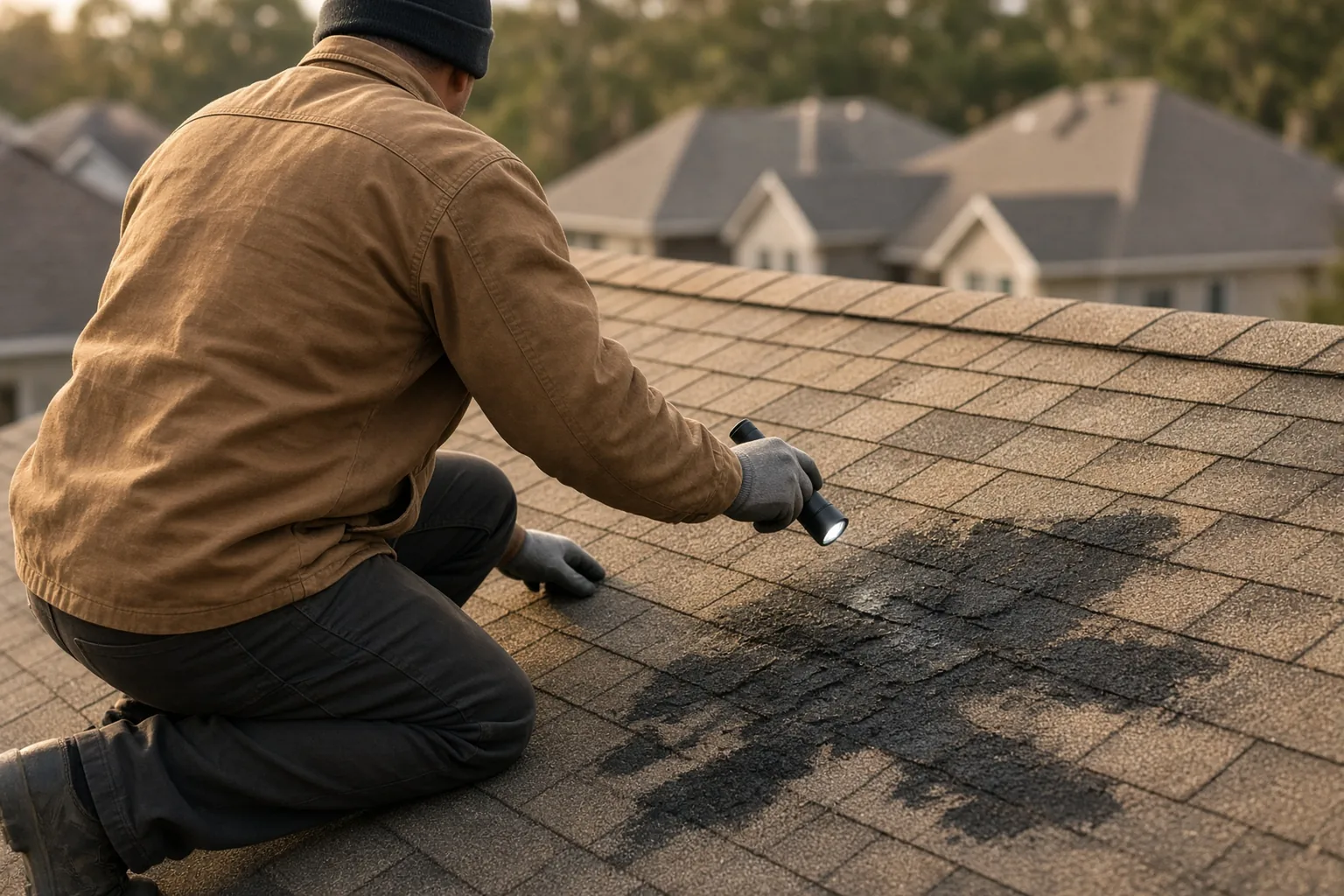
Who is responsible when a new roof leaks?
The roofer, if the leak comes from work that was not done as agreed or not in a workmanlike manner. A leak from a wall, a window, an untouched part of the roof or condensation is someone else's problem.
A roofer's duty comes from the contract and from the common law. In Bretz v. Nagy, 2016-Ohio-3008, the Ohio Court of Appeals for the Eleventh District described the common law duty to perform in a workmanlike manner as performance equal to what others in the same trade and community customarily do. In Louisiana the rule is statutory: under Civil Code article 2769, as applied in Nuerge v. Coldewy Corp., 14 So. 3d 39 (La. Ct. App. 5th Cir. Apr. 28, 2009), a contractor who fails to do the work, or does not do it as agreed, is liable for the resulting losses.
A leak after a replacement has more than one possible source. The new roof covering, the flashings at a chimney, wall or skylight, the drip edge, the vents and the penetrations are the roofer's work if the contract included them. The siding above a roof, the windows, the masonry of the chimney, a plumbing vent boot that the contract left alone, ice dams and attic condensation are not.
Manufacturers also appear in these disputes. A shingle warranty usually depends on installation to the manufacturer's instructions, so a roofer who did not follow them can leave the owner without the manufacturer's coverage as well. In Nuerge the expert testified that the shingles were not installed to the manufacturer's specifications, which voided the manufacturer's warranty.
What does the owner have to prove with an expert?
Under the Louisiana test applied in Nuerge: the existence and nature of the defects, that faulty materials or workmanship caused them, and the cost of repair. Other states ask for the same proof.
In Nuerge Hurricane Katrina had damaged part of the roof of a house in Metairie. The owners hired a roofer for $10,700 to remove and replace the pitched and flat roofs, re-flash the chimney and install a drip edge and shingles, and they paid in full. The roof leaked in two places when it rained, and two repair visits did not stop it.
The court took the owner's burden from Mount Mariah Baptist Church: the owner proves the existence and nature of the defects, that they were caused by faulty materials or workmanship, and the cost of repairing them. The homeowners met that burden through Patrick Vicknair, qualified as an expert in roof damage. The contractor testified that the roof was torched and flashed properly; a supervisor called the defects "pure speculation". The trial court believed the homeowners' expert, and the court of appeal affirmed.
In Bretz the roofer sued for the unpaid balance and the owner counterclaimed. Her expert, Jim Litsinger, a general contractor with 30 years of experience, inspected the roof and testified that the work did not meet roofing industry standards and would leak. The roofer conceded that ice guard "maybe" should have been installed. The court of appeals affirmed a finding that the roof was not installed in a workmanlike manner.
In both cases the expert went onto the roof, named specific defects and tied each one to a leak or to a standard. A report that says only that the roof leaks after the job, or that the roofer must have done something wrong, gives the court nothing to weigh against the roofer's own account.
How does the expert find where the water gets in?
By mapping interior stains, tracing them through the attic or ceiling to the roof above, and water-testing the suspected point with an observer inside. Walls, windows and condensation are ruled out first.
The investigation starts inside. The expert records where the ceiling stains and wet spots are, when they appear (during rain, during wind-driven rain from one direction, after snow, or on cold mornings without rain) and whether they existed before the replacement. Photographs and dated messages from the owner fix the timeline.
The expert then traces the water upward. In an attic the path usually shows on the underside of the deck, on rafters and on insulation; in a flat roof or a finished ceiling it may need moisture readings or a test opening. On the roof the expert examines the point above the wet area and the details water runs past on the way: flashings, laps, fasteners, penetrations, valleys and edges.
A controlled water test isolates the source. Water is applied to one detail at a time, starting low on the slope and moving up, with an observer inside, so that a leak can be tied to the last area wetted. The test is documented with times, locations and photographs on both sides.
ASTM E2128-26, the standard guide for evaluating water leakage of building walls, states that it does not address leakage through roofs. An expert who cites it for a roof leak is using a wall standard. The same guide is still relevant at the intersection: a leak that enters at siding or a window above the roof line runs down onto the roof and appears as a roof leak, and the expert has to exclude it before blaming the roofer.
What does the expert compare the roof against?
The contract and its scope, the manufacturer's installation instructions, the building code in force and the customary practice of the trade. Each defect in the report is tied to one of these.
The contract comes first because it defines the work. In Nuerge it required the roofer to re-flash the chimney, and the expert found that the chimney was not re-flashed: the siding was not removed to put flashing underneath, and roofing cement was applied on top of the area instead. He also found that the old flat roof had not been removed before the new one was installed, that the flat roof was not properly torched down and that its edges were curling.
The manufacturer's instructions set fastening, exposure, underlayment, starter course and flashing details for each product. The Nuerge expert's finding that the shingles were not installed to specification was the basis for his testimony that the manufacturer's warranty was void.
Trade practice and code requirements fill the rest. The Bretz expert found no ice guard on a low-pitch roof that needed it, rotted decking that was not replaced, shingles that were uneven and not sealed, and a vent pipe sealed with shingles. Each item is a measurable fact on the roof that another expert can go up and check.
The comparison also limits the claim. In Nuerge the expert testified that the back gable and the flat roof had to be replaced, but that the "front gable is o.k." That concession kept the opinion credible and became the basis of the damages award.
What can the owner recover?
The cost of correcting the defective work and the damage it caused, measured by the expert's repair scope. In Nuerge the court upheld $6,000, about half of the expert's $12,300 full replacement estimate, because about half the roof was defective.
The Nuerge owners asked for the full $10,700 contract price. The trial court awarded $6,000, and the court of appeal upheld that figure because about half the roof was defective and the award was roughly half of the expert's $12,300 estimate for full replacement. It rejected the roofer's argument that the owners had suffered no harm, citing the expert's testimony that the defects voided the warranty, would hinder insurance coverage for future wind damage and allowed leaks and rot.
In Bretz the owner paid $2,200 and counterclaimed for $5,675, the amount paid plus $3,275 to remove and replace the roof. The court of appeals affirmed an award of $1,450. Damages follow the evidence of what the defective work costs to fix, and a repair scope that covers sound parts of the roof or upgrades the owner did not buy is cut back.
Interior damage from the leaks (ceilings, insulation, drywall, finishes) is priced separately and tied to the same leak points. A cost estimate in the expert report lists each element, the quantity measured on site and the unit price with its source.
What evidence should the owner keep, and what will the court check?
The contract, invoices, product data, photographs of every leak with dates, and messages to the roofer. In federal court the expert opinion must meet Rule 702, and the other side may inspect the roof under Rule 34.
The owner keeps the contract and change orders, the proposal with the product named, invoices and payments, any permit and inspection record, the manufacturer's warranty registration, dated photographs and video of each leak, and every message to and from the roofer about the leaks and repair visits. Repairs by another contractor wait until the expert has documented the roof, or are photographed step by step.
Rule 34(a)(2) of the Federal Rules of Civil Procedure lets a party request entry onto land or property the other side possesses or controls to inspect, measure, survey, photograph, test or sample it, and the response is due in writing within 30 days after service. State rules have counterparts. The roofer's expert will ask to go up on the roof, and both sides do better when the defects are documented before anything is torn off.
Under Rule 702 of the Federal Rules of Evidence, as amended in 2023, the proponent must show the court that it is more likely than not that the expert's testimony rests on sufficient facts or data and on reliable principles and methods reliably applied to the facts of the case. A written report under Rule 26(a)(2)(B) states every opinion with its basis and reasons, the facts or data considered and the exhibits, and lists the expert's qualifications, publications from the previous 10 years, testimony from the previous 4 years and compensation.
What does IAE do when a new roof leaks?
IAE prepares construction defect expert reports on the client's questions and reviews of the opposing expert's report for US courts. The signed document is issued within up to 5 business days after the format and cost are confirmed.
The IAE construction defects page covers where the water came in, whether the work meets the contract and the code, whether the structure is sound and what the repair will cost. For the repair scope the expert lists each damaged element, measures quantities on site or from photos and prices the repair line by line, with defect repair kept apart from upgrades.
The client sends the roofing contract and proposal, the product data and warranty papers, dated photographs and video of the leaks inside and outside, correspondence with the roofer about the leaks and repair visits, any permit or inspection record, and the questions and the court. The secretariat confirms receipt the same day. IAE then confirms the format, the cost, the deadline and the specialist from its registry, and the client approves the candidate and the CV before work starts. Cases with tight deadlines have a 48-hour rush.
Every specialist is a member of the public IAE registry and can be verified by Member ID or QR code. The specialist confirms in the document that he or she has no interest in the outcome of the case. An expert report is evidence that the court weighs with the other materials; neither IAE nor the expert guarantees the outcome. IAE is not a law firm and does not advise on case strategy.
Sources
- Nuerge v. Coldewy Corp., 14 So. 3d 39 (La. Ct. App. 5th Cir. Apr. 28, 2009)
- Bretz v. Nagy, 2016-Ohio-3008 (Ohio Ct. App. 11th Dist.), Justia
- ASTM E2128-26 Standard Guide for Evaluating Water Leakage of Building Walls (ASTM)
- Federal Rules of Civil Procedure, Rule 34 (LII, Cornell Law School)
- Federal Rules of Evidence, Rule 702 (LII, Cornell Law School)
- Federal Rules of Civil Procedure, Rule 26 (LII, Cornell Law School)
Read also
All articles
A neighbor's grading or paving sends water onto my property: who is responsible, and how does an expert prove the drainage change?
Whether a neighbor answers for water that runs onto your land depends on the surface water rule of the state. California asks whether each owner Sergei Voronin
Construction next door damaged my house: how does an expert tie the cracks to the neighboring work?
When excavation, pile driving or underpinning next door is followed by new cracks, tilting floors or sticking doors, the owner has to prove thatSergei Voronin
Home inspector or structural engineer: who should look at a defect, and whose report holds up in a dispute?
A home inspector gives a written opinion on the condition of a home after a limited visual examination of its readily accessible systems; that is howSergei VoroninExpert examinations
Ready to discuss your case?
Send the materials: the secretariat will confirm the format, cost, deadline and the specialist within one business day.
