
Examinations
Inconclusive forensic comparison result: what does it mean, and what can a party do with it?
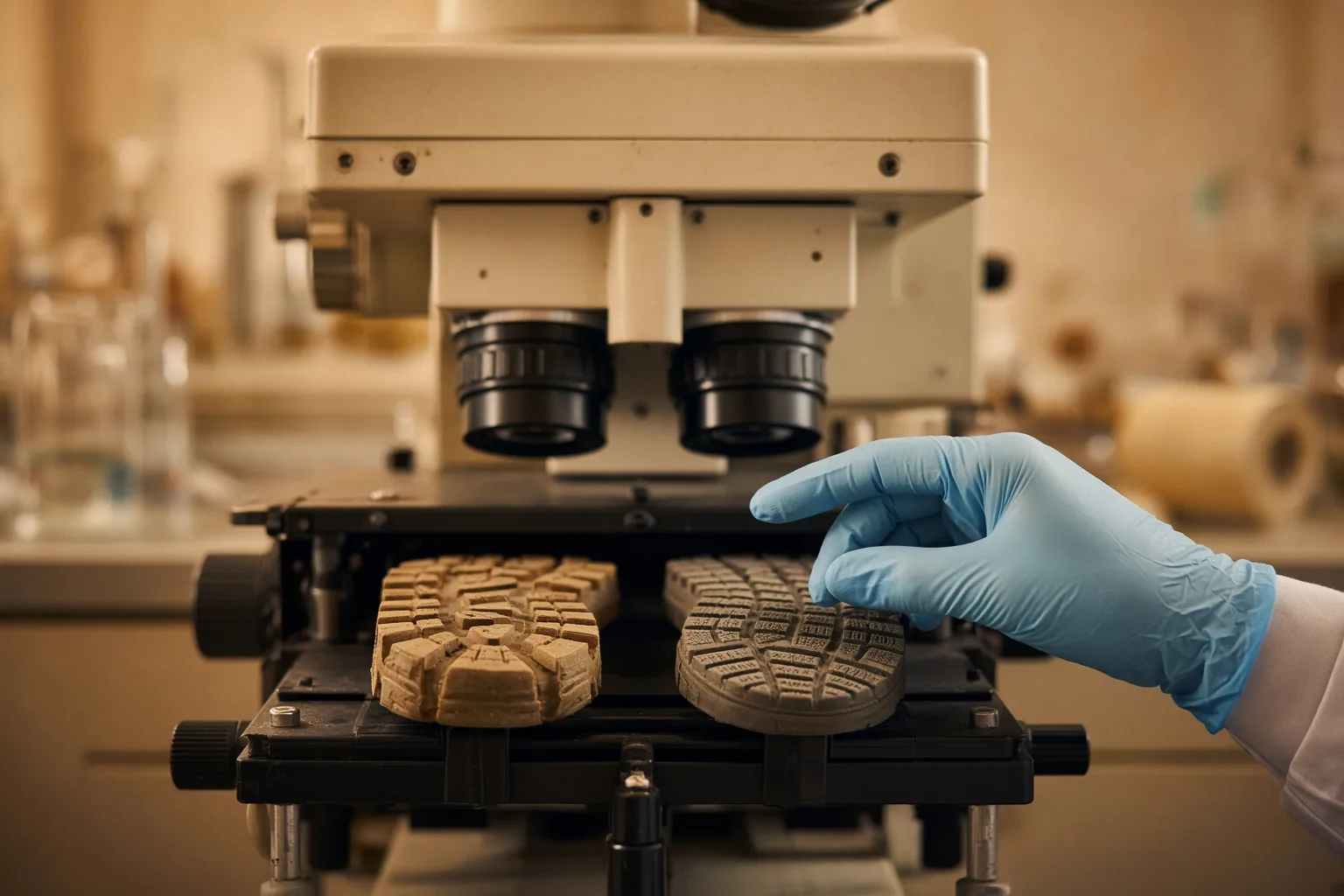
An inconclusive result means the examiner could neither associate the known item with the mark nor exclude it. The Department of Justice footwear rules and the Virginia state laboratory define the term in different words and place it among probable and class-level conclusions. NIST researchers argued in 2024 that an inconclusive can be a proper answer, and the abstract of a 2024 study reports preliminary support for the view that it can put an innocent suspect at risk.
What does an inconclusive result mean in a forensic comparison?
That the examiner could not determine whether the known item made the mark. Under the Department of Justice footwear rules, no determination can be reached as to whether the known shoe could or could not have made it.
The Department of Justice uniform language for footwear examiners, in force since August 15, 2020, defines "Inconclusive" as "an examiner's conclusion that no determination can be reached as to whether the known footwear item could or could not have made the questioned impression." It sits in the middle of the six permitted conclusions, between the two kinds of inclusion and support for exclusion.
The Virginia Department of Forensic Science puts the reason into the definition. Its manual for footwear and tire tread impressions (revision 14, November 11, 2025) defines inconclusive as "unable to identify or exclude the source of an impression because the corresponding areas and/or detail are absent or unreliable" (1.4.15.1). The model report sentence states that the comparison "is inconclusive; the impression could not be associated with or excluded from the submitted footwear" (12.2.3.3).
Both definitions describe the mark and the comparison: the areas or detail needed for a decision were missing or unreliable. Participants in a 2024 study read the result in a different way, as the section on jurors below sets out.
How is an inconclusive different from "not suitable for comparison"?
A not-suitable finding comes before any comparison: the mark has too little quality or detail to be compared at all. An inconclusive comes after a comparison that did not resolve the question.
The Virginia manual keeps the two apart. Not suitable for comparison is a "determination that a more detailed examination is not warranted" (1.4.25.1.1), and an impression is not of value for comparison when the observed data lack adequate quality and quantity (9.2.4.2). Another qualified examiner reviews the lift and all images whenever the first examiner finds no impression suitable for analysis (4.3.2.4, 4.5.1.2.3).
In the 2022 study of 84 footwear examiners by Hicklin and colleagues (Forensic Science International 339, article 111418), not suitable and inconclusive were grouped as neutral responses. They made up 6.1 percent of conclusions in the baseline dataset. Only 28 percent of neutral responses were reproduced by a second examiner, and most assessments of not suitable were not reproduced.
The authors wrote that "The forensic footwear discipline might benefit from standardization of suitability assessments." On those figures a second examiner departed from most neutral responses, and a request for a second examination can cite the study.
What are probable conclusions, and how are they worded?
Conclusions one step short of identification or exclusion. The Department of Justice words them as the shoe probably made, or probably did not make, the impression; Virginia calls them high degree of association and indications of non-association.
Under the Department's rules, "inclusion based on class and randomly acquired characteristics" is the conclusion that the known footwear item probably made the questioned impression, and "support for exclusion" is the conclusion that it probably did not make it. The examiner may not attach a statistic or numerical degree of probability unless it is based on relevant and appropriate data.
The Virginia scale has the same two steps under other names. A high degree of association is reported when the characteristics are "insufficient for an identification" (12.2.3.7). Indications of non-association are reported when "certain details or features are not sufficiently clear to permit an elimination" (12.2.3.4).
Hicklin and colleagues counted high degree of association and indications of non-association as probable conclusions. They made up 14.1 percent of conclusions in the baseline dataset, against 39.7 percent definitive conclusions (identification or exclusion) and 40.1 percent class associations.
What does "could have made the impression" tell the court?
Only that the shoe shares class characteristics, such as design and size, with the mark. A Department of Justice examiner who reports it must add that other footwear with indistinguishable characteristics could have made the impression.
The Department calls this "inclusion based on class characteristics": the known footwear item could have made the questioned impression. An examiner who reports either inclusion must also explain "that there may be other footwear items with characteristics that are indistinguishable from the known footwear item that could have also made the questioned impression."
Virginia has two levels at this point. Limited association of class characteristics reads: "There are no confirmable differences that would exclude the Item 6 right shoe from being the source" (12.2.3.5). Association of class characteristics ends with "therefore the Item 8 right shoe is a possible source" (12.2.3.6). Both carry a statement that other footwear with the same characteristics could be the source of the impression.
The Supreme Court of Delaware reviewed testimony of this kind in Rodriguez v. State on November 8, 2011. The State's examiner said that a boot "similar or almost similar" to the defendant's made the cast impression and that the boots and tire were consistent with the prints but were not a definitive match. "The only distinctive characteristic or mark on the boots that Hegman could detect was excessive wear on the left boot." The court upheld the testimony and left its weight to the jury.
Why do examiners reach inconclusive results?
Because of the mark, the known item or the review. In the 2022 footwear study higher-quality impressions produced more definitive conclusions and fewer neutral responses, and in Virginia an unresolved disagreement with the verifier ends in an inconclusive.
Hicklin and colleagues graded the questioned impressions by quality and reported that "higher quality was associated with more definitive conclusions, fewer class associations, and fewer neutral responses." The Virginia definition names the same cause in other words: the corresponding areas or detail are absent or unreliable.
The second cause is procedural. When the examiner and the verifier disagree and do not reach consensus after discussing the basis for their conclusions, the Virginia laboratory reports an inconclusive source conclusion (9.7.2.1, 9.7.2.2). An inconclusive in such a report may stand for two examiners who reached different answers. The file shows which case applies, because verifications and consultations are documented (9.5.1.1, 9.1.5.1).
The third concerns the known item. Virginia's report wording includes a statement that the known footwear or tire should be submitted for a conclusive comparison (12.2.6.2). A party that sees this sentence in a report can ask whether the shoe or tire itself ever reached the laboratory, and what the examiner compared instead.
Is an inconclusive result an error?
Not by itself, according to NIST researchers writing in 2024: an inconclusive opinion is appropriate when the analyst followed an approved method. They argued that error rates alone give an incomplete picture of reliability.
Swofford and eight co-authors, in Inconclusive Decisions and Error Rates in Forensic Science (Forensic Science International: Synergy, volume 8, 2024), review recent viewpoints and suggestions on the treatment of inconclusive decisions and separate two ideas. Method conformance concerns "whether the outcome of a method is the result of the analyst's adherence to the procedures that define the method." Method performance is "the capacity of a method to discriminate between different propositions of interest", such as same source and different source.
A NIST news release of January 13, 2025 summarizes the position: "an inconclusive opinion, or any opinion for that matter, is appropriate so long as the analyst properly followed the specifications of an approved method." It states that "the use of error rates alone provides an incomplete and potentially misleading representation of reliability", and quotes co-author Steve Lund: "Error rates are only suitable if all cases seem equally challenging and if experts must answer yes or no."
The Texas Forensic Science Commission reviewed the recommendations and set up a working group to apply them in Texas laboratories. Under this approach a disputed inconclusive becomes two questions for the examiner: was the approved method followed, and how does the method perform on marks of this quality?
How do lay participants read an inconclusive result?
As close to neutral. According to the abstract of two experiments reported in 2024, with 492 and 1,002 participants, an inconclusive was less incriminating than a match, more incriminating than a no-match and equivalent to no forensic evidence.
Madon, Burd and Guyll reported the experiments in Do inconclusive forensic decisions disadvantage the innocent? (Law and Human Behavior, 2024). Participants read expert testimony reporting a match, a no-match or an inconclusive result. The second experiment added an unsuitable-for-analysis condition and a control with no forensic evidence. The figures in this section come from the published abstract.
Inconclusive judgments were less incriminating than match judgments, with an average effect size of 0.96, and more incriminating than no-match judgments, by 0.62. The abstract describes them as equivalent to judgments in the unsuitable (0.12) and no-evidence (0.07) conditions. The authors concluded that the results give preliminary support to the view that "inconclusive decisions can put the innocent at risk of wrongful conviction."
For an innocent suspect the comparison point is the no-match result. If the suspect's shoe did not make the mark, an exclusion would have counted in the suspect's favor, while an inconclusive leaves the suspect where he would stand with no forensic evidence. A defense that faces an inconclusive therefore asks whether better images, the known item itself or a second examiner could have supported an exclusion.
Can the examiner put a probability on the conclusion?
Under the Department of Justice footwear rules, only when the statistic is based on relevant and appropriate data. The examiner may not claim absolute certainty or a reasonable degree of scientific certainty unless a judge or the law requires it.
Section IV of the uniform language states that an examiner "shall not provide a conclusion that includes a statistic or numerical degree of probability except when based on relevant and appropriate data." The same section bars assertions that the known item made the impression "with absolute or 100% certainty" and the expressions "reasonable degree of scientific certainty" and "reasonable scientific certainty" unless required by a judge or applicable law.
The 2024 NIST authors recommended reporting performance data from tests on samples that resemble the quality or condition of the evidence in the case. The 2022 footwear study graded questioned impressions by quality and reported that conclusions changed with quality, which is the kind of breakdown the NIST authors ask for.
NIST IR 8509sup2 (August 2024), a summary of published critiques of footwear and tire impression examination, records the National Research Council's 2009 finding of a lack of proficiency tests that include ambiguous samples that would lead to an inconclusive conclusion. A party can ask whether the examiner's proficiency tests included such samples and what the examiner answered.
What should a party request when the report says inconclusive?
The images with the features marked, the record of which areas could not be compared, the verifier's conclusion and any recorded disagreement, the known item's documentation and the examiner's proficiency test history.
Virginia's documentation rules list what should exist. The characteristics observed that support each conclusion are documented (9.6.1); comparison images are labelled with the conclusion, the date and the examiner's initials (9.6.2); impressions that were not analyzed, compared or evaluated are acknowledged (9.6.5); consultations are recorded (9.1.5.1). All comparison conclusions are verified by another examiner (9.5.1).
The Alaska Scientific Crime Detection Laboratory's notice template for footwear analysts has the analyst "Explain the opinions reached and limitations for each item or footwear impression analyzed" and describe the quality assurance measures in place. Under that template a notice that reports an inconclusive also states its limitations.
With these documents a party decides whether to ask for a second examination, retain its own examiner or cross-examine on the limits of the comparison. In Rodriguez the Supreme Court of Delaware upheld testimony that stopped short of identification and left the jury to weigh it, so the limits of such a conclusion reach the jury through questions.
What does IAE do when a report contains an inconclusive or probable conclusion?
An IAE examiner prepares a review of the opposing examiner's report or an expert report on the client's questions, in up to 5 business days. Each question is tied to the ANSI/ASB or ISO standard for that kind of mark.
The IAE trace evidence page addresses whether a shoe, tire or tool could have left a mark, how strong the association is and whether a lock or seal was defeated, in criminal defense and cargo loss cases in US courts. It cites ANSI/ASB Standard 137 (2023), which requires contemporaneous notes and photographs, analysis of the questioned impression before the known item and a record of the conclusion reached.
The client sends the report, the images and the disclosure and describes the task. The secretariat confirms receipt the same day and, within one business day, confirms the format, cost, deadline and the examiner from the registry; the client approves the candidate and the CV before work starts. For tight deadlines there is a 48-hour rush.
Examiners are listed in the public IAE registry and can be verified by Member ID or QR code. IAE is not a law firm and does not advise on case strategy, and neither IAE nor the examiner guarantees how the court will rule.
Sources
- U.S. Department of Justice, Uniform Language for Testimony and Reports for the Forensic Footwear Discipline (approved June 8, 2020, effective August 15, 2020)
- Virginia Department of Forensic Science, 241-D300 Impressions: Footwear and Tire Tread Procedures Manual, Revision 14 (November 11, 2025)
- Hicklin R.A. et al., Accuracy, Reproducibility, and Repeatability of Forensic Footwear Examiner Decisions, Forensic Science International 339 (2022) 111418 (accepted manuscript, Noblis)
- Swofford H. et al., Inconclusive Decisions and Error Rates in Forensic Science, Forensic Science International: Synergy 8 (2024) (NIST publication page)
- NIST, Texas Forensic Science Commission Supports NIST Recommendations (January 13, 2025)
- Madon S., Burd K.A., Guyll M., Do inconclusive forensic decisions disadvantage the innocent?, Law and Human Behavior (2024), abstract, PMID 38573703 (Read by QxMD)
- Sauerwein K., Summary of Published Critiques of Footwear and Tire Impression Examination and Community Responses, NIST IR 8509sup2 (August 2024)
- Rodriguez v. State, No. 603, 2010 (Del. Nov. 8, 2011) (FindLaw)
- Alaska Scientific Crime Detection Laboratory, Footwear Impression Analysis Notice of Expert Template (v 3.0)
Read also
All articles

Was the window broken from inside or outside? How does a glass fracture examination answer, and how far can the answer be trusted?
After a reported burglary, a shooting or a fire, one broken pane can decide which account is true: forced entry or a staged scene, a shot fired into Sergei Voronin
No signs of forced entry: how is a door, lock or window examined after a reported burglary?
Some commercial burglary policies pay only for entry by force that leaves visible marks, and police reports often carry the line "no signs of forcedSergei Voronin
Safe burglary: how does an examiner tell whether a safe was forced, drilled or opened with the combination?
An examination of a safe after a theft answers how it was opened: by force on the door or body, by drilling, or with the combination or keySergei VoroninExpert examinations
Ready to discuss your case?
Send the materials: the secretariat will confirm the format, cost, deadline and the specialist within one business day.
