
Examinations
Is a partial recording of a conversation admissible, and can an examiner tell whether parts are missing?
A recording that captures only part of a conversation can still be admitted in a federal court. Rule 106 of the Federal Rules of Evidence lets the other side require, at the same time, any other part that in fairness ought to be heard with it. Whether the recorder was paused, restarted or cut is a separate question, and a forensic examiner answers it from the file and the device.
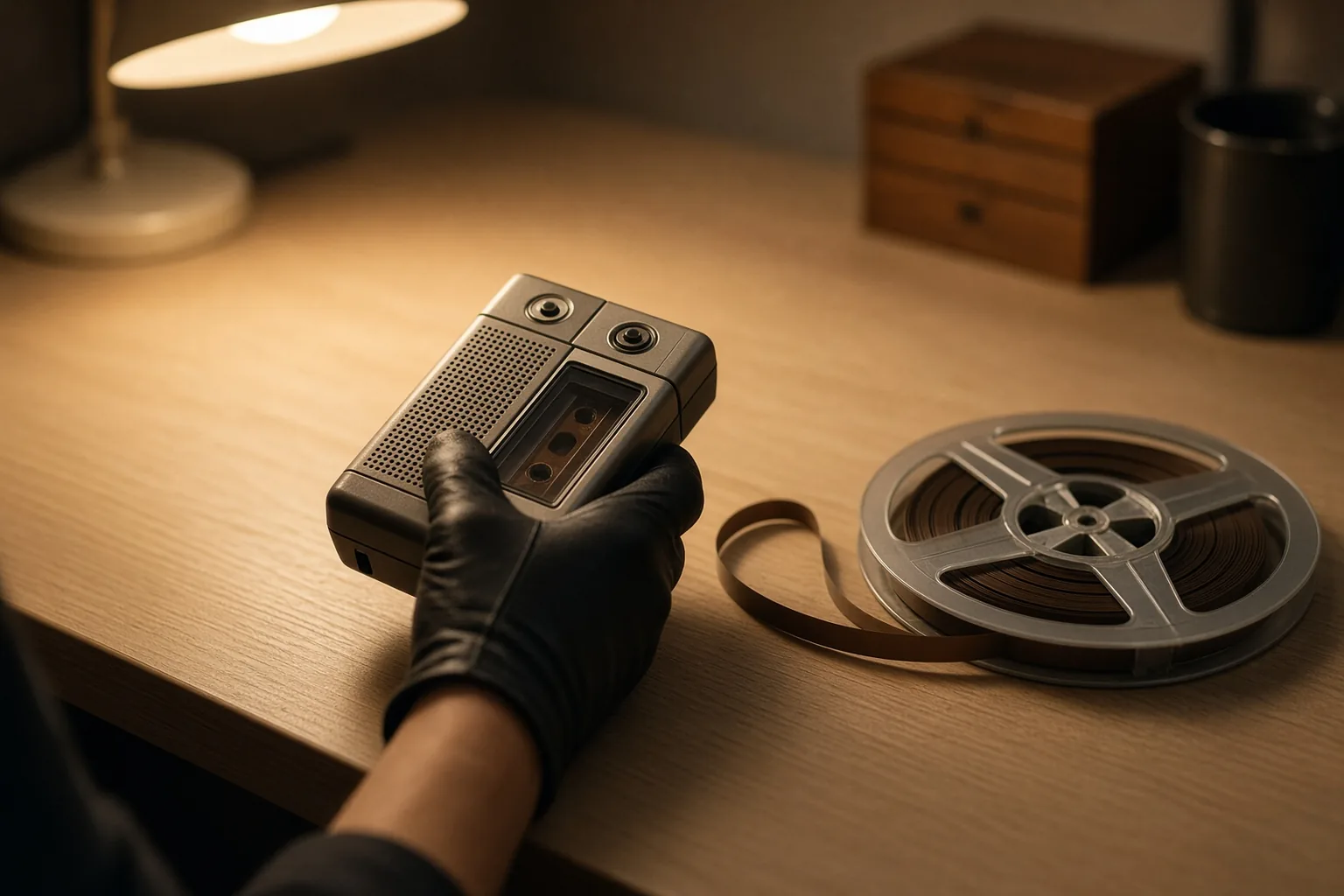
Can a recording that captures only part of a conversation be admitted?
Yes. No federal rule requires a recording to cover the whole conversation. Courts admit partial or partly inaudible recordings unless the missing or inaudible parts make the rest more misleading than helpful.
The Federal Rules of Evidence treat a recording like other evidence. The party offering it must authenticate it under Rule 901(a), which requires "evidence sufficient to support a finding that the item is what the proponent claims it is." For a partial recording the claim has to be precise: a recording of the second half of a meeting is offered as that, and not as a record of the whole meeting.
In United States v. Hagen, decided on September 10, 2020, Judge Jane J. Boyle of the Northern District of Texas applied a test from a Fifth Circuit decision, United States v. Thompson, 130 F.3d 676 (5th Cir. 1997): a recording with inaudible parts is inadmissible if "the inaudible parts are so substantial as to make the rest more misleading than helpful." The same order notes that admitting a tape "falls within the sound discretion of the trial court."
A recording that starts late or stops early raises two different questions. The first is legal: does the part offered give a fair picture of what was said, and may the other side add more? Rule 106 governs that. The second is technical: was the file stopped, paused or edited, and does it match what the device produces? That one goes to a forensic examiner.
What does Rule 106 let the other side do?
Require the introduction, at the same time, of any other part of the statement, or any other statement, that in fairness ought to be considered with the part already introduced, even over a hearsay objection.
Rule 106, as amended in 2023, reads: "If a party introduces all or part of a statement, an adverse party may require the introduction, at that time, of any other part", or any other statement, "that in fairness ought to be considered at the same time. The adverse party may do so over a hearsay objection."
The original advisory committee note gives the reason for the rule. The first concern it names is "the misleading impression created by taking matters out of context." A recording cut to the sentence in which a party agrees to a price, without the condition stated a minute later, is the classic case.
The words "at that time" matter at trial. The adverse party does not have to wait for its own case to play the remainder. The 2023 committee note says the rule retains the language that completion is made when the original portion is introduced, and adds that "many courts have held that the trial court has discretion to allow completion at a later point."
What changed in Rule 106 in 2023?
The rule now covers all statements, including oral statements that were never recorded, and it states that the completing part comes in over a hearsay objection. It still applies only where a misimpression has been created.
Before the amendment the rule spoke of writings and recorded statements. The 2023 committee note states: "Rule 106 has been amended to cover all statements, including oral statements that have not been recorded." It also says the rule now covers "all statements, in any form." For recordings this means the remainder can come from the recording itself or from a witness who heard the part that was not recorded.
The amendment also settles the hearsay question. According to the note, a completing statement is admissible over a hearsay objection, because "the rule of completeness, grounded in fairness, cannot fulfill its function" if the party that created a misimpression could block the correction on hearsay grounds.
The note limits the rule. It "applies only to the narrow circumstances in which a party has created a misimpression about the statement." A party cannot use Rule 106 to put in every remaining minute of a recording because it is helpful. The party has to point to the part that corrects a misleading impression.
Does the rule of completeness require playing the whole recording?
No. Courts admit the additional portions needed to explain or qualify the part already played. The party asking for more has to identify which portions it wants and why they matter.
In Hagen the defendants asked the court to bar the government from relying on "any incomplete portion" of a three-hour conversation. The court declined to order that the whole recording be played. It wrote that "neither Rule 106 nor the rule of completeness is an avenue for freely supplementing any statement" and that "each permits the admission of additional portions for contextual purposes."
Hagen also cites the Fifth Circuit formula that the rule of completeness "justifies admission of a statement only where it is necessary to qualify, explain, or place into context the portion already introduced." Because the defendants had not identified the statements they wanted played, the court deferred the issue to a later hearing.
The Seventh Circuit applied a four-part test in United States v. Sweiss, decided on September 5, 1986. Under it, an omitted portion may be required if it is necessary to "(1) explain the admitted portion," "(2) place the admitted portion in context," "(3) avoid misleading the trier of fact, or (4) insure a fair and impartial understanding." To lay a foundation, the court wrote, "the offeror need only specify the portion of the testimony that is relevant to the issue at trial and which qualify or explain portions already admitted."
What happened in United States v. Sweiss?
The Seventh Circuit said an excluded recorded conversation should have been admitted under Rule 106, yet found no abuse of discretion, because the defense had not specified at trial which portions it wanted and why.
Bassam Faraj secretly recorded two conversations in Arabic with the defendant, Musa Sweiss. The government introduced the conversation of September 10, and the parties stipulated to its English translation. The defense offered the conversation of August 14, and the district court excluded it. Sweiss was found guilty on four counts, including conspiracy to commit arson.
Judge Flaum, writing for a panel with Chief Judge Cummings and Judge Ripple, concluded that the excluded portions "should, therefore, have been admitted under Federal Rule of Evidence 106." The panel nevertheless wrote that "we are unable to say that the trial court abused its discretion in excluding the August tape-recording when it was offered", because the defense had not specified, when it offered the tape, which portions it relied on and how they bore on the September conversation. The judgment was affirmed.
The lesson of Sweiss for a party facing a partial recording is procedural. Before trial, counsel needs a transcript of the full recording, if it exists, marked with the passages that complete the excerpt, and a short explanation of why each one changes the meaning of the part the other side will play.
What if parts of the recording cannot be heard?
The court asks whether the inaudible parts are so substantial that the rest becomes more misleading than helpful. In Hagen a three-hour recording with over 1,100 inaudible notations in the transcript was not excluded.
In Hagen a man named Kimble recorded a pre-indictment conversation with the defendants that lasted roughly three hours. The government's transcript ran 170 pages, and the defendants counted over 1,100 "inaudible" notations in it.
The defendants argued that the recordings were irrelevant under Rules 401 and 402 because "material portions of the recordings are not intelligible", that Rule 403 required exclusion, that Rule 106 limited the government to complete portions and that the transcript violated the best evidence rule, Rule 1002. The court found that much of the conversation was audible and that the inaudible parts were not so substantial as to make the rest more misleading than helpful. It denied exclusion under Rules 401, 402, 403 and 1002, deferred the Rule 106 question and deferred its ruling on the accuracy of the transcript.
An inaudible passage is not the same as a missing one. On an inaudible passage the device kept recording and the speech is masked by noise or distance. A missing passage was never stored, or it was removed afterwards. No processing restores audio that the file does not contain.
Is a recording that starts late, pauses or stops early an edited recording?
Not necessarily. Recorders pause, stop and restart in normal use, and voice activation creates gaps. SWGDE requires the examiner to report each discontinuity with an explanation of its cause.
The SWGDE Best Practices for Digital Audio Authentication, version 1.3 of September 20, 2018, treat discontinuities as findings that need an explanation. Section 5.2 says: "Additionally, discontinuities and alterations within the questioned recording should be included in the report with an explanation of the cause. Examples would include recording pauses, voice activation discontinuities, etc."
Appendix A of the same document describes a sample case that matches a common courtroom dispute. A laboratory received a CD said to contain a conversation between two parties. One party contended that "the recording is continuous during the entire conversation". The other said the device had been paused and that the recording should not be admitted.
The examiner imaged the CD and hashed the images, identified the evidence file as a WMA file, decoded the timestamps in its header, ran global analyses and then local waveform, spectrogram and power analyses. Those analyses indicated a pause and restart. The examiner made test recordings on an Olympus WS-321M owned by the laboratory: a continuous recording, recordings with a pause and a reference file edited in Adobe Audition. The conclusion was that the submitted file is consistent with an original recording made by an Olympus WS-321M, and that a pause and restart event is present at about 2.7 seconds.
That example contains both answers at once. The file was an original, and it was not continuous. What that means for each side depends on what was said before and after the pause, a question for the lawyers and the court.
How does an examiner look for stops, gaps and missing audio?
By reading the file's header and metadata, listening without processing, and measuring the signal for breaks, then comparing the findings with test recordings made on the same model of device.
SWGDE section 4.2 lists technical characteristics to document at the start, which may include the container format and encoding scheme, channel configuration, bit rate and sample rate, duration, and encoded date and time. Under section 4.4.2.1 the metadata may include recording start and stop dates and times, recording length and codec. In the Appendix A case the examiner decoded the fields START REC, STOP REC, REC LENGTH, SESSION LENGTH and TOTAL PAUSE LENGTH from the recorder's file header.
Section 4.3 calls for "Critical aural review of the submitted recording, without applying any processing", listening for "uncharacteristic noises that may indicate equipment malfunction and possible record and edit events". Section 4.5 lists four local analyses: waveform, signal power, spectrographic analysis and butt-splice detection. Signal power can "reveal possible missing information of the acoustic signal", which the document says may be caused by "mechanical failure, compression artifacts, or insertion of silence."
Section 4.4.2.1 also warns that editing software can modify metadata fields and change their order or content. In the Appendix A case the metadata of the reference file edited in Adobe Audition named Adobe Audition as the writing application and showed an encoded date in 2015, while the recorder's timestamps dated the recording to 2013. Test recordings made on the claimed device, or on a device of the same manufacturer and model under section 4.7, show the examiner what an unedited file with a pause looks like.
Section 4.1 adds: "Not all tests will be applicable in each case, nor shall any single analysis be relied upon solely." A finding of a pause rests on several of these analyses together.
What can the examiner conclude about a recording said to be incomplete?
Whether the file is consistent with an original, inconsistent with one or whether no conclusion is possible, and where any pause, stop or other discontinuity occurs, with its likely cause and without overstating certainty.
SWGDE section 5.2 lists three possible results: "Consistent with an original," "Inconclusive," and "Inconsistent with an original." Separately, each discontinuity is reported with an explanation of its cause. A report on a disputed recording can therefore say that the file is an original and also that it contains a pause at a given time code.
Section 5.2.1 states: "No scientific inquiry, including those in forensics, produce a result of absolute certainty." It adds that language implying 100 percent certainty should be avoided unless the examiner is speaking about known alterations or deletions. The 2023 committee note to Rule 702 makes the same point for court: forensic experts "should avoid assertions of absolute or one hundred percent certainty" where the method is subjective.
What an examiner cannot do is reconstruct the words spoken during a pause. The report can state that a pause of a certain length is present and what the file shows on either side of it. The content of the conversation during the gap has to come from witnesses.
Which file and records does the examiner need?
The file as the device first stored it, the device itself if possible, the hash values of any copies and an account of who made the recording, when it was started and stopped and how it was copied.
SWGDE defines the original recording as "the first manifestation of sound in a recoverable stored format" and says in section 3.1 that "Transcoded or re-encoded versions of an original recording are not original recordings." Pause and restart records sit in the header of the original file. A file converted to another format, or a recording of a playback, may carry none of them.
Section 3.1 also asks for the date and time the recording was purportedly made. The person who made the recording should say when the device was switched on and off, whether it was paused and why, and how the file was moved from the device. Those statements give the examiner something to test.
Rule 1003 admits a duplicate to the same extent as the original "unless a genuine question is raised about the original's authenticity or the circumstances make it unfair to admit the duplicate." When one side says the recording was stopped and restarted at the decisive moment, that genuine question exists, and the original file and the device become the material the court and the examiner need. Rule 902(14) lets a qualified person certify by hash value that a copy matches the original.
How do completeness and continuity questions reach the court?
Completeness is raised under Rule 106 at trial or in a motion in limine. Continuity is raised through an expert report, served under Rule 26(a)(2), or a rebuttal report within 30 days of the other side's disclosure.
In Hagen both questions came up in a pretrial motion. The defendants asked the court to exclude the recordings and transcripts, and the court ruled on some grounds and set the completeness question for a later hearing. Under Sweiss the party asking for completion has to name the portions it wants. Counsel who plan to rely on Rule 106 prepare that list before trial.
A retained examiner in a federal civil case serves a report under Rule 26(a)(2)(B) with a complete statement of opinions and their basis and reasons and "the facts or data considered by the witness in forming them", which for a recording includes the file, its hash, the device and the test recordings. Absent a stipulation or court order, a report intended solely to rebut the other side's examiner on the same subject is due within 30 days after that disclosure, under Rule 26(a)(2)(D)(ii).
The examiner's opinion must meet Rule 702. The proponent has to show that the opinion rests on sufficient facts or data, uses reliable principles and methods and applies them reliably to the facts of the case. A continuity opinion based on listening alone, with no header analysis and no test recordings, is open to challenge on each of those points.
What does IAE do when a recording is said to be incomplete?
IAE prepares an expert report on the client's questions about the file, pauses, stops and edits, or a review of the opposing examiner's report, issued in up to 5 business days after format and cost are confirmed.
IAE frames the questions around the recording: the speaker, the integrity of the file and the words spoken. The examiner checks the file for edits, including breaks in background noise, metadata that does not match the device, signs of re-recording and gaps in the chain of copies. A transcript, if the questions require one, marks speakers, time codes and unintelligible passages against the original file.
The client sends the file, its history and the case materials and describes the task. The secretariat confirms receipt the same day. Within one business day IAE confirms the format, the cost, the deadline and the specialist from its registry, and the client approves the candidate and the CV before work starts. The signed PDF is issued in up to 5 business days after the format and cost are confirmed, and a 48-hour rush is available for tight deadlines.
Every specialist is a member of the public IAE registry and can be verified by Member ID or QR code. The specialist confirms in the document that he or she has no interest in the outcome of the case. IAE is not a law firm and does not advise on case strategy; whether to invoke Rule 106 or to challenge a recording is a question for the client's attorney. A report is evidence that the court weighs with the rest of the record, and neither IAE nor the examiner guarantees the outcome.
Sources
- Federal Rules of Evidence, Rule 106, with original and 2023 committee notes (LII, Cornell Law School)
- United States v. Hagen, No. 3:19-CR-0146-B (N.D. Tex. Sept. 10, 2020), memorandum opinion and order (FindLaw)
- United States v. Sweiss, 800 F.2d 684 (7th Cir. 1986) (Justia)
- SWGDE Best Practices for Digital Audio Authentication, 15-a-001, version 1.3, September 20, 2018 (PDF)
- Federal Rules of Evidence, Rule 901, Authenticating or Identifying Evidence (LII, Cornell Law School)
- Federal Rules of Evidence, Rule 1003, Admissibility of Duplicates (LII, Cornell Law School)
- Federal Rules of Evidence, Rule 902, Evidence That Is Self-Authenticating (LII, Cornell Law School)
- Federal Rules of Evidence, Rule 702, Testimony by Expert Witnesses, with 2023 committee note (LII, Cornell Law School)
- Federal Rules of Civil Procedure, Rule 26, Duty to Disclose; General Provisions Governing Discovery (LII, Cornell Law School)
Read also
All articles

Can a voice recording prove a verbal agreement in court, and what does the recording have to show?
In California all contracts may be oral, except those that a statute requires to be in writing: that is Civil Code section 1622. A recording is Sergei Voronin
Is voice stress analysis admissible in court, and can an audio expert tell from a recording whether someone lied?
Voice stress analysis results are kept from juries as proof that a person lied. In a study funded by the National Institute of Justice, twoSergei Voronin
The court transcript does not match the audio recording: how is the record corrected, and what can a forensic transcript add?
When the official transcript of a federal hearing differs from what the audio recording shows, the transcript is presumed correct until the courtSergei VoroninExpert examinations
Ready to discuss your case?
Send the materials: the secretariat will confirm the format, cost, deadline and the specialist within one business day.
