
Examinations
Lithium-ion battery fire investigation: did the battery start the fire or burn in it?
A lithium-ion battery found in the area of origin has not yet been shown to be the cause of the fire. An outside fire can drive a healthy battery into thermal runaway, so the investigator has to show that the burning began inside a cell. NTSB investigators of a 2013 Boeing 787 battery fire did that with CT scans and a cell-by-cell teardown and traced the failure to an internal short circuit in cell 6.
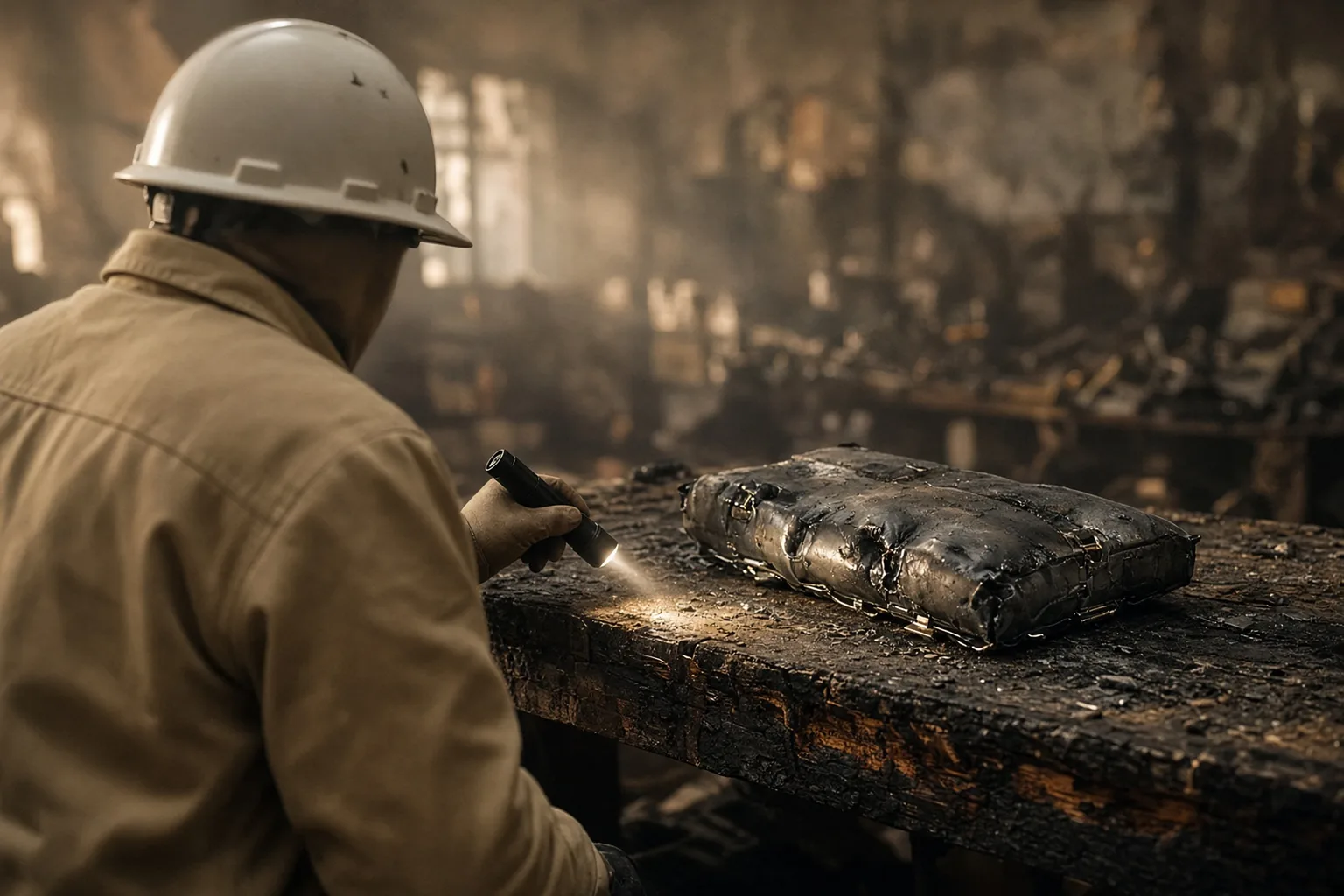
What happens when a lithium-ion battery catches fire?
A short circuit inside a cell usually starts thermal runaway, a chemical reaction that produces heat. The flammable electrolyte vents toxic and flammable vapors, and the failure can pass to the neighboring cells one after another.
The National Transportation Safety Board describes the process in its 2020 safety report on battery fires in electric vehicles. Thermal runaway is "a chemical process that produces heat (an exothermic reaction)," and "The originating cause of thermal runaway is generally short-circuiting inside a battery cell." The report names crushing and puncturing of a cell as one route to that internal short. It adds a second route that matters for every fire investigation: "An external fire might also heat a battery cell enough to initiate thermal runaway."
The materials explain why such fires grow quickly. According to the NTSB, "The organic solvents used in lithium-ion batteries are flammable," and the hazards of thermal runaway include "venting of toxic and flammable vapors from the electrolytic solvent." Cells are assembled into modules and modules into packs, and the report states that thermal runaway can travel through them "in a domino effect."
A burned pack can also hold energy after the flames are out. The NTSB calls it stranded energy: "energy remains inside any undamaged battery modules and cells, with no path to discharge it." In one of the electric vehicle fires the NTSB examined, the battery reignited five days after the crash. Lithium-ion packs also power e-bikes, scooters, power tools and phones, and the Phoenix count below lists such devices among the batteries found where fires began.
How often is a lithium-ion battery found where a fire started?
Often enough to be counted separately. A January 2024 summary posted by the City of Phoenix fire site lists 72 fires investigated where a lithium-ion battery was found in the area of origin, 52 of them involving a structure.
The summary, titled "Lithium-Ion Battery Fire Investigations" and dated January 5, 2024, states: "To date, there are a total of 72 fires investigated, where a lithium-ion battery was found in the area of origin." Structures were involved in 52 of the 72 incidents. Its device chart sorts the batteries into energy storage systems, electric vehicles, micromobility devices, portable electronics, power tools, remote-powered devices and other or multiple devices, and the text names micromobility devices, electric vehicles and power tools as the groups with the largest numbers.
Two other findings bear on how an investigation is run. In over half of the incidents the battery was indoors at the time of the fire. According to the chart on charging, 36 percent of the batteries were charging when the fire occurred, 51 percent were not, and the status of 13 percent was unknown.
The Phoenix summary says that a battery "was found in the area of origin." That is where an investigation starts. National data do not finish it either. When the NTSB reviewed six sources of fire data for its electric vehicle report, it found that all of them had serious limitations in their ability to identify batteries as the source of vehicle fires. Whether a particular battery was the cause is decided on the physical evidence from that fire.
How does an investigator tell whether the battery caused the fire or was burned by it?
By finding where the heat started. In the Boeing 787 case, microscopy showed that hot spots on the battery case originated inside it, and the NTSB excluded external short circuits and mechanical damage as causes.
The two hypotheses predict different evidence. If the battery started the fire, the damage leads back into the pack, to one cell or a group of cells, and the surrounding area burned later. If the fire reached the battery from outside, the origin lies elsewhere, and the battery shows heat that came at it from the outside. Because the NTSB recognizes that an external fire can push a healthy cell into thermal runaway, a vented or ruptured battery in the debris does not decide the question by itself.
NTSB investigators Joseph Kolly, Joseph Panagiotou and Barbara Czech described how they answered it for the auxiliary power unit battery of a Japan Airlines Boeing 787. On January 7, 2013, at about 10:21 a.m., cleaning personnel found smoke in the aft cabin of the airplane, which was parked at a gate at Logan International Airport in Boston. A mechanic found heavy smoke and fire at the front of the battery case. Using scanning electron microscopy with energy-dispersive spectroscopy, the investigators established that the hot spots on the case exterior originated inside the case, which ruled out external causes.
A 2026 laboratory study adds a data-based view. Ling Liu, Y. Andrew Wu and Haisheng Zhen, writing in the journal Fire, heated 18650 cells and recorded voltage, current and temperature. Under heating, the temperature rose steadily while voltage and current stayed essentially unchanged until thermal runaway, and the authors associate this pattern with a battery acting as a secondary ignition point in a fire. Where such records survive, they can be tested against the origin found at the scene.
How is a burned battery examined in the laboratory?
Imaging comes first and the teardown follows it. For the 787 battery the NTSB made digital radiographs and CT scans, scanned an undamaged battery for comparison, and only then took the case and the cells apart.
Firefighters removed the damaged battery on scene, and it was shipped to the NTSB Materials Laboratory. The battery had eight cells connected in series in two rows of four, rated at 75 ampere-hours and 29.6 volts nominal, 3.7 volts per cell. Each cell held three electrode windings, each about 33 feet long, with a flammable electrolyte of a lithium salt in an organic solvent.
Digital radiographs and CT scans were made at Chesapeake Testing under NTSB supervision with a 450 kV scanner, and an undamaged battery was scanned for comparison. The cells were bulged but mostly intact, and no foreign material was found outside them. The paper records the reason for imaging first: "Radiographic imaging successfully guided the disassembly and eliminated unnecessary destruction of evidence."
The teardown then went step by step. The bus bars were inspected for resistive heating and tested by cross-section microhardness under ASTM E384 and microetching under ASTM E407, with no grain growth or hardness change found. The wiring harness showed thermal discoloration and staining from electrolyte and cathode material. CT scans of single cells found a breach less than 0.10 inch long in the case of cell 5. The cells were cut open, the windings were unwound and examined, and electron microscopy was used to look for lithium dendrites, copper plating and foreign material.
The authors note the cost of the method: electron microscopy "proved very capable of characterizing these anomalies, but can be extremely time consuming." The schedule for a battery examination in litigation has to leave room for that work.
Can the investigator tell which cell failed first?
Sometimes. The NTSB traced the 787 battery fire to an internal short circuit in cell 6, the cell with the greatest thermal and mechanical damage. The cause of that short was still under investigation when the paper was written.
The battery had gone into thermal runaway in which "the failure of one battery cell cascaded to other neighboring cells within the battery assembly." Cells 5 through 8 had relieved pressure through their vent discs, and cells 1 through 3 also vented, with less deformation of their vent discs. Cell 6 had the greatest thermal and mechanical damage, and its windings showed holes in the copper foil, an aluminum lump projecting through a copper wrap and grain boundary decohesion near a hole in the foil. The investigators concluded: "The initial failure was determined to be an internal short circuit in cell 6."
The paper keeps two findings apart. Where the failure began was established. Why the internal short occurred was not: "Work continues to determine the cause of the internal short circuit," with manufacturing and design issues and the charging system still under review. External electrical short circuits and mechanical damage had been excluded.
The same split appears in court. That a fire began in a battery is an opinion about origin. That a cell failed because of a manufacturing or design defect, or because of the charger, is an opinion about the product and needs its own data and its own qualified witness.
What can battery data tell an investigator?
If records survive, how voltage, current and temperature behaved before thermal runaway. A 2026 laboratory study found different patterns for overcharge, external short circuit, heating and needle puncture.
Liu, Wu and Zhen tested 18650 cells with a nickel-cobalt-manganese cathode under four kinds of abuse and wrote that the logged patterns "can be used for post hoc fire investigation to trace the fire reasons." In their overcharge tests, thermal runaway followed a long charging period of about 15 minutes, with voltage above 4.2 V and a temperature rise in three stages. An external short circuit produced very high current and a voltage that dropped, rebounded and dropped again. Needle puncture made the voltage collapse abruptly with no rebound and the temperature surge within seconds.
The authors applied the method to an electric bus that caught fire during charging in August 2023. The battery management system recorded a sudden voltage drop and temperature rise with no steady temperature increase before them, and the authors concluded that two cells had external short circuit faults rather than overcharge. Metal frame fragments were found within the pack box, and the authors write that their result confirmed the cause given by the authority.
The study states its limits: each experiment tested a single inducing factor in 18650 cells, the electrical and thermal signals of thermal runaway may develop differently in other cells, and in real failures the factors are coupled together. In the electric vehicle cases studied by the NTSB, specialists could use the battery management system to check remaining voltage only if the system was operational, and in one case attempts to communicate with it failed.
Does it matter whether the battery was charging when the fire started?
Yes, it is one of the facts the investigator records. In the Phoenix summary 36 percent of the batteries were charging when the fire occurred, 51 percent were not and 13 percent were unknown.
In the Phoenix count, batteries that were not charging outnumbered those that were, so charging is a fact to establish and not a cause to assume. The overcharge pattern in the 2026 study, a long charge with voltage above 4.2 V before thermal runaway, gives the investigator something to test when the charging history is known. In the 787 investigation the charging system was one of the subjects the NTSB was still reviewing.
The record for a charging hypothesis includes the charger that was used and whether it came with the device, the cable and the outlet, how long the battery had been on charge, and who last saw it. The charger and the outlet are collected with the battery, because the hypothesis cannot be tested without them.
How should a burned battery be preserved for examination?
Photographed in place, collected with the debris around it, kept away from people and other fuel, and not opened before imaging. Undamaged cells can still hold energy and reignite.
Stranded energy is the reason for caution. The NTSB found that it creates the potential for thermal runaway that can result in reignition and fire, and one of the batteries it studied reignited five days after the crash. For damaged electric vehicles NFPA and manufacturers recommend a 50-foot clearance during storage. That recommendation was written for vehicles. For a small pack the investigator applies the same idea: the pack is stored apart from other evidence and from anything that can burn.
Position and orientation are evidence. In the 787 case the radiographs recorded the orientation of the components before parts were removed, and the investigators wrote that a "more deliberate disassembly process was necessary to avoid destroying any potential evidence." Cells ejected from a pack, the charger, the plug and the outlet are photographed where they lie and collected with notes of their location.
The other parties are notified before anything is cut. In the 787 investigation the NTSB drew on consultants from other federal agencies and private laboratories, and the authors describe multidisciplinary and internationally diverse teams of experts and facilities. In federal civil litigation, Rule 34(a) of the Federal Rules of Civil Procedure lets a party request to inspect, test or sample "any designated tangible things," and the party served responds in writing within 30 days after service, so a joint examination under an agreed protocol keeps the teardown from becoming a dispute of its own.
What does a court ask of a battery fire opinion?
Whether it rests on sufficient facts or data and reliable methods reliably applied. A retained expert's report must state each opinion with its basis and reasons and list the facts or data considered and the exhibits.
Rule 702 of the Federal Rules of Evidence lets a qualified expert testify if the proponent establishes that it is more likely than not that the expert's specialized knowledge will help the trier of fact, that the testimony is based on sufficient facts or data, that it is the product of reliable principles and methods, and that the opinion is a reliable application of those principles and methods to the facts of the case. For a battery opinion that means the origin, the excluded hypotheses and the laboratory work have to connect.
Rule 703 lets the expert rely on facts or data that experts in the field would reasonably rely on, even if they are not admissible themselves. CT images, teardown photographs and laboratory results produced by someone else are such data. Under Rule 26(a)(2)(B) of the Federal Rules of Civil Procedure the report of a retained expert contains a complete statement of all opinions and the basis and reasons for them, the facts or data considered, the exhibits that will summarize or support them, the witness's qualifications and publications of the previous 10 years, the cases of the previous 4 years in which the witness testified, and the compensation.
What does IAE do when a lithium-ion battery may have started a fire?
A fire investigator from the IAE registry prepares an origin and cause report on your questions or reviews the opposing investigator's report, in up to 5 business days after the format and cost are confirmed.
The IAE fire origin and cause service covers where the fire started, what ignited it, how it spread and whether an appliance, the wiring or a person's act caused it, for subrogation, product liability, arson defense and coverage disputes in US courts. The investigator works from the scene record, photos, removed artifacts and witness accounts, names the ignition source, the first fuel ignited and the circumstances that brought them together, and tests each hypothesis against the scene and the timeline. The investigator also checks whether appliances and debris were photographed in place before removal, logged and examined at a joint lab exam with all interested parties notified.
For a battery fire, send the fire department report, the scene photographs, the list of collected items with the battery, the charger and the outlet, any CT or teardown reports and the opposing report if there is one, and tell us whether the fire scene still exists. The secretariat confirms receipt the same day. Within one business day IAE confirms the format, cost, deadline and the specialist from its registry, and you approve the candidate and the CV before work starts. Cases with tight deadlines have a 48-hour rush.
Every specialist is a member of the public IAE registry and passed the council's attestation under the published Criteria Matrix; the Member ID in the document can be checked by QR code. The specialist confirms in the document that he or she has no interest in the outcome of the case. Neither IAE nor the specialist guarantees the outcome, and IAE is not a law firm.
Sources
- City of Phoenix fire site, Lithium-Ion Battery Fire Investigations, Public Release Summary, January 2024
- J. M. Kolly, J. Panagiotou, B. A. Czech (National Transportation Safety Board), The Investigation of a Lithium-Ion Battery Fire Onboard a Boeing 787, ISASI technical papers, 2013
- National Transportation Safety Board, Safety Risks to Emergency Responders from Lithium-Ion Battery Fires in Electric Vehicles, Safety Report NTSB/SR-20/01, adopted November 13, 2020
- L. Liu, Y. A. Wu, H. Zhen, Fire Investigation Based on Time-Sequential Analysis of Lithium-Ion Battery Thermal Runaway, Fire 9 (2026) 211
- Federal Rules of Evidence, Rule 702, Testimony by Expert Witnesses (LII, Cornell Law School)
- Federal Rules of Evidence, Rule 703, Bases of an Expert (LII, Cornell Law School)
- Federal Rules of Civil Procedure, Rule 34, Producing Documents, Electronically Stored Information, and Tangible Things, or Entering onto Land, for Inspection and Other Purposes (LII, Cornell Law School)
- Federal Rules of Civil Procedure, Rule 26, Duty to Disclose; General Provisions Governing Discovery (LII, Cornell Law School)
Read also
All articles
Gas explosion investigation: who is liable, and what does the investigator have to establish?
After a gas explosion the claim turns on one physical question: where the gas came from and why nobody noticed it before something ignited it Sergei Voronin
Tenant caused a fire: who is liable, can the landlord's insurer sue, and what must the investigator establish?
When a rented house burns, three questions come up in order: where the fire started, what started it, and who answers for that cause under the leaseSergei Voronin
Fire spread from a neighbor's property: who is liable, and what does the investigator have to establish?
A neighbor is liable for a fire that spreads onto your property when the fire started through his negligence or in violation of law, not merelySergei VoroninExpert examinations
Ready to discuss your case?
Send the materials: the secretariat will confirm the format, cost, deadline and the specialist within one business day.
