
Examinations
Pedestrian accident reconstruction: what does the expert establish, and how do courts test it?
A pedestrian accident reconstruction answers where the pedestrian was struck, how fast the vehicle was going, when the driver could first see the pedestrian and whether braking from that moment would have stopped the vehicle in time. Courts test each input. In Solis v. Southern California Rapid Transit District, the only opinion placing the pedestrian outside the crosswalk rested on an assumed speed and friction value, and the Court of Appeal reversed the judgment on her injury claim.
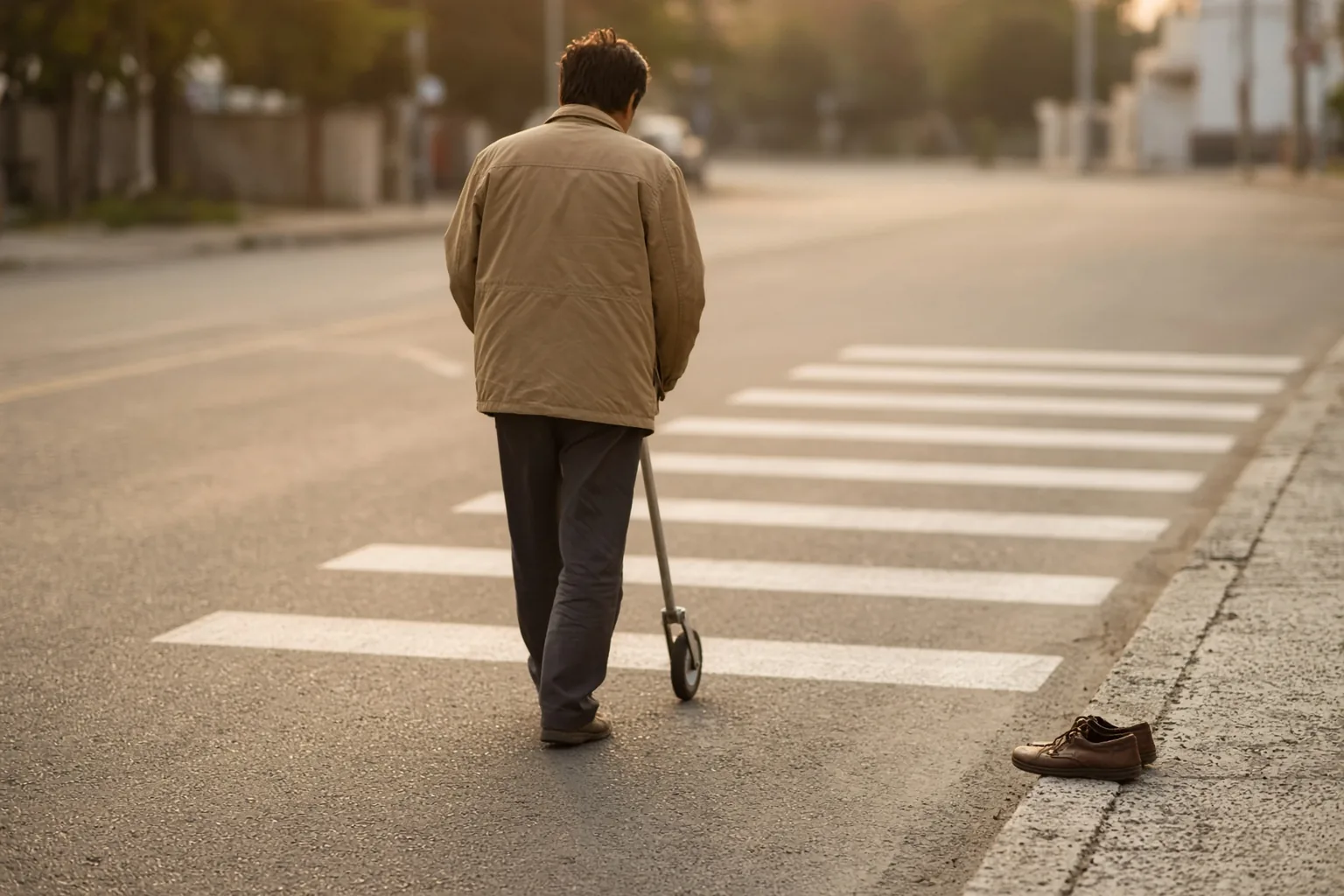
What does a pedestrian accident reconstruction establish?
The point of impact, the vehicle's speed, the pedestrian's path, the moment the driver could first see the pedestrian and whether the driver could have stopped from that moment. Each answer rests on inputs from the scene.
NHTSA's Traffic Safety Facts report Pedestrians: 2023 Data (DOT HS 813 727, June 2025) counts 7,314 pedestrians killed in 2023, 3.7 percent fewer than the 7,593 killed in 2022, and an estimated 68,244 injured. Pedestrians were 18 percent of all traffic deaths. Seventy-seven percent of pedestrian fatalities occurred in the dark and 19 percent in daylight; 84 percent occurred in urban areas, and 74 percent at locations that were not intersections.
Those figures mark out the usual disputes. A crash in the dark puts sight distance and headlights at issue. A crash away from an intersection puts the right of way at issue, because a pedestrian crossing outside a crosswalk generally has to yield to vehicles. In both kinds of case the reconstructionist first has to fix where the impact happened, since that point often decides which traffic rule governs.
The engineer works from the police diagram and photographs, the rest positions of the vehicle and the pedestrian, debris, marks on the road, damage to the vehicle, video and the vehicle's own recorded data where it exists. In Briggs v. Knapp, a 2023 Michigan case discussed below, neither vehicle had a data recorder or a dashcam, so the physical evidence and the witnesses were all the reconstruction could use.
How is the point of impact located?
From marks, debris, vehicle damage and rest positions, worked backward with values for speed, friction and reaction time. In Solis a point of impact built on untested values was held to lack foundation.
On January 7, 1974, at about 4 p.m. in heavy rain, Luisa Solis was struck by a bus turning left from northbound Wall Street onto westbound 11th Street in downtown Los Angeles. At trial the plaintiff and an eyewitness testified that she crossed with a green light and a walk signal. She suffered brain damage and did not remember the impact. The driver estimated his speed at 5 to 8 mph.
The defense reconstructionist, David Bruce Lent-Koop, worked backward from photographs of the rest positions of the bus and the plaintiff. He placed the bus's right front corner about 21 feet west of the crosswalk. With perception and reaction times of 0.75 seconds each, a friction coefficient of 0.45 for a wet street and a speed of 6 mph, he calculated a minimum stopping distance of about 17 feet and concluded that the plaintiff had been struck west of the crosswalk.
Each input had a gap. The 6 mph came from a test run more than two years later on a dry day, with the same bus and driver and an uncalibrated speedometer marked in 5 mph steps. He did not know the actual friction, which could have been as low as 0.35, or the condition of the tires and of the bus. He testified that a longer perception time or a speed of 7.5 mph could place the impact inside the crosswalk. The plaintiff had also taken a few steps backward before she fell, so her rest position was partly a matter of human movement.
The Court of Appeal, in 105 Cal.App.3d 382 (1980), held that "there was no adequate foundation for the expert's opinion testimony." It wrote: "Many decisions have excluded such expert testimony attempting to work backward from the point of the rest," and "Such small differences in speed made big differences in the conclusion sought to be reached." Because the reconstruction was "the only evidence placing plaintiff outside the crosswalk," the error was prejudicial. The court reversed the judgment for the transit district on Luisa Solis's personal injury claim and affirmed it on her privacy claims.
When could the driver first see the pedestrian?
That moment starts the avoidance calculation. In Niamtu v. Boudah the driver had seen the pedestrian step off the curb, and his own reconstructionist conceded that braking then would have avoided the impact.
Shortly before 1:00 p.m. on September 22, 2005, a drizzly day, Angel Niamtu was crossing State Street at Morrison Street in Big Rapids, Michigan, in a marked crosswalk. She had almost reached the far curb when Jeffrey Boudah's car struck her near the center of the lane closest to the median. The limit was 35 mph, and nothing obstructed the driver's view of the intersection. At trial Boudah said he first saw her about two-thirds of the way across the lane. In his deposition he had agreed that he saw her step off the curb when he was 150 to 200 feet from the crosswalk, and he said that he braked and turned right.
The defense reconstructionist, Donald Rudny, put Boudah's speed at 28 to 34 mph when he first saw Niamtu, working from the final rest positions of the car and the pedestrian in a newspaper photograph. He testified that Niamtu created a sudden emergency and that Boudah did everything he could. On cross-examination he conceded that if Boudah had seen her step off the curb, braking at that time would have avoided the impact.
The trial court directed a verdict for the driver. On February 10, 2011, in an unpublished per curiam opinion in No. 292667, the Michigan Court of Appeals reversed that ruling and remanded, noting that the case must be tried a second time: "The reasonableness of the parties' conduct presents a quintessential jury question." A jury could infer that Boudah failed to keep a proper lookout, and no evidence showed that Niamtu ran or stepped suddenly into the car's path.
The pedestrian's walking speed sets how long she was in view before the impact. Signal designers use a standard value: the Maryland State Highway Administration's design guidelines state that "The pedestrian clearance time is usually timed using a walking rate of 3.5 feet per second." That is a design value for timing signals. In a reconstruction of one crash the walking speed comes from the evidence in that case, such as video, witness accounts or the pedestrian's age, and the report shows how the result changes if the speed is different.
How does darkness enter a pedestrian reconstruction?
Through sight distance: how far ahead the headlights and any street lighting let the driver see a person in the clothing worn. In NHTSA's 2023 data, 77 percent of pedestrian deaths occurred in the dark.
In Briggs v. Knapp, decided by the Michigan Court of Appeals on March 9, 2023 in an unpublished per curiam opinion (No. 358641), Jeffrey Knapp's car struck a pedestrian, Omari Bell, on a freeway at night, after two motorists had called 911 about a pedestrian on westbound I-94. Knapp pointed to the dark conditions and to the lack of ambient light because of a nearby wall. The limit was 70 mph, and Knapp had set his cruise control at about 70 mph. He testified that he never saw the pedestrian before the impact.
The accident reconstructionist and the investigating officer concluded that the pedestrian was at fault and compared the crash to a vehicle striking a deer. The plaintiff's expert, Timothy Robbins, stated in an affidavit that other drivers could see the pedestrian, and he named factors within the driver's control, such as cleaning dim headlights or using bright headlights. The two 911 callers had seen the pedestrian before the crash.
The court affirmed the denial of summary disposition. Whether Knapp breached his duty was a question of fact, because his testimony that he never saw the pedestrian had to be weighed against the two callers who did. The court wrote: "The officers' determination that defendant was credible did not remove the issue from the jury." A sight-distance opinion that ignores what other drivers on the same road could see leaves that conflict unanswered.
Who has to yield, the driver or the pedestrian?
It depends on where the pedestrian crossed. Under Florida law a pedestrian crossing outside a crosswalk yields to vehicles, but every driver must still exercise due care to avoid colliding with any pedestrian.
Section 316.130 of the Florida Statutes sets the pedestrian rules. A pedestrian crossing outside a crosswalk "shall yield the right-of-way to all vehicles upon the roadway" (subsection 10). Between adjacent intersections with traffic control signals, "pedestrians shall not cross at any place except in a marked crosswalk" (subsection 11). Under subsection 8, "No pedestrian shall suddenly leave a curb or other place of safety and walk or run into the path of a vehicle" that is too close for the driver to yield.
The driver's duty continues outside the crosswalk. Subsection 15 provides that "every driver of a vehicle shall exercise due care to avoid colliding with any pedestrian." Where sidewalks exist, a pedestrian may not, unless required by other circumstances, walk along the roadway (subsection 3).
These rules make the point of impact a legal fact as well as a physical one. In Solis the expert's reconstruction was the only evidence that the plaintiff was outside the crosswalk. In Niamtu the parties agreed that the impact was inside a marked crosswalk, and the dispute moved to what the driver saw and when.
How does the pedestrian's own fault affect the claim?
In Florida the pedestrian's share of fault reduces the damages, and a claimant found more than 50 percent at fault for his or her own harm recovers nothing, except in medical negligence cases.
Section 768.81(2) of the Florida Statutes provides that "contributory fault chargeable to the claimant diminishes proportionately the amount awarded." Subsection (6), as printed in the 2026 statutes, adds that "any party found to be greater than 50 percent at fault for his or her own harm may not recover any damages," with an exception for actions arising out of medical negligence under chapter 766. The latest amendment in the section history is chapter 2023-15. Under subsection (3) the court enters judgment against each liable party on the basis of that party's percentage of fault.
Under that threshold the allocation of fault can decide whether there is any recovery, and the reconstruction supplies the facts for it. If the evidence is that the pedestrian stepped from the curb into the path of a car too close to stop, section 316.130(8) speaks to the pedestrian's conduct. If the driver saw the pedestrian step off the curb when he was 150 to 200 feet from the crosswalk, as Boudah agreed in his deposition in Niamtu, the driver's lookout is at issue.
Michigan courts send the same questions to the jury. In Briggs the court held that the decedent's clothing, location and timing went to comparative negligence: "Questions regarding the reasonableness of a decedent's actions are relevant to comparative negligence, not duty." In Niamtu the pedestrian's comparative negligence could not be decided as a matter of law.
When do courts admit or exclude a pedestrian reconstruction?
Courts admit it when it rests on enough data in evidence and the contested fact, such as speed, is beyond lay knowledge. They exclude it when key inputs are assumed, as the California Court of Appeal did in Solis.
The Appellate Court of Illinois, Second District, stated the condition in Smith v. Latos, 2015 IL App (2d) 141237-U, a nonprecedential Rule 23 order: "For reconstruction testimony to be admissible, there must be sufficient data about the accident in evidence." The engineer there computed a motorcycle's speed at impact of at least 57 to 60 mph from how far the motorcycle and rider traveled after the collision. The court upheld the testimony because the evidence on the speed and on how the defendant turned conflicted, there may have been no eyewitness to the impact, and "how energy affects objects in motion is beyond the knowledge of the average juror."
Florida's Fourth District Court of Appeal reached the same result on speed in Bryant v. Buerman, 739 So. 2d 710, decided September 8, 1999. The trial court had excluded a physicist's reconstruction of speed and force in a rear-end collision on I-95, reasoning that lay witnesses could estimate speed. The appellate court held the exclusion to be prejudicial error, reversed in part and remanded for a new trial: expert speed testimony "is admissible, so long as the expert's testimony is helpful to the jury," and there it "was not merely cumulative but critical in resolving the factual issues."
The exclusion in Solis turned on the inputs: a speed taken from a test under different conditions, a friction value the expert did not know and a rest position the pedestrian changed by moving. A review of the opposing report lists each input, its source and how far the conclusion moves when the input changes. In Solis the expert himself testified that 7.5 mph, 1.5 mph above the speed he assumed, could place the point of impact inside the crosswalk.
What does IAE do in a pedestrian accident case?
An IAE engineer prepares an expert report on the crash or a review of the opposing reconstruction, in up to 5 business days. The questions are confirmed with the client before work starts.
The IAE accident reconstruction service covers how the vehicles moved before impact, what the event data recorder shows about speed and braking, and whether the damage on each vehicle fits the claimed crash. The engineer sets the point of impact and pre-crash speeds from crush, tire marks, gouges, the police diagram and video. Where a vehicle has an event data recorder, the engineer checks the download against the scene evidence.
The client sends the report or the case materials and describes the task. The secretariat confirms receipt the same day, and within one business day IAE confirms the format, the cost, the deadline and the specialist from its registry. The client approves the candidate and the CV before work starts, the draft is checked for facts, and the signed PDF is issued in up to 5 business days. Cases with tight deadlines can use a 48-hour rush.
Every specialist is a member of the public IAE registry, and the Member ID in the document can be checked by QR code. The specialist confirms in the document that he or she has no interest in the outcome. Neither IAE nor the engineer guarantees the outcome, and IAE is not a law firm.
Sources
- NHTSA, Traffic Safety Facts: Pedestrians, 2023 Data, DOT HS 813 727 (June 2025)
- Solis v. Southern California Rapid Transit District, 105 Cal.App.3d 382 (1980)
- Niamtu v. Boudah, No. 292667 (Mich. Ct. App. Feb. 10, 2011) (unpublished)
- Briggs v. Knapp, No. 358641 (Mich. Ct. App. Mar. 9, 2023) (unpublished)
- Smith v. Latos, 2015 IL App (2d) 141237-U (Ill. App. Ct. 2015), Rule 23 order
- Bryant v. Buerman, 739 So. 2d 710 (Fla. 4th DCA 1999), full text
- Florida Statutes 2025, section 316.130, Pedestrians; traffic regulations
- Florida Statutes 2026, section 768.81, Comparative fault
- Maryland SHA Bicycle and Pedestrian Design Guidelines, Chapter 11: Pedestrian Signs and Signals
Read also
All articles
Sideswipe or lane-change crash: how does an expert establish which vehicle left its lane?
Two cars travelling in the same direction touch sides, and each driver says the other drifted over. Traffic codes put the duty on the driver who Sergei Voronin
Motorcycle accident reconstruction: how does the expert find speed, position and visibility without a car's data recorder?
In 2024, 6,228 motorcyclists were killed on US roads, 16 percent of all traffic deaths, according to NHTSA. Many of these crashes turn on threeSergei Voronin
Who ran the red light? How does an accident reconstructionist analyze signal timing?
When two drivers each say the light was green, the answer comes from timing: when each signal phase changed, where each vehicle was at that momentSergei VoroninExpert examinations
Ready to discuss your case?
Send the materials: the secretariat will confirm the format, cost, deadline and the specialist within one business day.
