
Expert witnesses
Structural engineer expert witness in Florida condominium cases: milestone inspections, reserve studies and warranties
In a Florida condominium case a structural engineer expert starts with the documents state law now requires: milestone inspection reports under section 553.899, structural integrity reserve studies under section 718.112 and the developer's turnover reports under section 718.301. The engineer then inspects, tests and gives an opinion on the cause and extent of the damage and on the repair. Under section 90.702 that opinion needs sufficient facts or data and a reliable method, reliably applied.
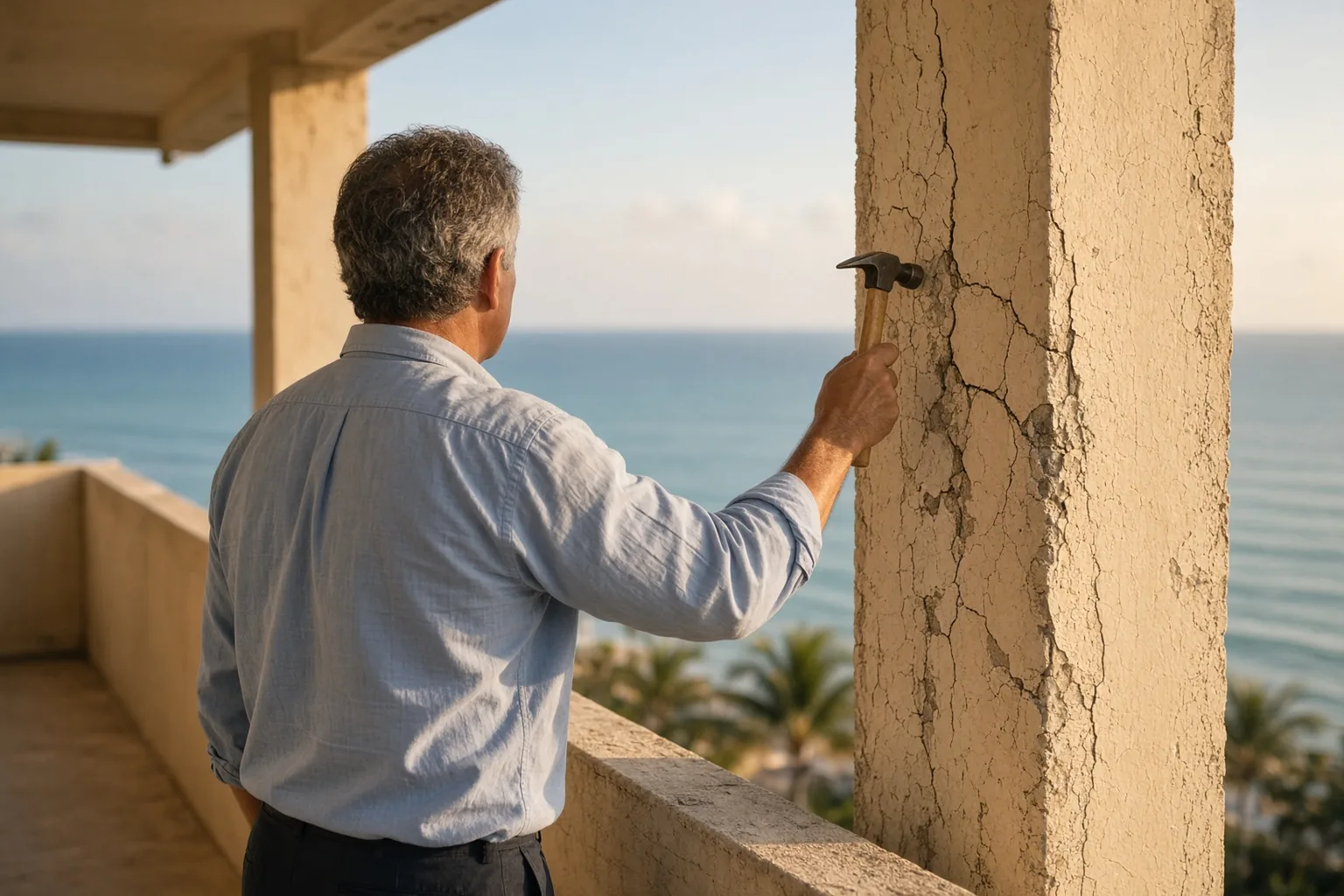
What does a structural engineer expert do in a condominium case?
The engineer decides whether the structure has a defect or deterioration, what caused it and what repair it needs, working from the milestone and reserve study reports, the construction documents and the engineer's own inspection and tests.
One group of structural claims rests on the statutory warranties. Under section 718.203, the developer is deemed to grant each unit purchaser implied warranties of fitness and merchantability, including for the roof and structural components. Contractors, subcontractors and suppliers grant implied warranties of fitness to the developer and to unit purchasers. A second group of disputes follows the milestone inspection: the report recommends repairs, local ordinances set the time to start them, and the association has to fund them.
In each dispute the engineer answers three questions: what is wrong with the structure, why, and what the repair takes. Other experts work from those answers. A cost estimator prices the repair scope the engineer defines. A reserve study under section 718.112 records the condition, useful life and replacement cost of the same components.
Section 718.203(4) conditions the statutory warranties on routine maintenance being performed, unless the developer or a developer-controlled association was responsible for that maintenance. A crack caused by a design or construction error and a crack caused by missed maintenance point to different defendants. The engineer's report has to say which one the building has and on what data.
Which condominium buildings need a milestone inspection, and when?
Buildings three habitable stories or more in height under condominium or cooperative ownership, by December 31 of the year the building turns 30 and every 10 years after that. The local enforcement agency may set 25 years instead.
Chapter 2022-269, Laws of Florida (Senate Bill 4-D), created section 553.899. The Governor approved it on May 26, 2022, and it took effect on becoming law. The section was amended in 2023, 2024 and 2025; the last chapter law in its history note is 2025-175, which came from House Bill 913. The text cited here is the 2026 edition on the Florida Senate website.
A milestone inspection is a structural inspection by an architect or engineer licensed to practice in Florida. It covers load-bearing elements and the primary structural members and systems. Its purpose is to attest to "the life safety and adequacy of the structural components of the building" and, as far as reasonably possible, to determine the general structural condition of the building.
Age runs from the date the certificate of occupancy was issued. If that date is unavailable, the statute uses the date of occupancy shown in any record of the local building official. Based on local circumstances, including proximity to salt water as defined in section 379.101, the local enforcement agency may require the first inspection by December 31 of the year the building reaches 25 years.
Older buildings had transition deadlines. A building that reached 30 years before July 1, 2022 had to complete its first inspection before December 31, 2024. A building that reached 30 years on or after July 1, 2022 and before December 31, 2024 had to complete it before December 31, 2025. The agency may extend the first deadline for good cause when the owner has a contract with an architect or engineer and the inspection cannot reasonably be finished in time.
The section does not apply to single-family, two-family, three-family or four-family dwellings with three or fewer habitable stories above ground. The association pays for the inspection of the parts of the building it maintains.
What do phase one and phase two of the inspection cover?
Phase one is a visual examination of habitable and nonhabitable areas with a qualitative assessment. Phase two follows only if phase one finds substantial structural deterioration, and it may include destructive or nondestructive testing.
The local enforcement agency sends written notice to the association, and the association passes it to the unit owners within 14 days. Phase one must be finished within 180 days after the owner receives that notice. The inspector examines the major structural components and assesses their condition. If no substantial structural deterioration is found, the inspection ends with phase one.
The statute defines substantial structural deterioration as "substantial structural distress or substantial structural weakness" that negatively affects the building's general structural condition and integrity. Surface imperfections such as cracks, sagging or signs of leakage do not qualify unless the engineer or architect determines that they indicate such deterioration. The call belongs to the inspector, and in a lawsuit the other side's engineer checks it against the inspector's photographs, field notes and measurements.
Phase two may involve "destructive or nondestructive testing at the inspector's direction." A licensed architect or engineer performs it. A progress report with a completion timeline is due within 180 days after the phase one report is submitted. Test data come from phase two, because phase one is a visual examination.
What must the milestone inspection report contain?
The inspector's seal and signature, the manner and type of inspection, any substantial structural deterioration with its extent and recommended repairs, unsafe or dangerous conditions, other recommended repairs, and items that need further inspection.
Subsection (8) lists six items. The report must bear the seal and signature, or electronic signature, of the engineer or architect. It must state the manner and type of inspection performed. It must identify any substantial structural deterioration within a reasonable professional probability, describe its extent and recommend repairs. It must state whether unsafe or dangerous conditions, as the Florida Building Code defines them, were observed. It must recommend remedial or preventive repairs for damaged items that do not amount to substantial structural deterioration. And it must identify and describe the items that need further inspection.
The inspector submits the sealed report and a summary to the association, to any owner of non-condominium portions of the building and to the local building official. Within 45 days after receiving them, the association sends the summary to every unit owner, posts it in a conspicuous place on the property and publishes the full report and the summary on its website, if the association is required to have one.
Counties and municipalities must adopt ordinances that require repairs to begin within 365 days after the local enforcement agency receives a phase two report. If the repairs are not shown to be scheduled or underway, the agency must determine whether the building is unsafe for occupancy. The report date and the 365-day period fix what the association knew and when it had to act, and the engineer for either side compares the repair record with those dates.
How does a structural integrity reserve study differ from a milestone inspection?
The milestone inspection asks whether the structure has substantial deterioration and what to repair. The reserve study under section 718.112(2)(g), done every 10 years, prices future maintenance and replacement of listed building components.
Under section 718.112(2)(g), a structural integrity reserve study (SIRS) is required for residential buildings three habitable stories or higher, at least every 10 years after the condominium's creation. An engineer licensed under chapter 471, an architect licensed under chapter 481, or a person certified as a reserve specialist or professional reserve analyst may perform it.
The study covers at least eight groups of items: the roof; the structure, including load-bearing walls and other primary structural members; fireproofing and fire protection systems; plumbing; electrical systems; waterproofing and exterior painting; windows and exterior doors; and any other item with a deferred maintenance or replacement cost above $25,000 or the inflation-adjusted amount set by the state division, whichever is greater.
The study rests on a visual inspection of the condominium property. A milestone inspection performed within the past 5 years that meets the requirements of paragraph (g) can replace that visual portion. Unit-owner-controlled associations that existed on or before July 1, 2022 had to complete the study by December 31, 2025. An association that must complete a milestone inspection by December 31, 2026 may perform both together, and the statute adds: "In no event may the structural integrity reserve study be completed after December 31, 2026."
For a budget adopted on or after December 31, 2024, a unit-owner-controlled association that must obtain the study may not decide to provide no reserves or reduced reserves for those items. Under paragraph (2)(f), after a milestone inspection within the previous 2 calendar years, the board, with approval of a majority of the total voting interests, may pause reserve contributions for no more than two consecutive annual budgets adopted on or before December 31, 2028. If officers or directors willfully and knowingly fail to complete a required study, the statute treats that failure as a breach of their fiduciary relationship to the unit owners.
The milestone report records whether the inspector found substantial structural deterioration. The reserve study records condition, useful life and replacement cost. An opinion on a defect starts from the first; an opinion on what the association should have reserved starts from the second.
What does the developer hand over to the association at turnover?
Under section 718.301(4), the plans and specifications used in construction, certified by affidavit as the actual plans, and turnover inspection reports on the structure and building systems under seal of an architect or engineer.
When owners other than the developer take control of the association, section 718.301(4) lists what the developer delivers. Paragraph (4)(f) requires a copy of the plans and specifications used in the construction or remodeling of improvements. The developer, its agent, or an architect or engineer authorized to practice in Florida certifies in affidavit form that they represent the actual plans used.
Paragraph (4)(p) requires a turnover inspection report in the form of a structural integrity reserve study. It is issued under seal of an architect or engineer authorized to practice in Florida, or by a reserve specialist or professional reserve analyst certified by the Community Associations Institute or the Association of Professional Reserve Analysts. It attests to required maintenance, condition, useful life and replacement costs of the roof, structure, fireproofing and fire protection, plumbing, electrical systems, waterproofing and exterior painting, and windows and exterior doors.
Paragraph (4)(q) requires a separate report, under the same sealing rules, for elevators, heating and cooling systems, pools and spas, seawalls, pavement and parking areas, drainage systems and irrigation systems. Paragraph (4)(s) adds a copy of the association's most recent structural integrity reserve study.
These reports record the condition of the building on the date control passed to the owners. An engineer for the association compares them with later milestone findings. An engineer for the developer reads them for what was disclosed at turnover.
How long do the statutory warranties on the structure last?
The developer's warranty on the roof, structural components and mechanical, electrical and plumbing elements runs 3 years after completion, or 1 year after owners take control of the association if later, capped at 5 years.
Paragraph 718.203(1)(e) covers the roof and structural components of a building and the mechanical, electrical and plumbing elements serving it, except mechanical elements serving only one unit. The period begins with the completion of construction of each building or improvement. It continues for 3 years, or 1 year after owners other than the developer obtain control of the association, whichever occurs last, and "in no event more than 5 years." A unit carries its own 3-year warranty, which starts with completion of the building that contains it.
Contractors, subcontractors and suppliers give the developer and each unit purchaser implied warranties of fitness under subsection (2). For the roof, structural components and certain mechanical and plumbing elements the period is 3 years after completion of construction of the building or improvement. For all other improvements and materials it is 1 year after completion of all construction. The warranties inure to the benefit of each owner and successor owners.
A defect claim within these periods needs the date the condition first appeared and proof that separates a construction defect from a maintenance failure. The turnover reports, the milestone reports and the association's maintenance records are where the engineer finds those dates.
Can the milestone inspector bid on the repairs it recommends?
Yes, with a written disclosure. An architect or engineer bidding on the milestone inspection must tell the association in writing that it intends to bid on the repair work the inspection may recommend.
Chapter 2025-175 added subsection (12) to section 553.899. The architect or engineer who bids on the inspection discloses in writing to the association any intent to bid on maintenance, repair or replacement services the inspection may recommend. A design professional or licensed contractor bidding on those services may not have a direct or indirect interest in the inspecting firm, or be a relative of a person with such an interest, unless the relationship is disclosed in writing. The rule reaches relatives within the third degree, and a contract made without the disclosure is voidable.
Section 553.899 says nothing about the inspector later serving as a retained expert. In a lawsuit over the repairs the inspector's report, field notes and photographs record what was seen on the inspection dates, and the inspector can be deposed about them as a witness of fact.
A retained expert's prior work for the association, the developer, the contractor or the inspecting firm is a question at deposition. In federal court, the report of a retained expert lists the cases in which the expert testified in the previous 4 years and the publications of the previous 10 years under Rule 26(a)(2)(B). Florida state courts apply their own disclosure rules.
What does a Florida court require of the engineer's opinion?
Section 90.702 admits opinion testimony from a witness qualified by knowledge, skill, experience, training or education if it rests on sufficient facts or data and reliable methods, and the methods are reliably applied to the case.
The three conditions of section 90.702 read: "(1) The testimony is based upon sufficient facts or data; (2) The testimony is the product of reliable principles and methods; and (3) The witness has applied the principles and methods reliably to the facts of the case." The current federal Rule 702 lists the same conditions and requires the proponent to show the court that it is more likely than not that each one is met.
In a condominium case the first condition depends on the record the engineer used. An opinion based on a walk-through, without the phase two data, the turnover reports or the plans and specifications, gives the other side grounds to argue that the facts or data were insufficient. The second and third conditions depend on the method: how the engineer chose the areas to open and test, and whether the same procedure was applied across the building before the results were extended to areas that were not opened.
What happens before an association sues over a structural defect?
Chapter 558 requires a written notice of claim describing each defect in reasonable detail, served at least 120 days before suit when the association represents more than 20 parcels, followed by an inspection and a written response.
Under section 558.004 the claimant serves the notice at least 60 days before filing an action, or at least 120 days before an action involving an association representing more than 20 parcels. The notice describes in reasonable detail the nature of each alleged construction defect and, if known, the resulting damage or loss.
The recipient may inspect within 30 days after service, or within 50 days for such an association, to assess each alleged defect. Destructive testing takes place only by mutual agreement. If the claimant objects to the person chosen to perform it, the recipient provides a list of three qualified persons and the claimant picks one. The written response is due within 45 days, or 75 days for such an association. It offers to repair, to pay, or both, disputes the claim, or states that the insurer will decide on payment within 30 days.
On request, the parties exchange documents, including design plans, specifications and as-built plans, photographs and videos, subcontracts, purchase orders, maintenance records and "expert reports that describe any defect upon which the claim is made." Service of the notice tolls the statute of limitations as to persons covered by the chapter. The association's engineer can describe the defects for the notice; the recipient's engineer attends the inspection and any agreed destructive testing.
How does IAE find a structural engineer for a condominium case?
In the request choose the case type Construction and write structural engineering in the field line. Within 5 business days IAE sends 2-3 candidates with CVs, hourly rates and lists of prior testimony.
The construction expert witness page lists seven specialties, structural engineering among them, and states that structural engineers review cracked slabs, beam deflection, settlement and Florida condominium milestone inspections under section 553.899. The request form asks for the field, the case type, the state and court, the firm's side, the expert disclosure deadline and the parties with their counsel. In the short description, name the building, its number of stories and its age, the documents in hand (milestone report with phase one or phase two, reserve study, turnover reports) and the question: defect, cause, repair scope or maintenance. The form asks not to include privileged or sealed information.
Within 1 business day IAE replies whether it can search in that field by the deadline. Each candidate confirms in writing that he or she has no ties to the parties or their counsel. In a condominium case that list can include the association, the developer, the general contractor, subcontractors, the design professionals and the firm that performed the milestone inspection.
Within 5 business days the firm receives 2-3 candidates with CVs, hourly rates, testimony in the last 4 years and publications in the last 10 years. Candidate names and CVs come after the $2,000 search fee is paid in advance. If no candidate fits, the second search is free, and if IAE finds no candidates, it refunds the fee. The expert bills the firm directly or through IAE under the agency option for hours at the expert's rate plus $100 per hour, for fixed fees, minimum charges and surcharges plus 40%, and for expenses at cost, which credits the search fee to the first invoice. The expert's hourly rate never depends on the outcome of the case or on the content of testimony.
IAE is not a law firm. Case strategy and the decision to retain an expert stay with the attorney.
Sources
- Fla. Stat. 553.899, Mandatory structural inspections for condominium and cooperative buildings (Florida Senate, 2026 edition)
- Fla. Stat. 718.112, Bylaws, paragraph (2)(g), structural integrity reserve study (Florida Senate, 2026 edition)
- Fla. Stat. 718.301, Transfer of association control (Florida Senate, 2026 edition)
- Fla. Stat. 718.203, Warranties (Florida Senate, 2026 edition)
- Fla. Stat. 90.702, Testimony by experts (Florida Senate, 2026 edition)
- Fla. Stat. 558.004, Notice and opportunity to repair (Florida Senate, 2026 edition)
- Chapter 2022-269, Laws of Florida (SB 4-D)
- Chapter 2025-175, Laws of Florida (CS/HB 913)
- Federal Rule of Civil Procedure 26 (LII)
- Federal Rule of Evidence 702 (LII)
Read also
All articles
Spearin doctrine: when does the owner bear the cost of defective plans and specifications, and what does the contractor's expert have to prove?
Under the Spearin doctrine, an owner who gives the contractor plans and specifications impliedly warrants that work built to them will be adequate Sergei Voronin

Differing site conditions claim: what must the contractor prove, and which experts carry the proof?
A differing site conditions claim asks the owner to pay for ground the contract did not describe. On federal projects the clause is FAR 52.236-2Sergei Voronin
SB 800 construction defect claims in California: which standards apply, what comes before a lawsuit and what must the expert prove?
SB 800, enacted in 2002, governs construction defect claims against builders of new homes in California. Civil Code section 896 lists buildingSergei VoroninExpert witnesses
Need an expert witness for your case?
Describe the question, the case type and the court. Within 5 business days you receive 2-3 candidates with CVs, hourly rates and lists of prior testimony.
