
Examinations
Tire impression evidence: what can tire tracks tell about a vehicle?
A tire impression can narrow a search to a tread design and size, point to a class of vehicles through track width and wheelbase, and, when wear and damage show in the mark, link it to one tire. What an examiner can say depends on how the impression was photographed, cast and measured at the scene and how the suspect vehicle's tires were collected. State crime laboratories in Indiana, California, Colorado and Florida publish these procedures.
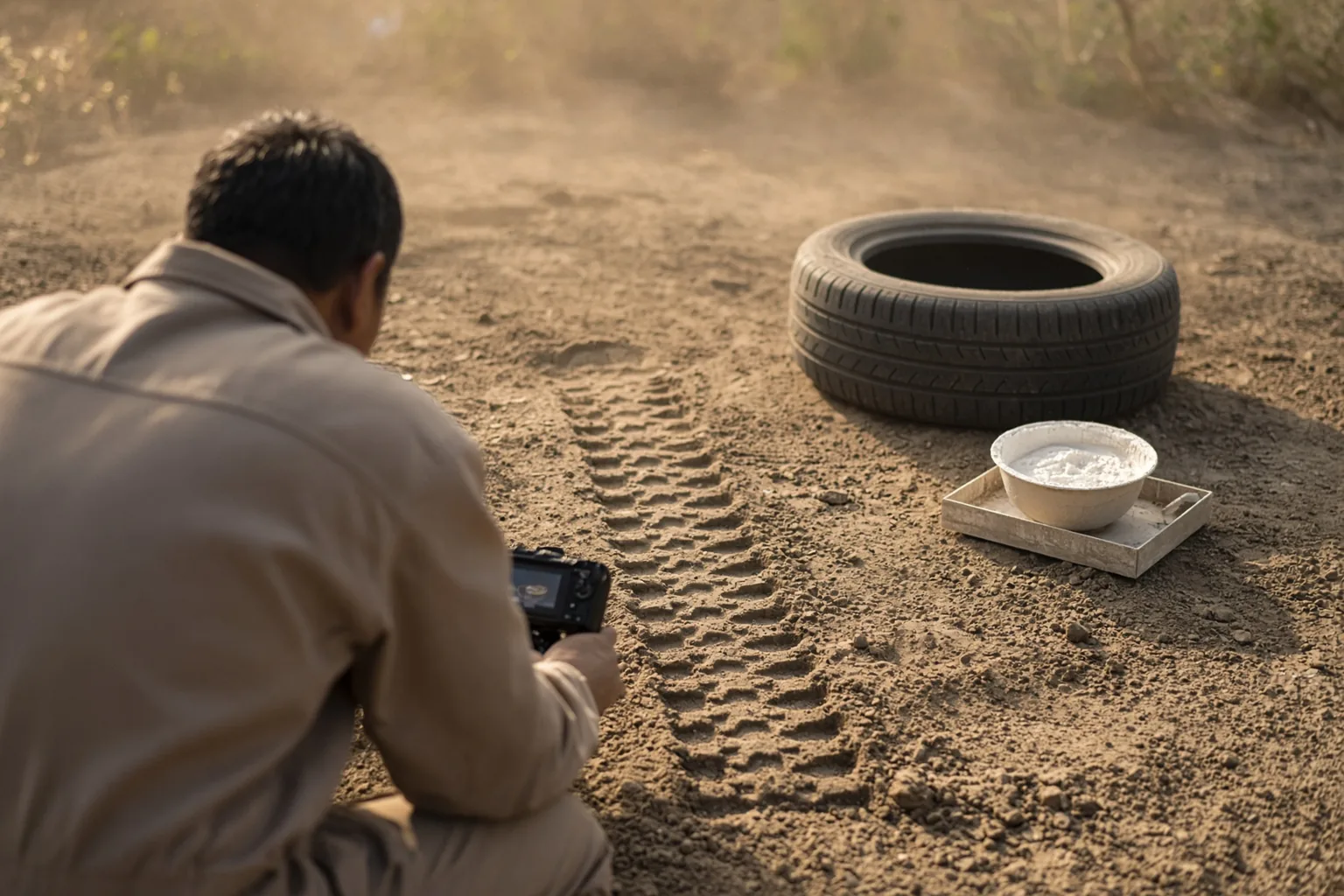
What can a tire impression link to a vehicle?
A tread design and size shared by many tires, a class of vehicles through scene measurements, or one specific tire when the impression carries enough wear and damage. Direction of travel usually cannot be determined.
The Department of Justice's supporting documentation for its proposed uniform language in the footwear and tire discipline describes a comparison in four areas: tread design, tread dimension, wear and randomly acquired characteristics. It defines the last group this way: "The damage and/or items that can be found on outsoles/treads are referred to as randomly acquired characteristics (RACs)." Design and size let examiners "reduce the potential sources of an impression to a class of potential sources."
No count of features decides the matter. The same document states that "there is no consensus regarding the number of individual characteristics needed to make a positive identification" and that "The discipline has no defined threshold or number of individual characteristics."
Laboratory reports use fixed wording. The Indiana State Police Physical Evidence Bulletin PEB-12 lists results that include an identification (the impression "was made by that specific shoe/tire"), agreement in class characteristics only (it "could not be positively identified to the submitted shoe/tire"), and a make-and-model result stating that the impression is "consistent with having been made by the tread design" of a named tire.
Some questions fall outside the comparison. The Florida Department of Law Enforcement answers the question about direction of travel this way: "In most circumstances this information is not able to be determined through the examination process." A tire comparison addresses the source of the mark. Who drove the vehicle, and when, has to be proved by other evidence.
How should a tire impression be photographed at the scene?
From directly overhead on a tripod, in overlapping sections, with a tape measure along the track and a flat scale on the same plane as the impression, covering about one full turn of the tire.
The Indiana bulletin, version 12 of October 20, 2025, gives the field method: "For long continuous tire impressions, place a tape measure along the length of the impression." Photographs overlap "for at least eight feet" ("approximately the full circumference of most tires") with an overlap of "approximately 2 inches." "The small scale should be on the same plane as the impression," and "Comparison quality photographs should be taken from directly overhead using a tripod," at f/11 or f/16, with images kept uncompressed or losslessly compressed.
The California Department of Justice, Bureau of Forensic Services, revised its bulletin PEB 23 on June 29, 2026. It recommends that each image capture "no more than 18 inches of length," with an overlap of about 1 inch, and that the tape measure "should not be moved until the entire series of images are captured." A thin rigid scale lies along the impression on the plane of its bottom, and that scale, not the tape, is used to size the image 1:1.
Colorado's submission guidelines add equipment limits. Scales must be at least 300 mm long and completely flat: "Never use hinged or curved scales." Images need at least 300 ppi, with 600 ppi in RAW or TIFF preferred, and photos taken on phones are not comparison quality. Wide photographs show where each labeled impression lies at the scene.
A missing scale costs the comparison its measurements. One of the Indiana results states that the size "was unable to be compared" because of "the lack of a scale present in the photographs."
When is a tire impression cast or lifted?
When it is three-dimensional, in soil, mud, sand or snow, or when a residue mark can be lifted. Photographs come first, because casting and lifting can destroy the impression and usually give one chance.
California's bulletin states that photography "is not a substitute for casting or lifting of footwear and tire impressions." Dental stone is the casting material; casts about 3 feet (0.91 m) long are "optimal for examination," and adjacent segments can cover the whole circumference. The bulletin gives a scale for that work: "One common tire size, 225/60/16, has a circumference of approximately 7 ft (2.13 m)." "Shorter segments may also be of value."
Indiana names the same material and adds a prohibition: "Dental Stone (Do not use Plaster of Paris.)" Dust impressions on hard surfaces "can be recovered using an electrostatic dust lifter, a tape lift, or gel lift," and evidence goes in paper or cardboard, never plastic.
The OSAC Footwear and Tire Subcommittee recorded the limits of current methods in a research need approved on October 24, 2022: recovery consists of "two-dimensional DSLR photography and casting or lifting," these methods are "highly dependent on the crime scene technician's expertise," and "these processes can be destructive so there is normally only one opportunity to capture the impression."
Colorado asks agencies to submit both the photographs taken before collection and the casts or lifts, and not to clean casts: the analyst cleans them at the laboratory. A page of the American Society of Trace Evidence Examiners contributed by Lesley Hammer describes the same order: tire impressions are photographed in overlapping sections because of their length, photographs are taken before other collection techniques are applied, and three-dimensional impressions are cast with dental stone.
Which scene measurements point to a type of vehicle?
Track width, wheelbase and turning diameter. California's state laboratory asks investigators to take them before examination-quality photographs, because track width and wheelbase can be searched to list vehicles that may have left the impressions.
PEB 23 states: "Measurements of vehicle track width, turning diameter, and wheelbase of tire impressions should be collected prior to examination quality photography." It defines the first two. Track width is "the distance between the center of the tire mounted on one side of the vehicle and the center of the tire mounted on the opposite side of the vehicle." In practice it is measured between the outside edge of the left impression and the inside edge of the right one, and "The front and rear track width measurements may be different."
Wheelbase is "the distance between the center of the front axle and the center of the rear axle," measured in practice between the leading edges of the front and rear tire impressions. The bulletin explains the use: "Crime scene measurements of the vehicle track width and/or wheelbase may be searched to provide a list of vehicles which may have left the tire impressions."
The result is a list of models, not a vehicle. Many models share the same track width and wheelbase, so these figures narrow an investigation and can exclude a vehicle whose measurements differ; they do not identify one car.
Measurements and tread drawings have a long history in this field. P. McDonald's 239-page guide Tire Imprint Evidence, published in 1989 and abstracted by the National Criminal Justice Reference Service, covers measurements, tread drawings and trial preparation.
Can the lab name the tire without a suspect vehicle?
It can search for one. Colorado's laboratory runs make and model searches against tread design databases for an investigative lead, but some impressions lack detail and some tires are not in the databases.
The Colorado Bureau of Investigation asks agencies to submit all questioned tire impression evidence for a make and model search even before a known tire has been identified. The analyst uses available databases or resources to attempt to identify a make and model and to provide an investigative lead. Two limits are stated: some impressions do not carry enough detail for a search, and some tires are not in the databases.
A failed search does not end the use of the impression. The same guidelines say the impression can still be compared once a known tire is found.
The Florida Department of Law Enforcement submission FAQ says impressions "can also be compared against laboratory references" when no known tires have been submitted. Indiana reports a successful search with its make-and-model result, naming the tread design the impression is consistent with.
For the defense, a make and model result is a class statement: every tire of that design and size shares it. Counsel asks which databases were searched and whether the result names one design or several.
What do labs need from the suspect vehicle?
The vehicle or its tires on the rims, plus full-circumference test impressions made while the tires are mounted, with each tire's position, direction of rotation, brand, model, size and DOT number recorded.
Florida's FAQ ranks the options: "The entire vehicle can be submitted for comparison and is the preferred standard for comparison." Tires on their rims are "the next best option," and test impressions are used when the tires themselves cannot be collected. FDLE prefers black ink on a transparent medium and asks that "brand, model, size, DOT number" be written on the standards. Photographing a tire "limits the comparison but may be helpful in eliminating a tire."
California keeps the tires mounted so that "position, wear, and load duplicate the conditions at the time the evidence impression was produced." Dual tires are printed together. The person making the print marks the sidewall into four or more sections, coats the tread with petroleum jelly, rolls the vehicle slowly over drafting film or lab paper, develops the print with magnetic powder and labels it with the wheel position, make, model, size, DOT number and rolling direction.
Colorado's tire exemplar procedure, last edited March 24, 2025, covers "the entire 6- to 8-foot circumference of all five tires," spare included, on a smooth floor, because "The texture of blacktop or porous concrete will transfer to the known impression." Embedded rocks, nails and debris stay in the tread, and the tread wear indicator bars are lettered on the sidewall.
Prints alone rarely carry the top conclusion. Colorado states that an identification "rarely can be made without submitting the physical known tire," and Indiana warns that "Not submitting the tires or photographs of the tires will limit the analyst's examination and conclusions."
Why does the time between the incident and the seizure matter?
Tires keep wearing and picking up damage after the incident. California asks that known tires be collected as soon as possible and lists the time passed after the event among the limits of any comparison.
PEB 23 says known tires "should be collected as soon after the incident as possible" and states the limits of every comparison: "The evidentiary value of a comparison depends upon the quality of the impression, the manner in which it is documented, the length of time passed after the event, and the collection method of the known shoes, tires, or objects."
The DOJ supporting documentation explains why. With use, "frictional and abrasive forces begin to create wear on the outsole/tread surface," and randomly acquired characteristics appear "by happenstance." A cut acquired after the incident appears on the known tire and not in the scene impression; a feature in the impression may be worn away by the time the tire is printed.
Indiana lists the opposite problem among its inconclusive results: the comparison may fail because of "the lack of wear and identifying characteristics on the submitted shoe/tire."
Tires also move. If they were removed before the arrest, Colorado asks that they be remounted on the suspect vehicle or a similar one and that their original positions be documented. Shop invoices for purchase, rotation or replacement tell the parties whether the tire printed after the seizure was on that wheel on the day of the incident.
Why do labs ask for the tires of police and rescue vehicles?
Patrol cars, ambulances and tow trucks may reach the scene before the impressions are recorded. Indiana's laboratory asks for elimination exemplars whenever the impressions could come from officers or first responders.
PEB-12 states that "elimination exemplars of the shoes or tires should be submitted" when the impressions "could contain footwear/tire impressions from officers or first responders." Without them, a track that belongs to a responding vehicle can be compared with the suspect's tires as if it came from the offender.
An exclusion needs less than an identification. Colorado accepts photographs for a spare that does not resemble any questioned impression: "photograph the tire sidewall and tread design with a scale for exclusionary purposes." Florida likewise says a photograph "may be helpful in eliminating a tire."
The wide scene photographs Colorado requires show which vehicles were present and where. Counsel can compare them with the list of impressions submitted to the laboratory and ask which responding vehicles were excluded and by what method.
What questions should counsel put to the tire examiner?
Which features carry the conclusion, how the scene impression and the known tires were recorded, whether the physical tires were examined, and how the conclusion is worded. Federal Rule 702 requires sufficient facts and a reliable application.
Under Rule 702 of the Federal Rules of Evidence the proponent must show the court that it is more likely than not that "the testimony is based on sufficient facts or data" and that the opinion applies reliable principles and methods reliably to the facts of the case. Under Rule 703 an expert may base an opinion on facts or data that experts in the field "would reasonably rely on." The laboratory procedures above are the field's own description of those facts.
The material comes through discovery. In federal criminal cases Rule 16(a)(1)(E) lets the defendant inspect and copy "photographs, tangible objects" in the government's possession that are material to the defense or were obtained from the defendant, which includes the seized tires. Rule 16(a)(1)(F) covers "the results or reports of any physical or mental examination and of any scientific test or experiment." If the defendant requested those reports and the government complied, Rule 16(b)(1)(B) requires the defense to let the government inspect its own test reports that it intends to use at trial or that relate to the testimony of a defense witness who prepared them.
The DOJ's proposed uniform language for the footwear and tire discipline listed statements an examiner may not make: that the tire is the only possible source, since not all tires have been examined; any numerical error rate; and any numerical probability for the opinion, for which the document says reliable data or statistical models do not exist. Questions built on the procedures above include:
- Which tread design, dimension, wear and randomly acquired characteristics did you record in the scene impression?
- Was the impression photographed from directly overhead, with a flat scale on its plane, over a full circumference?
- Did you examine the physical tires, or only test impressions or photographs?
- Were the test impressions made with the tires mounted, and are wheel position and rolling direction recorded?
- How much time passed between the incident and the collection of the tires, and were they rotated or replaced?
- Were the vehicles of officers and first responders excluded?
- Does the report say that other tires with the same class characteristics could have made the impression?
What does IAE do in a case with tire impression evidence?
An IAE examiner prepares an expert report on the client's questions or a review of the opposing examiner's report, in up to 5 business days. Each question is tied to the ANSI/ASB standard for that kind of mark.
The IAE trace evidence page addresses whether a shoe, tire or tool could have left the mark, how strong the association is and whether a lock or seal was defeated, for criminal defense and cargo loss cases in US courts. For tire tracks the examiner compares tread design, width and damage in the track with the suspect tires; the page cites ANSI/ASB Best Practice Recommendations 052 (2022) and 049 (2020) for collection and lifting, and ANSI/ASB Standard 137 (2023) for footwear and tire examination.
The client sends the report, photographs and case materials and describes the task. The secretariat confirms receipt the same day and, within one business day, the format, cost, deadline and the examiner from the registry; the client approves the candidate and the CV before work starts. For tight deadlines there is a 48-hour rush.
Examiners are listed in the public IAE registry and can be verified by Member ID or QR code. The examiner confirms in the document that he or she has no interest in the outcome. IAE is not a law firm and does not advise on defense strategy, and neither IAE nor the examiner guarantees how the court will rule.
Sources
- Indiana State Police, Forensic Services Division, Physical Evidence Bulletin PEB-12, Shoe and Tire Impressions (version 12, October 20, 2025)
- California Department of Justice, Bureau of Forensic Services, Physical Evidence Bulletin PEB 23, Impression Evidence (rev. June 29, 2026)
- Colorado Bureau of Investigation, Forensic Services, Tire Exemplar Collection (last edited March 24, 2025)
- Colorado Bureau of Investigation, Footwear and Tire Track Impression Submission Guidelines
- Florida Department of Law Enforcement, Forensic Submission FAQ, Footwear and Tire (Impression Evidence)
- U.S. Department of Justice, Proposed Uniform Language for Testimony and Reports for the Forensic Footwear and Tire Impression Discipline (archived)
- U.S. Department of Justice, Supporting Documentation for the Proposed Uniform Language for the Forensic Footwear and Tire Impression Discipline (archived)
- OSAC Footwear and Tire Subcommittee, Development, Testing and Validation of 3D Imaging Technologies for Footwear and Tire Impression Evidence (version 2, approved October 24, 2022)
- American Society of Trace Evidence Examiners, Footwear and Tire Impression Crime Scene Recovery (contributed by Lesley Hammer)
- National Criminal Justice Reference Service, abstract of P. McDonald, Tire Imprint Evidence (1989)
- Federal Rules of Evidence, Rule 702 (LII, Cornell Law School)
- Federal Rules of Evidence, Rule 703 (LII, Cornell Law School)
- Federal Rules of Criminal Procedure, Rule 16 (LII, Cornell Law School)
Read also
All articles

Was the window broken from inside or outside? How does a glass fracture examination answer, and how far can the answer be trusted?
After a reported burglary, a shooting or a fire, one broken pane can decide which account is true: forced entry or a staged scene, a shot fired into Sergei Voronin
No signs of forced entry: how is a door, lock or window examined after a reported burglary?
Some commercial burglary policies pay only for entry by force that leaves visible marks, and police reports often carry the line "no signs of forcedSergei Voronin
Safe burglary: how does an examiner tell whether a safe was forced, drilled or opened with the combination?
An examination of a safe after a theft answers how it was opened: by force on the door or body, by drilling, or with the combination or keySergei VoroninExpert examinations
Ready to discuss your case?
Send the materials: the secretariat will confirm the format, cost, deadline and the specialist within one business day.
