
Examinations
Toolmark expert witness: what can an examiner say about a pry bar or screwdriver mark?
A pry bar or screwdriver forced into a door frame or window sash can leave a mark that a laboratory compares with test marks made by a seized tool. Under the Department of Justice uniform language in force since August 16, 2023, a DOJ examiner reports one of three conclusions and may not claim uniqueness, a zero error rate or 100 percent certainty.
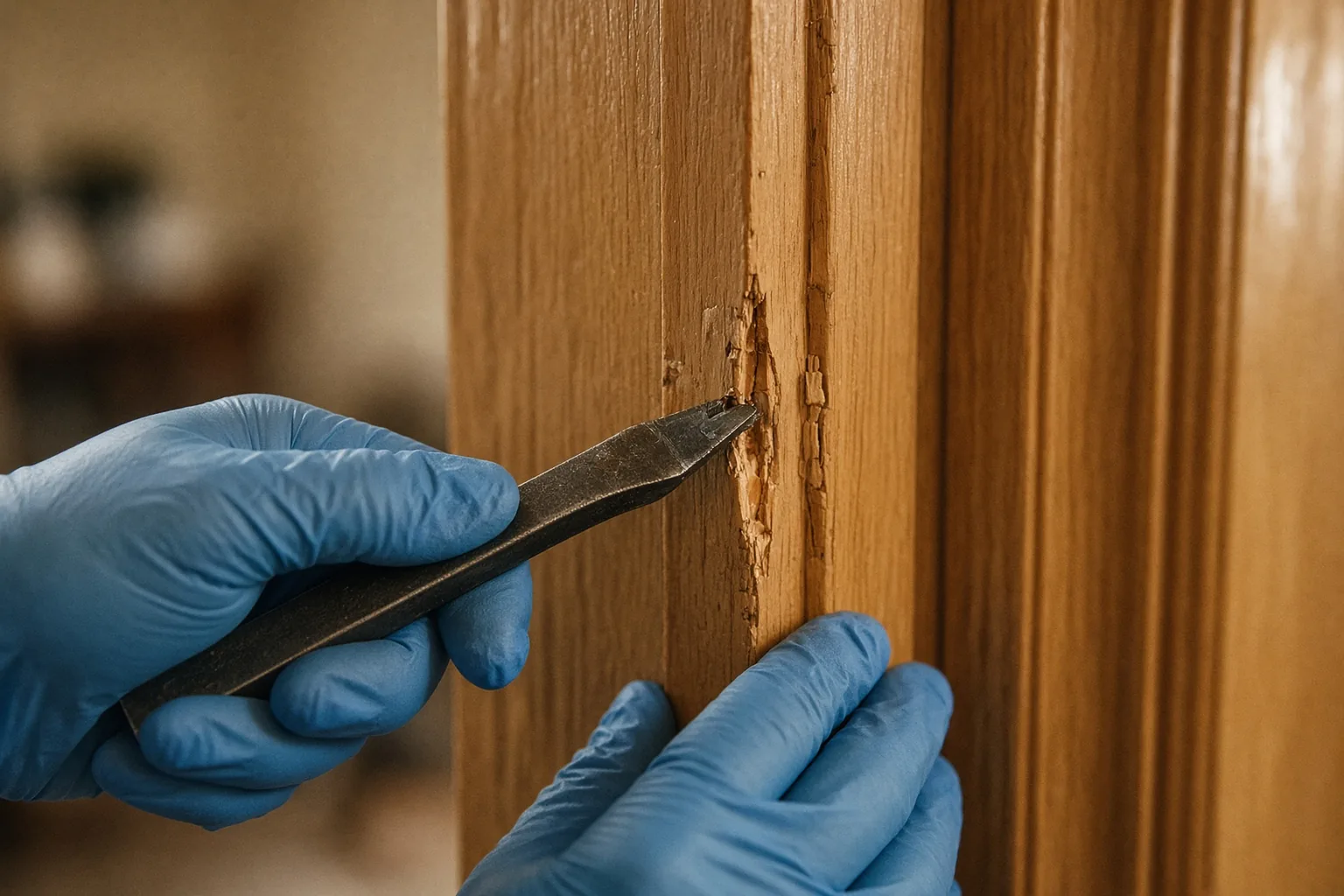
What does a toolmark examiner compare in a burglary case?
The mark left at the scene, or a cast of it, with test marks made by a seized tool. NIST names screwdrivers, pry bars and bolt cutters among the tools whose marks are compared this way.
The National Institute of Standards and Technology describes the discipline on its firearms and toolmarks research page, starting from fired bullets and cartridge cases: "A similar comparison is performed for marks left by other tools, such as screwdrivers, pry bars, and bolt cutters." NIST states the goal of its program as building "a scientific infrastructure for objective forensic firearm and toolmark analysis" with an evaluation of uncertainty that would quantify the strength of the evidence for testimony in court.
In a burglary the questioned marks sit on the point of entry: a door frame, a window sash, a lock housing, a padlock shackle, a cut wire or cable. Nicholas Petraco and Nicholas D. K. Petraco reproduce a burglary review sheet in their chapter on impression evidence in the Forensic Science Handbook, Volume II (CRC Press, 2016). Among the items sent to the laboratory it lists a "pry bar found by window" together with a silicone cast of the tool mark on the window.
The examiner answers three questions in sequence. Was the damage made by a tool at all? What kind of tool could have made it, judged by width, shape and the pattern of the mark? Can the seized tool be included or excluded as the source? The Petraco procedure for tool marks lists the features to record as "class characteristics, subclass, wear patterns, and individual or accidental characteristics" and then requires a decision on whether the known tool can be included or excluded.
How are toolmarks at the scene documented and cast?
With photographs of the whole object, intermediate views, close-ups and macro images, with a scale in the field of view, and then a cast. The Petraco procedure names Mikrosil silicone for questioned marks and test marks.
The tool mark procedure in the Petraco chapter calls for photographs of the whole object, intermediate views, close-ups and macro images when necessary, says that a NIST-traceable scale can be placed in the field of view, and asks that comparative examinations be performed on a one-to-one scale when possible. On casting it states: "Cast of both questioned and known test tool marks can be made with Mikrosil® silicone casting material." The burglary review sheet in the same chapter records a tool mark cast taken from a window with Mikrosil.
In the burglary on that sheet the cast of the mark on the window went to the laboratory together with the pry bar found by the window. A lock cylinder or a cut padlock shackle can be sent to the laboratory itself.
The photographs and the cast are the record that every later examiner works from. A second examiner retained by the defense or by another party sees the mark only through them, unless the original object was kept.
Which features of a mark point to a type of tool, and which to one tool?
Class characteristics, such as the width and shape of a blade, narrow the type of tool. Subclass features come from manufacture and can be shared by several tools. Individual features come from use, wear and damage.
Class characteristics put a tool in a group: a flat-blade screwdriver of a given width, a pry bar with a given tip profile, a cutter with a given jaw shape. Agreement at this level means the seized tool belongs to the group that could have made the mark. Disagreement at this level can exclude the tool: under the DOJ uniform language a source exclusion can rest on class characteristics, individual characteristics or both.
A paper by R. Grzybowski, J. Miller, B. Moran, J. Murdock, R. Nichols and R. Thompson, then with the Bureau of Alcohol, Tobacco, Firearms and Explosives and the Sacramento County District Attorney's laboratory, defines them as "discernible surface features of an object which are more restrictive than class characteristics," produced incidental to manufacture and relating to a smaller group source. Because subclass features are shared within such a group, a match on them alone does not point to one tool.
The same paper summarizes earlier studies on non-firearm tools. Burd and Kirk, on screwdrivers, stressed "the need for the examiner to evaluate the manufacturing technique used to produce tool working surfaces." Butcher and Pugh, on bolt cutters, reported that "a toolmark less than 2mm wide increases the possibility of a false match." The width of the questioned mark therefore enters the analysis before any comparison of fine detail.
Individual or accidental characteristics come from grinding, use and damage of the working surface. They are what an examiner relies on for a source identification, and the Petraco procedure records wear patterns as a separate item.
How does the examiner make test marks with a seized pry bar or screwdriver?
On a soft material that records the working surface: lead sheet, modeling wax or clay, or wire for cutting tools. The Petraco chapter shows screwdriver standards made on lead sheet and numbered pry bar test marks in clay.
The Petraco procedure states: "Test tool marks can be made directly on soft lead sheet(s) or pieces of lead sheeting wrapped around pipe(s)." It also lists wire or cable for cutters, modeling wax, modeling clay such as Plastilina, and textiles or leather. The chapter's figures show screwdriver standards being made on a piece of lead sheet, test marks from screwdriver tips in clay, and a pry bar used to make numbered test marks in clay.
The procedure then compares the questioned mark with the test marks by examining both with a stereomicroscope and a comparison microscope. In one of the chapter's cases, a gas explosion homicide, the questioned and known pipe wrench tooth marks were compared on a comparison microscope and shown in superimposed images. A second examiner looks in the file for which test marks were made, on what material and in what positions, and which of them was compared with the questioned mark.
What conclusions may a Department of Justice toolmark examiner report?
Three: source identification, source exclusion and inconclusive. The uniform language document for the firearms/toolmarks discipline, effective August 16, 2023, defines each and applies to DOJ examiners who report or testify on such evidence.
The Uniform Language for Testimony and Reports for the Forensic Firearms/Toolmarks Discipline, Pattern Examination took effect on August 16, 2023, in an update approved on May 18, 2023. It "applies to Department of Justice examiners who are authorized to prepare reports and provide expert witness testimony regarding the forensic pattern examination of firearms/toolmarks evidence," and to reports and testimony based on reports finalized after the effective date.
"Source identification" is "an examiner's conclusion that two toolmarks originated from the same source." It means that all observed class characteristics agree and that the quality and quantity of corresponding individual characteristics is such that the examiner "would not expect to find that same combination of individual characteristics repeated in another source." The document calls it an inductive inference that the probability that the two toolmarks were made by different sources "is so small that it is negligible."
"Source exclusion" is the conclusion "that two toolmarks did not originate from the same source," based on class or individual characteristics. "Inconclusive" means that all observed class characteristics agree but the examiner is unable to identify or exclude. The document gives three reasons for it: microscopic similarity insufficient for an identification, no observed microscopic similarity, or microscopic dissimilarity insufficient for an exclusion.
The document also states the nature of every conclusion: it "is ultimately an examiner's decision and is not based on a statistically-derived or verified measurement or comparison to all other firearms or toolmarks."
Which statements does the Department of Justice bar its toolmark examiners from making?
That a conclusion rests on uniqueness, that the tool made the mark to the exclusion of all other sources, that the discipline has a zero error rate, or that the examiner is 100 percent certain.
Section IV of the 2023 uniform language document lists the limits. A DOJ examiner shall not assert that a source identification or exclusion is based on the "uniqueness" of an item of evidence, shall not use the terms "individualize" or "individualization," and shall not assert that two toolmarks originated from the same source "to the exclusion of all other sources."
The examiner shall not assert that examinations in the discipline "are infallible or have a zero error rate," shall not give a statistic or numerical degree of probability "except when based on relevant and appropriate data," and shall not cite the number of examinations performed in his or her career as a direct measure of the accuracy of a conclusion. That number may be cited to describe qualifications or experience.
The examiner shall not assert that two toolmarks came from the same source "with absolute or 100% certainty," or use "reasonable degree of scientific certainty," "reasonable scientific certainty" or similar expressions, "unless required to do so by a judge or applicable law."
The document applies by its terms to DOJ examiners. In a state burglary prosecution the defense asks which reporting policy the state or county laboratory follows and compares the wording of the report with it.
Is toolmark comparison an objective measurement?
Not yet. NIST states that the comparison of toolmarks "is currently a subjective process that relies on the skill and expertise of the examiner." The AFTE theory of identification also calls the interpretation subjective.
NIST writes that the field is moving away from comparison microscopes and toward the acquisition and comparison of three-dimensional toolmark topography images. Its own work covers standards and reference artifacts for measurement quality assurance, research and reference databases of toolmarks, objective metrics and algorithms for evaluating similarity, and statistical models to quantify the strength of the evidence.
The Association of Firearm and Tool Mark Examiners states its theory of identification in terms of "sufficient agreement," quoted in the Grzybowski paper: agreement "of a quantity and quality that the likelihood another tool could have made the mark is so remote as to be considered a practical impossibility." Agreement is significant, under the same theory, when it "exceeds the best agreement" observed between toolmarks known to have been produced by different tools. The theory adds that "currently the interpretation of individualization/identification is subjective in nature, founded on scientific principles and based on the examiners training and experience."
Statistical work on screwdrivers exists. The Petraco chapter describes classification of screwdriver striation profiles with a conformal prediction method and writes that such a system "should then produce misidentifications at a rate of about 5%." These are research methods described by the authors; the DOJ document requires that any statistic in a report rest on relevant and appropriate data.
What did the D.C. Court of Appeals say about examiners who testify they have no doubt?
In Williams v. United States (2016) the court affirmed on plain error review, though the examiner had testified that he had no doubt. Judge Easterly's concurrence said D.C. courts must bar such certainty statements.
Williams v. United States, No. 13-CF-1312, was decided by the District of Columbia Court of Appeals on January 21, 2016, before Associate Judges Thompson and Easterly and Senior Judge Nebeker. The firearms examiner testified that the marks were "unique" and "similar to a fingerprint, basically," that "those markings are unique to that gun and that gun only," and that "Item Number 58 fired these three bullets." Asked whether he had any doubt, he answered "[n]o sir." Defense counsel did not object.
Because there was no objection, the court reviewed only for plain error. It found no binding precedent that barred such testimony. In Ricardo Jones v. United States (2011) the court had only assumed, on the government's representation that it did not present such testimony as a matter of policy, that examiners should not testify they are "100% certain of a match." In Williams the government conceded that it had violated its own policy of eliciting opinions only "to a reasonable degree of scientific certainty," and the court noted that an internal policy is not binding law.
Judge Easterly concurred. Relying on the National Research Council reports of 2008 and 2009, she wrote that "a certainty statement regarding toolmark pattern matching has the same probative value as the vision of a psychic" and that "the District of Columbia courts must bar the admission of these certainty statements."
A federal trial court in New York limited the wording for a firearm. In United States v. Shipp, No. 19-CR-029 (E.D.N.Y.), Judge Nicholas G. Garaufis ruled on November 26, 2019 that the examiner may testify that the toolmarks on the recovered bullet fragment and shell casing are consistent with having been fired from the recovered firearm and that the firearm cannot be excluded as their source. He may not testify "to any degree of certainty, that the recovered firearm is the source of the recovered bullet fragment or the recovered shell casing." The court quoted these limits in its order of March 9, 2020 on the motions in limine. Both cases concerned firearms. The DOJ document treats firearms and toolmarks as one discipline, and Judge Easterly's concurrence spoke of "toolmark pattern matching" in general.
What does a toolmark expert retained by the defense or another party do?
Works from the same photographs, casts and test marks and, where the court permits, the tool itself. The expert checks class features first, then the basis for the conclusion, then its wording against the laboratory's policy.
The first request is for the record: the photographs at each distance and magnification, the casts, the test marks and the material they were made on, the examiner's notes and the comparison images. Without them a second examiner can only comment on the wording of the report.
The second step is class. If the class characteristics of the seized tool, such as the shape of the blade or jaws, disagree with the questioned mark, a source exclusion under the DOJ document can rest on that basis alone. If the class features fit, the question becomes whether the agreement in individual features goes beyond what tools of the same make and finish share as subclass marks.
The third step is the conclusion and its wording. Under the 2023 DOJ document a source identification is an examiner's opinion and not a statistically derived measurement, and statements of uniqueness, exclusion of all other sources or 100 percent certainty are barred for DOJ examiners. Williams shows the procedural point: the examiner's certainty testimony went to the jury without objection, and on appeal the court applied the plain error standard.
When the tool is available, the party's expert can make new test marks on soft material under the conditions the court sets and compare them with the cast. The results go into a written report that states what was examined, how, and what follows from it.
What does IAE do in a toolmark case?
IAE prepares an expert report on the client's questions or a review of the opposing examiner's report for criminal defense and cargo loss cases in US courts, in up to 5 business days, with a 48-hour rush.
The trace evidence service answers whether a shoe, tire or tool could have left the mark, how strong the association is, and whether a lock or seal was defeated. Toolmarks on lock cylinders and seals are compared with test marks made by the suspect tool. IAE ties each question to the standard for that kind of mark and confirms the questions with the client before work starts.
The client sends the report or the case materials, such as photographs of the mark, the inspection record and the opposing report, and describes the task. The secretariat confirms receipt the same day. Within one business day IAE confirms the format, the cost, the deadline and the specialist from its registry, and the client approves the candidate and the CV before work starts. The signed PDF is issued in up to 5 business days after the format and cost are confirmed.
Every specialist is a member of the public IAE registry and passed the council's attestation under the published Criteria Matrix. The Member ID in the document or the QR code opens the specialist's category, specialization, attestation date and record status. The specialist confirms in the document that he or she has no interest in the outcome of the case, and materials are not passed to third parties without the client's consent. Neither IAE nor the examiner guarantees the outcome, and IAE is not a law firm.
Sources
- U.S. Department of Justice. Uniform Language for Testimony and Reports for the Forensic Firearms/Toolmarks Discipline, Pattern Examination. Update approved May 18, 2023, effective August 16, 2023
- National Institute of Standards and Technology. Firearms and Toolmarks, Forensic Science Program
- Petraco N., Petraco N. D. K. Impression Evidence: Footwear and Tool Marks Cases from the Crime Scene to the Courtroom (chapter). Forensic Science Handbook, Volume II. CRC Press, 2016
- Grzybowski R., Miller J., Moran B., Murdock J., Nichols R., Thompson R. Firearm/Toolmark Identification: Passing the Reliability Test Under Federal and State Evidentiary Standards (AFTE)
- Williams v. United States, No. 13-CF-1312 (D.C. Court of Appeals, January 21, 2016), reproduced in Open Casebook, Advanced Evidence: Forensic Evidence and Expert Testimony
- United States v. Shipp, No. 19-CR-029 (NGG) (E.D.N.Y.), Memorandum and Order of March 9, 2020, quoting the ruling of November 26, 2019 (govinfo)
Read also
All articles
Was the window broken from inside or outside? How does a glass fracture examination answer, and how far can the answer be trusted?
After a reported burglary, a shooting or a fire, one broken pane can decide which account is true: forced entry or a staged scene, a shot fired into Sergei Voronin
No signs of forced entry: how is a door, lock or window examined after a reported burglary?
Some commercial burglary policies pay only for entry by force that leaves visible marks, and police reports often carry the line "no signs of forcedSergei Voronin
Safe burglary: how does an examiner tell whether a safe was forced, drilled or opened with the combination?
An examination of a safe after a theft answers how it was opened: by force on the door or body, by drilling, or with the combination or keySergei VoroninExpert examinations
Ready to discuss your case?
Send the materials: the secretariat will confirm the format, cost, deadline and the specialist within one business day.
