
Examinations
Trace evidence expert witness: which examiner compares fibers, hair and glass, and which compares shoe prints, tires and toolmarks?
A trace evidence case can need two different examiners. One compares materials: textile fibers, hair, glass, soil, metal. The other compares patterns: shoe prints, tire tracks and toolmarks on doors, locks and seals. The Department of Justice writes separate testimony rules for each discipline, and they allow different conclusions: footwear and toolmark examiners may report a source identification, while hair and fiber examiners may report only that a source is included or excluded.
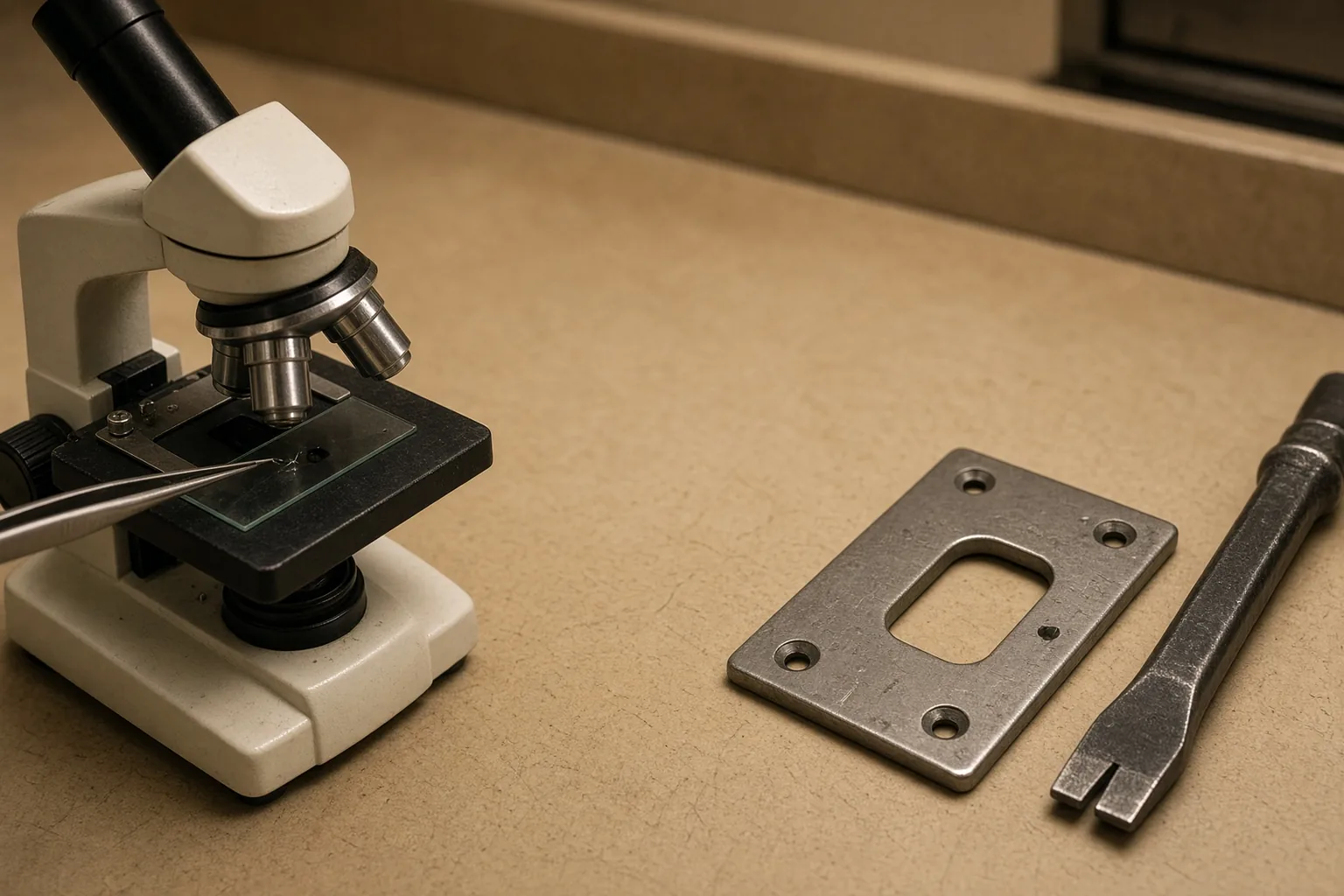
What does a trace evidence expert examine?
It depends on the evidence. Fibers, hair, glass, soil and metal go to one group of examiners; shoe prints, tire tracks and toolmarks go to another. DOJ issues separate testimony rules for each discipline.
The Office of Legal Policy of the U.S. Department of Justice publishes Uniform Language for Testimony and Reports (ULTR), guidance documents "governing the testimony and reports of its forensic experts." The page lists separate documents for textile fiber, hair, glass, geology and metallurgy, and separate ones for footwear, tire, and firearms and toolmarks, with a pattern examination document and a fracture examination document for the last discipline. The page was last updated on March 6, 2024.
The split matters when counsel looks for an expert. A fiber examiner works with a microscope and the optical properties of the fibers. A footwear or toolmark examiner compares the marks in an impression with test impressions or test marks made by the suspect shoe or tool. Each discipline has its own conclusions and its own limits.
Before retaining anyone, counsel lists the items in the case: a cast of a shoe print, a pry bar, a cut seal, a sweater, a broken window. The list decides which examiner, or which two examiners, the case needs.
Which examiner does a case with a shoe print, a tire track or a pry mark need?
A footwear and tire examiner for impressions, and a toolmark examiner for marks a tool left on a door, a lock or a seal. Under DOJ rules both may report a source identification, worded within set limits.
The DOJ footwear ULTR, effective August 15, 2020, lists six conclusions: source identification, inclusion based on class and randomly acquired characteristics, inclusion based on class characteristics, inconclusive, support for exclusion and source exclusion. It defines the first one this way: "'Source identification' is an examiner's conclusion that the known footwear item made the questioned impression." A separate ULTR for tires took effect on the same date.
The same document bars an examiner from claiming that a source identification or exclusion is based on the "uniqueness" of an item, from stating that the known shoe made the impression to the exclusion of all other footwear, and from claiming absolute or 100 percent certainty. Phrases such as "reasonable degree of scientific certainty" are barred unless a judge or applicable law requires them.
Toolmarks fall under the firearms and toolmarks ULTR documents, effective August 16, 2023: one titled Pattern Examination and one titled Fracture Examination.
What can a fiber examiner conclude?
Inclusion, exclusion or inconclusive. Under the DOJ textile fiber ULTR, effective March 1, 2021, an inclusion means the fibers could have come from the same source or from another source with indistinguishable characteristics.
The textile fiber ULTR defines inclusion as "an examiner's conclusion that two or more fibers could have originated from the same source," or from another source with indistinguishable microscopic characteristics and optical properties. Exclusion means that the fibers are excluded as having come from the same source. Inconclusive means that no determination can be reached on whether they could share a source.
The limits are stricter than for shoe prints. A fiber examiner may not state that a questioned fiber has a particular source to the exclusion of all others, may not use the words "individualize" or "individualization," and must explain with any inclusion that the fibers could have come from other sources that cannot be told apart. The examiner may not claim that fiber examinations are infallible or have a zero error rate.
The document adds that the conclusions are the examiner's own judgment and are not based on a statistical comparison against all other fibers. Statistics or numerical probabilities are allowed only when they rest on relevant and appropriate data.
What can a hair examiner conclude, and what went wrong with hair testimony?
Only that a known sample can or cannot be included as a possible source, or that no determination is possible. The DOJ hair ULTR states that forensic hair examination is not a basis for source identification.
The hair ULTR, effective March 1, 2021, permits three conclusions. A known sample "can be included as a possible source of the questioned hair" when all assessed characteristics appear in it with no exclusionary differences. It "cannot be included as a possible source" when the characteristics are absent. The result is inconclusive when the hair shows both similarities and differences or is of limited value for comparison. Any inclusion must explain that the hair could also have come from other sources, and the document states: "Forensic hair examination is not a basis for source identification."
Past FBI hair testimony was reviewed before the current document took effect. On April 20, 2015, the Department of Justice, the FBI, the Innocence Project and the National Association of Criminal Defense Lawyers reported that of 268 cases in which FBI examiners' testimony was used to inculpate a defendant at trial, 257, or 96 percent, contained erroneous statements. Twenty-six of 28 examiners had given testimony or reports with such statements. In at least 35 cases the defendant was sentenced to death, and errors were found in 33 of them.
FBI official Amy Hess said in the release that "such statements are no longer being made by the FBI." For a defense lawyer with an old conviction that rests on hair testimony, the release and the current ULTR give two fixed points for comparing what the examiner said with what an examiner may say today.
What can a glass examiner conclude?
Physical fit, inclusion, exclusion or inconclusive. Physical fit means the fragments were once part of the same broken object, and it may be reported only when the pieces actually fit together.
The glass ULTR was updated on February 8, 2024 and took effect on May 8, 2024. It defines physical fit as "an examiner's conclusion that two or more glass fragments were once part of the same broken glass object." An inclusion means the fragments "could have originated from the same broken glass source" or from another source with indistinguishable characteristics. An exclusion rests on differences in physical properties, refractive index or elemental composition.
The document notes that an inclusion may be reached with or without elemental composition data, and that the chance of coincidental indistinguishability is significantly higher without it. A report that includes a fragment from a suspect's jacket as possibly coming from a broken window, without elemental analysis, rests on the weaker of the two bases the ULTR describes.
Physical fit carries its own limits. The examiner may not base it on uniqueness, may not call it individualization and may not state that the fragments belonged to one object to the exclusion of all other broken glass.
Why may a footwear examiner report a source identification when a hair examiner may not?
Because DOJ wrote the rules discipline by discipline. The footwear and toolmark documents include source identification; the hair, fiber and glass documents stop at inclusion, with physical fit as the glass exception.
The footwear ULTR names randomly acquired characteristics, next to class characteristics, as a basis for its conclusions. The hair document, by contrast, states outright that hair examination is not a basis for source identification, and the fiber document requires every inclusion to admit other indistinguishable sources.
For counsel, the difference sets the questions for cross-examination and for a defense review. A footwear report that claims a source identification is checked against the six conclusions and the wording limits of its ULTR. A fiber report that goes beyond inclusion has already left the limits its own discipline sets.
The 2023 committee note to Rule 702 of the Federal Rules of Evidence applies to all of them: forensic experts "should avoid assertions of absolute or one hundred percent certainty" when the methodology is subjective and potentially subject to error.
What may no DOJ examiner say, in any of these disciplines?
Uniqueness as the basis of a conclusion, exclusion of all other sources, a zero error rate, statistics without data, the number of examinations as proof of accuracy, and certainty phrases.
The hair, fiber, glass and footwear documents repeat the same core limits. Examiners may not base a conclusion on the "uniqueness" of the evidence, may not claim infallibility or a zero error rate, and may not give a statistic or numerical probability unless it is "based on relevant and appropriate data."
The number of examinations an examiner has performed may be cited to describe qualifications or experience, but not as a direct measure of the accuracy of a conclusion. Phrases such as "absolute certainty," "100% certainty" and "reasonable scientific certainty" are barred unless a judge or applicable law requires them.
These rules bind DOJ examiners. State laboratory examiners and private experts are not bound by them, but a report that uses the barred phrases can be compared with the DOJ text in a motion or on cross-examination.
What must the prosecution disclose about its trace or impression examiner?
A complete statement of all opinions with their bases and reasons, the examiner's qualifications with publications from the previous 10 years, and cases with testimony in the previous 4 years. The examiner must approve and sign the disclosure.
Rule 16(a)(1)(G)(iii) of the Federal Rules of Criminal Procedure lists the content: "a complete statement of all opinions that the government will elicit from the witness in its case-in-chief," "the bases and reasons for them," the witness's qualifications with publications from the previous 10 years, and a list of other cases in the previous 4 years in which the witness testified as an expert at trial or by deposition.
Under Rule 16(a)(1)(G)(v), "the witness must approve and sign the disclosure," unless the government states why it could not obtain the signature or has already provided a signed report containing all the opinions.
Rule 16(b)(1)(C)(iii) applies the same content to a defense expert. A defense fiber or footwear examiner who will testify discloses the opinions, their bases, qualifications and prior testimony in the same form.
What should counsel send when retaining a trace or impression examiner?
The opposing report or disclosure, the photographs and casts of the questioned marks, the known items or their test impressions, the laboratory's notes if produced, and a list of the questions the case needs answered.
For impressions and toolmarks the examiner needs the questioned mark in the best available form, the known shoe, tire or tool or its test impressions, and the case file that shows how the comparison was made and verified. For fibers, hair and glass the examiner needs the samples or the laboratory's data, including whether elemental analysis was done on glass.
The questions should follow the conclusions the discipline permits. Asking a hair examiner to say whose hair it is asks for a conclusion the DOJ hair document rules out. Asking a footwear examiner whether the shoe could have made the print, and on what features, fits the six-conclusion scale.
Where the case has both kinds of evidence, for example a shoe print and fibers on a broken window frame, the two examiners work separately and each report stays within its discipline.
What does IAE do in a trace evidence case?
IAE prepares expert reports on the client's questions and reviews of the opposing examiner's report on shoe prints, tire tracks and toolmarks on locks and seals, for US criminal defense and cargo loss cases.
The questions cover whether a shoe, a tire or a tool could have left the mark, how strong the association is and whether a lock or seal was defeated. Under ANSI/ASB Standard 137 (2023) the footwear examiner documents the class characteristics and characteristics of use of the questioned print before examining the known shoe. Tire tracks are compared by tread design, width and damage; toolmarks on lock cylinders and seals are compared with test marks made by the suspect tool, and freight container seals are classified under ISO 17712:2013. IAE ties each question to the standard for that kind of mark and confirms the questions with the client before work starts.
The secretariat confirms receipt the same day. Within one business day IAE confirms the format, the cost, the deadline and the specialist from its registry, and the client approves the candidate and the CV before work starts. The signed PDF is issued in up to 5 business days after the format and cost are confirmed; cases with tight deadlines have a 48-hour rush.
Every specialist is a member of the public IAE registry and can be verified by Member ID or QR code, and confirms in the document that he or she has no interest in the outcome of the case. IAE is not a law firm and does not advise on case strategy. A report is evidence that the court weighs with the rest of the record, and neither IAE nor the examiner guarantees the outcome.
Sources
- U.S. Department of Justice, Office of Legal Policy, Uniform Language for Testimony and Reports (list of disciplines)
- U.S. Department of Justice, ULTR for the Forensic Textile Fiber Discipline, effective March 1, 2021
- U.S. Department of Justice, ULTR for the Forensic Hair Examination Discipline, effective March 1, 2021
- U.S. Department of Justice, ULTR for the Forensic Glass Discipline, effective May 8, 2024
- U.S. Department of Justice, ULTR for the Forensic Footwear Discipline, effective August 15, 2020
- NACDL news release, FBI Testimony on Microscopic Hair Analysis Contained Errors in at least 90% of Cases in Ongoing Review, April 20, 2015
- Federal Rules of Evidence, Rule 702, Testimony by Expert Witnesses, with committee notes (Office of the Law Revision Counsel, uscode.house.gov)
- Federal Rules of Criminal Procedure, Rule 16 (LII, Cornell Law School)
- U.S. Department of Justice, ULTR for the Firearms/Toolmarks Discipline, Pattern Examination, effective August 16, 2023
Read also
All articles
Was the window broken from inside or outside? How does a glass fracture examination answer, and how far can the answer be trusted?
After a reported burglary, a shooting or a fire, one broken pane can decide which account is true: forced entry or a staged scene, a shot fired into Sergei Voronin
No signs of forced entry: how is a door, lock or window examined after a reported burglary?
Some commercial burglary policies pay only for entry by force that leaves visible marks, and police reports often carry the line "no signs of forcedSergei Voronin
Safe burglary: how does an examiner tell whether a safe was forced, drilled or opened with the combination?
An examination of a safe after a theft answers how it was opened: by force on the door or body, by drilling, or with the combination or keySergei VoroninExpert examinations
Ready to discuss your case?
Send the materials: the secretariat will confirm the format, cost, deadline and the specialist within one business day.
