
Examinations
Vehicle fire investigation: how does an investigator find the origin and cause, and what changes with an electric car?
A vehicle fire investigation fixes the origin first and then tests each cause that could have started burning there: leaking fuel, failed wiring, a deliberate act or, in an electric car, the high-voltage battery. NTSB investigators who examined four Tesla fires of 2017 and 2018 found batteries that reignited days later and still held dangerous voltage at the tow yard. Those findings change how a burned car is moved, stored and opened.
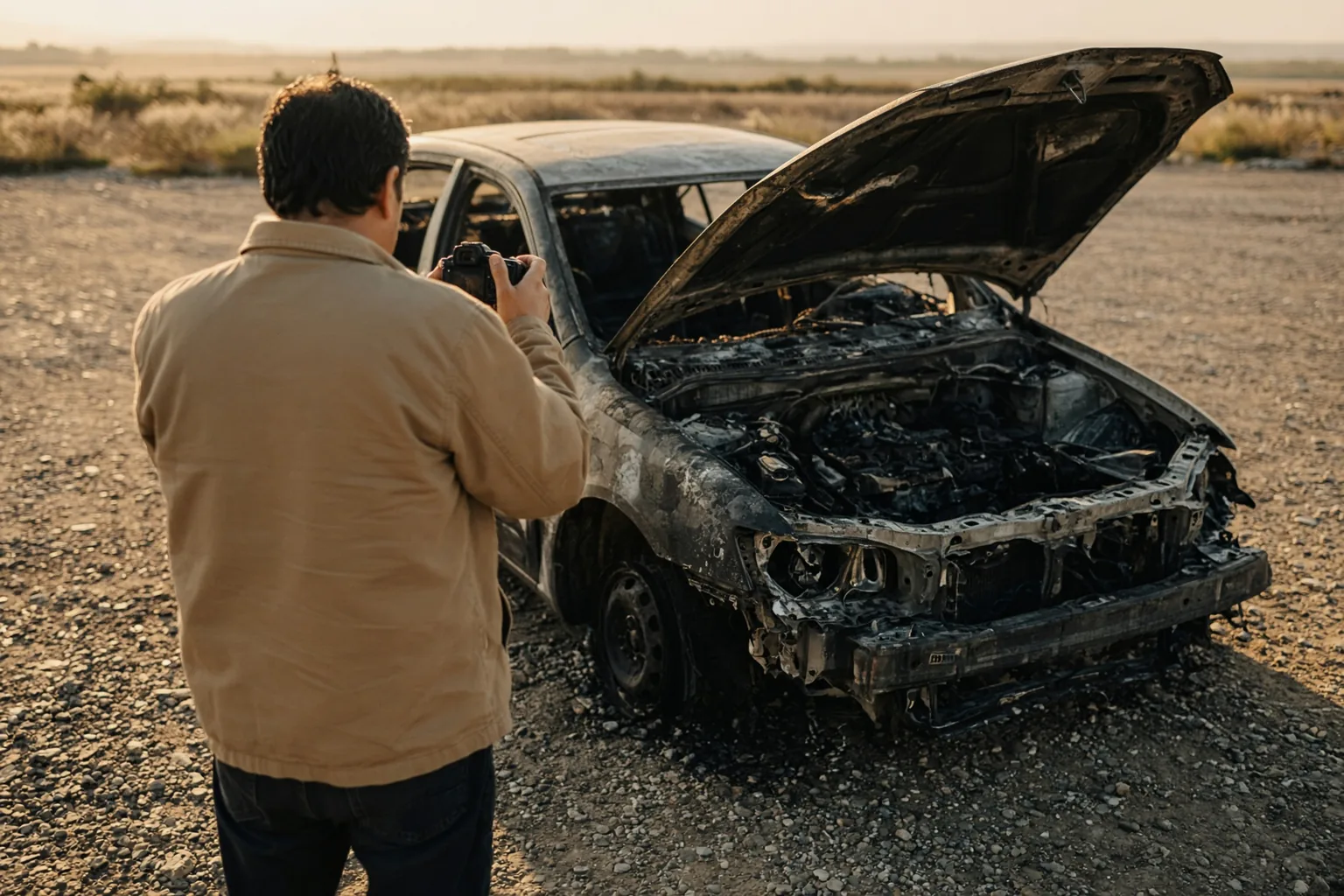
What does a vehicle fire investigation have to establish?
Where the fire started, what ignited it, which fuel burned first and how they came together. In an electric car the investigator also decides whether the battery started the fire or was damaged by it.
The questions are the same as in a building fire. The investigator locates the area of origin, names the ignition source and the first fuel ignited, and explains the circumstances that brought them together. Each hypothesis about the cause is tested against the physical evidence, the witness accounts and the timeline, and every hypothesis that fails is recorded with the reason it failed.
National figures do not settle the cause of a fire in a particular car. In its 2020 safety report on battery fires in electric vehicles, the National Transportation Safety Board evaluated six data sources on the prevalence of such fires. The NTSB found that each database contained some information related to vehicle fires, but that all "had serious limitations," among them limits "in their ability to identify batteries as the source of vehicle fires." The data report, "Prevalence of Electric Vehicle Battery Fires," is available in the NTSB public docket under case number HWY19SP002.
The type of drivetrain does not decide the case either. A Chevrolet Volt caught fire at a test facility in June 2011, three weeks after a crash test. In a press release dated January 20, 2012, cited in the NTSB report, the National Highway Traffic Safety Administration stated: "NHTSA does not believe that Chevy Volts or other electric vehicles pose a greater risk of fire than gasoline-powered vehicles." Whether a battery, a fuel leak or a wiring fault started a given fire is answered by the evidence from that vehicle.
In federal court the answer must also pass Rule 702 of the Federal Rules of Evidence. After the 2023 amendment, the party offering the investigator shows the court that it is more likely than not that the testimony is based on sufficient facts or data, is the product of reliable principles and methods, and that the opinion is a reliable application of those principles and methods to the facts of the case.
How does an investigator test competing explanations of a vehicle fire?
By working out what each explanation would leave behind and testing it with calculations and burns. In a 2007 study of a fatal minivan fire, an underbody fuel spray did not ignite a compartment without floor openings within 500 seconds.
Norman Alvares and Kirk Staggs of Fire Science Applications and Guillermo Rein of the BRE Centre for Fire Safety Engineering at the University of Edinburgh described such a test in a paper for the 5th International Seminar on Fire and Explosion Hazards, held in Edinburgh in 2007. A minivan about eight years old, with a gasoline engine and about 170,000 km on the odometer, caught fire after 5 to 6 minutes of driving. Three passengers died. The driver and a surviving passenger were injured, and the vehicle was a total loss. The driver reported hearing a "pop" and seeing "dense white smoke" from behind the middle of the back seat before the fire grew quickly.
The authors tested two hypotheses. Under the external one, fuel sprayed and burned under the moving vehicle, and the flame heated the rear floor pan of the passenger compartment. Under the internal one, a cloud of flammable gas inside the compartment ignited. They modeled heat conduction through the floor pan, used the Fire Dynamics Simulator for the compartment after ignition, ran small-scale spray and aerosol tests, and then ran two full-scale tests on an exemplar van of the same vintage, on a platform with a fan that simulated the airflow under a moving vehicle.
With perforations in the floor pan, piloted ignition inside the compartment occurred at about 210 seconds. Without openings, the model and the test gave "no fire ignition in the compartment in more than 500 s." In the test of the internal source, in the authors' words, "Flame propagation took place rapidly," and the driver had described rapid fire spread from the rear along the headliner. The subject van had no open penetrations in its passenger compartment floor pan. Even for a floor with openings, the authors wrote that "there would have been more than enough time for the driver to have stopped."
The same logic applies to any vehicle fire. Each hypothesis predicts a timeline, a path for the fire and a pattern of damage. A hypothesis that needs an opening the vehicle did not have, or a fire growth the witnesses did not see, fails, and the report says which fact defeated it.
Does it matter whether the fire followed a crash?
Yes. A crash can crush or puncture battery cells and start thermal runaway, while a fire during normal driving points to a failure inside the vehicle. Three of the four fires the NTSB examined followed crashes; one did not.
The NTSB examined four fires in Tesla vehicles. In Lake Forest, California, in August 2017, a 2016 Model X burned after a high-speed crash; its event data recorder showed 82 mph before the impact. In Mountain View, California, in March 2018, a 2017 Model X struck a crash attenuator at 71 mph and caught fire. In Fort Lauderdale, Florida, in May 2018, a 2014 Model S traveling 116 mph in a 30 mph zone left the road and burned. In West Hollywood, California, in June 2018, a 2012 Model S caught fire with no crash at all.
The report explains why the difference counts. It describes thermal runaway as "a chemical process that produces heat (an exothermic reaction)" and states that "The originating cause of thermal runaway is generally short-circuiting inside a battery cell." The report names one route to such a short, "damage to the cell caused by crushing or puncturing," the kind of damage a high-impact crash produces. Once it starts, thermal runaway can pass to neighboring cells "in a domino effect," in the report's words.
After a severe crash the investigator separates what the impact did to the battery case and modules from what the fire did. In Lake Forest, NTSB investigators examined the SUV and its battery at the tow yard on September 6 and 7, 2017. The right front corner of the battery had ruptured. The rupture exposed parts of modules 13 and 15, and modules 11 and 9, directly behind module 13, were damaged.
A noncrash fire takes the impact off the list. What remains to be tested are the vehicle's own components, its charging and repair history, and any act of a person.
How does an investigator decide whether the battery started the fire?
By tracing the damage inside the battery to a starting point and ruling out causes from outside it. In the West Hollywood fire one module failed internally, and all the other modules remained charged.
In West Hollywood the manufacturer bought the car after the fire and inspected it, first in Burbank and then in Sunnyvale, where the battery was torn down. Only module 14 had gone into thermal runaway. The inspection found that module 14 "had experienced internal failure and that all other modules remained charged," and the manufacturer found "no indication that an impact or other external factor was involved." The NTSB stated that the fire was caused by "internal failure of the vehicle's high-voltage lithium-ion battery during normal driving operations."
That is the pattern an internal origin predicts: one failed module among modules that still hold their charge. The competing hypothesis runs the other way. The NTSB notes that "An external fire might also heat a battery cell enough to initiate thermal runaway." A battery reached by a fire that began in the cabin, the motor compartment or under the vehicle can also go into thermal runaway, so the investigator has to place the origin before treating the battery as the cause.
The battery's own chemistry is part of both hypotheses. The report states that "The organic solvents used in lithium-ion batteries are flammable" and that thermal runaway brings "venting of toxic and flammable vapors from the electrolytic solvent." The investigator therefore records the condition of every module and of the pack housing, including modules far away from the heaviest burning.
A teardown destroys the arrangement it reveals, and it can be done once. The parties and their experts are invited to attend under an agreed protocol, and every step is photographed. In Mountain View the NTSB inspections on March 27 and 28 and April 6, 2018 were attended by representatives of the California Highway Patrol, and the manufacturer's engineers took part in the work on April 6.
Why can a burned electric car catch fire again days later?
Because energy stays in undamaged cells with no path to discharge. The Mountain View battery reignited at least six times, the last time five days after the crash at an impound yard.
The NTSB calls this stranded energy: "energy remains inside any undamaged battery modules and cells, with no path to discharge it." That energy is a shock hazard and "creates the potential for thermal runaway that can result in battery reignition and fire." Responders have no practical way to measure or drain it at the scene, and a crash can also damage the battery management system.
The four cases give the timeline. In Lake Forest the battery reignited repeatedly, including while the SUV was being loaded onto a tow truck, and more than 20,000 gallons of water were applied; the SUV was towed about 6 hours after the crash. The vehicle's guide for responders warned that "Battery fires can take up to 24 hours to extinguish." In Mountain View about 1,400 gallons of water and foam were used in all, and the battery reignited five days after the crash. In Fort Lauderdale the battery reignited while a tow truck handled the car and arced again at the tow yard. The West Hollywood battery did not reignite during the initial or the secondary response.
The report adds that "extinguishing a burning lithium-ion battery can require applying thousands of gallons of water." Every reignition is a new fire. It burns what the first fire left, it can move debris, and it brings more water and more handling. An investigator who arrives after the second or third event has to separate the damage of each, so the record lists the date, time and place of every reignition, every application of water and every move of the vehicle.
How should a damaged electric car be moved and stored before the inspection?
Away from other vehicles and buildings, on a flat surface and under watch. NFPA and manufacturers recommend a 50-foot clearance around a stored damaged electric vehicle, which the storage yards in the NTSB cases could not provide.
The NTSB report notes that NFPA and vehicle manufacturers recommend a "50-foot clearance around a stored, damaged electric vehicle." An SAE document gives an alternative: separate the vehicle by 50 feet on all sides or put up a barrier of earth, steel, concrete or solid masonry. The storage yards that received the crashed vehicles could not accommodate a 50-foot radius around them, and the NTSB concluded that storing a damaged electric vehicle inside that clear area "may be infeasible at tow or storage yards."
The NFPA guide cited in the report recommends monitoring the battery with thermal imaging. In Mountain View the manufacturer's engineers advised keeping the vehicle "on a flat surface to avoid flexing the vehicle structure." In West Hollywood a representative of the manufacturer advised against towing the car right away because of the risk of reignition; the fire captain had it moved anyway.
For the case file the storage chain counts as much as the scene. The investigator records who towed the vehicle and when, where it was kept, whether it stood under cover or in the rain, whether parts were removed for safety and by whom. A vehicle that passed through a tow yard, a storage lot and a buyer's hands may have to be reached through several people, and the photographs taken on the day of the fire become the main record of its condition before those moves.
Which data can survive a vehicle fire?
Sometimes the event data recorder, the battery management system and later voltage readings. The Lake Forest recorder showed 82 mph before the crash, while in Mountain View attempts to communicate with the battery management system failed.
The NTSB used the event data recorder of the Lake Forest SUV to establish that it had reached 82 mph before the crash. Crash data of this kind tells the investigator what the vehicle was doing in the seconds before the impact, which matters when the question is whether the impact damaged the battery.
Battery data is less certain. According to the report, specialists can use the battery management system to check for remaining voltage if the system is operational. In Mountain View, "Attempts to communicate with the battery management system were unsuccessful." Where the system cannot be read, direct measurement of each module is what is left.
In Fort Lauderdale the NTSB inspected the car and the debris piles at the tow yard on June 7, 2018, and measured the modules. Module 14 had zero voltage. Modules 1 through 5 read between 69.9 and 167.3 volts DC, well above the 50-60 volts DC the report gives as the limit for safe human exposure. "The measurements confirmed that stranded energy remained in the high-voltage lithium-ion battery." A record of which modules are dead and which still hold charge is part of the physical evidence about where the battery failed or burned.
A request for the vehicle should therefore come with a request for the data: the raw files read from the event data recorder and the battery management system, the tool and software used to read them, and the voltage log with the date and the person who took each reading.
Can an investigator open a damaged battery at the scene?
Often not safely. In Mountain View removing the battery case was judged unsafe, and the battery was inspected by hand with electrical and fire-safety precautions. A full examination of the cells needs controlled conditions.
At Mountain View the steel battery cover over modules 15 and 16 had peeled back and lay over modules 13 and 14. "Removing the battery case for further inspection was deemed unsafe." Because the battery could not be deenergized, it was inspected by hand, "taking appropriate electrical and fire-safety measures," and the engineers judged that "further attempts to remove damaged parts would be unsafe."
Voltage is one hazard and reignition is the other. The Fort Lauderdale modules still read up to 167.3 volts DC at the tow yard, and the Mountain View battery reignited five days after the crash. An inspection plan for a damaged battery names who will measure the voltages, how the battery will be isolated or discharged, where it will be opened, and how the modules and cells will be stored afterwards.
Opening the battery is the point after which the evidence cannot be put back. A party that was not notified can later argue that the teardown destroyed what its expert needed to see. The request to inspect, the written protocol and the list of attendees are settled before anyone cuts into the case.
How does the other side get access to the burned vehicle and its data?
In federal court, through a Rule 34 request to inspect, test or sample tangible things and electronically stored information, or through a Rule 45 subpoena when a tow yard or another nonparty holds the vehicle.
Rule 34(a) of the Federal Rules of Civil Procedure lets a party serve on any other party a request within the scope of Rule 26(b). It covers "any designated documents or electronically stored information," a category that includes "images, and other data or data compilations," and it covers "any designated tangible things." Rule 34(a)(2) adds entry onto land or other property the responding party possesses or controls, "so that the requesting party may inspect, measure, survey, photograph, test, or sample the property or any designated object or operation on it." The party served responds in writing within 30 days after service.
A burned vehicle often sits with someone who is not a party: a tow operator, a storage yard, a salvage buyer or, as in West Hollywood, the manufacturer that bought the car. Rule 34(c) provides: "As provided in Rule 45, a nonparty may be compelled to produce documents and tangible things or to permit an inspection."
What the experts rely on is then disclosed in their reports. Under Rule 26(a)(2)(B) a retained expert's report contains a complete statement of all opinions and the basis and reasons for them, the facts or data considered, the exhibits that will summarize or support them, the witness's qualifications with publications of the previous 10 years, the cases of the previous 4 years in which the witness testified as an expert, and the compensation. Teardown photographs, voltage readings and data downloads belong in that record.
What does a court check in a vehicle fire expert's opinion?
Whether the opinion rests on sufficient facts or data and reliable methods reliably applied. Rule 703 lets the expert build on data such as a manufacturer's teardown if experts in the field would reasonably rely on it.
Rule 702 sets four conditions: the expert's specialized knowledge will help the trier of fact; the testimony is based on sufficient facts or data; it is the product of reliable principles and methods; and the opinion is a reliable application of those principles and methods to the facts of the case. The witness must also be qualified by knowledge, skill, experience, training or education.
Rule 703 governs what the opinion may be built on. An expert may base an opinion on facts or data in the case that the expert "has been made aware of or personally observed." If experts in the field would reasonably rely on those kinds of facts or data, they need not be admissible for the opinion to be admitted. Facts that are otherwise inadmissible reach the jury only if their probative value in helping the jury evaluate the opinion substantially outweighs their prejudicial effect. A manufacturer's teardown report, fire department records and data read by someone else all fall under this rule.
The record of a vehicle fire often holds the findings of several investigators: the fire department, an insurer's investigator and the manufacturer's engineers. An opinion states which of their findings it adopts, which it rejects and on what data. The NTSB report points to one more document worth collecting: its recommendation H-20-32 asked manufacturers to base their emergency response guides on ISO 17840, as included in SAE J2990, and to add vehicle-specific information on battery fires, thermal runaway, reignition, stranded energy and safe storage. The guide in force for the model shows what responders were told to do with that vehicle.
Opinions of different reach need different support. That a fire began in the battery compartment is an opinion about origin. That a cell failed because of a manufacturing or design defect is an engineering opinion about the product, and the court asks whether the witness has the qualifications and the data for each of them.
What does IAE do in a vehicle fire case?
A fire investigator from the IAE registry prepares an origin and cause report on your questions or reviews the opposing investigator's report, in up to 5 business days after the format and cost are confirmed.
The IAE fire origin and cause service covers where the fire started, what ignited it, how it spread and whether an appliance, the wiring or a person's act caused it, for subrogation, product liability, arson defense and coverage disputes in US courts. The investigator works from the scene record, photos, removed artifacts and witness accounts, names the ignition source, the first fuel ignited and the circumstances that brought them together, and tests each hypothesis against the scene and the timeline. The investigator also checks whether wiring, appliances and debris were photographed in place before removal, logged and examined at a joint lab exam with all interested parties notified.
For a vehicle fire, send the fire department report, the photographs from the day of the fire, the towing and storage records, any teardown or data download reports and the opposing report if there is one, and tell us whether the vehicle still exists and who holds it. The secretariat confirms receipt the same day. Within one business day IAE confirms the format, cost, deadline and the specialist from its registry, and you approve the candidate and the CV before work starts. Cases with tight deadlines have a 48-hour rush.
Every specialist is a member of the public IAE registry and passed the council's attestation under the published Criteria Matrix; the Member ID in the document can be checked by QR code. The specialist confirms in the document that he or she has no interest in the outcome of the case. Neither IAE nor the specialist guarantees the outcome, and IAE is not a law firm.
Sources
- National Transportation Safety Board, Safety Risks to Emergency Responders from Lithium-Ion Battery Fires in Electric Vehicles, Safety Report NTSB/SR-20/01, adopted November 13, 2020
- N. Alvares, K. Staggs, G. Rein, Investigation of a Fatal Fire in a Moving Vehicle, 5th International Seminar on Fire and Explosion Hazards, Edinburgh, 2007
- Federal Rules of Evidence, Rule 702, Testimony by Expert Witnesses (LII, Cornell Law School)
- Federal Rules of Evidence, Rule 703, Bases of an Expert (LII, Cornell Law School)
- Federal Rules of Civil Procedure, Rule 34, Producing Documents, Electronically Stored Information, and Tangible Things, or Entering onto Land, for Inspection and Other Purposes (LII, Cornell Law School)
- Federal Rules of Civil Procedure, Rule 26, Duty to Disclose; General Provisions Governing Discovery (LII, Cornell Law School)
Read also
All articles
Gas explosion investigation: who is liable, and what does the investigator have to establish?
After a gas explosion the claim turns on one physical question: where the gas came from and why nobody noticed it before something ignited it Sergei Voronin
Tenant caused a fire: who is liable, can the landlord's insurer sue, and what must the investigator establish?
When a rented house burns, three questions come up in order: where the fire started, what started it, and who answers for that cause under the leaseSergei Voronin
Fire spread from a neighbor's property: who is liable, and what does the investigator have to establish?
A neighbor is liable for a fire that spreads onto your property when the fire started through his negligence or in violation of law, not merelySergei VoroninExpert examinations
Ready to discuss your case?
Send the materials: the secretariat will confirm the format, cost, deadline and the specialist within one business day.
