
Examinations
Wiretap recordings as evidence: what does the sealing requirement protect, and what does a defense examiner check?
Federal wiretap law requires intercepted calls to be recorded in a way that protects them from editing and, when the order expires, to be sealed by the judge who issued it. Under 18 U.S.C. 2518(8)(a) the seal, or a satisfactory explanation for its absence, is a prerequisite for using the recordings. The Supreme Court held in 1990 that proof the tapes were not altered does not replace that explanation. A forensic examiner tests what the seal cannot: the files themselves.
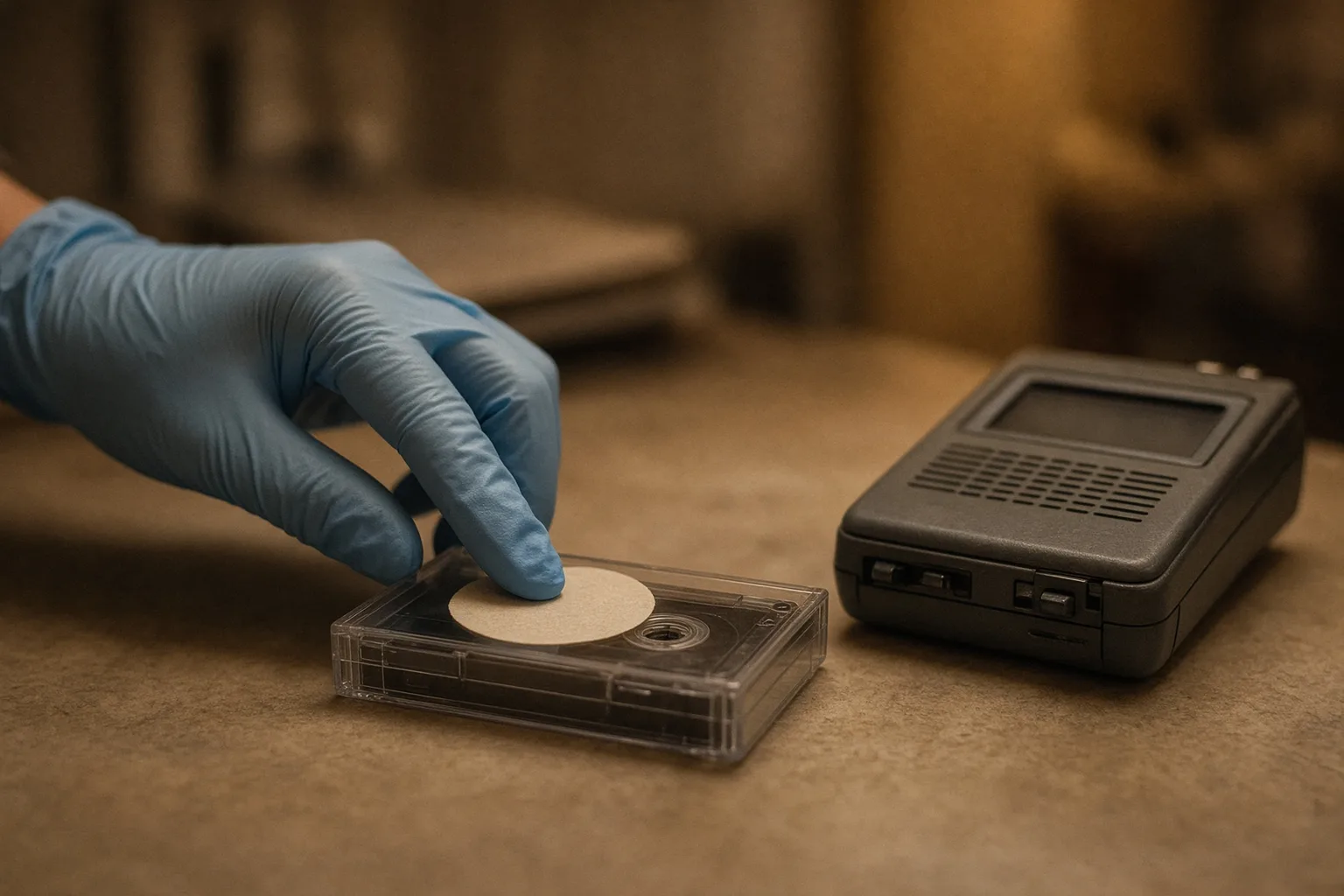
What does federal law require for wiretap recordings?
Recording, if possible, on tape, wire or a comparable device in a way that protects against editing; delivery to the issuing judge and sealing immediately when the order expires. The seal or a satisfactory explanation is a prerequisite for use.
Section 2518(8)(a) of title 18, part of the federal wiretap statute known as Title III, governs what happens to the recordings. As quoted by the Supreme Court in United States v. Ojeda Rios, 495 U.S. 257, decided on April 30, 1990, the contents of an intercepted communication "shall, if possible, be recorded on tape or wire or other comparable device," and the recording "shall be done in such way as will protect the recording from editing or other alterations."
The statute then sets the timing: "[i]mmediately upon the expiration of the period of the order, or extensions thereof," the recordings "shall be made available to the judge issuing such order" and "sealed under his directions."
The last sentence carries the consequence. "[T]he presence of the seal provided for by this subsection" or "a satisfactory explanation for the absence thereof" is "a prerequisite for the use or disclosure of the contents" of the communication or evidence derived from it. A defendant who proves that a seal is missing or late puts the burden on the government to explain.
Why must wiretap recordings be sealed by a judge?
To protect the recordings from tampering. Ojeda Rios described the provision's primary thrust as the reliability and integrity of electronic surveillance evidence, and Gigante called judicial sealing an external safeguard against tampering.
Justice White, writing for the Court in Ojeda Rios, described the "primary thrust" of section 2518(8)(a) as protecting "the reliability and integrity of evidence obtained by means of electronic surveillance." Once the seal is in place, "the Government has no opportunity to tamper with, alter, or edit the conversations." Congress treated sealing as important because "it limits the Government's opportunity to alter the recordings."
The Second Circuit had explained the same point fourteen years earlier in United States v. Gigante, 538 F.2d 502, decided on June 22, 1976, in an opinion by Chief Judge Irving R. Kaufman. Tape, the court wrote, is "uniquely susceptible to manipulation and alteration," and skillful edits can rarely be detected. Judicial sealing is an "external safeguard against tampering."
The seal is a procedural safeguard and does not examine the recording. A sealing order records that the recordings reached the judge and were closed under the judge's directions. In Gigante the sealing orders were signed without a hearing, and the court noted that Title III does not provide for an inquiry into alteration at the time of sealing.
How soon after the order expires must the recordings be sealed?
Immediately, which the Seventh Circuit in United States v. Coney (2005) read as a couple of days at most. Ten days was too long, although the court accepted the explanation for that delay.
In Coney, decided on May 11, 2005, and reported at 407 F.3d 871, the second intercept order expired on October 10, 1997, and its tapes were not sealed until October 20. Judge Posner wrote for the panel that ten days is too long to be "immediate" and suggested a delay of "a couple of days at most."
The facts of Gigante were far worse. Investigators had wiretapped Bronx telephones in a gambling investigation under orders issued from November 1972 through April 1973. For six of the orders the tapes reached the issuing judges months late, with delays between about 8 months and just over 12 months, and were sealed on January 7 and 8, 1974. After the supervising attorney left in June 1973, the tapes sat in a locked filing cabinet, and the government offered no explanation.
For the defense, the dates are the first thing to check: when each order and extension expired, when the recordings were presented to the judge and when the sealing order was entered. Each gap is a separate question for the government.
What counts as a satisfactory explanation for a late seal?
An explanation of why the delay is excusable, not merely why it happened. Ojeda Rios held that a good-faith, objectively reasonable misunderstanding of the law can qualify, if the government relied on it at the suppression hearing.
The Supreme Court held in Ojeda Rios that the "satisfactory explanation" language requires the government to explain "why it is excusable"; an account of why the delay occurred is not enough. The government's good-faith and objectively reasonable misunderstanding of the law could qualify as an excuse, but only an explanation actually relied on at the suppression hearing counts, and the Court remanded for that determination.
In Coney the Seventh Circuit reviewed the explanation as a finding of fact, with deference to the district court. Two assistant United States attorneys handled the matter. One was on vacation until October 17 and expected the other to submit the tapes, the other did not, and scheduling problems delayed the application until October 20. The court called the delay "neglect" that was "harmless," held it excusable although it could not be justified, and affirmed the denial of the motion to suppress.
In Gigante the government gave no reason at all for the long delays, and the Second Circuit affirmed suppression of the recordings from the six later orders. For the first order it remanded to decide whether a later order extended the authorization and whether a thirteen-day gap was explained.
Is proof that the recordings were not altered enough to excuse a late seal?
No. Ojeda Rios held that proof the tapes were not tampered with does not substitute for a satisfactory explanation, and Gigante rejected the argument that suppression requires proof of actual tampering.
The Court in Ojeda Rios held that proof that the tapes were not tampered with does not substitute for the explanation the statute requires.
Gigante had answered the same argument from the other direction. The government claimed that suppression was too harsh without proof of actual tampering. The Second Circuit rejected that demand as one that would defeat the purpose of the statute; the same opinion notes that skillful edits to tape can rarely be detected.
Integrity still matters at the next step. In Coney the tapes had sat in a closed evidence bag that was neither locked nor sealed and was readily accessible to anyone in the office; the court found no motive for tampering and "no suggestion of a pattern" of noncompliance. Whether the recordings show signs of editing is a question for an audio examiner, and the answer can support or weaken the explanation the government offers.
Which recording is the original, and what happens to the working copies?
In Gigante each shift was recorded on two tapes: one labeled the original was boxed and sealed, the duplicate went to an agent with a chain-of-custody form. The court noted irregularities in how the duplicates were handled.
The Gigante record describes the practice of the time. Each shift's recordings were made on two tapes at once. One was labeled the "original" and boxed and sealed; the duplicates went to the case agent with a chain-of-custody form. The court noted irregularities, among them tapes dropped in a mail folder and tapes that were not initialed.
When intercepts are stored as digital files, the questions are the same. Which file did the recording system write first? Where was it stored between the end of the order and the seal? Which copies were made for the case agents, the translators and the transcribers, and which copy did the government's examiner or transcript preparer use?
When transcripts and summaries are prepared from working copies and the defense disputes a passage, the comparison is with the sealed original, and the examiner's report states which file was used for each finding.
What does a forensic audio examiner check in wiretap recordings?
Whether each file is consistent with an original from the recording system: its structure, metadata and continuity, compared with exemplar recordings from the same system. SWGDE requires all applicable tests and no reliance on a single test.
SWGDE Best Practices for Digital Audio Authentication, document 15-a-001, version 1.3 of September 20, 2018, sets the method. "The first removable instance of the original data should be protected from modification," the original is hashed if possible, and the examiner works on a copy. The file structure "should be compared with exemplar recordings made from submitted recorders or other test recordings."
For a wiretap the exemplar is a recording that the same interception system made in the same format. The examiner compares file headers, metadata, time stamps and the structure of the audio data, and then listens to and measures the audio itself: breaks in background noise, gaps, changes in the recording channel and signs of re-recording.
SWGDE requires that "All applicable tests available to the examiner shall be conducted" and states that no "single analysis be relied upon solely." The report documents the test plan, procedures, data, results and decision criteria, and states one of three outcomes: consistent with an original, inconsistent with an original or inconclusive.
What does the defense need to obtain for an examination of intercepted calls?
The sealing orders and their dates, the recordings in the format the system produced, the logs of the interception system, the chain-of-custody records and the working copies used for transcripts.
The sealing record shows when the recordings reached the judge. Gigante and Coney both turned on dates: the expiration of each order, the presentation to the judge and the sealing. Without those dates the defense cannot say whether a seal was immediate.
The recordings themselves, in the format the interception system wrote them, are the examiner's main object. A disc of converted audio files can carry less information about the original structure than the system's native files, and some tests depend on that structure.
Logs and custody records fill the gap between the end of the order and the seal. In Coney the court looked at where the tapes were kept and who had access during the ten days. A forensic examination that compares the files with the logs can show whether the number, length and time stamps of the recordings match the record of interception.
How does a sealing or integrity problem reach the court?
By a motion to suppress before trial. The government then has to show a seal or a satisfactory explanation, and an examiner's report can be offered on whether the recordings bear signs of alteration.
In Gigante the district court suppressed the late-sealed recordings, and the Second Circuit affirmed for the six later orders. In Coney the defendant moved to suppress almost three years after the sealing, one of the prosecutors was notably vague in her recollection, and the court still accepted the explanation. In Ojeda Rios the Supreme Court remanded so that the lower court could decide whether the government had relied on its explanation at the suppression hearing.
The examiner's report does not decide the legal question of the seal. It answers a separate factual question: whether the files are consistent with original recordings from the interception system, and whether any passage shows signs of editing. Defense counsel decides whether to use it at the suppression hearing, at trial or in both.
An examiner who is to testify is disclosed under the rules that govern expert testimony in the case, and the report states the files examined, the methods and the limits of the conclusions.
What does IAE do when wiretap recordings are disputed?
IAE prepares an expert report on the client's questions about a recording, or a review of the opposing audio examiner's report, for a federal or state case. The document is issued in up to 5 business days.
The forensic audio page lists three groups of questions: whose voice is on the recording, whether the file was edited and what was said. For authenticity, the examiner checks the file for breaks in background noise, metadata that does not match the device, signs of re-recording and gaps in the chain of copies. Transcripts mark speakers, time codes and unintelligible passages against the original file.
The client sends the recordings or the opposing report with the case materials and describes the task, and IAE confirms the questions with the client before work starts. The secretariat confirms receipt the same day. Within one business day IAE confirms the format, the cost, the deadline and the examiner from its registry, and the client approves the candidate and the CV. The signed PDF is issued in up to 5 business days after the format and cost are confirmed, and cases with tight deadlines have a 48-hour rush.
Every examiner is a member of the public IAE registry, and the Member ID in the document opens the examiner's category, specialization and attestation date on the status check page or by QR code. The examiner states in the document that he or she has no interest in the outcome of the case. A report is evidence that the court weighs with the other evidence, and neither IAE nor the examiner guarantees the outcome. IAE is not a law firm and does not advise on case strategy.
Sources
- United States v. Ojeda Rios, 495 U.S. 257 (1990) (LII, Cornell Law School)
- United States v. Gigante, 538 F.2d 502 (2d Cir. 1976) (OpenJurist)
- United States v. Coney, 407 F.3d 871 (7th Cir. May 11, 2005) (Justia)
- SWGDE Best Practices for Digital Audio Authentication, 15-a-001, version 1.3, September 20, 2018
Read also
All articles

Can a voice recording prove a verbal agreement in court, and what does the recording have to show?
In California all contracts may be oral, except those that a statute requires to be in writing: that is Civil Code section 1622. A recording is Sergei Voronin
Is voice stress analysis admissible in court, and can an audio expert tell from a recording whether someone lied?
Voice stress analysis results are kept from juries as proof that a person lied. In a study funded by the National Institute of Justice, twoSergei Voronin
The court transcript does not match the audio recording: how is the record corrected, and what can a forensic transcript add?
When the official transcript of a federal hearing differs from what the audio recording shows, the transcript is presumed correct until the courtSergei VoroninExpert examinations
Ready to discuss your case?
Send the materials: the secretariat will confirm the format, cost, deadline and the specialist within one business day.
