
Examinations
How to tell if a document has been altered: what does a forensic document examiner check?
A forensic document examiner looks for alterations on the original under magnification, side light, ultraviolet and infrared, then checks the paper, printing, staples and indentations page by page. ANSI/ASB Standard 035 sets out these steps and one limit: if no sign of alteration is found, that does not support a definite finding that the document is unaltered.
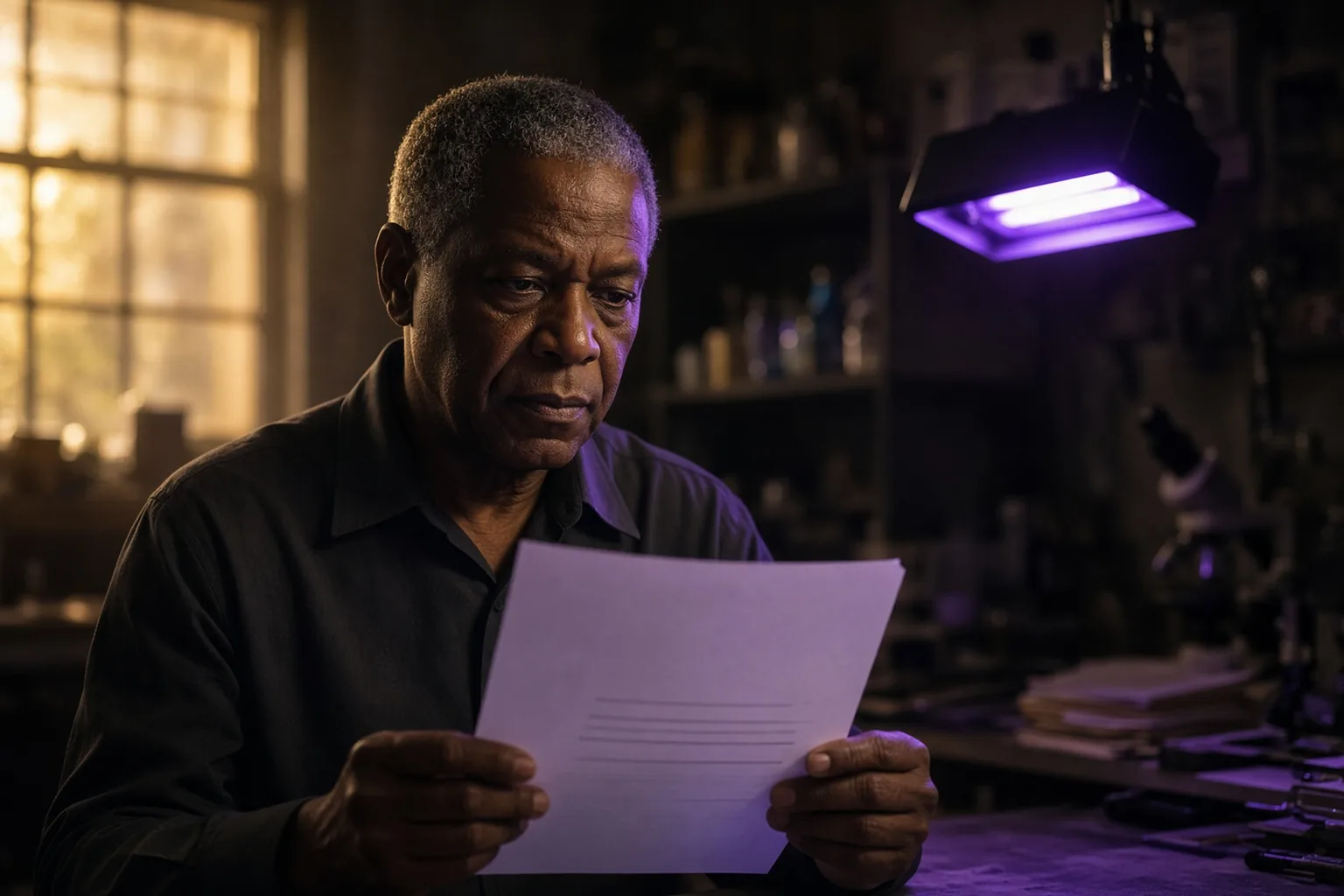
How can you tell if a document has been altered?
A forensic document examiner compares the handwriting, printing, paper and fastenings of the original under magnification and special lighting. ANSI/ASB Standard 035 lists what to observe and which instruments to use.
ANSI/ASB Standard 035, Standard for the Examination of Documents for Alterations, was approved by the AAFS Standards Board in January 2019 and by ANSI in September 2020. It is the first edition. Its procedure starts with an initial assessment to decide which examinations to perform, in what sequence, and what factors limit the work (section 4.4.1).
The examiner then examines every side of each item, both macroscopically and microscopically (section 4.5.2). Under section 4.4.3, the results and notes "should have sufficient detail to allow for an independent review and assessment of the conclusions by another FDE," and include the equipment used, methods and evaluations. A reviewer for the other side can repeat the reasoning only if the observations were written down when they were made.
The Scientific Working Group for Forensic Document Examination published an earlier text on the same subject, the SWGDOC Standard for Examination of Altered Documents, version 2013-1. Under its section 7.0, "All procedures shall be performed when applicable and noted when appropriate," and the steps need not follow the listed order.
A visual check by a lawyer or a client can find an obvious change. It cannot read an erased entry, separate two inks of the same color, or show that one page came from a different printer. Those questions need the instruments and procedures described below.
What counts as an alteration of a document?
Any modification made to a document by physical, chemical or mechanical means. The standards name erasures, additions, obliterations, overwriting, cutting and pasting, and inserted, removed or substituted pages and entries.
Standard 035 defines an alteration in section 3.1 as "A modification made to a document by any combination of physical, chemical, or mechanical means." Section 3.6 defines an erasure as "The area where material has been removed from a document by chemical, abrasive, or other means." The SWGDOC standard, in section 3.2.1, lists obliterations, additions, overwritings and erasures within the same definition.
Section 4.4.4(e) of Standard 035 adds cutting and pasting or substitution, and the insertion or omission of pages or entries. A contract can be altered without a single stroke being touched if one of its pages has been printed again with different terms.
Indentations are part of the same work. Section 3.10 defines them as "Latent or visible impressions in paper or other media." Writing on one sheet leaves impressions on the sheet beneath, and those impressions can contain words that are no longer visible anywhere else.
What signs of alteration does the examiner look for on the page?
Overwriting, crowded spacing and changes in ink color in handwriting, mismatched fonts and alignment in print, disturbed paper fibers and discoloration, and staples, holes, clips and punches that do not match the rest.
Section 4.4.4 of Standard 035 groups the observations by feature. For handwriting it lists overwriting or obliteration of entries, "crowded or awkward spacing of writing," inconsistent handwriting features, and characteristics of the writing media "such as variation in color and intensity or class of writing instrument." For printing, the process type, fonts, alignment and class characteristics. For paper, discoloration, fiber disturbance, variation in thickness, size, opacity, guillotine marks, watermarks and UV fluorescence, cuts, tears, perforations, folds and indentations. For fastening and binding, adhesives, staples and staple holes, paper clips and hole punches.
Section 4.5.3 asks the examiner to record observations and measurements of the paper, spacing, color, fastening marks, facsimile information and trash or roller marks. Trash marks and roller marks come from the machine that printed or copied the page. When they differ between pages, the examiner records the difference.
Section 4.3.8 tells the examiner to consider that characteristics associated with alteration "may have occurred during normal preparation, handling, and storage of the document." A fold, a stain or a smudge is recorded, and the examiner considers whether it points to a change of content or to ordinary handling.
How does an examiner read erased or covered entries?
With side, transmitted and vertical light, ultraviolet and infrared sources, and an electrostatic detection device for indentations. Destructive methods for entries under correction fluid or tape come only afterward.
Section 4.2.2 of Standard 035 lists the equipment: light sources for transmitted, side and vertical incident light; optical or digital magnification; image capture devices; an infrared image conversion device "for use in infrared reflectance (IRR) and infrared luminescence (IRL) examinations"; long-wave, mid-wave and short-wave ultraviolet sources; measuring devices such as a micrometer, typewriter grids and rulers; and an electrostatic detection device. Section 4.5.4 names the optical techniques: side lighting, transmitted lighting, UV, IRR and IRL.
ANSI/ASB Standard 011 lists among standard equipment colored filters "for visual and photographic differentiation of inks." An entry added later in a second pen of the same color can then stand apart from the original text. Section 3.11 of Standard 035 defines side lighting as illumination at a low angle of incidence, or even parallel to the surface of the item, also called oblique lighting. Paper fiber disturbance is among the paper features listed in section 4.4.4(c).
Latent indentations are visualized with oblique lighting, an electrostatic detection device, or both (section 4.5.9). Visualized entries are recorded (section 4.5.10) and may be deciphered and transcribed (section 4.5.11).
Entries hidden under correction fluid or tape can be visualized by several destructive methods (section 4.6.6). Entries obscured by tape, gum, grease or a similar substance may be recovered after freezing (section 4.6.9). Under section 4.7.2(b), the report states whether the altered entries could be deciphered.
How can an examiner tell if a page was substituted?
By comparing each page with the others: printing process, fonts and alignment, paper, staple holes and other fastening marks. Instrumental analysis of paper and toner can separate pages that look identical under optical methods.
Section 4.4.4(e) of Standard 035 names the insertion or omission of pages among the things to observe. The comparison runs across the whole document. A substituted page may come from a different printer, use slightly different margins or font settings, sit on different paper, or carry staple holes that do not line up with the other pages.
Standard 011 (2022) lists among the examiner's tasks "the examination, comparison and classification of documents produced by typewriters, facsimile machines, photocopiers, computer printers, commercial printing and other mechanical or electronic imaging devices." It also lists "the examination and comparison of ink, paper, and writing instruments."
Optical methods have a limit when pages were printed on similar machines with similar paper. Valery Aginsky described in 2012, in the Journal of the American Society of Questioned Document Examiners, a combination of thin-layer chromatography, gas chromatography-mass spectrometry and FT-IR microspectroscopy for page insertion and substitution cases. According to the abstract, the combination can distinguish paper and toners that optical methods cannot.
When both parties hold signed counterparts of the same contract, the two counterparts are compared page by page. A page whose text differs between them, or that differs from its neighbors in printing or paper, becomes the focus of the examination.
Does the examiner ever need to damage the document?
Only after non-destructive methods are exhausted and with recorded permission. Standard 035 also requires images before and after, and the SWGDOC standard warns that destructive tests can interfere with later ink or fingerprint work.
Section 4.5.13 of Standard 035 has the examiner decide whether destructive examination is needed. Under section 4.6.1, destructive examinations should be performed after non-destructive methods have been exhausted. Section 4.6.3 requires obtaining and recording permission before testing. Section 4.6.5 requires images before and after destructive techniques, and under section 4.6.7 a solvent is tested before its general application to each item.
The SWGDOC standard, section 7.13, says destructive techniques "should be performed only after non-destructive methods have been exhausted." Section 7.13.1 adds that destructive testing can interfere with later chemical ink examination or latent print work. If fingerprints on the document may matter, the sequence of examinations is agreed before any solvent touches it.
In federal civil cases, testing the other side's original goes through Rule 34. A party may request to "inspect, copy, test, or sample" designated documents, and the request "must specify a reasonable time, place, and manner for the inspection and for performing the related acts." The 2006 committee note says that "issues of burden and intrusiveness raised by requests to test or sample can be addressed under Rules 26(b)(2) and 26(c)."
Can alterations be found on a copy or a scan?
Some can, with limits. Standard 035 calls examination of the original always preferable and warns that apparent alterations can actually be the result of software, hardware or user-affected variations.
Section 4.3.2 of Standard 035 reads: "The examination of the original item(s) is always preferable." When the original is unavailable, the examiner works from the best available evidence (section 4.3.3). The SWGDOC standard, section 5.2, names the submission of non-original documents as one source of limitations.
A copy loses most of what the instruments read. Ink differences under infrared and ultraviolet light, fiber disturbance from an erasure, indentations and staple holes are features of the paper and the ink. On a copy, the examiner can still look for cut-and-paste traces, inconsistent alignment, mismatched fonts and repeated defects of the copier.
Section 4.7.2(f) of Standard 035 requires the conclusions to address, as appropriate, "apparent alterations in documents that can actually be the result of software, hardware, or user affected variations, and can occur during normal or legitimate document production." A scan, a fax or a reprint passes the page through software and hardware. A report that calls such a feature an alteration without considering these causes gives the other side a point for cross-examination.
Section 4.3.8 sets the limit that applies to every copy case. Some alterations might not be detectable "due to the examination of a non-original document," and "The absence of observed physical characteristics does not support a definite determination that the document is unaltered."
How does an alteration opinion come into a federal case?
Through authentication under Rule 901 and expert testimony under Rule 702. The party offering the examiner must show that the opinion more likely than not rests on sufficient facts and a reliably applied method.
Under Rule 901(a), the proponent of a document must produce evidence "sufficient to support a finding that the item is what the proponent claims it is." Rule 901(b)(3) names "A comparison with an authenticated specimen by an expert witness or the trier of fact." Rule 901(b)(4) names "The appearance, contents, substance, internal patterns, or other distinctive characteristics of the item" taken together with all the circumstances.
The examiner's opinion is expert testimony under Rule 702. The committee note to the 2023 amendment says that it "clarifies that the preponderance standard applies to the three reliability-based requirements added in 2000." The same note says that forensic experts "should avoid assertions of absolute or one hundred percent certainty" if the methodology is subjective and thus potentially subject to error.
A retained examiner delivers a written report under Rule 26(a)(2)(B), with all opinions and their basis and reasons, the facts or data considered, exhibits, qualifications with publications from the previous 10 years, testimony from the previous 4 years and the compensation. A report that answers the other side's examiner on the same subject is due under Rule 26(a)(2)(D)(ii) "within 30 days after the other party's disclosure," absent a stipulation or court order.
What should an alteration report contain?
The purpose, the examinations conducted, observations, conclusions, limitations and sources of uncertainty, and the methods used. Its conclusions say whether alteration was observed, whether altered entries were deciphered, and how the change was made.
Section 4.7.1 of Standard 035 lists the contents: stated purpose, examinations conducted, observations, conclusions or opinions, limitations and uncertainty, and the methods used. Section 4.7.2 lists what the conclusions address as appropriate: (a) whether characteristics indicating alteration were observed; (b) whether altered entries were decipherable; (c) the text or description of the altered and original entries; (d) the method or sequence of the alterations; (e) images of the alterations and original entries; (f) apparent alterations that can actually be the result of software, hardware or user-affected variations.
Under section 4.4.2, an examination may be discontinued, and the reasons are recorded. A reviewer for the other side asks for those reasons along with the notes kept under section 4.4.3.
The SWGDOC standard, section 8.1, says conclusions "may be reached once sufficient examinations have been conducted." A reviewer checks which of the listed techniques were applied. A report that rests on visual inspection alone, with no infrared, ultraviolet or oblique light work recorded, leaves the reader without the observations that the standards call for.
What does IAE do when a party says a document was altered?
An examiner from the IAE registry prepares a report on your questions about erasures, overwriting and substituted pages, or a review of the opposing examiner's report, in up to 5 business days after the format and cost are confirmed.
The questioned documents page describes the work for federal and state cases: whether a page was inserted or replaced, an entry erased or overwritten, a stamp impression made by the stamp in question, and how the document was printed. Alterations are examined under ANSI/ASB Standard 035 with side lighting, ultraviolet light and infrared examinations. Printing processes are compared under Standard 011, stamp impressions under Standard 117.
A review of the other side's report checks whether each opinion comes with its basis and the facts or data considered, as Rule 26(a)(2)(B) requires, and whether the examiner considered apparent alterations caused by software, hardware or user-affected variations under Standard 035.
Before work starts IAE confirms the questions and the handling of the original. The secretariat confirms receipt of the materials the same day and, within one business day, the format, the cost, the deadline and the examiner from the registry; you approve the candidate and the CV. Cases with tight deadlines have a 48-hour rush.
Every examiner is a member of the public IAE registry and passed the council's attestation under the published Criteria Matrix; the Member ID in the report opens the record on the status check page or by QR code. Materials go through the contact form or to info@iaexperts.com and are not passed to third parties without the client's consent. The court weighs the report with the other evidence. Neither IAE nor the examiner guarantees the outcome, and IAE is not a law firm.
Sources
- ANSI/ASB Standard 035, Standard for the Examination of Documents for Alterations, 1st Ed. 2020 (AAFS Standards Board)
- SWGDOC Standard for Examination of Altered Documents, ver. 2013-1
- ANSI/ASB Standard 011, Scope of Expertise in Forensic Document Examination, 1st Ed. 2022 (AAFS Standards Board)
- V. Aginsky, Examination of paper and toner in page insertion/substitution cases using TLC, GC-MS and FT-IR microspectroscopy, Journal of the American Society of Questioned Document Examiners, vol. 15, no. 2 (2012), pp. 3-15
- Federal Rules of Civil Procedure, Rule 34, Producing Documents and Tangible Things, with Committee Notes (LII)
- Federal Rules of Civil Procedure, Rule 26, Duty to Disclose; General Provisions Governing Discovery (LII)
- Federal Rules of Evidence, Rule 702, Testimony by Expert Witnesses, with Committee Notes (LII)
- Federal Rules of Evidence, Rule 901, Authenticating or Identifying Evidence (LII)
Read also
All articles

What can you ask a forensic document examiner, and what should you send with the document?
A forensic document examiner answers questions about how a document was made and what was done to it afterwards: whether an entry was added, a page Sergei Voronin
Burned, soaked or torn: what can a document examiner recover from a damaged document?
A document that went through a fire, a flood or a shredder is often still readable in part. Forensic document examiners work with charredSergei Voronin
Same pen or a different pen: what can a document examiner tell from the ink?
A document examiner can often show that two entries were written with different inks, and that settles that two pens were used. The reverse isSergei VoroninExpert examinations
Ready to discuss your case?
Send the materials: the secretariat will confirm the format, cost, deadline and the specialist within one business day.
