
Examinations
Same pen or a different pen: what can a document examiner tell from the ink?
A document examiner can often show that two entries were written with different inks, and that settles that two pens were used. The reverse is weaker. Under the SWGDOC ink comparison standard, matching inks only means the examiner could not tell them apart at the level of analysis used: they may come from different batches or different pens of the same formula. Identifying the individual pen is outside the standard.
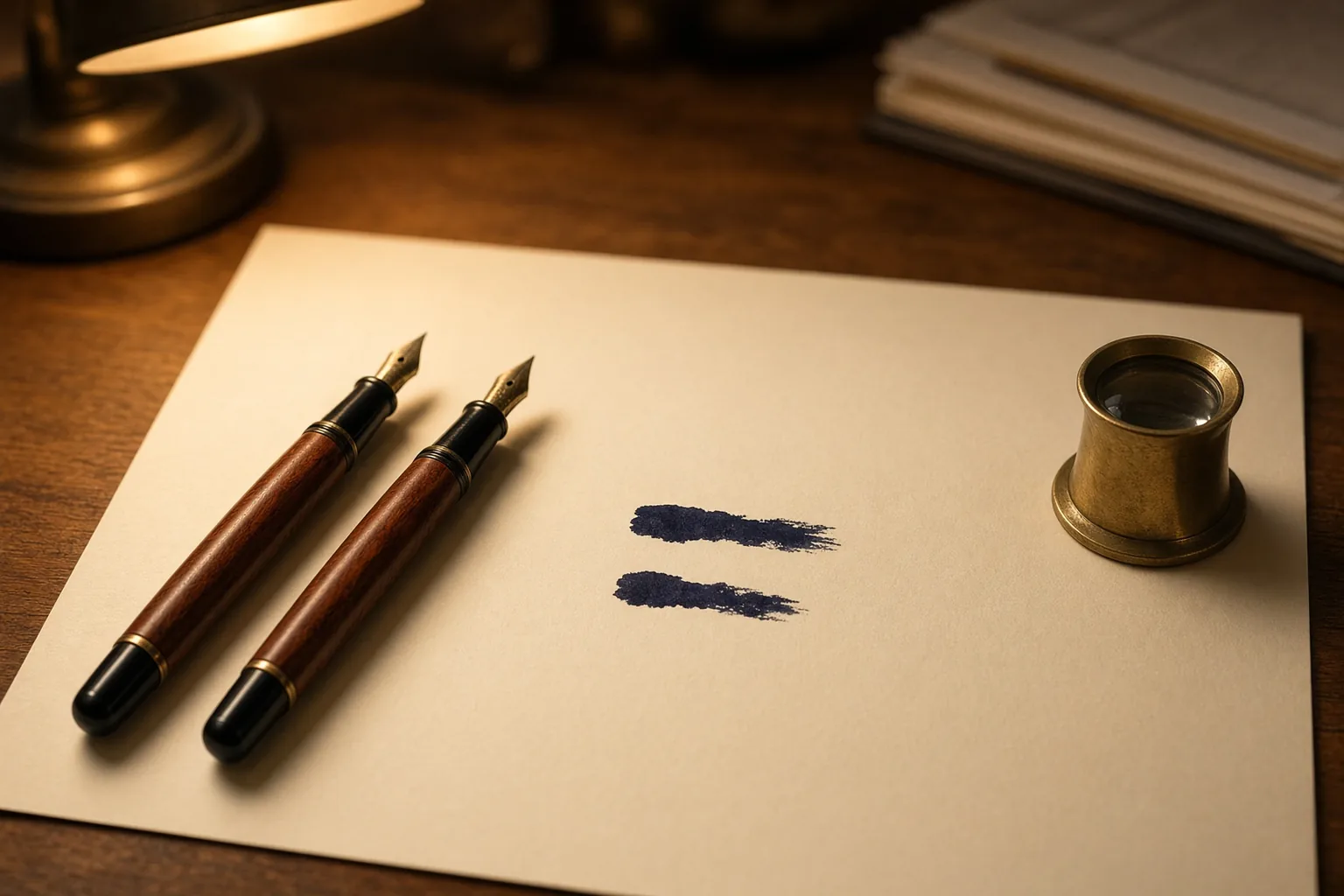
Can a document examiner tell whether two entries were written with the same pen?
Not as a rule. The examiner can show that two inks differ, which means two writing instruments. A match shows the same ink formula, not the same pen, because modern inks are rarely distinctive below the manufacturing batch.
The SWGDOC Standard for Test Methods for Forensic Writing Ink Comparison (version 2013-1) is written for examiners comparing writing or marking inks to decide whether two samples have a common or a different origin. Section 4.3 states that contemporary ink rarely has sufficient individuality to show common origin below the level of the manufacturing batch, and that a full match is consistent with common origin but does not prove it.
The note to section 4.3 explains why. Ink in cartridges or packaged in pens is not exposed to the mixing and contamination that could make the ink of one ink well distinctive, and examining the ink line to identify the specific writing instrument is outside the scope of the standard.
So the question "same pen?" usually becomes two narrower questions. Were the entries written with inks of different formulas? If the answer is yes, two instruments were used. If the inks cannot be distinguished, the examiner says so and stops there.
Which questions can an ink comparison answer?
Whether an ink matches, by formula, the ink of other entries on the same document. The standard names three further questions, about a common instrument and about age, and answers none of them fully.
Section 4.1 of the SWGDOC standard lists four kinds of questions an examiner is asked: whether an ink is the same, in formula, as the ink on other parts of the same document; whether two writings with similar ink have a common origin, that is, the same writing instrument or ink well; whether dated entries are consistent with their dates; and whether an ink is as old as it is claimed to be.
Section 4.2 says that the standard fully answers only the first. Section 1.2 excludes identification of the manufacturer or time of manufacture of a formula and states that ink dating examinations are beyond its scope.
A request that asks the examiner whether a disputed line "was written at the same time" as the rest of the page is therefore a request for two separate examinations: an ink comparison under this standard and, if possible, a dating examination under a different method.
How are inks compared without damaging the document?
With light: magnification and color in visible light, fluorescence under long-wave and short-wave ultraviolet light, and examination in the infrared, including infrared luminescence. A range of light sources and filters is used.
Section 7 of the SWGDOC standard starts with nondestructive optical examinations. In visible light, with magnification, the examiner determines whether the ink is ballpoint or non-ballpoint, notes its condition and determines its color (section 7.1); microspectrophotometry is listed in 7.1.4. Under section 7.2 the ink is examined under long-wave and short-wave ultraviolet light and its fluorescence is recorded. Section 7.3 covers infrared examination and infrared luminescence.
Section 7.5 asks for a range of light sources and filters, because ink reactions vary by wavelength. Two blue inks that look the same in daylight can separate at one wavelength and not at another.
Instrumental methods are being added to the visual ones. Amy R. Stefan, Natalya O. Hall and Stephen L. Morgan of the University of South Carolina presented to the Academy in 2007 a method that combines UV and visible microspectrophotometry with multivariate statistics, tested on inks from the same pen, from pens of the same type and from pens of similar color.
Nondestructive methods have limits of their own. In a 2011 study presented to the American Academy of Forensic Sciences, Derek L. Hammond of the United States Army Criminal Investigation Laboratory had five similarly trained examiners compare 25 pairs of black ballpoint inks with hyperspectral imaging: three pairs were the same ink, 22 were different. He reported high variation between examiners and several false negatives, with unanimous agreement on only five pairs, and concluded that training for nondestructive ink differentiation needs to change.
When does the examiner need to take ink from the document?
When optical methods cannot separate the inks. Chemical tests then follow; thin layer chromatography usually takes 7 to 10 small plugs of ink from a line, or about 1 cm of line cut with a scalpel.
Section 7.6 of the standard covers spot and solubility tests, which can be done in place on the document with small amounts of solvent; section 7.6.3 uses solvent behavior to separate ballpoint from non-ballpoint ink. Section 7.7 covers thin layer chromatography. Under 7.7.2.1, "usually 7 to 10 plugs of ink from a line are sufficient", a scalpel can remove about 1 cm of line instead, and limited writing may require single-plug microsampling (7.7.2.5).
An equal amount of paper from a clean area is sampled as a blank (7.7.2.4). The ink is extracted with about 3 to 5 microliters of solvent, pyridine for ballpoint inks and ethanol and water for non-ballpoint inks, and the comparison samples are extracted with the same solvent (7.7.3.1). The plate is developed and the color, fluorescence and Rf values of the separated components are recorded (7.7.5 to 7.7.6).
Because sampling removes part of the entry, the request should say which entries may be sampled and how much may be taken. The SWGDOC standard for altered documents requires the item to be documented before destructive techniques are used (section 7.13.3) and recommends consulting the submitter first (7.13.2).
What does it mean when the inks match?
That the examiner could not distinguish them at the level of analysis used. It does not exclude different manufacturing batches or different pens, and the standard forbids calling two inks identical.
Section 9.3.1 of the SWGDOC standard permits samples to be described as a match "at that level of analysis": they are of the same formula, or of two similar formulas with the same nonvolatile components. Section 9.3.2 adds that a match does not rule out samples from different manufacturing batches or from different writing or marking instruments. Section 9.3.3 says a report must never call two samples identical or the same ink.
Section 4.8.1 gives the wording that fits: "inability to distinguish the ink samples at this level of analysis." A report that says an added line was written "with the same pen" as the signature goes beyond what the method supports.
A match still carries information. If an entry said to be added later matches the surrounding text at every level tested, the ink comparison gives no support to the claim of a second pen, and the dispute moves to other evidence, such as dating, sequence of entries or indentations.
What does it mean when the inks differ?
Two different inks, and therefore at least two writing instruments, if the differences are significant, reproducible and not explained by batch variation or interference from the paper or other factors.
Section 9.2.1 permits a conclusion of no common origin on "significant, reproducible, inexplicable differences" between the samples. Section 9.2.2 requires the examiner to account for batch-to-batch variation and for interfering factors before reporting the difference. Section 8 lists additional methods, such as a second solvent system (8.1.2) and instrumental techniques (8.2), for inks that remain similar after the first tests.
A difference answers the question of two pens. It does not by itself say when the second pen was used or by whom. A line added in a different ink may have been written a minute later by the same person who signed, and the ink comparison cannot tell those cases apart.
Can an ink library tell which pen or brand was used?
A library can show which known formulas an ink matches. The Secret Service's International Ink Library holds over 15,000 samples dating back to the early 1900s, but a match to a formula still is not a match to one pen.
Section 4.6.1 of the SWGDOC standard describes an ink library as samples of ink formulas from known sources and notes that, even with a large library, an unknown ink may not map to a single formula. Section 4.7 says analysts without a library can still compare inks, but a match carries more weight when the rarity of the formula is known.
The United States Secret Service describes its International Ink Library as the largest collection of writing inks in the world, holding over 15,000 globally sourced ink samples dating back to the early 1900s. The library is dedicated to Dr. Antonio Cantu, a former Secret Service chief chemist who began collecting samples in the 1960s, and law enforcement and academic partners request its use for investigations and research. Its Questioned Document Branch provides chemical analysis of inks, toner, paper and other media.
For a party, the practical point is the rarity of the formula. A match between two entries in a common blue ballpoint formula says less than a match between two entries in an unusual ink.
What should you send for an ink comparison?
The original document, a list of the entries to compare, other documents written with the pen in question if they exist, and a clear statement of what may be sampled. Copies and scans cannot be used for ink comparison.
Ink comparison works on the ink itself. A photocopy or a scan carries toner or pixels, not the ink of the entry, so neither the optical tests of section 7.1 to 7.5 nor the chemical tests of 7.6 and 7.7 can be run on it.
The request should name each entry by page and line, say which entries the parties accept and which they dispute, and state whether sampling is permitted. If the pen said to have been used still exists, it can be sent as a source of known ink for comparison.
What does IAE do when a party says an entry was written with a different pen?
An examiner from the IAE registry prepares a report on your questions about the document, including additions and overwriting, or a review of the opposing examiner's report, in up to 5 business days after the format and cost are confirmed.
The IAE forensic document examination page lists the questions the examiner answers: whether a page was inserted or replaced, an entry erased or overwritten, a stamp impression made by the stamp in question, and how the document was printed. Erasures, additions, overwriting and inserted or substituted pages are examined under ANSI/ASB Standard 035 (2020) with side lighting, UV light and infrared methods. IAE frames the questions around the document and the part of it in dispute, and the handling of the original, including any sampling, is agreed with you before work starts.
Send the case materials through the form on the contact page and describe the task; you approve the examiner and the CV before work starts. Cases with tight deadlines have a 48-hour rush.
Registry members passed the collegial attestation of the council under the published Criteria Matrix, and the Member ID in the report can be checked by QR code. The examiner confirms in the document that he or she has no interest in the outcome, and materials are not passed to third parties without your consent. The court weighs the report with the other evidence; neither IAE nor the examiner guarantees the outcome, and IAE is not a law firm.
Sources
- SWGDOC Standard for Test Methods for Forensic Writing Ink Comparison, version 2013-1
- U.S. Secret Service, Since You've Been Gone: FSD Forensics Advancements (February 2025)
- Hammond D. L., Enhancing the Subjective Decision Making Process in Non-Destructive Differentiation of Writing Inks, AAFS 2011, J18
- Stefan A. R., Hall N. O., Morgan S. L., Forensic Discrimination of Ink Samples Using UV/Visible Microspectrophotometry and Multivariate Statistics, AAFS 2007, B17
- SWGDOC Standard for Examination of Altered Documents, version 2013-1
Read also
All articles
What can you ask a forensic document examiner, and what should you send with the document?
A forensic document examiner answers questions about how a document was made and what was done to it afterwards: whether an entry was added, a page Sergei Voronin
Burned, soaked or torn: what can a document examiner recover from a damaged document?
A document that went through a fire, a flood or a shredder is often still readable in part. Forensic document examiners work with charredSergei Voronin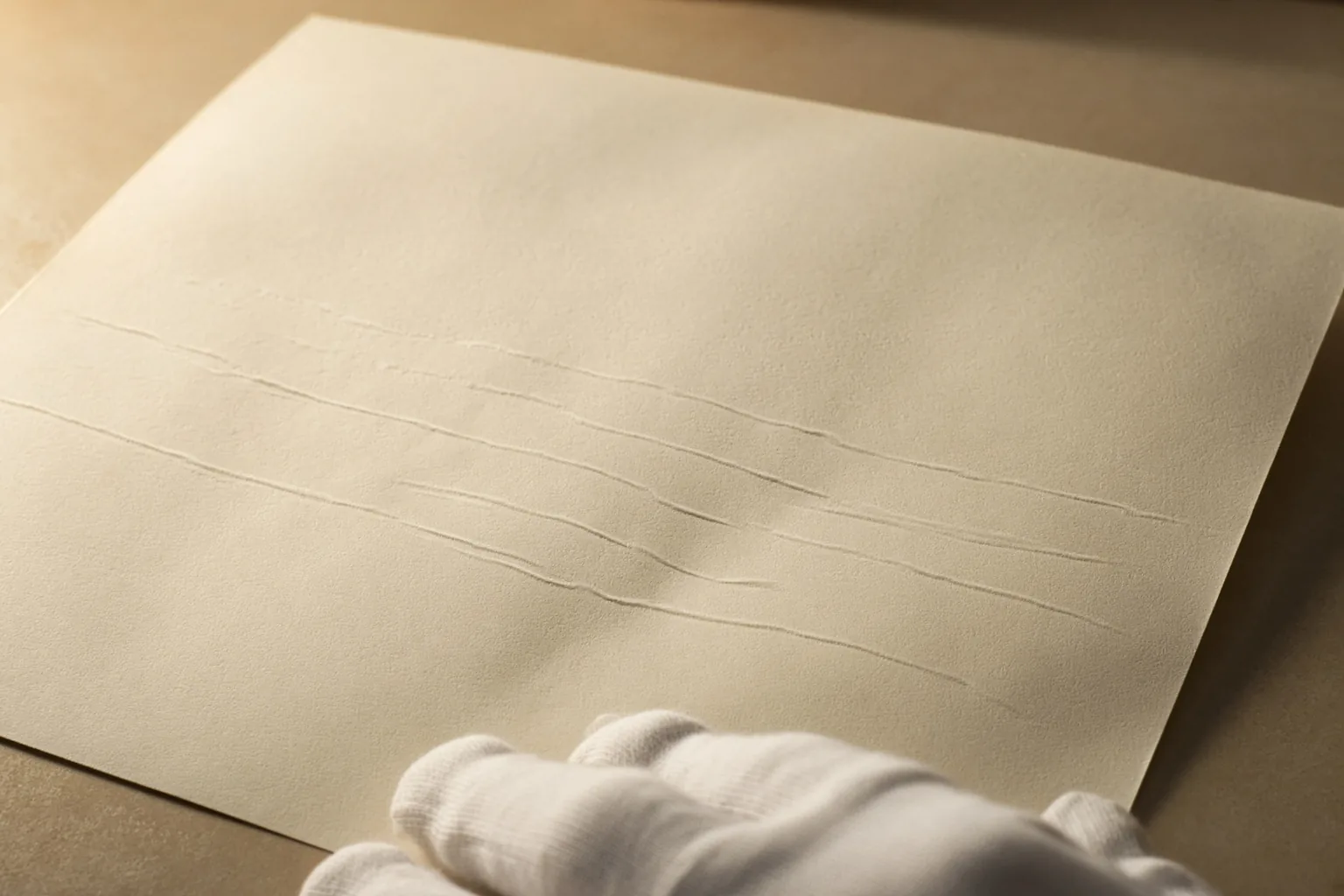
Indented writing: can an examiner read what was written on the sheet above?
Writing presses into the sheets underneath, and a document examiner can often make those invisible indentations readable with low-angle lightSergei VoroninExpert examinations
Ready to discuss your case?
Send the materials: the secretariat will confirm the format, cost, deadline and the specialist within one business day.
