
Expert report review
Artificially aged document: how is the opposing examiner's finding of heat or light aging reviewed?
A report that calls a document artificially aged makes one of two claims: that someone treated the paper or ink to make it look older, or that the examiner heated a sample to estimate the age of an entry. Published research gives a reviewer tests for both: heat drives off ink solvents without aging the dyes, ordinary light can fade an entry on a shelf, and accelerated aging was called unreliable as a dating method in the 1990s.
What does "artificially aged" mean in a document examination?
Either a forger's treatment of the paper or ink to make a document look old, or a laboratory method that heats a sample to estimate ink age. The review first establishes which of the two the report means.
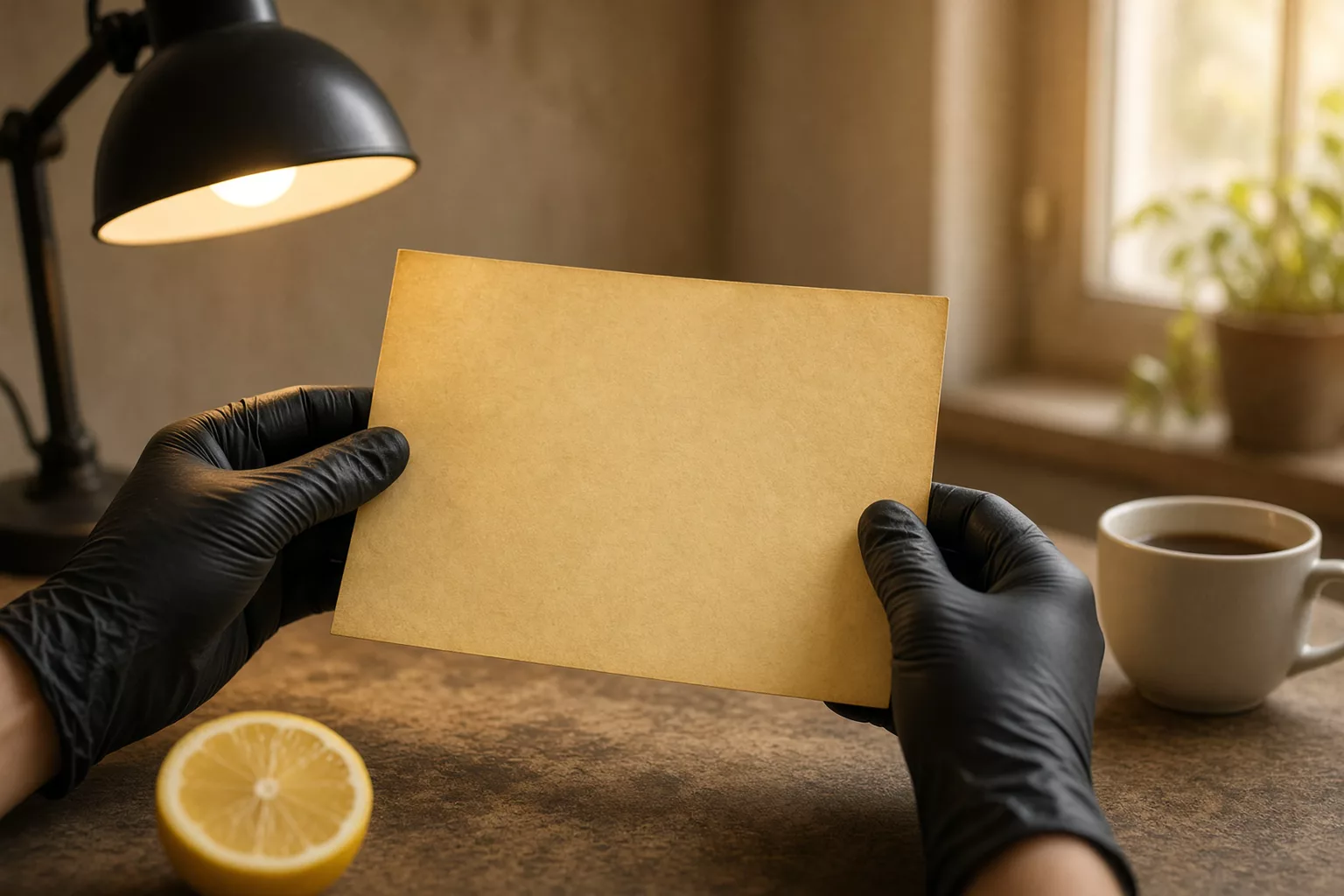
The first meaning is a finding about the document. Gerald M. LaPorte of the National Institute of Justice and Kirsten A. Singer of the Department of Veterans Affairs Office of Investigation listed the usual methods in "The Examination of Suspected Artificially Aged Paper", presented to the Questioned Documents section of the American Academy of Forensic Sciences in 2012: soaking paper in coffee or tea, or applying lemon juice or milk before baking the paper in an oven, and adding intentional burn marks or man-made holes.
A 2021 study in Rapid Communications in Mass Spectrometry (volume 35, issue 9) by L. F. C. Oliveira and co-authors describes counterfeit land documents in Brazil aged with coffee, cola and crickets.
The second meaning is a method. In the accelerated aging technique the examiner heats a sample of the questioned entry and measures how much its extractable ink changes, on the theory that a fresh entry changes more than an old one. Larry F. Stewart and Susan L. Fortunato contrasted it with relative ink age determination in the International Journal of Forensic Document Examiners in 1996 (volume 2, No. 1, pages 10 to 15).
The two meanings call for different reviews. A finding that the paper was treated is checked against the physical and chemical observations. An age estimate made by heating is checked against what is known about the reliability of the technique.
How does an examiner detect artificially aged paper?
By physical, optical and chemical tests of the paper: texture, discoloration patterns and ultraviolet properties, compared with how paper ages naturally. Some laboratories add chemical tests for coffee, tea or other agents.
LaPorte and Singer state that the natural paper aging process tends to produce observable, readily identifiable characteristics, and that appropriate physical, optical and chemical techniques can distinguish them from treatment, naming paper texture, discoloration patterns and ultraviolet properties.
Chemistry has added tests for the agents themselves. Oliveira and co-authors used easy ambient sonic-spray ionization mass spectrometry on papers aged with coffee, a cola drink and crickets; with multivariate analysis, the chemical fingerprints could qualitatively differentiate all the examined paper samples, and the authors describe the method as cheap, fast, simple and non-destructive.
A review checks which of these observations appear in the report and its images. A conclusion of artificial aging that rests on color alone has a gap, because, as the next sections set out, light and storage change color too.
Does heat age ink the way time does?
Not for the dyes. Heat drives solvents out of an entry, but in a 2002 study an ink heated at 100 degrees C for 320 minutes stayed "new" in its dye, while ultraviolet light degraded the dye.
Donna M. Grim, Jay Siegel and John Allison studied methyl violet dye in ballpoint ink with laser desorption mass spectrometry in the Journal of Forensic Sciences (volume 47, No. 6, November 2002). They write that "the addition of heat fails to sufficiently accelerate the mechanism producing the dye degradation products": heat removes the solvent, so the sample ages from a solvent perspective but not from a dye perspective. A sample heated at 100 degrees C for 320 minutes was still "new" from the standpoint of dye degradation.
Ultraviolet light behaved differently. In their system every hour of UV irradiation accelerated dye aging by about 182 days, later refined to about 187, and the authors caution that the rate of 180 to 190 days per hour holds for that particular system only. The article was filed as an exhibit in Ceglia v. Zuckerberg in the Western District of New York (docket 1:10-cv-00569, document 263).
Céline Weyermann and Bernhard Spengler reached a similar result in Forensic Science International in a paper on "The potential of artificial aging for modelling of natural aging processes of ballpoint ink." Light from a xenon lamp reduced the relative peak area of the dye BV4 to 30% after 50 hours, while heating at 100 degrees C caused only slight degradation. Heat did speed up solvent loss: at 60 degrees C, 10 hours corresponded to about 500 hours at 20 degrees C for one solvent and about 2,900 hours for another.
A document baked to look old can therefore show dried-out solvents with dyes that look young. A review asks whether the report measured both and compared them.
Can ordinary light or storage look like artificial aging?
Yes. Ink kept in light can change within a week, ink kept in the dark changes slowly, and the same hours of artificial light matched very different periods of natural aging in different seasons.
Georgina Sauzier and co-authors tracked blue ballpoint inks on paper for up to 32 months (Analytical Methods, 2018, volume 10, issue 47, pages 5613 to 5621). Most inks exposed to light showed rapid spectral changes that continued throughout the 32 months, and in the authors' earlier two-month study such changes appeared in as little as one week. The authors attribute them to photodegradation of triarylmethane dyes, accelerated by titanium dioxide in the paper. They also note that artificial ageing "does not necessarily provide a complete representation of ink ageing processes under natural conditions."
Weyermann and Spengler found no dye degradation within three years of storage in the dark. Their comparison of artificial and natural light aging gave 50 hours of lamp exposure equal to about 600 days of natural aging in the winter of 2002, 200 days in the summer of 2002 and 80 days in the summer of 2004.
Jan Andrasko kept monthly ink entries in a closed notebook at room temperature for about two years (Journal of Forensic Sciences, 2002, volume 47, No. 2, pages 324 to 327). The composition of the inks changed in darkness in ways similar to changes caused by light or heat, and the abstract warns that prolonged exposure to daylight, artificial light or extensive heat makes his relative dating procedure inapplicable.
The storage history of the document is therefore part of the evidence. A contract kept in a window display and a contract kept in a closed safe will not age alike, and a finding of deliberate aging has to exclude the first explanation.
Is the accelerated aging technique a reliable way to date an entry?
The published record is weak. Stewart and Fortunato reported 1994 results calling it unreliable and possibly misleading, and Weyermann and Spengler concluded that artificial aging of dyes cannot be advocated for dating ink from a single entry.
Stewart and Fortunato describe the appeal of the technique: it "does not require known entries for comparison", while relative ink age determination "historically has required known standards for comparison." They also record its problems. A 1988 scaling factor, under which 90 days of natural aging at 25 degrees C equal 4 minutes of artificial aging at 100 degrees C, applied to one ink on one paper. In heating experiments, "the more heat that was introduced, the less the ink extracted." It had not been established whether inks chemically degrade at temperatures of 100 degrees C or below. The 1994 results described in the article called accelerated aging "unreliable and possibly misleading", and the authors wrote that the technique "is still in its infancy."
Weyermann and Spengler wrote that "one cannot advocate the use of artificial aging of dyes for the purposes of dating ink from a single entry" and that no model can be generalized to all inks stored under different conditions and on different papers. They noted that inter-laboratory validation of artificial aging dating methods had not been published.
The SWGDOC Standard for Test Methods for Forensic Writing Ink Comparison places ink dating outside its scope (section 1.2). An examiner who dates an entry by heating names the method, its validation and its error, and Rule 26(a)(2)(B)(i) of the Federal Rules of Civil Procedure requires the basis and reasons for every opinion in the report.
What can a dating examination prove, and what can it not?
It can show that a document could not have been made on its date. It cannot prove that the document is authentic. A finding of artificial aging belongs to the first kind of result and needs the same basis.
Antonio A. Cantu described the two approaches to dating in the International Journal of Forensic Document Examiners in 1995 (volume 1, issue 1, pages 40 to 51). The static approach establishes when materials in or on a document first came into existence, using reference standards. The dynamic approach examines how materials of the same composition age, usually on the same document. His abstract states: "These methods detect fraud but cannot prove authenticity."
A conclusion that a document was artificially aged is a conclusion of fraud. It carries the weight of the observations behind it: treated paper fibers, residues of an aging agent, a mismatch between solvent loss and dye degradation. A conclusion built on a single indicator that ordinary light could also produce is weaker, and the review says so with the page reference.
What does a reviewer check in a finding of artificial aging?
Which meaning the report uses, which observations support it, whether light and storage were excluded, whether both solvents and dyes were measured, and whether the method used for any age estimate has published validation.
The review goes through the report and the examiner's file point by point.
- Does the report say that the paper or ink was treated, or does it estimate age by heating a sample, and is each conclusion stated separately?
- Which physical, optical and chemical observations of the paper are recorded, with images: texture, discoloration pattern, ultraviolet response, residues?
- Were other documents from the same file or the same storage examined as controls?
- Did the examiner measure both solvent loss and dye degradation, and do the two indicators agree?
- What does the report say about the storage of the document, where did that information come from, and was exposure to light considered?
- If the age estimate rests on accelerated aging, which published procedure was used, on which ink and paper was it validated, and what error does it carry?
How is an artificial aging finding tested in a US case?
Through the report requirements, discovery of what the examiner assumed about storage, the deposition and a rebuttal report on the same subject, due within 30 days of the other side's disclosure unless the court sets another date.
Rule 26(a)(2)(B) requires the report to state the basis and reasons for each opinion and the facts or data considered. Rule 26(b)(4)(C)(iii) opens to discovery communications that identify assumptions the attorney provided and the expert relied on; in an aging case these can include where and how the document was kept, which the studies above tie to the result.
Rule 705 of the Federal Rules of Evidence lets an expert state an opinion without first giving the underlying data, but the expert may be required to disclose those facts or data on cross-examination. A rebuttal report intended solely to contradict or rebut evidence on the same subject is due within 30 days after the other party's disclosure under Rule 26(a)(2)(D)(ii), absent a stipulation or order.
What does IAE do when the opposing report says a document was artificially aged?
IAE prepares a review of the opposing questioned document report, checked against the published standards and the examiner's file, in up to 5 business days after the format and cost are confirmed.
The IAE review page for questioned documents is written for attorneys facing the other side's report on alterations, substituted pages, ink or dating. The reviewer reads the report and the produced file against ANSI/ASB Standards 011 and 035, the SWGDOC ink comparison standard and Rule 26(a)(2)(B). The page lists destructive testing among the checks: Standard 035 places destructive tests after non-destructive methods and requires recorded permission and images before and after.
Send the opposing report and the produced file through the form on the contact page and describe what needs to be checked. The secretariat confirms receipt the same day and, within one business day, the format, the cost, the deadline and the specialist from the registry; you approve the reviewer and the CV before work starts. Cases with tight deadlines have a 48-hour rush.
Registry members passed the collegial attestation of the council under the published Criteria Matrix, and the Member ID in the document can be checked by QR code. The reviewer confirms in the document that he or she has no interest in the outcome, and materials are not passed to third parties without your consent. Neither IAE nor the reviewer guarantees the outcome, and IAE is not a law firm and does not advise on case strategy.
Sources
- LaPorte G. M., Singer K. A., The Examination of Suspected Artificially Aged Paper, AAFS 2012 Proceedings, J5
- Oliveira L. F. C. et al., Rapid and direct detection of artificially aged papers employing easy ambient sonic-spray ionization mass spectrometry, Rapid Communications in Mass Spectrometry, 2021, 35(9), record in the Mackenzie repository
- Stewart L. F., Fortunato S. L., Distinguishing Between Relative Ink Age Determinations and the Accelerated Aging Technique, International Journal of Forensic Document Examiners, 1996, 2(1), 10-15
- Grim D. M., Siegel J., Allison J., Evaluation of Laser Desorption Mass Spectrometry and UV Accelerated Aging of Dyes on Paper as Tools for the Evaluation of a Questioned Document, Journal of Forensic Sciences, 2002, 47(6), filed in Ceglia v. Zuckerberg, W.D.N.Y. 1:10-cv-00569, Doc. 263
- Weyermann C., Spengler B., The potential of artificial aging for modelling of natural aging processes of ballpoint ink, Forensic Science International
- Sauzier G. et al., A study into the ageing and dating of blue ball tip inks on paper using in situ visible spectroscopy with chemometrics, Analytical Methods, 2018, 10(47), 5613-5621
- Andrasko J., Changes in Composition of Ballpoint Pen Inks on Aging in Darkness, Journal of Forensic Sciences, 2002, 47(2), 324-327 (NCJRS abstract)
- Cantu A. A., Sketch of Analytical Methods for Document Dating, Part I, The Static Approach, International Journal of Forensic Document Examiners, 1995, 1(1), 40-51 (NCJRS abstract)
- SWGDOC Standard for Test Methods for Forensic Writing Ink Comparison, version 2013-1
- Federal Rules of Civil Procedure, Rule 26 (LII, Cornell Law School)
- Federal Rules of Evidence, Rule 705 (LII, Cornell Law School)
Read also
All articles
The government's forensic report says your document is counterfeit: how is it reviewed and rebutted in immigration proceedings?
An asylum file or a benefit application can turn on one sheet of paper: a birth certificate, a church letter, a party card. When a government Sergei Voronin
The opposing examiner says the pages came from different printers: how is that opinion reviewed?
Opinions that a page was printed on a different machine than the rest of a contract often decide substitution claims. The SWGDOC standards for tonerSergei Voronin
The opposing examiner calls the document a forgery: may a document examiner decide that?
A document examiner may testify that a signature is not the writing of the person named, that a page was replaced or that an entry was added. WhetherSergei VoroninExpert report review
Ready to discuss your case?
Send the materials: the secretariat will confirm the format, cost, deadline and the specialist within one business day.
