
Examinations
Backdated documents: can a forensic examiner tell when a document was signed?
A forensic document examiner can sometimes show that a document could not have been made on the date it bears, or that one entry was written later than the others. ANSI/ASB Standard 011 lists comparison of ink, paper, printing and watermarks against a reference collection among the examiner's tasks and says that dating a document can require more than one type of examination.
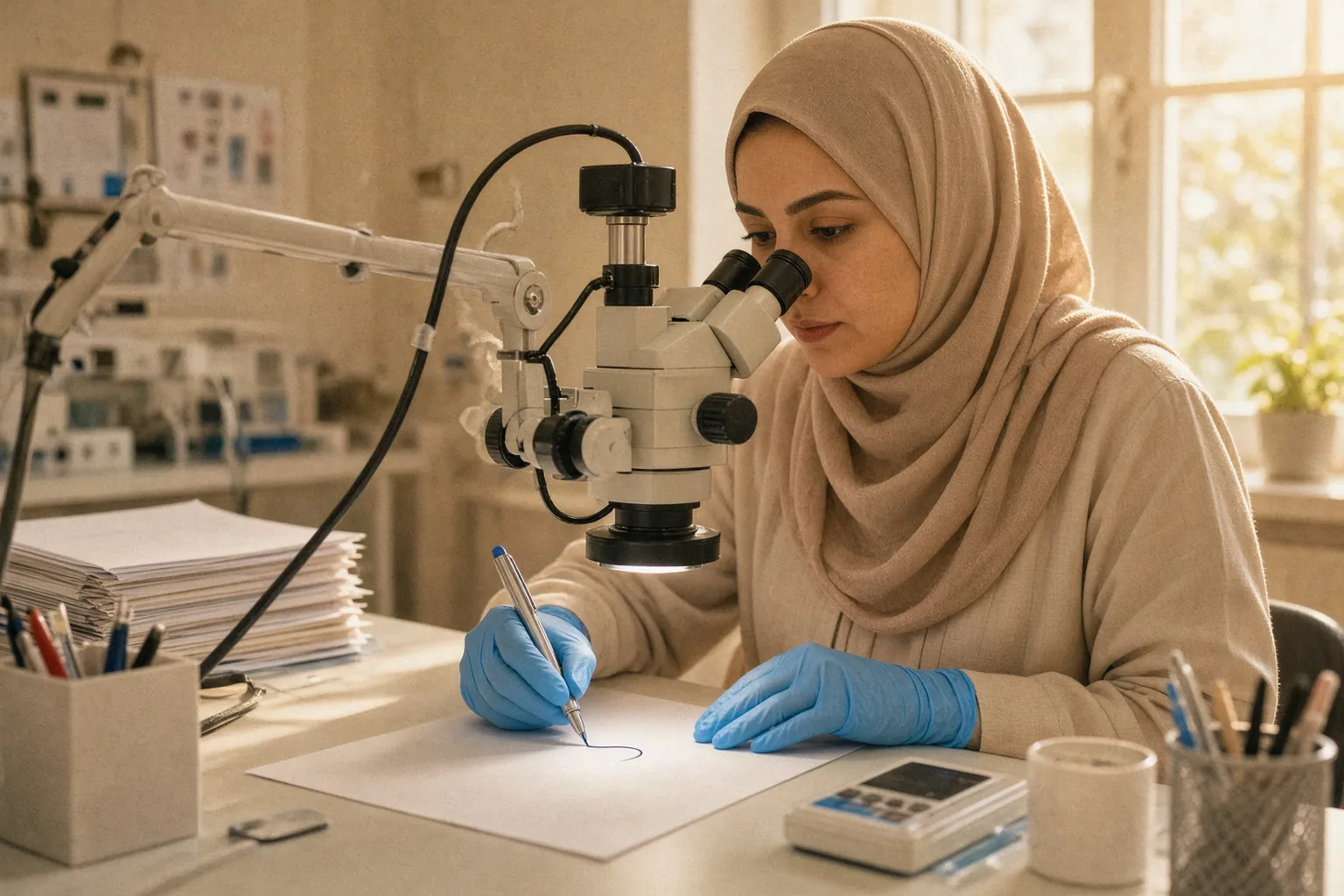
Can a forensic document examiner tell when a document was signed?
Sometimes. The examiner can find elements that did not exist on the stated date or compare the relative age of inks on the same document. These methods can expose backdating but cannot prove that a document is authentic.
ANSI/ASB Standard 011, Scope of Expertise in Forensic Document Examination, first edition 2022, lists the tasks of a forensic document examiner. Two of them concern dating. One is "the examination and comparison of ink, paper, and writing instruments." The other is "the comparison of elements of a document (e.g., typewriting, printing, paper, watermarks, ink) with an appropriate standard reference collection to determine age, production history, or authenticity."
Section 4.2.3 of the same standard sets a limit: "Many analytical requests involving documents, such as the sequence of preparation, dating of documents, and counterfeit recognition, can require more than one type of document examination." A dating question is seldom answered by one test. The examiner may need to examine the ink, the paper, the printing and any indentations, and report what each examination found.
A. A. Cantu, writing in the International Journal of Forensic Document Examiners in 1995, divided dating methods into two groups. The static approach determines when items in or on a document first came into existence. The dynamic approach compares the relative aging of similar materials, often on the same document. His abstract states the limit that applies to both: "These methods detect fraud but cannot prove authenticity."
In practice the examiner's answer falls into one of two kinds. Either something on the page is inconsistent with the stated date, or nothing found contradicts it. The second answer is not proof that the document was signed on that date.
How can an examiner show that a document could not exist on its date?
By identifying an ink, paper, watermark or printing element and checking in a reference collection when that element first came into existence. If it first appeared after the stated date, the document was made later.
Cantu's first paper, "Sketch of Analytical Methods for Document Dating, Part I" (volume 1, issue 1, pages 40-51, NCJ 159687 in the National Criminal Justice Reference Service), describes the static approach. The examiner compares the items on the document with reference standards to find when they first existed. The abstract adds that authenticity can sometimes be suggested when several different inks on an old document show no backdating and each has a discontinuance date close to the alleged date.
The U.S. Secret Service keeps one such collection. In a press release dedicating its Forensic Services Division library to Dr. Cantu, its former Chief Forensic Chemist, the agency says that he oversaw the international ink library and helped collect and consolidate "more than 11,000 samples, dating back as early as the 1920s." The same release describes the laboratory's capabilities "to identify ink makes, models, types and document authenticity."
A Secret Service Forensic Services capabilities flyer lists the work of its Questioned Documents Branch. The branch examines the chemical makeup of pen and printer inks and compares inks against the International Ink Library, which the flyer calls "the largest ink library in the world."
The same logic applies to paper, watermarks, typewriting and printing. Each item that the reference collection dates after the date on the document is evidence that the document was prepared later. Each item that existed before that date is consistent with it and proves nothing more.
Can ink age show how long ago a signature was made?
Only in relative terms. Relative aging compares how similar inks on the same document or set of documents have aged since they were placed on the paper, to find which entries were made later.
Cantu's second paper, "Sketch of Analytical Methods for Document Dating, Part II" (volume 2, issue 3, pages 192-208, 1996, NCJ 166131), deals with the dynamic approach. The abstract starts from the chemistry: "For inks, the aging process usually begins when they are placed on paper." It covers sampling, the shape of the aging curve and the role of statistics in age determinations.
According to the same abstract, most of the methods determine "when inks of the same formula were placed on a sheet relative to one another." The abstract uses that comparison to detect backdating fraud and to test whether an ink was placed on the alleged date. The Secret Service release says that Dr. Cantu worked on the first ink dating case "using the relative aging of inks to determine when the ink was placed on a document."
Relative aging needs comparison material. The examiner compares similar materials, so the first step is to confirm that the entries being compared were made with the same ink formulation. The comparison entries can be on the questioned document itself or on other documents of the same party whose dates nobody disputes.
A report that converts relative aging into a calendar date has to show how the method supports that date. The committee note to the 2023 amendment of Federal Rule of Evidence 702 says that "each expert opinion must stay within the bounds of what can be concluded from a reliable application of the expert's basis and methodology."
What besides ink can date a document or one of its pages?
Paper, watermarks, typewriting and printing, staples and staple holes, and indentations left by writing on a sheet above. ASB Standards 011 and 035 list these features among the things a document examiner examines and records.
ASB Standard 011 lists "the examination, comparison and classification of documents produced by typewriters, facsimile machines, photocopiers, computer printers, commercial printing and other mechanical or electronic imaging devices, and also the examination of the devices themselves as appropriate." It also lists the examination, visualization, decipherment and preservation of indentations, and names an electrostatic detection device among the standard equipment.
ANSI/ASB Standard 035, Standard for the Examination of Documents for Alterations, first edition 2020, lists what the examiner observes on each page in section 4.4.4. For handwriting it names overwriting, crowded spacing and inconsistent features. For printing, the process type, fonts, alignment and class characteristics. For paper, discoloration, fiber disturbance, cuts, tears, folds and indentations. For fastening, adhesives, staples and staple holes, paper clips and hole punches. The list also covers cutting and pasting or substitution, and insertion or omission of pages or entries.
These features matter when the dispute concerns one page of a longer document. A page printed by a different process, on different paper or with staple holes that do not match the rest of the set raises a question of when that page joined the document. Section 4.5.9 of Standard 035 provides for visualizing latent indentations with oblique lighting, an electrostatic detection device, or both.
Does the examiner need the original document?
Yes, for any ink work, because a copy carries an image of the writing without the ink. ASB Standard 035 calls examination of the original always preferable and limits what a copy can establish.
Section 4.3.2 of Standard 035 reads: "The examination of the original item(s) is always preferable." Under section 4.3.3, when the original is not available, the examiner works from the best available evidence. Section 4.3.8 adds that the absence of observed characteristics of alteration "does not support a definite determination that the document is unaltered."
Ink chemistry and relative aging are performed on the ink on the page. A photocopy, a scan or a fax holds no ink from the original pen, so neither method can be applied to it. A copy can still be compared with other copies and examined for signs of cutting and pasting, but the date of the ink is not among the questions it can answer.
The same preference applies to stamps. ANSI/ASB Standard 117, on stamping devices and stamp impressions, states in section 4.5.10.1 that "Examination of the original stamp impression is preferable," and in section 4.5.10.3 asks the examiner to examine the original questioned impression for characteristics of duplication by electronic or other means.
How does a party get the other side's original for testing?
Through a Rule 34 request to inspect, copy, test or sample the document. The request sets a reasonable time, place and manner, and the responding party answers in writing within 30 days after service.
Federal Rule of Civil Procedure 34(a)(1) lets a party serve a request "to produce and permit the requesting party or its representative to inspect, copy, test, or sample" designated documents in the other party's possession, custody or control. Under Rule 34(b)(1)(B), the request "must specify a reasonable time, place, and manner for the inspection and for performing the related acts." Under Rule 34(b)(2)(A), the response is due in writing within 30 days after service.
The 2006 amendment made testing and sampling explicit. Its committee note explains that parties "may request an opportunity to test or sample materials sought under the rule in addition to inspecting and copying them," and that "issues of burden and intrusiveness raised by requests to test or sample can be addressed under Rules 26(b)(2) and 26(c)."
Ink sampling removes material from the page, so the other side may ask for a protective order. Rule 26(c)(1) lets the court, for good cause, specify terms including time and place, prescribe a discovery method other than the one the requesting party selected, and designate the persons who may be present.
Standard 035 sets similar safeguards for destructive work in its own field. Under section 4.6, destructive examinations should be performed after non-destructive methods have been exhausted, permission is obtained and recorded before testing, and the item is imaged before and after. A request that names the method, the sampling points, the photographs and the persons present gives the court the terms it can set under Rule 26(c)(1).
What must a dating opinion meet to be heard at trial?
Rule 702. The party offering the examiner must persuade the court that it is more likely than not that the opinion rests on sufficient facts or data and applies a reliable method reliably to this document.
Rule 702 begins: "A witness who is qualified as an expert by knowledge, skill, experience, training, or education may testify in the form of an opinion or otherwise" if the proponent meets the four conditions. According to the 2023 committee note, "The amendment clarifies that the preponderance standard applies to the three reliability-based requirements added in 2000."
The same note warns that "Forensic experts should avoid assertions of absolute or one hundred percent certainty" if the methodology is subjective and thus potentially subject to error. The note to the 2000 amendment lists further factors, among them "Whether the expert has adequately accounted for obvious alternative explanations" and whether the expert "is being as careful as he would be in his regular professional work outside his paid litigation consulting."
For an ink-age opinion, an obvious alternative explanation for a difference between two entries is that two different inks were used. The static comparison of formulations answers that point before any relative aging result is offered.
Authenticity itself is governed by Rule 901. Under Rule 901(a), the proponent must produce evidence "sufficient to support a finding that the item is what the proponent claims it is." Rule 901(b)(3) names "A comparison with an authenticated specimen by an expert witness or the trier of fact" as one way, and Rule 901(b)(4) names distinctive characteristics "taken together with all the circumstances." The committee note on example (3) treats all comparison situations alike, to be governed by Rule 104(b).
What should the examiner's report say about its limits?
The purpose, the examinations performed, observations, conclusions, limitations and sources of uncertainty, and the methods used. Under Rule 26(a)(2)(B), a retained examiner's report also lists the facts or data considered and the reasons for each opinion.
Section 4.7.1 of Standard 035 lists the contents of a report: the stated purpose, the examinations conducted, observations, conclusions or opinions, limitations and sources of uncertainty, and the methods used. Annex B of Standard 011, the Department of Justice Code of Professional Responsibility, says in requirement 12 that "Reports should disclose known limitations that are necessary to understand the significance of the findings."
Rule 26(a)(2)(B) requires a retained expert's written report to contain "a complete statement of all opinions the witness will express and the basis and reasons for them," the facts or data considered, any exhibits, the witness's qualifications with a list of all publications authored in the previous 10 years, a list of all other cases in which the witness testified as an expert during the previous 4 years, and "a statement of the compensation to be paid for the study and testimony in the case."
A reviewer reading the other side's dating report checks a short list. Was the original examined, or a copy? Which reference collection or reference data dated the ink, paper or printing? Were the compared entries made with the same ink? Does the conclusion stay within what the method can support, or does it name a date that the method cannot produce?
Absent a stipulation or court order, a rebuttal report on the same subject is due under Rule 26(a)(2)(D)(ii) "within 30 days after the other party's disclosure."
What does IAE do when the date of a document is disputed?
An examiner from the IAE registry prepares a report on your questions or a review of the opposing examiner's report. The document is issued in up to 5 business days after the format and cost are confirmed.
The questioned documents page lists the questions the examiner answers for federal and state cases: whether a page was inserted or replaced, an entry erased or overwritten, a stamp impression made by the stamp in question, and how the document was printed. The examinations follow ANSI/ASB Standards 035 (alterations), 011 (printing process and scope) and 117 (stamp impressions). To the question whether an examiner can tell when a document was made, the page answers: in some cases.
The questions are framed around the document and the part of it in dispute. Before work starts IAE confirms with you the questions and the handling of the original. The client sends the document or the case materials, and the secretariat confirms receipt the same day. Within one business day IAE confirms the format, the cost, the deadline and the examiner from its registry, and you approve the candidate and the CV. Cases with tight deadlines have a 48-hour rush.
Every examiner is a member of the public IAE registry and passed the council's attestation under the published Criteria Matrix. The Member ID in the document opens the examiner's category, specialization, attestation date and record status on the status check page or by QR code.
Materials go through the contact form or to info@iaexperts.com and are not passed to third parties without the client's consent. The court weighs the report together with the other evidence. Neither IAE nor the examiner guarantees the outcome, and IAE is not a law firm and does not advise on case strategy.
Sources
- ANSI/ASB Standard 011, Scope of Expertise in Forensic Document Examination, 1st Ed. 2022 (AAFS Standards Board)
- ANSI/ASB Standard 035, Standard for the Examination of Documents for Alterations, 1st Ed. 2020 (AAFS Standards Board)
- ANSI/ASB Standard 117, Standard for Examination of Stamping Devices and Stamp Impressions, 1st Ed. 2020 (AAFS Standards Board)
- A. A. Cantu, Sketch of Analytical Methods for Document Dating, Part I, International Journal of Forensic Document Examiners, vol. 1, no. 1 (1995), pp. 40-51, NCJ 159687
- A. A. Cantu, Sketch of Analytical Methods for Document Dating, Part II, International Journal of Forensic Document Examiners, vol. 2, no. 3 (1996), pp. 192-208, NCJ 166131
- U.S. Secret Service, press release on the dedication of the Forensic Services Division library to Dr. Cantu (international ink library)
- U.S. Secret Service, Forensic Services capabilities flyer (RVSD 6-2022)
- Federal Rules of Civil Procedure, Rule 34, Producing Documents and Tangible Things, with Committee Notes (LII)
- Federal Rules of Civil Procedure, Rule 26, Duty to Disclose; General Provisions Governing Discovery (LII)
- Federal Rules of Evidence, Rule 702, Testimony by Expert Witnesses, with Committee Notes (LII)
- Federal Rules of Evidence, Rule 901, Authenticating or Identifying Evidence, with Committee Notes (LII)
Read also
All articles
What can you ask a forensic document examiner, and what should you send with the document?
A forensic document examiner answers questions about how a document was made and what was done to it afterwards: whether an entry was added, a page Sergei Voronin
Burned, soaked or torn: what can a document examiner recover from a damaged document?
A document that went through a fire, a flood or a shredder is often still readable in part. Forensic document examiners work with charredSergei Voronin
Same pen or a different pen: what can a document examiner tell from the ink?
A document examiner can often show that two entries were written with different inks, and that settles that two pens were used. The reverse isSergei VoroninExpert examinations
Ready to discuss your case?
Send the materials: the secretariat will confirm the format, cost, deadline and the specialist within one business day.
