
Expert report review
Careless smoking fire: how does a reviewer check a report that blames a cigarette?
A cigarette that starts a fire almost never survives it, so a report that blames careless smoking rests on circumstances: who smoked, where, when, what the cigarette touched and which other ignition sources were ruled out. Courts have admitted such opinions when the investigator eliminated the alternatives on data, and struck them when there was no evidence that anyone smoked at the origin.
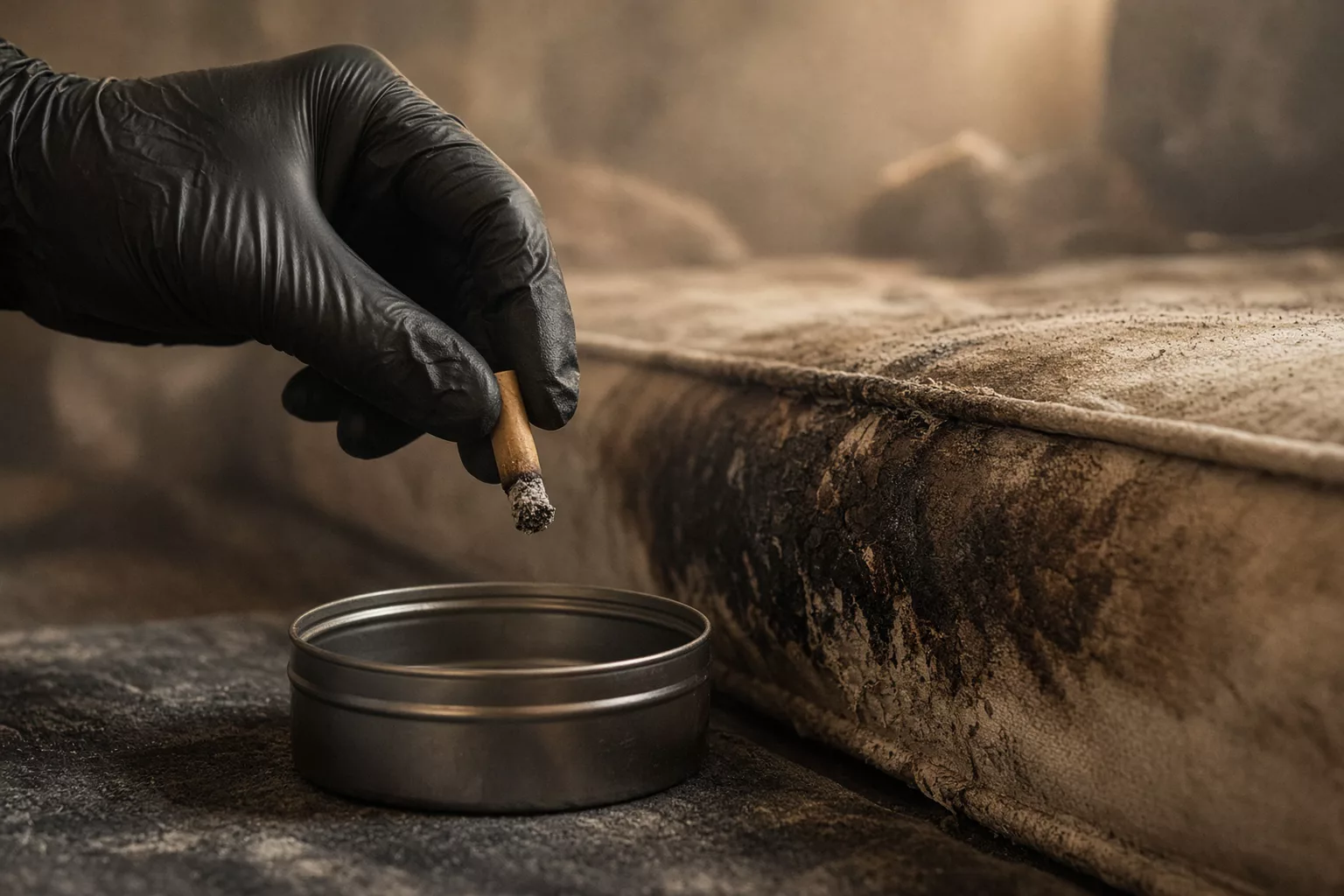
Why is careless smoking such a common and disputed fire cause?
It is common in fatal home fires: the U.S. Fire Administration ranks smoking third among causes of fatal residential fires in 2018-2020. It is disputed because the cigarette burns away and the proof is circumstantial.
The U.S. Fire Administration's topical report Fatal Fires in Residential Buildings (2018-2020), Volume 22, Issue 2, dated June 2022, puts smoking third among causes at 14 percent, after other unintentional or careless actions at 20 percent and cause under investigation at 16 percent. Smoking was the leading cause of fatal fires that started in bedrooms (21 percent) and in common rooms (23 percent).
The same report shows when these fires happen. Fatal fires peaked between midnight and 1 a.m. (7 percent), and the eight hours between 11 p.m. and 7 a.m. accounted for 45 percent. The report notes that "cigarette and other smoldering fires" started before bedtime may go unnoticed and grow rapidly while the occupants sleep, and that the leading human factor contributing to ignition was being asleep (41 percent).
Those numbers explain why investigators reach for smoking and why the other side resists it. The physical evidence is thin: the cigarette is consumed in the fire. The opinion is built from the occupants' habits, the location of ashtrays and butts, the timeline and the elimination of other sources, and each of those can be tested.
Does a fire department's smoking code prove the cause?
No. In USFA's cause categories smoking is a behavioral cause, smoking materials are a separate heat source group, and a fire deliberately set with smoking materials counts as intentional. A code records a classification, not the data behind it.
The USFA report explains its own categories in a footnote: "smoking" is a behavioral cause, while fires ignited by smoking materials form a separate heat source group, and a fire deliberately set with smoking materials is counted as intentional. A department report that checks the smoking box therefore says how the officer classified the fire. It does not say what the officer observed.
Courts treat the cause line in a fire report with the same caution. In Emmet v. American Insurance Co. (D.C. 1970) the trial court relied on a fire investigator's report that gave the "apparent cause of fire" as "careless smoking ignited mattress." The investigator did not testify, and the District of Columbia Court of Appeals reversed, writing that such an opinion "is usually based upon hearsay and often is mere speculation or conjecture."
In Westinghouse Electric Corp. v. Dolly Madison Leasing & Furniture Corp. (Ohio 1975) a fire chief gave the opinion that careless smoking was the probable cause. The Supreme Court of Ohio held in its syllabus that "The hearsay rule includes within its scope written summaries of interviews conducted during an official fire investigation." A review therefore separates what the fire service saw from what it was told and from the code it entered.
What does a careless smoking opinion have to show?
That someone smoked in the area of origin within a time window that fits a smoldering ignition, that smoking materials could ignite the first fuel there, and that the other ignition sources in that area were excluded on data.
The first link is the smoker. A report needs evidence that a person smoked in the area of origin: testimony, butts or ashtrays found in place, a smoking area by policy. A general statement that a resident was a smoker does not put a cigarette at the origin.
The second link is the time. The report has to place the last smoking before the first sign of fire and explain why the interval fits a smoldering start. The third is the first fuel: bedding, upholstered furniture, trash in a plastic can or debris on a balcony. The fourth is the elimination of the other ignition sources in the area: wiring, appliances, heating, candles, and in some cases an incendiary act.
A reviewer writes each link down with the evidence the report gives for it. Smoking is often the only remaining hypothesis after the others are excluded, and an investigator who stops there has an opinion by elimination with no positive evidence that a cigarette was present. That is the gap the New Jersey courts found fatal in the next case.
What happened when there was no evidence that anyone smoked at the origin?
In Sayta Sankalp v. Five Star Auction (N.J. App. Div. 2014) the court affirmed summary judgment. The plaintiff's expert blamed careless smoking with no evidence that anyone smoked there, which the court called at best an educated guess.
On March 25, 2008, a fire started in the storage section of Five Star Auction's unit in a strip mall in Salem, New Jersey, and spread to the plaintiff's adjacent Dollar Dream store. Five Star had a no-smoking policy, and its employees denied seeing anyone smoke in the building. One employee who smoked left by 8:00 p.m. The fire alarm sounded at 11:17 p.m.
The plaintiff's expert, John Oakley, considered and eliminated electrical causes, spontaneous combustion, weather and intentional acts, and concluded that the "most probable cause of the fire is related to careless smoking." In a supplemental report he said that a lit cigarette was a competent ignition source and that thought experiments, rather than physical testing, supported his hypothesis. An electrical engineer found that the wiring and fixtures were not the ignition source. The defense investigator found no physical evidence of smoking.
Captain Rodman Meyer of the New Jersey Division of Fire Safety classified the cause as undetermined. He had eliminated careless discarding of smoking materials based on the owners' denials and explained that a smoldering cigarette fire would take longer to develop. The defense expert, Frank Schwalje, said that Oakley's conclusion lacked supporting data, did not follow NFPA 921 and amounted to speculation.
The trial court struck Oakley's opinion as a net opinion on reconsideration and granted summary judgment to Five Star. On September 10, 2014 the Appellate Division affirmed in an unpublished per curiam opinion. It called the smoking conclusion "at best, an educated guess," "devoid of supporting facts," and held that without admissible expert proof "no reasonable jury could have found negligence on the part of defendant."
When have courts let a smoking opinion go to the jury?
When the investigators tied the cigarette to a person and a place and eliminated the other sources. In Travelers v. Volunteers of America (E.D. Ky. 2012) smoking opinions resting on scene work and a resident's account were admitted.
Travelers, as subrogee of the owner of the Brookview Apartments in Lexington, Kentucky, claimed that a resident, Dena Sellers, caused the fire in Apartment 51 by discarding cigarettes into a plastic trashcan next to her bed. The defense, Volunteers of America, said the fire started on the patio and was caused by an unknown energized electrical device.
Three witnesses supported the smoking cause. Captain Gary Ward of the Lexington Fire Department concluded that the fire started in the trashcan after eliminating other ignition sources. James Thomas, Travelers' investigator, narrowed the origin to the bedroom and attributed the fire to discarded smoking materials based on his scene observations, Ward's report and Sellers's account. Frederick Franklin, an engineer who examined the bedroom outlets, concluded that careless smoking caused the fire.
On August 21, 2012 Judge Karen K. Caldwell denied the motions to exclude on both sides. The court held that the "inability to physically test a hypothesis" does not disqualify an expert who eliminated the other ignition sources under section 18.2.1 of NFPA 921, that "Experts can base opinions on direct and circumstantial evidence," and that "An expert is free to rely on another expert's opinion in formulating their own opinion." It noted that Ward "testified that he is 100% certain" and treated the disputes as matters of weight.
The contrast with Sayta Sankalp is the positive evidence. In Brookview there was a resident who smoked, an account of where she discarded the cigarettes and a trashcan in the area of origin. In the Salem warehouse there was a no-smoking policy, denials and a gap of more than three hours.
How does a reviewer test the timeline of a smoldering cigarette fire?
By fixing the last time anyone smoked in the area and the first sign of fire, and asking the report to explain the interval with the first fuel and the ventilation. A report with no times cannot be tested.
Both endpoints come from records and witnesses: the last time a smoker was in the area, the time a door was locked or a shift ended, the first smoke seen, the alarm or the 911 call. In Sayta Sankalp the endpoints were 8:00 p.m. and 11:17 p.m., and Captain Meyer's view that a smoldering cigarette fire takes longer to develop was part of the record the court reviewed.
The interval alone settles nothing. A cigarette in a plastic trashcan full of paper, a cigarette between upholstered cushions and a cigarette on a concrete balcony are different scenarios. The reviewer asks what the report names as the first fuel, whether that fuel can smolder long enough to fill the interval, and what research or testing the report cites for it.
If the report gives no times, the reviewer writes that the smoking hypothesis has not been tested against the timeline. If the report gives times and an interval it does not explain, the reviewer marks the explanation as the missing step.
What does a reviewer check in a report that blames careless smoking?
The evidence that someone smoked at the origin, the times, the first fuel, the area of origin found independently of the smoking theory, the excluded ignition sources and the source of every statement about smoking.
The reviewer starts with the people: who smoked, where, how often, what witnesses and documents say about it, and whether butts, ashtrays or packs were found and documented in place. Then the times, as above. Then the first fuel and its location relative to the fire patterns.
The origin must stand on its own data. If the report placed the origin at the trashcan because the resident smoked there, the origin and the cause support each other and neither is tested. The reviewer checks that the origin rests on fire patterns, arc sites and witness observations and that the smoking evidence came after.
Last come the eliminations and the hearsay. Each ignition source in the area of origin needs a line with the data that excluded it, including outlets, cords, appliances, heaters, candles and an incendiary act. Every statement about smoking is traced to the person who made it and to the record that preserved it, because a fire department narrative that repeats what a neighbor said is the kind of summary the Ohio court treated as hearsay.
What does IAE do when the opposing report blames careless smoking?
IAE prepares reviews of the opposing investigator's report for subrogation, product liability, arson defense and coverage disputes in US courts, and expert reports on the client's questions. Up to 5 business days.
The review lists each hypothesis the opposing investigator considered, checks what data excluded the others and which NFPA 921 edition was applied, and traces every artifact to its examination. In a smoking case the client sends the opposing report with its exhibits, the fire department report and narrative, the scene photographs, statements and deposition transcripts about smoking in the building, alarm and call records, and states whether the scene and the removed artifacts still exist.
The secretariat confirms receipt the same day. Within one business day IAE confirms the format, the cost, the deadline and the specialist from its registry, and the client approves the candidate and the CV before work starts. The signed review is issued within up to 5 business days once the format and cost are confirmed; cases with tight deadlines have a 48-hour rush.
Every specialist is a member of the public IAE registry and passed the council's attestation under the published Criteria Matrix; the Member ID or QR code in the document opens the specialist's record. The specialist confirms in the document that he or she has no interest in the outcome. Materials are not passed to third parties without the client's consent. A review is evidence the court weighs with the other materials; neither IAE nor the reviewer guarantees the outcome, and IAE is not a law firm.
Sources
- U.S. Fire Administration, Fatal Fires in Residential Buildings (2018-2020), Topical Fire Report Series, Vol. 22, Issue 2 (June 2022)
- Sayta Sankalp, LLC v. Five Star Auction, Inc., No. A-3203-12 (N.J. Super. Ct. App. Div. Sept. 10, 2014) (unpublished) (Justia)
- Travelers Casualty Insurance Co. of America v. Volunteers of America Kentucky, Inc., No. 5:10-301-KKC, Document 98 (E.D. Ky. Aug. 21, 2012) (Justia)
- Emmet v. American Insurance Co., 265 A.2d 602 (D.C. 1970) (Justia)
- Westinghouse Electric Corp. v. Dolly Madison Leasing & Furniture Corp., 42 Ohio St.2d 122 (1975) (vLex)
Read also
All articles
Clothes dryer fire: how does a reviewer check a report that blames lint, the owner or the dryer's design?
In the dryer fire litigation described below, the reports ended in one of two sentences: the owner let lint build up, or the dryer was built so that Sergei Voronin
Space heater fire: how does a reviewer check a report that blames the heater?
Portable heaters start about 1,100 residential building fires a year in the United States, and in the court cases below the dispute ran betweenSergei Voronin
Unattended cooking fire: how does a reviewer check a report that blames the stove?
Cooking causes about half of all residential building fires in the United States, and in the kitchen fire cases discussed below the dispute ranSergei VoroninExpert report review
Ready to discuss your case?
Send the materials: the secretariat will confirm the format, cost, deadline and the specialist within one business day.
