
Expert report review
Clothes dryer fire: how does a reviewer check a report that blames lint, the owner or the dryer's design?
In the dryer fire litigation described below, the reports ended in one of two sentences: the owner let lint build up, or the dryer was built so that lint collected near the heater. Federal testing, a multidistrict litigation order and a 2014 ruling on three experts describe what each sentence has to rest on. A reviewer of the opposing report checks where the lint was, what the vent and thermostats did and what was tested.
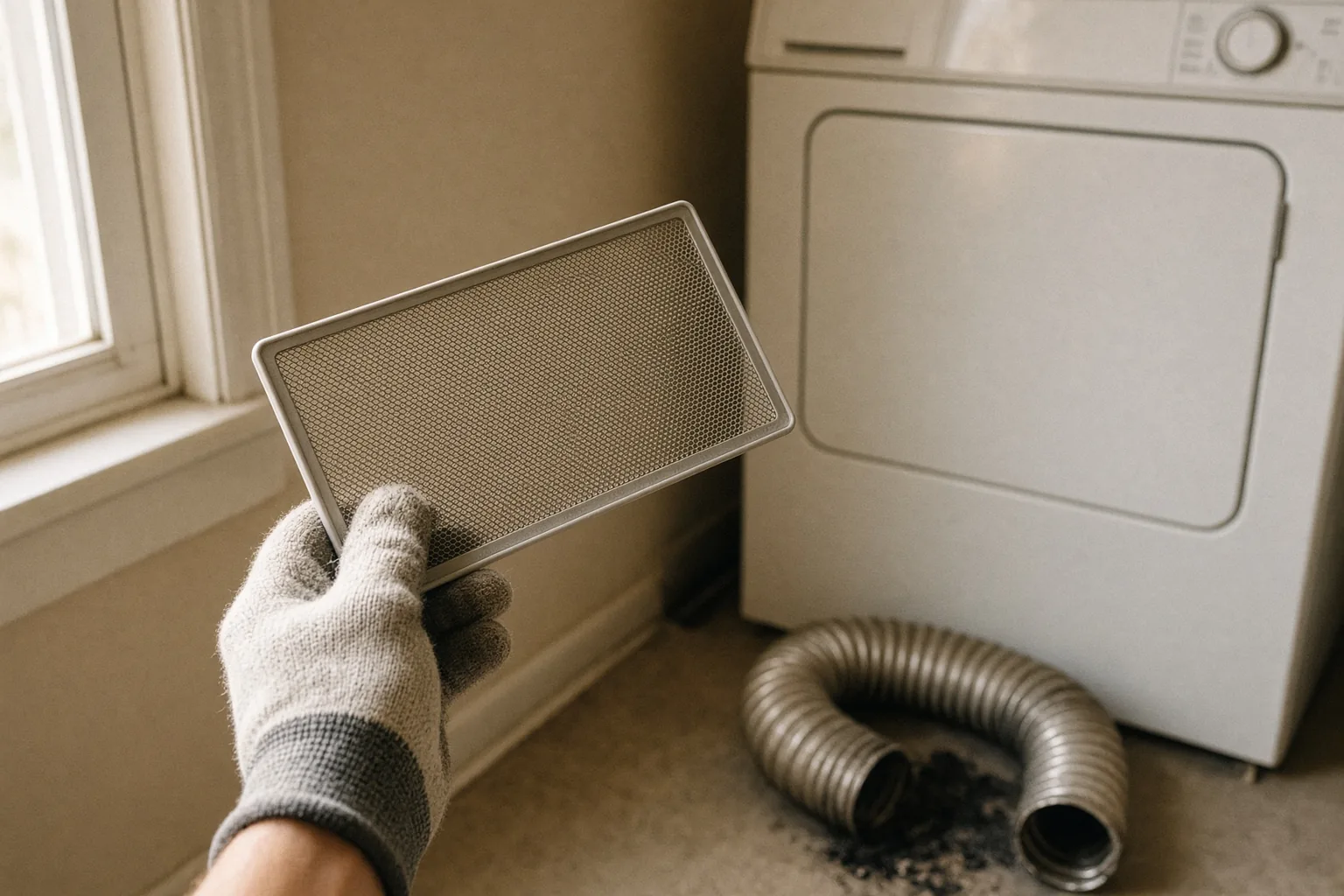
How often do clothes dryers start fires, and what burns first?
CPSC staff estimated 15,600 clothes dryer fires in 1998. An agency letter cites a January 2002 NFPA report naming lack of maintenance as the leading cause, with dust, lint and fibers ignited first in almost 28 percent.
Both figures are quoted here out of correspondence between the U.S. Consumer Product Safety Commission (CPSC) and the appliance manufacturers' association AHAM about the agency's Final Report on Electric Clothes Dryers and Lint Ignition Characteristics, dated May 2003. The agency's letter of November 21, 2003 gives the staff estimate, says it rested on data collected by the National Fire Protection Association (NFPA) and on the national fire incident reporting system, and cites the NFPA report. The May 2003 report and the NFPA report are described in this article only as those letters describe them.
Statistics of this kind put lint and maintenance at the head of the list of hypotheses. They do not decide a case. A cause recorded as "lack of maintenance" in incident data says nothing about where in a particular machine the lint lay or what heated it.
What are the two competing explanations in a dryer fire claim?
Maintenance and installation on one side, design on the other. In the Electrolux dryer litigation insurers alleged that a design let lint accumulate behind the drum near the heat source; the manufacturer pointed to installation, venting and owner maintenance.
On October 16, 2013 the U.S. Judicial Panel on Multidistrict Litigation ruled on a request to centralize the Electrolux cases. The order counts 35 actions pending in 21 districts. Most were subrogation actions brought by insurers that had paid fire losses.
The alleged defect was what the parties called the ball-hitch design, said to create a fire hazard through "accumulation of lint behind the drum near the heat source." Electrolux answered that each fire turned on its own facts: the dryer model, the installation, the venting, compliance with local building codes and the owner's maintenance.
The Panel denied centralization. It accepted that the cases shared factual questions about a common design, but found that, on the record before it, "individualized facts concerning the circumstances of each fire" appeared likely to predominate, and named installation, repair and maintenance as examples. The order notes that the product had been on the market since the mid-1990s and that numerous trials had reached jury verdicts.
For a reviewer the order is a map of the dispute. An opposing report on either side has to deal with both columns: the design of the model and the history of the particular machine.
Does lint build up inside a dryer that is cleaned and vented properly?
Yes, according to CPSC staff. An agency letter of November 21, 2003 says staff tests showed that lint accumulates in a dryer even when it is installed according to manufacturer instructions and the lint screen is cleaned between drying cycles.
The same letter says staff concluded that lint accumulation begins with the first uses of a clothes dryer, and that staff measured four sample dryers under controlled conditions. An earlier letter, sent on May 30, 2003 by the staff project manager for clothes dryers to Underwriters Laboratories, says staff initiated testing in 2002. It states that lint "begins to accumulate inside a dryer chassis upon first use," on components that include the heater and the dryer floor, even when the lint screen has been cleaned after each usage and the dryer is properly exhausted. On March 19, 2004 the agency's Executive Director withdrew the May 30 letter pending reevaluation. A reviewer checks whether an opposing report that quotes the May 30 letter mentions the withdrawal.
This finding bears on one line of reasoning: lint was found inside the cabinet, therefore the owner neglected the dryer. If lint reaches the cabinet in a correctly used machine, its presence alone does not prove neglect. The reviewer asks how much lint was found, where, and how the report ties that quantity to the owner's conduct and not to ordinary operation.
Under what conditions did lint ignite in the CPSC tests?
Under normal operation the heater housing did not reach temperatures sufficient to ignite lint. Ignition occurred only when airflow was reduced and the high-limit thermostat was bypassed to simulate a thermostat that had failed closed.
According to the letter of November 21, 2003, staff simulated exhaust blockages of 0, 25, 50, 75 and 100 percent on four sample dryers and measured temperature and airflow, and blocked exhaust ducts can cause elevated temperatures. The withdrawn letter of May 30, 2003 adds that the dryers tested cycled on the high-limit thermostat when the exhaust vent was 75 or 100 percent blocked.
All four designs had a back-up device for the high-limit thermostat. The November 21 letter says that for some designs the back-up device "might not sufficiently limit the temperature" on the heater housing. The withdrawn May 30 letter states that the high-limit thermostat "may prematurely fail when subjected to high ambient temperatures" and recommends that Underwriters Laboratories conduct additional tests on that point.
AHAM disputed the tests and asked the agency to retract the report. Its letter lists eight points about the test conditions, among them a vertical heater housing that was modified and tested horizontally and lint balls that, in the association's words, were 100 times larger than those that can pass through the inlet grill. On March 19, 2004 the agency's Executive Director found no basis for withdrawing the report and directed that every copy made available to the public carry a statement: "This report should not be used to suggest that current clothes dryers are unsafe or defective."
A reviewer checks how the opposing expert uses this report. Two conditions had to be present for ignition in the tests. A report that relies on the tests must therefore address both in the machine at issue: the state of the exhaust path and the state of the high-limit thermostat and its back-up.
What does the reviewer look for in the examination of the dryer?
A record of four things: where the lint lay, how far the exhaust was blocked, what condition the thermostats were in and which components carried the fire. Each was contested in the Electrolux litigation or tested by CPSC staff.
Location comes first. The insurers' theory in the Wisconsin case was that lint accumulated behind the drum near the heat source, where it could ignite. A report that speaks only of "lint in the dryer" has not said whether the lint was at the screen, in the exhaust duct, on the cabinet floor or at the heater.
The exhaust path is second. The agency's tests used stated degrees of blockage. An opposing report that calls the vent "clogged" should give the length and material of the duct, where the obstruction was and how much of the cross-section it closed, with photographs taken before the duct was disturbed.
The controls are third. If the report blames a blocked vent, the reviewer asks what the high-limit thermostat and the back-up device did, and whether they were removed and examined or only looked at in place.
Materials are fourth. The plaintiffs' experts in the Wisconsin case criticized the use of HB plastic in place of fire-retardant 5V plastic or steel for certain components, the air duct and the blower housing among them. Their theory was that such parts add fuel to a fire that starts in the dryer and that another plastic or metal would better contain the fire to the cabinet. Whether a fire stayed inside the cabinet or left it is a separate question, with its own evidence, apart from what ignited first.
How did a court treat a fire analyst who could not reproduce the lint fire?
It admitted his design opinions. In 2014 a federal court in Wisconsin held that the criticisms of his testing went to cross-examination, noting that the defect alleged was where the lint accumulates.
The ruling came on June 25, 2014 in American Family Mutual Insurance Co. v. Electrolux Home Products, Inc., a set of consolidated dryer fire lawsuits before Magistrate Judge Stephen L. Crocker. Electrolux moved under Rule 702 to exclude three of the plaintiffs' experts.
The first was Michael Stoddard, a fire analyst with a degree in arson investigation and certification as a fire investigator. He had examined more than 500 Electrolux dryers and investigated hundreds of dryer fires. Electrolux argued that he lacked engineering credentials, had done no lint accumulation testing, had used exemplar dryers whose operation, installation and maintenance histories were unknown, and could recreate a fire only by physically introducing lint to the heat source.
The court answered each point. Rule 702 does not require "such a precise correlation" between a witness's credentials and the subject. The problem alleged was "where the lint accumulates," not how much. The court accepted the witness's explanation that reproducing a spontaneous ignition would cost "unknown amounts of time and money." It added: "Electrolux is free to attempt to discredit Stoddard's test methods at trial."
Electrolux did not challenge the validity of his origin and cause work in the individual fires, which the court described as following the scientific method. A reviewer preparing a defense in a similar case reads that as a division of labor: the points that failed as grounds for exclusion remain as questions for deposition and trial.
Which opinions did the same court keep out?
Opinions without testing or data behind them: warning and lockout systems that existed in concept form only, a feedback system the witness had not attempted to construct, broad statements about consumer expectations and testimony on engineering ethics.
Stoddard was allowed to say whether the existing literature was adequate. He was not allowed to testify about engineered warning or lockout systems, because they existed "in 'concept' form only" and were untested.
The second witness, a mechanical engineer with expertise in plastics, was admitted on the plastics opinions, which the court called "a close question." The admission was conditional: causation had to come through another witness, and on that point "the court hasn't seen it." His testimony that the manufacturer acted unethically was excluded under Rules 702 and 403.
Dr. Eric J. Boelhouwer, a human factors consultant, had most of his opinions excluded. The court excluded his opinion that a reminder mechanism should replace the printed warning, since it rested only on background, training and experience: "the opinion must be an expert opinion." It excluded his proposed feedback system: he had no relevant engineering or design experience with such systems and had not attempted to construct one. It excluded a general opinion about what consumers expect as resting on "too slender a thread."
One opinion survived: that the cost of complying with the manual was too high for many owners. It rested on a 2010 CPSC survey of 358 owners, about 100 depositions of litigants and two scholarly articles. The court called the data "somewhat flimsy" but sufficient.
Does the owner's failure to clean the dryer end the claim?
Not by itself. The answer depends on what the manual for that model required, whether the lint that burned was in a place the owner could reach and what the evidence says about cleaning and service.
In the Wisconsin case the June 2008 Use and Care Guides called for cleaning "approximately every 18 months by qualified service personnel." The plaintiffs argued that owners would not comply with such an instruction, and the court admitted the opinion that the cost of compliance was too high for many owners.
A reviewer of a report that blames the owner checks three things. The manual quoted is the manual for the model and year of the machine that burned. The lint said to have ignited was in a place the cited instruction covers, and the instruction says who was expected to clean it: the owner or service personnel. The evidence of neglect is specific: service records, the owner's testimony and the condition of the screen and duct as photographed.
A reviewer of a report that blames the design checks the mirror image: whether the history of this machine, its installation and its venting were investigated or assumed. The Panel's order of 2013 treats those facts as individual to each fire.
What does Rule 702 require of the opposing dryer fire expert?
The proponent must show that the testimony more likely than not rests on sufficient facts or data, is the product of reliable principles and methods, and applies them reliably to the facts of the case.
Rule 702 was amended effective December 1, 2023, after the Wisconsin ruling, to state that burden in its text. The committee note says each expert opinion must stay within the bounds of what can be concluded on a reliable application of the expert's basis and methodology.
Rule 26(a)(2)(B) of the Federal Rules of Civil Procedure requires a retained expert's report to contain "a complete statement of all opinions the witness will express and the basis and reasons for them" and "the facts or data considered by the witness in forming them." The notes of the dryer examination, the laboratory photographs and any exemplar testing are such facts or data.
Evidence intended solely to contradict or rebut the other side's expert is due "within 30 days after the other party's disclosure," absent a stipulation or a court order. A review ordered when the opposing report arrives fits inside that period.
What should be sent for a review of a dryer fire report?
The opposing report with photographs and laboratory notes, the fire department report, the dryer's make, model and manual, the installation and service history and a statement of where the dryer and the duct are now.
The reviewer needs to know whether the machine still exists and who holds it. If the dryer, the duct and the receptacle were retained, a joint examination can answer questions the photographs leave open. If they were discarded, the review says which conclusions of the opposing report can no longer be tested.
The claim file adds the dates: when the dryer was bought and installed, when it was last serviced, when the fire occurred. The Wisconsin litigation involved manuals of a stated date, so the manual sent to the reviewer should be the edition supplied with the machine.
What does IAE do when the opposing report blames a clothes dryer or its owner?
IAE prepares reviews of the opposing investigator's report for subrogation, product liability, arson defense and coverage disputes in US courts, and expert reports on the client's questions. Up to 5 business days.
The review lists each hypothesis the opposing investigator considered, checks what data excluded the others and which NFPA 921 edition was applied, and traces every artifact to its examination. In a dryer fire case the client sends the opposing report with its exhibits, the fire department report, the scene photographs, the dryer and duct or their photographs if they were retained, the model and manual, the service history, and states whether the scene and the removed artifacts still exist.
The secretariat confirms receipt the same day. Within one business day IAE confirms the format, the cost, the deadline and the specialist chosen in its registry, and the client approves the candidate and the CV before work starts. The signed review is issued within up to 5 business days once the format and cost are confirmed; cases with tight deadlines have a 48-hour rush.
Every specialist is a member of the public IAE registry and passed the council's attestation under the published Criteria Matrix; the Member ID or QR code in the document opens the specialist's record. The specialist confirms in the document that he or she has no interest in the outcome. Materials are not passed to third parties without the client's consent. A review is evidence the court weighs with the other materials; neither IAE nor the reviewer guarantees the outcome, and IAE is not a law firm.
Sources
- U.S. Consumer Product Safety Commission, correspondence on the Final Report on Electric Clothes Dryers and Lint Ignition Characteristics (May 2003), letters of 2003 and 2004
- In re: Electrolux Dryer Products Liability Litigation, MDL No. 2477, Order Denying Transfer (J.P.M.L. October 16, 2013) (govinfo)
- American Family Mutual Insurance Co. v. Electrolux Home Products, Inc., No. 11-cv-678-slc, Opinion and Order (W.D. Wis. June 25, 2014) (govinfo)
- Federal Rules of Evidence, Rule 702, Testimony by Expert Witnesses, with Committee Notes (LII)
- Federal Rules of Civil Procedure, Rule 26, Duty to Disclose; General Provisions Governing Discovery (LII)
Read also
All articles
Space heater fire: how does a reviewer check a report that blames the heater?
Portable heaters start about 1,100 residential building fires a year in the United States, and in the court cases below the dispute ran between Sergei Voronin
Unattended cooking fire: how does a reviewer check a report that blames the stove?
Cooking causes about half of all residential building fires in the United States, and in the kitchen fire cases discussed below the dispute ranSergei Voronin
Careless smoking fire: how does a reviewer check a report that blames a cigarette?
A cigarette that starts a fire almost never survives it, so a report that blames careless smoking rests on circumstances: who smoked, where, whenSergei VoroninExpert report review
Ready to discuss your case?
Send the materials: the secretariat will confirm the format, cost, deadline and the specialist within one business day.
