
Expert report review
Unattended cooking fire: how does a reviewer check a report that blames the stove?
Cooking causes about half of all residential building fires in the United States, and in the kitchen fire cases discussed below the dispute ran between an unattended burner and a malfunction of the range. A reviewer checks whether the report shows how the burner came to be on, who controlled it, what was on or near the stove and what data excluded a malfunction of the appliance.
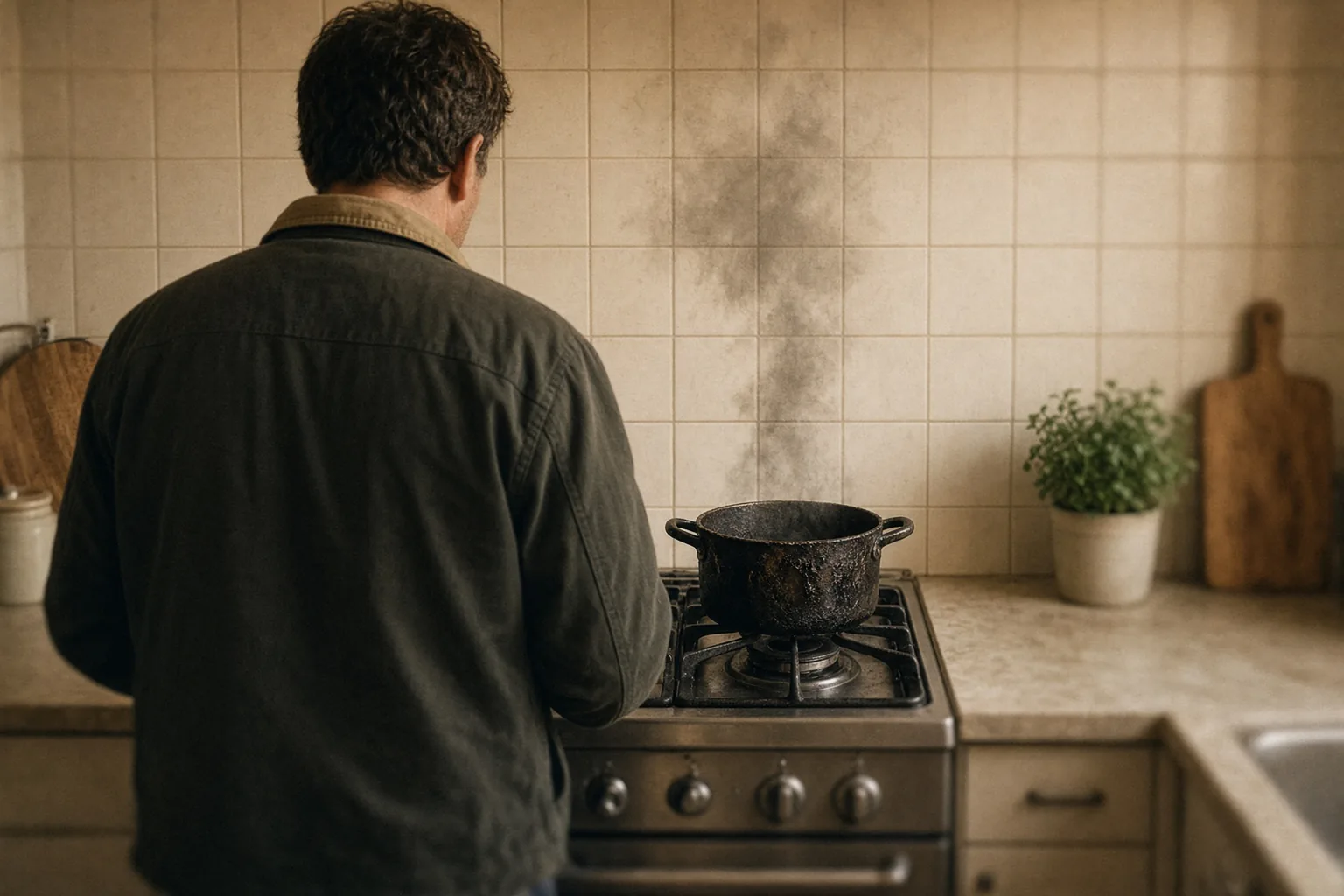
How common are cooking fires, and why do they end up in disputes?
Very common: the U.S. Fire Administration estimates about 187,500 residential cooking fires a year for 2017-2019, 51 percent of residential building fires. Disputes arise when the fire escapes the pan and someone has to pay.
The U.S. Fire Administration's topical report Cooking Fires in Residential Buildings (2017-2019), Volume 21, Issue 5, dated July 2021, estimates "an estimated average of 187,500 cooking fires in residential buildings" a year, causing "an estimated annual average of 165 deaths, 3,325 injuries and $444 million in property loss." Cooking "accounted for 51% of all residential building fires."
Most of these fires stay small. Confined fires, those contained within the cooking vessel, "accounted for 93% of residential building cooking fires." The disputes come from the other 7 percent, the nonconfined fires that spread to cabinets, walls and other units.
For nonconfined cooking fires the report names the pattern a reviewer will see in many opposing reports. The leading factor contributing to ignition was "unattended equipment (37%)"; "oil, fat and grease were the leading types of material ignited" (45 percent); and "ranges or kitchen stoves (71%)" led the equipment involved. The fires clustered in the late afternoon and evening, with the five hours between 4 and 9 p.m. accounting for 40 percent of residential cooking fires.
What does a report blaming unattended cooking have to show?
That the origin is at the stove, that the burner or oven was turned on by a person, who that person was and when, what material ignited, and what excluded a defect in the range or its controls.
A kitchen fire report that blames cooking makes two claims at once. The first is technical: the fire started at the range, from a burner or oven that was on. The second is about people: someone turned the control on and left it, or left combustibles where the heat reached them. A claim against a tenant, a guest or a landlord turns on the second claim.
Each claim needs its own data. The origin rests on fire patterns around the range and the cabinets. The burner position rests on the controls as found and photographed in place, the condition of the burner and any oven temperature setting firefighters observed. The person rests on the timeline and on who was in the unit. The material ignited rests on the debris in and around the pan or the broiler.
The alternative the reviewer always tests is the appliance itself. A gas valve that leaked, an electric control that failed in the on position or a broiler that ignited without anyone touching it turns a negligence case against the occupant into a product case against the manufacturer or a maintenance case against the landlord.
What happened when the tenant blamed a broiler malfunction?
In Karalia v. Smith (N.J. App. Div. 2019) the tenant relied on a fire department report citing a mechanical malfunction. The court called that report a net opinion and upheld summary judgment for the landlord.
Kimberly Karalia rented an apartment from Steven Smith. On November 12, 2016, a fire broke out and made the apartment uninhabitable. The fire started in the broiler attached to a gas oven. Karalia certified that she had not used the oven or the broiler that day and that both had stopped working about four months earlier. She sued the landlord.
The landlord served two expert reports. Larry Wharton, P.E., placed the origin in the broiler drawer from burn patterns and concluded that the broiler had been manually turned on and left unattended with its pan covered in aluminum foil, against the warning in the manual. He wrote: "The burner was deliberately and manually operated to the "on" position by a human act." Chris Ricciardi, CFEI, agreed that the broiler had been turned on and found heavy grease accumulation inside the oven and broiler that ignited and spread the fire.
Karalia served no expert report. She relied on a local fire department report that cited a "mechanical malfunction." On April 9, 2019 the Appellate Division, in an unpublished opinion, affirmed summary judgment for the landlord. It wrote: "The opinion in the fire department report is clearly net and therefore inadmissible." It also rejected her argument that the landlord's experts helped her: "[T]he reports of defendants' experts clearly do not support but are damaging to plaintiff." There was no evidence of a dangerous condition the landlord knew about, and no evidence that the broiler's failure to heat caused the fire.
Can an insurer recover when nobody knows who turned the stove on?
Not without facts linking a defendant to the stove. In Norfolk & Dedham v. Kostovick (Me. Super. Ct. 2009) the court granted summary judgment to family members because nothing showed how the stove was activated.
On November 26, 2006, a fire broke out in Unit 62 of the Marlborough Condominiums at 180 High Street in Portland, Maine. Agnes Kostovick had placed a towel on the stovetop before that day. Her son Gerard and his wife Rebecca helped her move items into the unit and left at about 4:30 p.m. The fire department was called at about 4:44 p.m., and the responding officer found the stove on, its right front burner glowing, and the oven at 350 degrees.
Norfolk & Dedham sued as subrogee of the condominium association and of the unit owner, Maria Boston, Agnes's daughter. Investigators' affidavits placed the origin on top of the cook stove and named combustibles left on the stove as the "most likely cause." The court excluded a police incident report the plaintiffs relied on because it was not properly attached to an affidavit.
In a decision that the Maine Superior Court decisions archive dates March 11, 2009, Justice Robert E. Crowley of the Cumberland County Superior Court granted summary judgment to all three defendants. For Agnes, the court found a landlord-tenant relationship with her daughter and applied North River Insurance Co. v. Snyder, under which "a residential tenant may not be held liable in subrogation" without an express written agreement. For Gerard and Rebecca, the plaintiffs had not shown breach or proximate cause because nothing linked their conduct to how the stove was activated. The court rejected res ipsa loquitur because the cause was not wholly unexplained and the plaintiffs offered no facts about the activation, and it repeated that "the mere fact of the happening of an accident is not evidence of negligence."
The investigators agreed on the origin and on a likely cause. What the plaintiffs lacked was the step between the glowing burner and a person: who turned it on, and when.
Can the fire department's cause line settle a kitchen fire case?
Rarely. In Karalia the court called a fire department's mechanical malfunction finding a net opinion, and in Kostovick a police report was excluded for lack of a proper affidavit. Courts look for an investigator who explains the basis.
Fire department reports in kitchen fires often contain one line on cause, such as cooking left unattended or mechanical malfunction. In Karalia the tenant built her case on such a line and lost, because the report gave a conclusion without the reasoning, which New Jersey courts call a net opinion.
In Kostovick the plaintiffs relied on a police incident report, and the court excluded it because it was not properly attached to an affidavit. The investigators' sworn affidavits, by contrast, were in the record and placed the origin on the stove.
For a reviewer, the official report is a source of observations: the time of the call, what firefighters found when they entered, the position of the controls, the oven temperature. The cause line is a conclusion that has to be checked against those observations and the physical evidence, and the review says which observations support it and which do not.
How does a reviewer check the burner and control evidence?
By tracing each control position to a photograph or an observation made before the scene was disturbed, and by checking whether the appliance was examined for a malfunction that could turn a burner on or keep it on.
A report that says the burner was on needs a source for that fact: a photograph of the knob in place, a firefighter's statement that the burner was glowing, an observation of the oven temperature, or a laboratory examination of the valve or switch. In Kostovick the responding officer saw the right front burner glowing and the oven at 350 degrees, which is the kind of observation a report can rest on.
The appliance examination is the second check. In Karalia the landlord's engineer concluded that the manual controls precluded the possibility that the burner turned "on" without physical intervention. A reviewer for the other side asks whether that conclusion came from examining the actual valve, igniter and wiring of the range, from the design of the model, or from the manual. Each source has different weight.
If the range was removed and discarded before the other side could examine it, the review notes that the malfunction hypothesis could not be tested and identifies who controlled the appliance after the fire.
How does a reviewer test who was cooking and when?
By building the timeline from call records, the occupants' movements and the last use of the stove, and checking whether the report names a person and a time or infers them from the burner being on.
The cooking hypothesis needs a cook. The reviewer collects who was in the unit, when each person left, when the stove was last used and for what, and the time of the first alarm or call. In Kostovick Gerard and Rebecca left at about 4:30 p.m. and the call came at about 4:44 p.m., a gap of fourteen minutes, and still the court found nothing that linked either of them to how the stove was activated.
The reviewer also checks what was on the stove and near it. Grease accumulation, foil in a broiler pan, a towel on the stovetop, boxes or food packaging nearby are all physical facts that can support or undercut the opposing theory. In Karalia the defense experts relied on the foil and the grease; the tenant had no expert to answer them.
When the report blames a specific person, the review lists the evidence for that person's presence and use of the stove, separately from the evidence that the burner was on. If only the second exists, the review says so.
What does a review of a kitchen fire report contain?
The origin and its data, the source for each control position, the appliance examination, the timeline of occupants and calls, the material first ignited, the excluded alternatives and the basis of any fire department finding the report repeats.
The review starts with the origin: whether the fire patterns place it at the range and at which burner, oven or broiler. Then the controls and the appliance: what position each control was in, how that is known, and whether the range was examined for a malfunction. Then the people: who was present, who used the stove and when, and what the report says about each.
Next come the material and the spread. The reviewer checks what was ignited first, such as oil in a pan, grease in a broiler or a towel on a cooktop, and how the fire reached the cabinets and the rest of the unit. Last, the reviewer lists the alternatives the opposing report considered and the data that excluded each, including an electrical cause in the kitchen circuits and a defect in the appliance.
Each point carries a page reference to the opposing report and to the photographs or records behind it, so that counsel can use the review at the expert's deposition or in a motion.
What does IAE do when the opposing report blames unattended cooking?
IAE prepares reviews of the opposing investigator's report for subrogation, product liability, arson defense and coverage disputes in US courts, and expert reports on the client's questions. Up to 5 business days.
The review lists each hypothesis the opposing investigator considered, checks what data excluded the others and which NFPA 921 edition was applied, and traces every artifact to its examination. In a kitchen fire case the client sends the opposing report with its exhibits, the fire department and police reports, the scene photographs, the range or its components if they were retained, statements about who used the kitchen, alarm and call records, and states whether the scene and the removed artifacts still exist.
The secretariat confirms receipt the same day. Within one business day IAE confirms the format, the cost, the deadline and the specialist from its registry, and the client approves the candidate and the CV before work starts. The signed review is issued within up to 5 business days once the format and cost are confirmed; cases with tight deadlines have a 48-hour rush.
Every specialist is a member of the public IAE registry and passed the council's attestation under the published Criteria Matrix; the Member ID or QR code in the document opens the specialist's record. The specialist confirms in the document that he or she has no interest in the outcome. Materials are not passed to third parties without the client's consent. A review is evidence the court weighs with the other materials; neither IAE nor the reviewer guarantees the outcome, and IAE is not a law firm.
Sources
- U.S. Fire Administration, Cooking Fires in Residential Buildings (2017-2019), Topical Fire Report Series, Vol. 21, Issue 5 (July 2021)
- Karalia v. Smith, No. A-0953-17T1 (N.J. Super. Ct. App. Div. Apr. 9, 2019) (unpublished)
- Norfolk & Dedham Group of Insurance Companies v. Kostovick, Maine Superior Court, Cumberland County (CV-08-238) (Maine Law Library)
- Maine Superior Court decisions list (University of Maine School of Law): CUMcv-08-238, Norfolk & Dedham Group v. Kostovick, Robert E. Crowley, Cumberland, 2009-03-11
Read also
All articles
Clothes dryer fire: how does a reviewer check a report that blames lint, the owner or the dryer's design?
In the dryer fire litigation described below, the reports ended in one of two sentences: the owner let lint build up, or the dryer was built so that Sergei Voronin
Space heater fire: how does a reviewer check a report that blames the heater?
Portable heaters start about 1,100 residential building fires a year in the United States, and in the court cases below the dispute ran betweenSergei Voronin
Careless smoking fire: how does a reviewer check a report that blames a cigarette?
A cigarette that starts a fire almost never survives it, so a report that blames careless smoking rests on circumstances: who smoked, where, whenSergei VoroninExpert report review
Ready to discuss your case?
Send the materials: the secretariat will confirm the format, cost, deadline and the specialist within one business day.
