
Expert report review
Cast iron pipe claim: what does a reviewer check in the opposing plumbing or engineering expert's report?
In a cast iron pipe dispute the expert's words about cause and duration decide coverage. In State Farm Florida Insurance Co. v. Feltes (Fla. 6th DCA Nov. 27, 2024) the homeowner's own plumbing expert testified that wastewater escaped every time the system was used for more than four months, and the court held the damage to the fill excluded as repeated seepage. A reviewer reads the opposing report with the policy wording beside it.
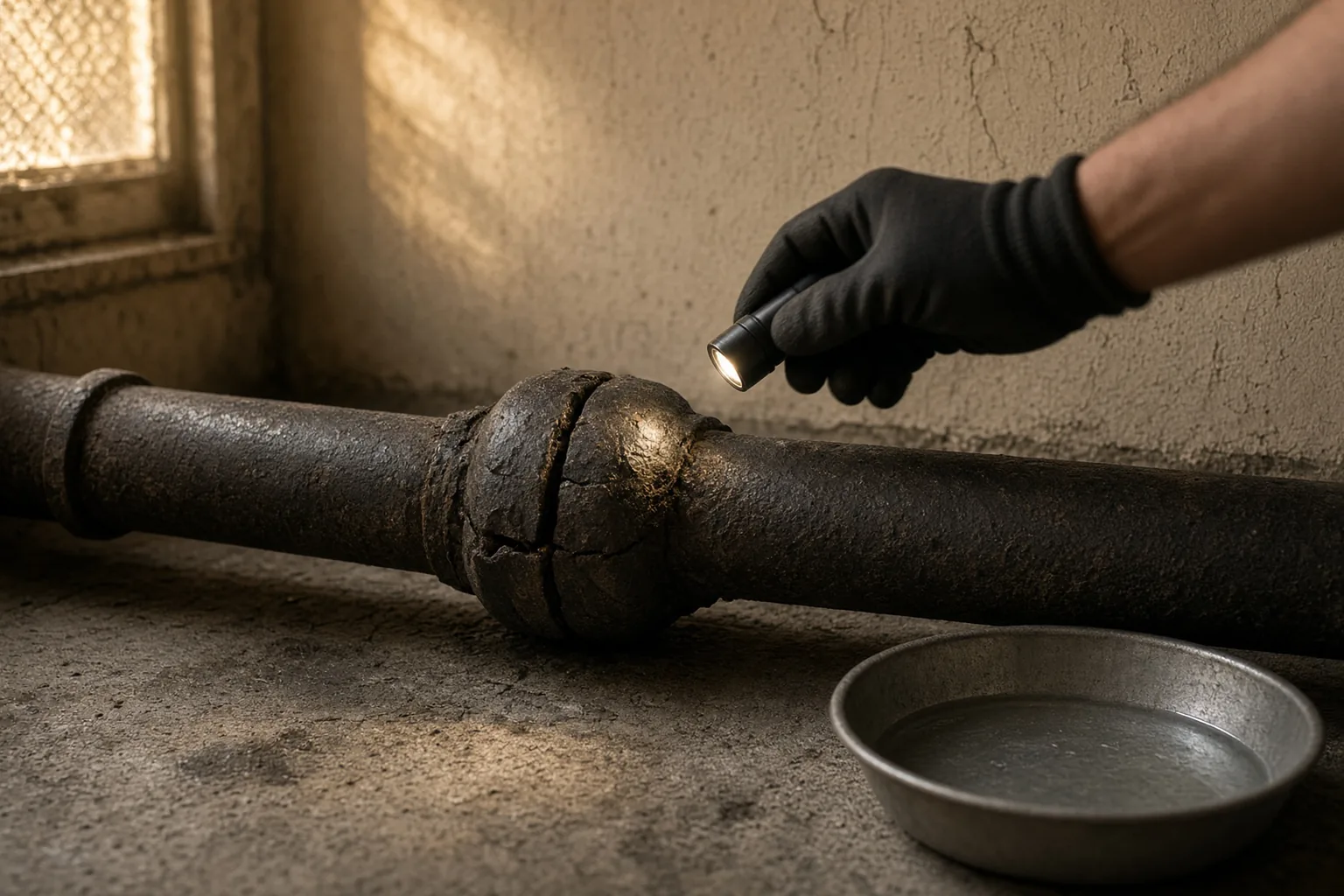
What does the opposing expert's report decide in a cast iron pipe claim?
Where the pipe failed, why it failed, how long water escaped and what has to be torn out to reach the failure. Each answer maps onto a policy term, so the reviewer checks the facts behind each one.
The Florida homeowner policies in the appeals below insure direct physical loss and exclude wear and tear, deterioration and corrosion of the pipe itself. They then treat the water that escapes in different ways: some endorsements limit water damage to $10,000 including tear-out, some exclude repeated seepage or leakage over a period of time, and some exclude water below ground regardless of its source. The expert report supplies the facts that decide which clause applies.
In People's Trust Insurance Co. v. Banks, No. 3D22-1436 (Fla. 3d DCA Sept. 13, 2023), the loss came from deterioration of old cast iron plumbing, and an appraisal award totaled $113,318.17. The court held that corrosion is an act of nature, so the policy's water damage exclusion applied, and that tear-out costs fall under the $10,000 limited water damage endorsement. It reversed the judgment entered for the homeowners on the appraisal award and remanded for entry of summary judgment for the insurer.
In Koss v. Florida Insurance Guaranty Association, No. 3D21-1904 (Fla. 3d DCA Apr. 9, 2025), the trial court found that a sewer backup from cast iron plumbing caused the loss. The policy excluded water below ground that seeps or leaks into a building regardless of its source, and the Third District affirmed recovery limited to $10,000. In these cases the policy language did most of the work, and the cause facts determined which language applied.
Does the report identify the failure location and mechanism with evidence?
It should give the exact location of each hole, crack or separation, the mechanism (corrosion, a crack from settlement, a failed joint, a blockage) and the evidence for each: camera footage with distances, photographs of exposed pipe, test results.
Cast iron drain lines under a slab are not visible, so the first evidence is usually a camera run from a cleanout. The reviewer asks for the full unedited video files, not stills, with the footage counter, the entry point, the direction of travel and the locator readings that tie each defect to a point on the floor plan. A report that describes "multiple failures" without positions cannot support a tear-out scope.
The mechanism matters because the policies treat causes differently. Internal corrosion and channeling of the pipe bottom are deterioration. A break from settlement of the slab or from root intrusion may be argued under a different clause. A blockage that caused a backup, as in Koss, is a third event. The reviewer checks whether the expert separated the observations (what the camera saw) from the inference (why it happened) and gave a basis for the inference.
Where pipe was excavated or replaced, the removed sections are physical evidence. The reviewer asks whether they were kept, photographed with scale and examined, and whether the other side had the chance to see them before disposal.
What does the report say about how long water escaped, and what was it based on?
The reviewer checks whether the duration opinion rests on evidence such as dated events, fill and slab conditions or usage records, or on assumption. In Feltes the expert's own duration testimony brought the loss within the repeated seepage exclusion.
The Feltes home was built in 1961 on a slab over compacted sand fill, with the original cast iron drain line running through the fill. In autumn 2018 the kitchen sink overflowed, and the following spring a toilet overflowed. The homeowner's plumber found wear, tear, corrosion and deterioration, with one or more holes letting wastewater into the fill, and recommended replacing the whole line, which required tearing out floor and foundation. The jury awarded nearly $60,000 in tear-out costs.
The homeowner's plumbing expert, Edward Jaremko, testified that the line failed from "wear, tear, deterioration, and corrosion." He could not fix the failure date but thought it likely failed around the kitchen sink overflow, and he testified that water escaped each time the system was used, for more than four months. Asked whether that was repeated seepage or leakage, he answered that it was not something constantly dripping all of the time.
The Sixth District held that the deterioration of the drain line led directly to repeated seepage, an excluded loss, so the damage to the fill was itself a Loss Not Insured rather than a covered resulting loss, and the homeowner was not entitled to tear-out coverage. It reversed the denial of the insurer's directed verdict on that issue. The expert's description of intermittent discharge over months, and his effort to distinguish it from constant dripping, did not change the result.
For a reviewer the lesson runs both ways. A duration opinion needs a stated basis: the dates of overflows and repairs, water bills, the condition and extent of saturated fill, staining and odor reports. An opposing expert who assigns a long duration to bring the loss under an exclusion is asked for the same basis.
How do the expert's cause words line up with the policy?
Words like corrosion, deterioration, sudden, accidental and seepage carry legal effect under the policy. The reviewer checks that each one is a finding with evidence, and notes where the expert used a policy term as a conclusion.
In Banks the homeowners argued that pipe deterioration was a natural process rather than an act of nature. The Third District treated corrosion as a naturally occurring force and therefore an act of nature within the water damage exclusion endorsement. Once the expert report attributed the loss to corrosion of the cast iron, the coverage question was largely decided by the endorsement.
That is why the reviewer separates technical findings from labels. "The pipe wall is perforated at 23 feet from the cleanout, with tuberculation and graphitization visible on the video" is a finding another expert can test. "The loss was sudden and accidental" or "this is long-term seepage" is a characterization under the policy that the court will decide; an expert who offers it needs facts that support it, and an opinion that goes no further than the label adds nothing for the trier of fact.
The reviewer also checks consistency. The same report sometimes calls the deterioration gradual to defeat coverage for the pipe and calls the discharge sudden to obtain coverage for the water. Both can be true, since a pipe can deteriorate for years and then open suddenly, but the report has to explain the sequence with evidence.
Is the tear-out scope tied to the point where the water escaped?
Feltes read the tear-out clause as covering only the part of the structure necessary to gain access to the point of escape. The reviewer checks whether the expert's scope stops there or prices a full replacement of the system.
The Feltes policy paid to tear out and replace "only that particular part of the building structure necessary to gain access" to the point where water escaped. The court held that the toilet overflow did not trigger that coverage at all, because no tear-out was needed to reach the point of escape. A recommendation to replace the entire drain line is a plumbing repair choice; it is not the same as the access needed for a covered loss.
The reviewer compares the estimate with the camera findings: how many failure points, where they are, how much slab and floor has to come up to reach each, and whether tunneling or rerouting was considered. Line items for flooring beyond the access areas, for rooms without a failure point beneath them or for upgrades are flagged.
In Banks the court held that tear-out costs are part of the water damage loss and fall under the limited water damage endorsement's $10,000 limit. Before pricing tear-out as a separate item, the reviewer confirms how the policy in the case treats it.
Which materials does the reviewer need from the other side?
The report with its exhibits, the full camera video files and logs, photographs and any retained pipe, the estimate with its quantities, and the policy. Rule 26(a)(2)(B) requires disclosure of the facts or data the expert considered.
Under Rule 26(a)(2)(B) of the Federal Rules of Civil Procedure, a retained expert's report contains a complete statement of all opinions and the basis and reasons for them, the facts or data considered in forming them and any exhibits used to summarize or support them. In a cast iron case that means the raw camera footage, the locator data, the plumber's notes, test results, photographs and the estimate with its takeoff. Florida state courts have their own discovery rules, and counsel requests the same materials under them.
The reviewer also needs what the opposing expert did not consider: the homeowner's timeline of backups and repairs, earlier plumbing invoices, prior inspection or sewer scope reports, and the policy declarations and endorsements. Gaps between what the expert considered and what existed are review points in themselves.
A party seeking discovery from the opposing expert, including a deposition, pays the expert a reasonable fee for the time spent responding, unless manifest injustice would result (Rule 26(b)(4)(E)(i)).
How does the review reach the court?
As a rebuttal report, deposition questions and the basis for a challenge under Rule 702. A rebuttal on the same subject is due within 30 days after the other side's disclosure unless the court orders otherwise.
Under Rule 26(a)(2)(D)(ii), evidence intended solely to contradict or rebut evidence on the same subject matter identified by another party is disclosed within 30 days after the other party's disclosure, absent a stipulation or court order. A rebuttal report answers the opposing expert's location, mechanism, duration and scope opinions point by point.
Rule 702 of the Federal Rules of Evidence, as amended in 2023, requires the proponent to show the court that it is more likely than not that the testimony rests on sufficient facts or data and on reliable principles and methods reliably applied to the facts. A duration opinion with no stated basis, or a scope that does not follow from the camera findings, is a candidate for that challenge.
Many cast iron cases are decided on summary judgment or directed verdict on the policy wording, as in Banks and Feltes. The review then matters at the stage where the facts are fixed: the expert's report and deposition are where the cause and duration facts enter the record.
What does IAE do when the other side relies on a cast iron pipe report?
IAE prepares reviews of the opposing construction expert's report and rebuttal reports for US cases, each point tied to a rule or standard, in up to 5 business days after format and cost are confirmed.
The IAE page on reviews of construction expert reports is written for attorneys facing the other side's construction expert on a leak, defective work or a repair estimate. The reviewer reads the opposing report with its exhibits and the data the expert considered, tests each opinion against the data behind it and writes a rebuttal report; deposition questions are part of the service.
The client sends the opposing report with its exhibits, the camera video files and photographs disclosed, the estimate, the policy with its endorsements, the timeline of backups and repairs, and the deadlines, and describes what to check. The secretariat confirms receipt the same day. IAE then confirms the format, the cost, the deadline and the specialist from its registry, and the client approves the candidate and the CV before work starts. Cases with tight deadlines have a 48-hour rush.
Every specialist is a member of the public IAE registry and can be verified by Member ID or QR code. The specialist confirms in the document that he or she has no interest in the outcome of the case. A review is evidence that the court weighs with the other materials; neither IAE nor the reviewer guarantees the outcome. IAE is not a law firm and does not advise on coverage or case strategy.
Sources
- State Farm Florida Insurance Co. v. Feltes, No. 6D2023-0991 (Fla. 6th DCA Nov. 27, 2024)
- People's Trust Insurance Co. v. Banks, No. 3D22-1436 (Fla. 3d DCA Sept. 13, 2023)
- Koss v. Florida Insurance Guaranty Association, No. 3D21-1904 (Fla. 3d DCA Apr. 9, 2025)
- Federal Rules of Civil Procedure, Rule 26 (LII, Cornell Law School)
- Federal Rules of Evidence, Rule 702 (LII, Cornell Law School)
Read also
All articles
Sinkhole claim denied in Florida: how does a reviewer test the insurer's engineering report?
When a Florida insurer denies a sinkhole claim after testing, the denial rests on the report of the engineer or geologist it hired. Sections 627.706 Sergei Voronin

Window leak expert report: what does a reviewer check in the opposing water test?
A window leak report rests on a water test, and the test decides whether the opinion survives. In 2016 a federal court excluded all window-testingSergei Voronin
Concrete moisture testing in a flooring failure dispute: what does a reviewer check in the opposing expert's report?
When glue-down flooring lifts, bubbles or cups, the other side's expert may blame moisture in the concrete slab. ASTM F2170 measures relativeSergei VoroninExpert report review
Ready to discuss your case?
Send the materials: the secretariat will confirm the format, cost, deadline and the specialist within one business day.
