
Expert report review
Sinkhole claim denied in Florida: how does a reviewer test the insurer's engineering report?
When a Florida insurer denies a sinkhole claim after testing, the denial rests on the report of the engineer or geologist it hired. Sections 627.706 to 627.7074 of the Florida Statutes say when the insurer must test, what the report has to state and how a homeowner can dispute it. A review reads the report against those sections and against its own data, line by line.
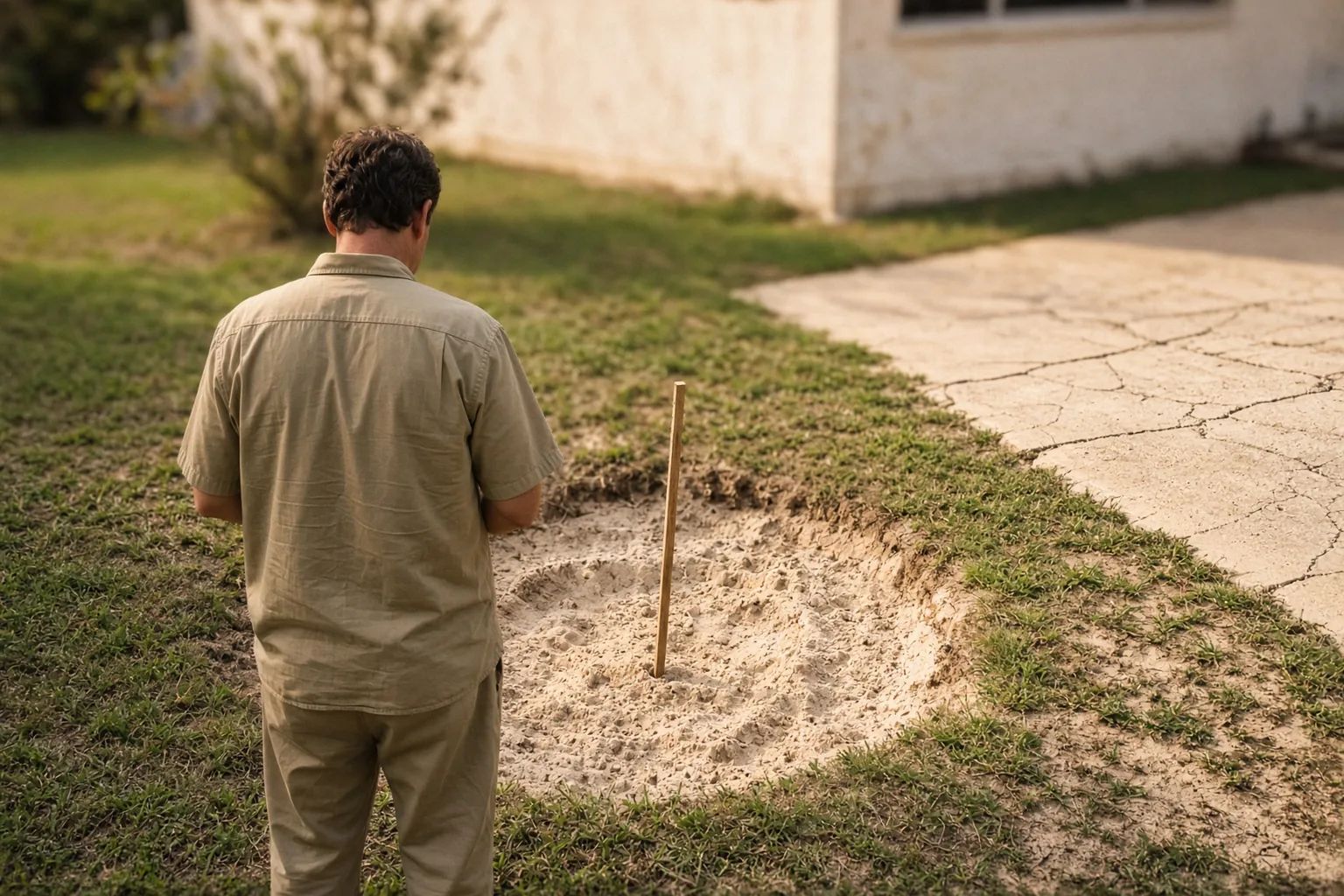
What do "sinkhole loss" and "structural damage" mean under Florida law?
Section 627.706 defines sinkhole loss as structural damage to the covered building, including the foundation, caused by sinkhole activity. Structural damage has five statutory tests, so cracks alone do not meet the definition.
The statute defines a sinkhole as "a landform created by subsidence of soil, sediment, or rock as underlying strata are dissolved by groundwater." Sinkhole activity is settlement or systematic weakening of the earth supporting the covered building, and only when it results from contemporaneous movement or raveling of soils, sediments or rock materials.
Structural damage is defined in five alternatives. The first is interior floor displacement or deflection beyond the variances of ACI 117-90 or the Florida Building Code that makes the interior unfit for service or a safety hazard. The second is foundation displacement or deflection beyond ACI 318-95 or the Florida Building Code that stresses primary structural members beyond one and one-third the nominal strength. The third is listing, leaning or buckling of exterior load-bearing or vertical primary members so that a plumb line through the center of gravity falls outside the middle one-third of the base.
The fourth alternative is damage that makes the building significantly likely to collapse imminently because of ground movement or instability. The fifth is damage on or after October 15, 2005 that qualifies as substantial structural damage under the Florida Building Code.
A denial can therefore rest on either of two findings: no structural damage as defined, or structural damage with a cause other than sinkhole activity. The reviewer first identifies which of the two the report makes, because each calls for different data.
Which coverage is in dispute: sinkhole loss or catastrophic ground cover collapse?
Every property insurer in Florida must cover catastrophic ground cover collapse, which requires four conditions at once. Sinkhole loss coverage is separate, and the insurer must make it available for an additional premium.
Section 627.706(1)(a) says every insurer authorized to transact property insurance in the state "must provide coverage for a catastrophic ground cover collapse." The definition has four conditions: the abrupt collapse of the ground cover; a depression in the ground cover clearly visible to the naked eye; structural damage to the covered building, including the foundation; and the insured structure being condemned and ordered to be vacated.
Section 627.706(1)(b) requires the insurer to make coverage for sinkhole losses available on any structure "for an appropriate additional premium." The same paragraph lists residential deductible options of 1, 2, 5 or 10 percent of the dwelling limits.
The reviewer reads the declarations page before the engineering report. Several duties described below, including the duty to hire an engineer or geologist for testing, apply under section 627.707(2) only if the policy covers sinkhole loss.
When must the insurer hire an engineer or a geologist to test?
Under section 627.707 the insurer first inspects the premises. If it confirms structural damage but cannot identify a valid cause, or finds the damage consistent with sinkhole loss, it must engage a professional engineer or professional geologist.
Section 627.707(1) requires the insurer, on receiving a sinkhole claim for a covered building, to inspect the policyholder's premises to determine if there is structural damage that may be the result of sinkhole activity. Subsection (2) then says "the insurer shall engage a professional engineer or a professional geologist to conduct testing" under section 627.7072 and to issue a report under section 627.7073. The insurer pays the fees, with the exceptions in subsections (4) and (6).
Section 627.706 sets qualifications. A professional engineer has a bachelor's degree or higher in engineering and experience in identifying sinkhole activity or other causes of structural damage. A professional geologist has a bachelor's degree or higher in geology or a related earth science, with relevant experience and expertise.
After the initial inspection the insurer must notify the policyholder in writing of the cause of damage, if determined, of when testing is required and of the policyholder's right to request testing. A reviewer asks for that notice together with the report: it records what the insurer concluded before any engineer was hired.
What must a report that rules out a sinkhole state?
Section 627.7073(1)(b) requires four statements: no structural damage or a cause other than sinkhole activity, analyses and tests of sufficient scope to eliminate sinkhole activity, the cause of the structural damage, and a description of the tests performed.
Each of the first three statements must be made "within a reasonable professional probability." The report and certification go to both the policyholder and the insurer.
A report that verifies sinkhole loss has a different list under section 627.7073(1)(a): structural damage was identified, its cause is sinkhole activity, the analyses were of sufficient scope to identify sinkhole activity as the cause, the tests are described, and the professional engineer recommends methods for stabilizing the land and building and repairing the foundation.
Section 627.7072 leaves the choice of tests to the professionals. The engineer and the geologist "shall perform such tests as sufficient, in their professional opinion," to determine the presence or absence of sinkhole loss or another cause of damage within reasonable professional probability. The statute names no fixed set of tests, so the dispute turns on whether the tests chosen were sufficient for this building.
What does a reviewer check in the insurer's report?
The reviewer takes the four required statements one at a time: which definition of structural damage was applied and to what measurements, what each test covered, and whether the stated cause accounts for the damage that was recorded.
On structural damage, the report should say which of the five statutory alternatives it considered and show the measurements: floor elevations compared with the ACI 117-90 or Florida Building Code variances, the plumb of walls and columns against the middle one-third of the base, and the load calculation behind any statement about nominal strength. A sentence that the damage is "cosmetic" with no measurements answers none of the five.
On scope, the reviewer lists each test the report describes: where on the lot it was run, how deep it reached and what it found. The list is compared with the map of the damage, and the reviewer marks every damaged area that no test covered.
On cause, the statute requires a statement of what did cause the structural damage. In the Warfel case the insurer's engineering firm attributed the damage to shrinkage, thermal stress and differential settlement. A reviewer checks whether each named cause fits the pattern, the location and the timing of the damage, and whether the report's own data contradict it.
The reviewer also notes what the report leaves out: areas of the building not inspected, test results mentioned but not attached, and photographs without dates or locations.
Is the insurer's report presumed correct?
Section 627.7073(1)(c) says the findings of the insurer's engineer or geologist shall be presumed correct. The Florida Supreme Court held in Warfel in 2012 that the presumption did not shift the burden of proof at trial.
In Universal Insurance Co. of North America v. Warfel, decided January 26, 2012, the homeowner held an all-risks policy issued in 2005 that covered sinkhole claims. The insurer's firm concluded that sinkhole activity did not damage the home, and the insurer denied the claim. Warfel's experts concluded that a sinkhole, at least in part, caused the damage.
At trial the jury was told that the findings in the insurer's report were to be presumed correct and that Warfel had to prove by a preponderance of the evidence that they were not. The Supreme Court held that the presumption in the 2005 text of section 627.7073(1)(c) is governed by section 90.303 of the Evidence Code and not by section 90.304. A section 90.303 presumption is a "vanishing" or "bursting bubble" presumption: once evidence rebutting it is introduced, it disappears and the jury is not told of it.
The Court wrote that nothing in section 627.7073 "justifies application of that statute to the litigation context" and that the presumption applies to the initial claim process and investigation. It called the instruction "tantamount to a directed verdict," approved the decision of the Second District Court of Appeal, which had required a new trial, and remanded for further proceedings.
The current text still says the findings, opinions and recommendations of the insurer's engineer or geologist "shall be presumed correct." It does not mention the burden of proof. Counsel decides how Warfel applies to a policy and a claim governed by the later text.
What if the insurer denied the claim without testing?
If the policy covers sinkhole loss, section 627.707(4) lets the policyholder demand testing in writing within 60 days after receiving the denial. The policyholder pays 50 percent of the actual cost or $2,500, whichever is less.
The insurer refunds that payment if its engineer or geologist certifies sinkhole loss. Subsection (6) adds a risk for the policyholder: if the insurer obtains certification of no sinkhole loss and the claim was submitted without good faith grounds, the policyholder reimburses 50 percent of the testing costs, capped at $2,500. That applies only if the policyholder requested the testing and the insurer gave written notice of this liability and an opportunity to withdraw the claim before ordering the tests.
A review of the denial letter and of the inspection notes comes before a demand for testing. If the first inspection applied none of the five structural damage tests, the demand can say so.
What is neutral evaluation, and where does a review fit?
Under section 627.7074 either party may request neutral evaluation after a sinkhole report is issued. It is nonbinding but mandatory if requested, the insurer pays the reasonable costs, and the evaluator's report is admissible in a later action.
The neutral evaluator is an engineer licensed under chapter 471 with experience in identifying sinkhole activity, or a professional geologist, who has completed a course of study in alternative dispute resolution designed or approved by the department. The parties pick an evaluator; if they cannot agree within 14 business days, the department appoints one. Each party may disqualify two evaluators without cause, and for cause on listed grounds, such as work for an entity that tested the property within the past 5 years.
The request is filed with the department on an approved form and must state the reason and list all disputed issues. The evaluator notifies the parties of the conference date within 14 business days after the referral, the evaluator makes reasonable efforts to hold the conference within 90 days after the department receives the request, and the evaluator's report follows within 14 days after the conference.
At a minimum the evaluator determines causation, all stabilization and repair methods above and below ground, and the costs of stabilization and repairs. The process is informal: formal rules of evidence and procedure need not be observed.
The review supplies the list of disputed issues: which required statement of the insurer's report is unsupported and on which page. The evaluator's written recommendation, oral testimony and full report are admissible in any later action on the claim, so the points raised at this stage stay in the case.
What standard does a Florida court apply to the engineers' opinions?
Section 90.702 of the Florida Evidence Code admits expert testimony if it is based upon sufficient facts or data, is the product of reliable principles and methods, and the witness has applied them reliably to the facts.
The three conditions line up with the statements the sinkhole statute requires. Tests of insufficient scope go to sufficient facts or data. A cause named without analysis goes to principles and methods. Measurements that do not match the definition of structural damage go to the application of the method to the facts of the case.
The same conditions apply to the homeowner's own engineer. In Warfel both sides had experts, and the Supreme Court approved the decision that required a new trial, this time without the instruction that favored the insurer's report.
Which deadlines run while the report is under review?
Notice of a sinkhole claim is due within 2 years after the policyholder knew or reasonably should have known of the loss. A demand for testing has 60 days, a repair contract 90 days after coverage is confirmed.
Section 627.706(5) bars a claim unless notice was given within the 2-year period in accordance with the terms of the policy. Under section 627.707(5) the policyholder must sign a stabilization and foundation repair contract within 90 days after coverage is confirmed; the period is tolled during neutral evaluation and restarts 10 days after it ends. Stabilization and other repairs must be completed within 12 months of the repair contract, with exceptions for mutual agreement, neutral evaluation, litigation, appraisal or mediation.
A request for neutral evaluation tolls the deadline to sue for 60 days after the process ends or for the section 95.11 period, whichever is later. Court proceedings on the same subject are stayed until the evaluation is complete and for 5 days after the report is filed with the court.
What does the report's repair recommendation decide?
If sinkhole loss is verified, section 627.707(5) has the insurer pay to stabilize the land and building and repair the foundation in line with the engineer's recommendations, subject to the terms of the policy.
Until a repair contract is signed, the insurer may limit payment to actual cash value, excluding underpinning, grouting or other work below the foundation. If the recommended repairs cannot be completed within policy limits, the insurer must either complete them or tender the limits. Subsection (8) lets the insurer hire a professional structural engineer to recommend structural repairs.
A review of a report that verifies the loss therefore concentrates on the method and its cost. The neutral evaluator is required to address the same two questions, and a reviewer's comparison of the recommended method with the test data gives the evaluator a document to work with.
What happens to the sinkhole reports after the claim is paid?
Under section 627.7073(2) an insurer that has paid a sinkhole claim files the report with the county clerk of court, and the policyholder files any report prepared at the policyholder's request before accepting payment.
The insurer pays for filing and recording its report, and the policyholder pays for filing his or her own. Recording does not create a lien, an encumbrance or a restriction on title.
Subsection (3) requires a seller who made a sinkhole claim that the insurer paid to disclose to the buyer, before the closing, that a claim was paid and whether the full proceeds were used to repair the sinkhole damage. A report prepared at the homeowner's request therefore has to be filed with the clerk before the homeowner accepts payment for the loss.
What does IAE do when a sinkhole claim was denied on an engineering report?
IAE prepares reviews of the opposing construction expert's report and rebuttal reports for US cases, each point tied to a rule or standard, in up to 5 business days after format and cost are confirmed.
The IAE page on reviews of construction expert reports is written for attorneys facing the other side's construction expert on a leak, defective work or a repair estimate. The reviewer reads the opposing report with its exhibits and the data the expert considered, tests each opinion against the data behind it and writes a rebuttal report; deposition questions are part of the service.
In a sinkhole dispute the client sends the insurer's report and certification with all attachments, the denial letter and the written notice after the first inspection, the policy with its sinkhole endorsement, photographs of the damage with dates, any report prepared for the homeowner, and the deadlines, and describes what to check. The secretariat confirms receipt the same day. IAE then confirms the format, the cost, the deadline and the specialist chosen in its registry, and the client approves the candidate and the CV before work starts. Cases with tight deadlines have a 48-hour rush.
Every specialist is a member of the public IAE registry and can be verified by Member ID or QR code. The specialist confirms in the document that he or she has no interest in the outcome of the case. A review is evidence that the court weighs with the other materials; neither IAE nor the reviewer guarantees the outcome. IAE is not a law firm and does not advise on case strategy; legal questions, coverage among them, are for the client's attorney.
Sources
- Florida Statutes, section 627.706, Sinkhole insurance; catastrophic ground cover collapse; definitions (2026 Florida Statutes, Florida Senate)
- Florida Statutes, section 627.707, Investigation of sinkhole claims; insurer payment; nonrenewals (2026 Florida Statutes, Florida Senate)
- Florida Statutes, section 627.7072, Testing standards for sinkholes (2026 Florida Statutes, Florida Senate)
- Florida Statutes, section 627.7073, Sinkhole reports (2026 Florida Statutes, Florida Senate)
- Florida Statutes, section 627.7074, Alternative procedure for resolution of disputed sinkhole insurance claims (2026 Florida Statutes, Florida Senate)
- Universal Insurance Co. of North America v. Warfel, No. SC10-948 (Fla. January 26, 2012), corrected opinion (Justia)
- Florida Statutes, section 90.702, Testimony by experts (2026 Florida Statutes, Florida Senate)
Read also
All articles
Cast iron pipe claim: what does a reviewer check in the opposing plumbing or engineering expert's report?
In a cast iron pipe dispute the expert's words about cause and duration decide coverage. In State Farm Florida Insurance Co. v. Feltes (Fla. 6th DCA Sergei Voronin

Window leak expert report: what does a reviewer check in the opposing water test?
A window leak report rests on a water test, and the test decides whether the opinion survives. In 2016 a federal court excluded all window-testingSergei Voronin
Concrete moisture testing in a flooring failure dispute: what does a reviewer check in the opposing expert's report?
When glue-down flooring lifts, bubbles or cups, the other side's expert may blame moisture in the concrete slab. ASTM F2170 measures relativeSergei VoroninExpert report review
Ready to discuss your case?
Send the materials: the secretariat will confirm the format, cost, deadline and the specialist within one business day.
