
Expert report review
Concrete moisture testing in a flooring failure dispute: what does a reviewer check in the opposing expert's report?
When glue-down flooring lifts, bubbles or cups, the other side's expert may blame moisture in the concrete slab. ASTM F2170 measures relative humidity inside the slab with in situ probes, and its own text says the result describes the slab only at the time of the test. A reviewer checks which method was used, which edition, when the slab was tested, which limit the number was compared with and whether other causes were ruled out.
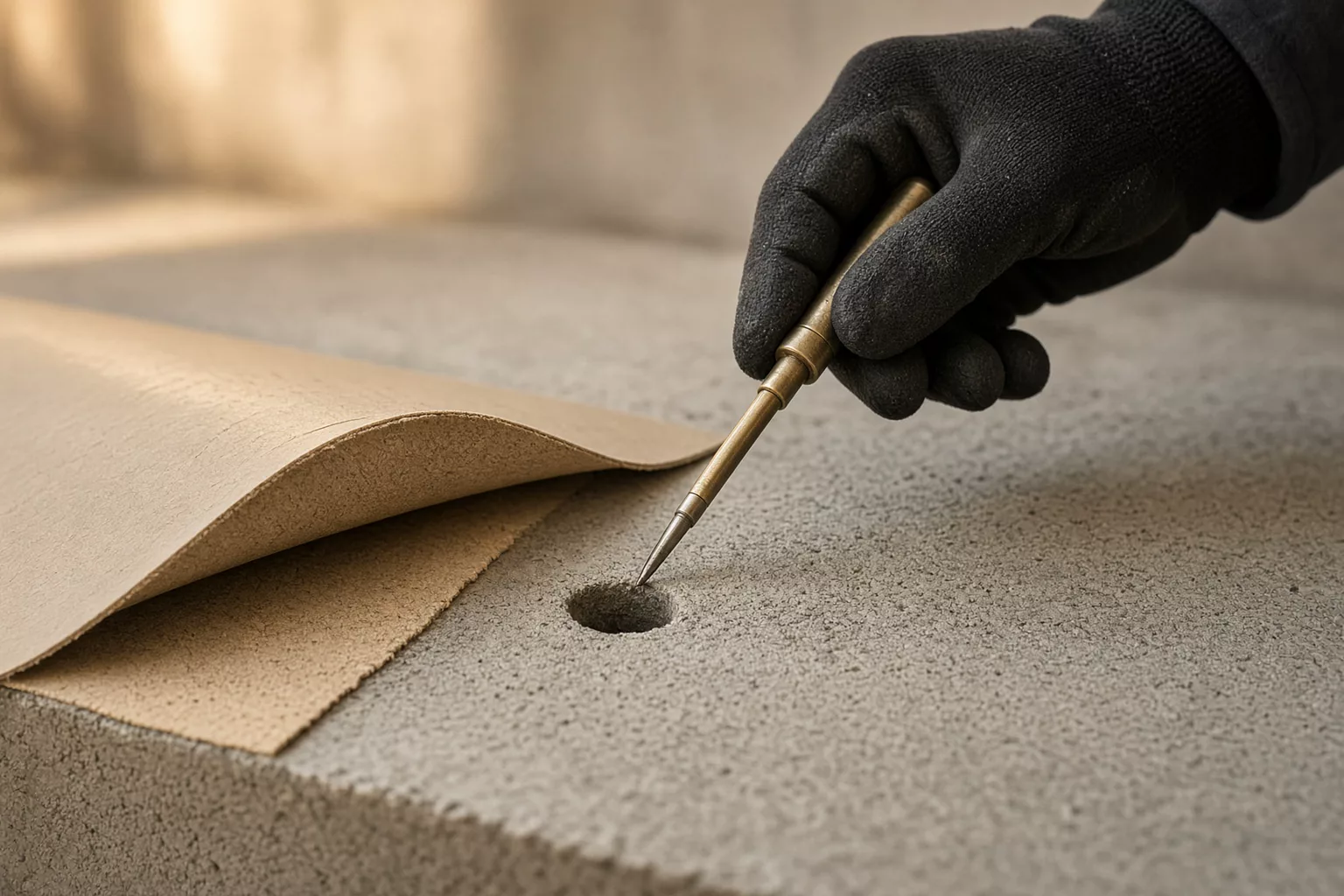
Why do flooring failure disputes turn on slab moisture?
Because excess moisture in a slab after the floor covering is installed can make the covering fail, and floor covering manufacturers generally require moisture testing before installation. The test record decides who knew what before the floor went down.
ASTM F2170 states the problem in its significance section: "Excessive moisture in floor slabs after floor covering has been installed can cause floor covering system failures." It adds that manufacturers of such systems generally require moisture testing to be performed before installation on concrete.
That puts three parties in the dispute. The general contractor placed the slab and set the schedule. The flooring contractor installed the covering and was expected to test or to see test results. The manufacturer wrote the limits in its installation instructions and the warranty. Each of them can retain an expert, and the experts can read the same moisture evidence differently.
A review starts by separating the moisture opinion into its parts: the test method, the test itself, the limit, and the link between the moisture and the failure. Each part can be checked on its own.
Which moisture test did the expert use, and what does it measure?
The report has to name the standard and the property measured. ASTM F2170 covers the quantitative determination of percent relative humidity in concrete slabs using probes placed in the slab; other methods measure other properties.
ASTM F2170 is titled Standard Test Method for Determining Relative Humidity in Concrete Floor Slabs Using in situ Probes. Its scope covers "the quantitative determination of percent relative humidity in concrete slabs". The result is a percentage of relative humidity at the probe location.
Flooring disputes also see other tests: surface emission tests, handheld meters, core samples. Each method measures a different property, so a number from one cannot be compared with a limit written for another. A report that quotes a relative humidity value against a limit stated in other units, or that converts one test into another, needs a source for the conversion.
The reviewer lists every moisture number in the report with its method, its units and the instrument used. Numbers without a named method are marked as unverifiable.
Which edition of the standard did the expert follow?
The edition in force on the test date. The ASTM page lists F2170-19a as the active edition, last updated on January 9, 2020. A report that names no edition, or an edition issued after the test, needs an explanation.
ASTM revises its test methods and keeps the earlier editions as historical. The page for F2170 lists F2170-19a as active and states that it was last updated on January 9, 2020. The edition matters because procedures such as the drilling depth, the time the probe stays in the hole before reading and the conditioning of the space can change between editions.
The reviewer compares three dates: the test date, the edition date and the date of the installation instructions that set the limit. An expert who tested in one year under an edition issued later, or who applied a current limit to an installation done years earlier, has a gap to explain.
When the manufacturer's instructions name a test method and edition, the reviewer checks that the expert's test matches them.
When was the slab tested, compared with the installation and the failure?
ASTM F2170 says that moisture test results indicate the condition of the slab only at the time of the test. A test run months after the failure describes the slab then, not on the day the floor was installed.
Section 5.3 of ASTM F2170 states: "Moisture test results indicate the moisture condition of the slab only at the time of the test". That sentence is the reviewer's starting point for every post-failure test.
Slabs change. A slab under a new building dries or gains moisture with the weather, the roof, the heating and air conditioning, and with water from leaks or cleaning. A reading taken after the floor failed, under a covering that slows drying, or after the covering was removed, is not the reading the installer would have obtained before installation.
The reviewer builds a timeline: slab placement, enclosure of the building, start of HVAC, any pre-installation tests, installation, first complaint, post-failure tests, removal of the covering. The moisture opinion must fit that timeline. If pre-installation test results exist, they carry more weight on what the installer knew than later tests do.
Which acceptance limit did the expert compare the result with?
The limit that applied to the product and the installation: the manufacturer's installation instructions and warranty in force at the time, and any contract specification. The reviewer asks for those documents and checks the edition.
ASTM F2170 is a test method for relative humidity. The description on the ASTM page names no acceptance value for any floor covering, and its significance section points to the manufacturers, who generally require moisture testing before installation. The limits therefore come from the product documents and from the project specifications.
The reviewer collects the installation instructions and the warranty for the product actually installed, the adhesive data sheet, and the flooring section of the project specifications. Each may set its own limit and its own test method, and the strictest one may not be the one the contract made binding.
If the expert's report gives a limit without a source, or uses a limit for a different product or adhesive, the comparison fails even if the measurement was correct.
Did the expert rule out other causes of the failure?
Rule 702's committee note asks whether the expert accounted for obvious alternative explanations. For flooring those include the adhesive and its application, slab preparation, product defects, water from above and site conditions.
The 2000 committee note to Rule 702 lists among the factors whether the expert "has adequately accounted for obvious alternative explanations." In a flooring failure the obvious alternatives include the wrong adhesive or too little of it, poor surface preparation, an uneven or contaminated slab surface, a product defect, water entering from a leak or from cleaning, and installation in a space without the temperature and humidity the product requires.
Each alternative leaves physical evidence. Adhesive transfer on the back of the covering, the pattern of failure across the room, staining, the condition of the slab surface under the failed area and the location of plumbing lines all point to a cause. The reviewer asks whether the expert removed samples, photographed the back of the covering, compared failed and sound areas and checked for leaks.
Rule 702(b) requires sufficient facts or data, and Rule 702(d) requires a reliable application of the method to the facts of the case. A moisture reading alone, without the inspection that separates moisture from the other causes, leaves the causation opinion short of both.
Which data should the other side produce?
Everything behind the numbers: raw readings by location with dates and times, instrument and calibration records, a plan of test locations, site conditions and photographs. Rule 26(a)(2)(B) requires the facts or data considered.
Rule 26(a)(2)(B) requires a retained expert's report to contain all opinions with their basis and reasons, the facts or data considered, the exhibits used to summarize or support them, the expert's qualifications with publications from the previous 10 years, testimony in the previous 4 years and compensation.
For a moisture opinion the facts or data are concrete: each probe or test location on a plan, the depth and the readings with dates and times, the instruments with serial numbers and calibration certificates, the ambient temperature and humidity in the space during testing, and the condition of the slab surface. The reviewer requests whatever is missing.
If the opposing report gives an average but not the individual readings, the reviewer cannot see whether a few high readings near a leak drive the average. If it gives readings but no plan, the reviewer cannot relate the readings to the failed areas.
How does the review reach the court?
As a rebuttal report, as deposition questions and as the basis for a Rule 702 motion. A rebuttal report is due within 30 days after the other side's disclosure unless the court orders otherwise.
Under Rule 26(a)(2)(D)(ii), evidence intended solely to contradict or rebut evidence on the same subject is disclosed within 30 days after the other party's disclosure, absent a stipulation or court order. Under Rule 26(b)(4)(A) a testifying expert who must provide a report may be deposed after the report is provided.
The review supplies the deposition outline: which method and edition, when the slab was tested and why then, where the probes were, which limit and from which document, what else was inspected, what was ruled out and how.
Under Rule 702 as amended on December 1, 2023, the party offering the expert must show the court that it is more likely than not that the opinion rests on sufficient facts or data and a reliable application of reliable methods. The 2023 committee note adds that each expert opinion "must stay within the bounds of what can be concluded from a reliable application" of the expert's basis and methodology. A moisture reading taken after the failure supports an opinion about the slab on that day; an opinion about the day of installation needs more.
What does IAE do when the other side blames slab moisture?
IAE prepares reviews of the opposing construction expert's report and rebuttal reports for US cases, each point tied to a rule or standard, in up to 5 business days after format and cost are confirmed.
The IAE page on reviews of construction expert reports is written for attorneys facing the other side's construction expert on a leak, defective work or a repair estimate. The reviewer reads the opposing report with its exhibits and the data the expert considered, tests each opinion against the data behind it and writes a rebuttal report. Deposition questions are part of the service.
The client sends the opposing report with exhibits, any raw moisture data and photographs disclosed, the installation instructions and warranty for the product, the project specifications and the case deadlines. The secretariat confirms receipt the same day. Within one business day IAE confirms the format, the cost, the deadline and the specialist from its registry, and the client approves the candidate and the CV before work starts. Cases with tight deadlines have a 48-hour rush.
Every specialist is a member of the public IAE registry and can be verified by Member ID or QR code. The specialist confirms in the document that he or she has no interest in the outcome of the case. A review is evidence that the court weighs with the other materials; neither IAE nor the reviewer guarantees the outcome. IAE is not a law firm and does not advise on case strategy.
Sources
Read also
All articles
Sinkhole claim denied in Florida: how does a reviewer test the insurer's engineering report?
When a Florida insurer denies a sinkhole claim after testing, the denial rests on the report of the engineer or geologist it hired. Sections 627.706 Sergei Voronin
Cast iron pipe claim: what does a reviewer check in the opposing plumbing or engineering expert's report?
In a cast iron pipe dispute the expert's words about cause and duration decide coverage. In State Farm Florida Insurance Co. v. Feltes (Fla. 6th DCASergei Voronin
Window leak expert report: what does a reviewer check in the opposing water test?
A window leak report rests on a water test, and the test decides whether the opinion survives. In 2016 a federal court excluded all window-testingSergei VoroninExpert report review
Ready to discuss your case?
Send the materials: the secretariat will confirm the format, cost, deadline and the specialist within one business day.
