
Examinations
How do you challenge the authenticity of a document in court?
In federal court the party offering a document must produce evidence sufficient to support a finding that the document is what it claims to be. That is Rule 901(a) of the Federal Rules of Evidence, and the bar is low. A challenge therefore works on three fronts: timely objections under Rule 26(a)(3)(B), discovery tools such as Rules 34 and 36, and evidence of forgery or alteration from a forensic document examiner.
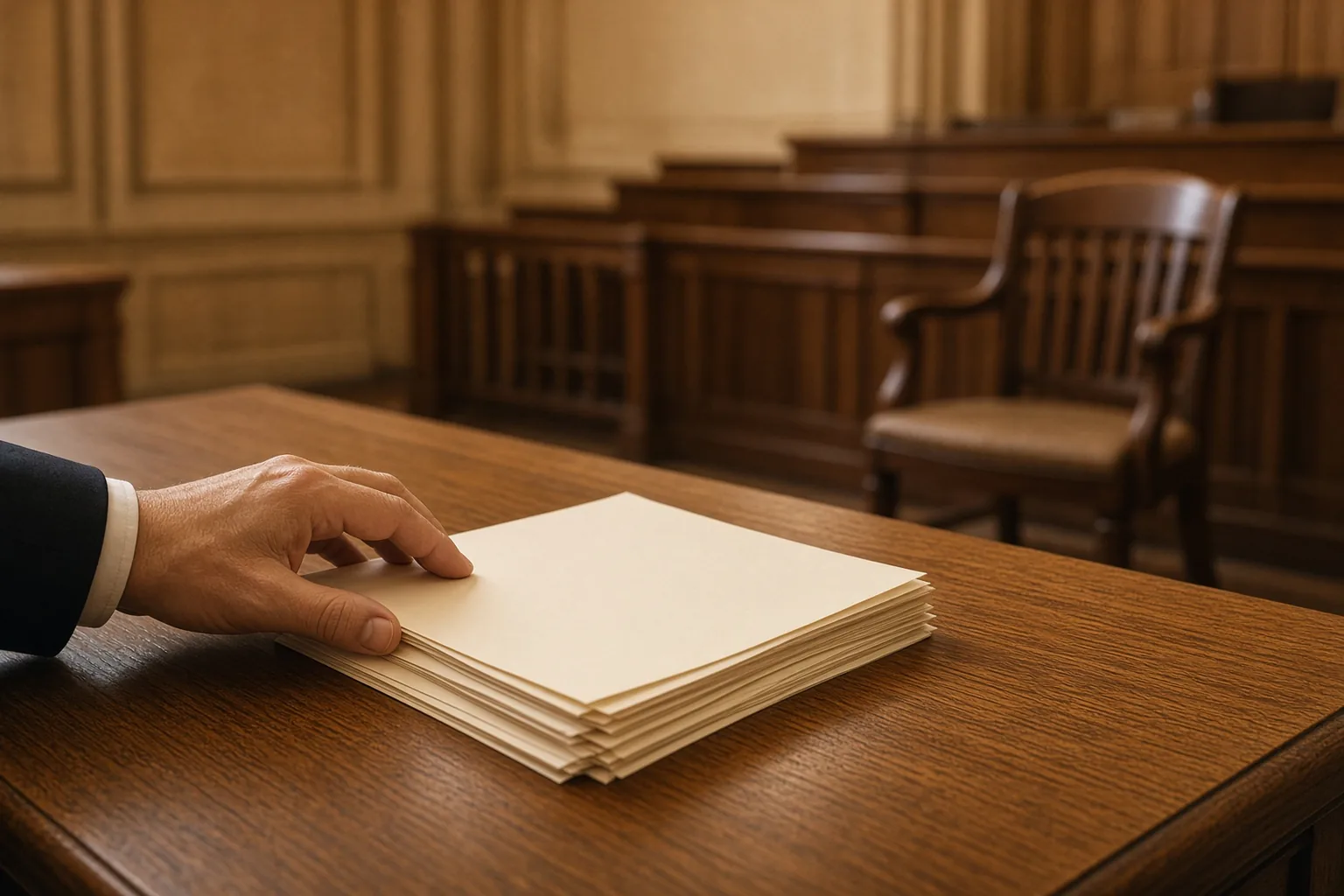
What does the party offering a document have to prove?
Evidence sufficient to support a finding that the item is what the proponent claims it is. The advisory committee called authentication a special aspect of relevancy, governed by the procedure of Rule 104(b).
Rule 901(a) reads: "To satisfy the requirement of authenticating or identifying an item of evidence, the proponent must produce evidence sufficient to support a finding that the item is what the proponent claims it is." The proponent does not have to prove that the contract or the letter is genuine. It has to offer enough evidence for a reasonable finding that it is.
The Advisory Committee's note to the rule states that authentication and identification represent a special aspect of relevancy. A contract signed by the defendant is relevant to a breach claim. A paper that only looks like that contract is relevant to nothing. The note places the requirement in the category of relevancy dependent upon fulfillment of a condition of fact, governed by the procedure set forth in Rule 104(b).
The low bar shapes the strategy of the party that disputes the document. An objection with nothing behind it does not answer a witness who testifies that the document is what it claims to be, and under Rule 901(b)(1) such testimony is one of the listed ways to authenticate. The challenge needs its own evidence: a witness, an inconsistency in the document, an examiner's findings.
Who decides whether a document is authentic, the judge or the jury?
Both, at different stages. Under Rule 104(b) the judge asks whether there is proof sufficient to support a finding of authenticity. If there is, the document comes in, and the jury weighs the conflicting evidence on whether it is genuine.
Rule 104(a) gives the court the preliminary questions about whether a witness is qualified, a privilege exists, or evidence is admissible, and in deciding them the court is not bound by evidence rules, except those on privilege. Rule 104(b) covers relevance that depends on a fact: "When the relevance of evidence depends on whether a fact exists, proof must be introduced sufficient to support a finding that the fact does exist."
Because the committee placed authentication under Rule 104(b), the judge does not decide whether the signature is in fact genuine before the document is admitted. The judge decides whether a reasonable jury could find it genuine on the evidence offered. The forgery dispute itself then goes to the jury, with both sides' witnesses and examiners.
The same note treats comparison of handwriting by an expert or by the jury, Rule 901(b)(3), alike: it sets no higher standard for handwriting specimens and leaves all comparison situations to Rule 104(b). A party that wants the jury to see the difference between a questioned signature and known signatures has to get authenticated specimens into the record.
How is a document usually authenticated?
Most often by a witness with knowledge, by a person familiar with the handwriting, by comparison with an authenticated specimen, or by the document's own contents and circumstances. Some records authenticate themselves by certificate under Rule 902.
Rule 901(b) lists examples. Testimony that an item is what it is claimed to be, under (b)(1), comes from a person who signed the document, saw it signed or received it. Under (b)(2), a nonexpert may give an opinion that handwriting is genuine, based on a familiarity with it that was not acquired for the current litigation. Under (b)(3), an expert witness or the trier of fact compares the item with an authenticated specimen.
Under (b)(4), the appearance, contents, substance, internal patterns, or other distinctive characteristics of the item, taken together with all the circumstances, can authenticate it. Under (b)(8), a document or data compilation qualifies as ancient if it is in a condition that creates no suspicion about its authenticity, was in a place where, if authentic, it would likely be, and is at least 20 years old when offered. A party challenging an old document attacks the first two conditions: the condition of the paper and where it was found.
Rule 902 lists items that need no extrinsic evidence of authenticity. Under Rule 902(11), a domestic record of a regularly conducted activity can come in on a certification of the custodian or another qualified person. The proponent must give an adverse party reasonable written notice before the trial or hearing and make the record and certification available for inspection, so that the party has a fair opportunity to challenge them.
When must you raise the objection?
In federal civil cases, within 14 days after the other side's pretrial disclosures unless the court sets another time. An objection to admissibility not made then, except under Rule 402 or 403, is waived unless excused.
Rule 26(a)(3)(A)(iii) requires each party to identify each document or other exhibit it may present at trial. Unless the court orders otherwise, these disclosures must be made at least 30 days before trial. Rule 26(a)(3)(B) then gives the other side 14 days after they are made, unless the court sets a different time, to serve and file its objections to the admissibility of the listed materials, with the grounds.
The consequence is written into the rule. An objection not so made, except for one under Federal Rule of Evidence 402 or 403, is waived unless excused by the court for good cause. An authenticity objection rests on Rule 901, so it falls outside that exception. A party that intends to call the contract a forgery at trial puts the objection, and the ground for it, in the 14-day filing.
A scheduling order can set different dates, and then the controlling deadline is the one in the order of the particular case. Without such an order, the 30-day and 14-day periods of Rule 26(a)(3) apply.
How do requests for admission work on the genuineness of documents?
Under Rule 36 a party can ask the other side to admit that a described document is genuine. A matter not answered in writing within 30 days is admitted, and an unjustified denial can cost the expense of proof.
Rule 36(a)(1) lets a party serve on any other party a written request to admit matters including the genuineness of any described documents. Under Rule 36(a)(2), a request to admit the genuineness of a document must be accompanied by a copy of the document. Under Rule 36(a)(3), a matter is admitted unless, within 30 days after being served, the party answers or objects in writing.
The answer has to be specific. Rule 36(a)(4) states that if a matter is not admitted, the answer must specifically deny it or state in detail why the answering party cannot truthfully admit or deny it. Under Rule 36(b), a matter admitted under the rule is conclusively established unless the court permits withdrawal or amendment.
Rule 37(c)(2) puts a price on an unjustified denial. If a party fails to admit what is requested under Rule 36 and the requesting party later proves a document to be genuine, the requesting party may move for the reasonable expenses, including attorney's fees, incurred in making that proof. The court must so order unless the request was held objectionable, the admission sought was of no substantial importance, the party failing to admit had a reasonable ground to believe that it might prevail on the matter, or there was other good reason for the failure to admit.
For the party disputing a document, the request works in reverse. A specific denial, served within 30 days and backed by an examiner's preliminary findings, can show a reasonable ground to believe the party might prevail under Rule 37(c)(2)(C), and the issue stays open for trial.
How do you get the original to your own examiner?
Through a Rule 34 request to produce the document and permit inspection, copying, testing or sampling at a reasonable time, place and manner. The written response is due within 30 days, and the court can set terms by protective order.
Rule 34(a)(1) lets a party request that another party produce and permit the requesting party or its representative to inspect, copy, test, or sample designated items in its possession, custody, or control. The request must specify a reasonable time, place, and manner for the inspection and for performing the related acts, and the response is due within 30 days after being served.
An examination of alterations, substituted pages or a stamp impression is done on the original where possible. The IAE page states, citing Standard 035, that images and copying processes can mask physical characteristics of a document. The request therefore names the original, the place where the examiner will see it and the equipment the examiner will bring.
Testing that removes ink is a separate question. Antonio Cantu of the U.S. Secret Service described dating methods that take micro discs, slivers or hole punches out of the entry, in a 1996 article in the International Journal of Forensic Document Examiners. Under Rule 26(c)(1)(B), the court may issue a protective order specifying terms, including time and place or the allocation of expenses, and a request to sample the only original of a disputed contract is the kind of request on which such terms are set.
What can a forensic document examiner add to the challenge?
Evidence the other side has to answer: findings on whether the signature matches known specimens, whether entries were altered or pages substituted, how and when the document was printed, and whether a stamp impression came from the stamp in question.
Rule 901(b)(3) names comparison with an authenticated specimen by an expert witness as one way to authenticate a document, and the same comparison can be used to attack one. The examiner compares the questioned signature with known signatures, or the questioned page with the other pages, and reports what agrees and what does not.
The IAE forensic document examination page lists the questions such an examiner answers: whether a page was inserted or replaced, an entry erased or overwritten, a stamp impression made by the stamp in question, and how the document was printed. According to the page, alterations are examined under ANSI/ASB Standard 035 (2020) with side lighting and ultraviolet and infrared light, printing processes under ANSI/ASB Standard 011 (2022), and stamp impressions under ANSI/ASB Standard 117 (2020).
The examiner's findings serve three steps of the challenge. Before trial they support the specific denial under Rule 36 and the objection under Rule 26(a)(3)(B). At a hearing they answer the proponent's witness. At trial they give the jury a reason to find that the document is not what the proponent claims.
What does the court require of the examiner's opinion?
Under Rule 702, the proponent of the examiner must show that it is more likely than not that the opinion rests on sufficient facts or data and on reliable methods reliably applied, and the report must meet Rule 26(a)(2)(B).
Rule 702 lets a qualified expert testify if the proponent shows the court that it is more likely than not that the expert's knowledge will help the trier of fact, that the testimony is based on sufficient facts or data, that it is the product of reliable principles and methods, and that the methods were reliably applied to the facts of the case. The 2023 committee note states that each expert opinion must stay within the bounds of what can be concluded from a reliable application of the expert's basis and methodology.
Rule 26(a)(2)(B) requires a retained expert's written report to contain a complete statement of all opinions and the basis and reasons for them, the facts or data considered, any exhibits, the witness's qualifications including publications from the previous 10 years, a list of cases in which the witness testified as an expert during the previous 4 years, and a statement of compensation.
For a document examiner the facts or data considered include what was examined: the original or a copy, which known specimens, which instruments and lighting. An opinion based on a copy, or on specimens from a different period, is bounded by that basis, and the report states the limits so that the opinion stays within them.
What does IAE do when a document's authenticity is challenged?
An examiner from the IAE registry prepares a report on your questions about the document or a review of the opposing examiner's report, in up to 5 business days after the format and cost are confirmed.
The IAE forensic document examination page covers inserted or replaced pages, erased or overwritten entries, stamp impressions and printing processes for federal and state cases. For a review, the page states that the reviewer checks whether each opinion comes with its basis and the facts or data considered, as Rule 26(a)(2)(B) requires, and whether the examiner considered apparent alterations caused by software, hardware or normal production variation under Standard 035.
Send the questioned document or its best available copy, known specimens if the dispute is about a signature or a stamp, the questions and the deadlines in the scheduling order. IAE confirms the questions and the handling of the original with you before work starts. The secretariat confirms receipt the same day, and within one business day IAE confirms the format, the cost, the deadline and the examiner from the registry; you approve the candidate and the CV.
The document is issued in up to 5 business days after the format and cost are confirmed, with a 48-hour rush for tight deadlines. The examiner confirms in the document that he or she has no interest in the outcome and can be verified by Member ID or QR code. The court weighs the report with the other evidence; neither IAE nor the examiner guarantees the outcome, and IAE is not a law firm and does not advise on case strategy.
Sources
- Federal Rules of Evidence, Rule 901, Authenticating or Identifying Evidence, with Notes of Advisory Committee, 28 U.S.C. Appendix, United States Code 2023 edition (govinfo.gov)
- Federal Rules of Evidence, Rule 104, Preliminary Questions (LII, Cornell Law School)
- Federal Rules of Evidence, Rule 902, Evidence That Is Self-Authenticating (LII, Cornell Law School)
- Federal Rules of Evidence, Rule 702, Testimony by Expert Witnesses, with the 2023 committee note (LII, Cornell Law School)
- Federal Rules of Civil Procedure, Rule 26, Duty to Disclose; General Provisions Governing Discovery (LII, Cornell Law School)
- Federal Rules of Civil Procedure, Rule 34, Producing Documents, Electronically Stored Information, and Tangible Things (LII, Cornell Law School)
- Federal Rules of Civil Procedure, Rule 36, Requests for Admission (LII, Cornell Law School)
- Federal Rules of Civil Procedure, Rule 37, Failure to Make Disclosures or to Cooperate in Discovery; Sanctions (LII, Cornell Law School)
- Cantu A. A., A Sketch of Analytical Methods for Document Dating Part II, International Journal of Forensic Document Examiners, Vol. 2, No. 3, 1996 (filed as Doc. 263-6 in Ceglia v. Zuckerberg, W.D.N.Y.; Justia PDF)
Read also
All articles
What can you ask a forensic document examiner, and what should you send with the document?
A forensic document examiner answers questions about how a document was made and what was done to it afterwards: whether an entry was added, a page Sergei Voronin
Burned, soaked or torn: what can a document examiner recover from a damaged document?
A document that went through a fire, a flood or a shredder is often still readable in part. Forensic document examiners work with charredSergei Voronin
Same pen or a different pen: what can a document examiner tell from the ink?
A document examiner can often show that two entries were written with different inks, and that settles that two pens were used. The reverse isSergei VoroninExpert examinations
Ready to discuss your case?
Send the materials: the secretariat will confirm the format, cost, deadline and the specialist within one business day.
