
Expert report review
How do you challenge a stamp impression examination?
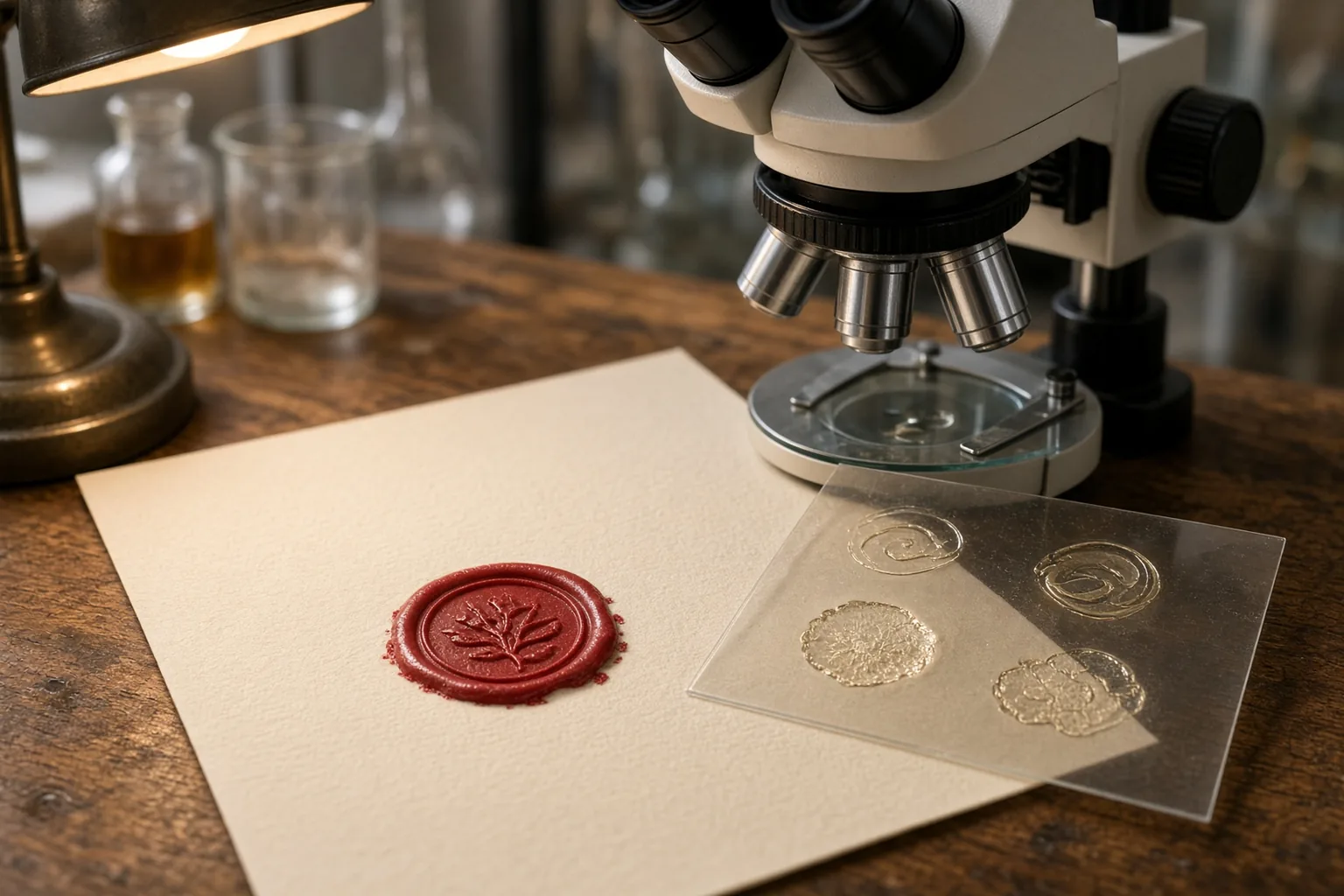
A stamp or seal opinion is reviewed against ANSI/ASB Standard 117 of 2020, which sets out how a document examiner compares a questioned impression with the stamp and with known impressions. The reviewer checks whether the examiner established that a stamp made the impression, obtained the device itself, used impressions from the same period, compared class characteristics first, ruled out a duplicate and chose an opinion type the work supports.
Which standard governs a stamp impression examination?
ANSI/ASB Standard 117 of 2020. It sets the sequence a review follows: the questioned impression, the known stamp and impressions, class characteristics, then individual defects, the duplicate question and one of four opinion types.
ANSI/ASB Standard 117, Standard for Examination of Stamping Devices and Stamp Impressions, first edition, was approved by the AAFS Standards Board in March 2020 and by ANSI in August 2020. Section 1 says it provides procedures to be used by forensic document examiners for examinations and comparisons of stamp impressions and stamping devices. Two other texts cover the same work: the SWGDOC Standard for Examination of Rubber Stamp Impressions, version 2013-1, and the FBI Laboratory procedure DOC-218-07, Stamped Impressions/Dry Seal Examinations, revision 7 issued December 16, 2024.
Standard 117 separates two kinds of features. Class characteristics belong to a production run: size, type style, design, text and shape (section 3.2). Randomly acquired characteristics belong to one stamp: wear, damage or blemishes, whose position, orientation, size and shape point to the source (section 3.19). An identification of one particular stamp rests on such characteristics, so the review asks which ones the examiner found and how much weight they carry.
The opposing examiner's report must state each opinion with its basis and reasons and the facts or data considered, as Federal Rule of Civil Procedure 26(a)(2)(B) requires. The reviewer reads the report against both texts: what Standard 117 requires at each step, and what the report says was done.
What question was the examiner asked to answer?
Standard 117 requires the examiner to clarify the questions with the submitter and to form two or more mutually exclusive hypotheses for each comparison. A report that tested one hypothesis answers less than its conclusion suggests.
Under section 4.5.1 the examiner first makes an initial assessment that sets the examinations, their sequence and the limiting factors. Section 4.5.8 requires the questions to be clarified with the submitter, and section 4.5.9 requires two or more mutually exclusive hypotheses for each set of comparisons. In a stamp case the usual pair is that the questioned impression was made by the submitted stamp, or that it was made by another stamp. A second pair is that a stamp made the impression, or that it was printed or reproduced.
The FBI procedure uses two scales that follow from the question. When a questioned impression is compared with a device, the opinions run Source Identification, May Have Prepared, Inconclusive, May Not Have Prepared and Source Exclusion. When two impressions are compared with each other, they run Items Share a Common Source, Support for a Common Source, Inconclusive, Support for Different Sources and Source Exclusion.
The reviewer checks that the report answers the question the case needs. A finding that impressions on two documents share a common source says nothing about whether either came from the notary's or the company's own stamp, unless the stamp itself was compared.
Did the examiner establish that a stamp made the impression at all?
Section 4.5.6 puts this step before the comparison: determine whether the questioned impression was produced by a stamping device. Section 4.5.10.3 places the search for electronic duplication on the original impression.
Section 4.5.6 reads: "Determine whether the submitted questioned impression(s) was produced by a stamping device." If it was not, the standard directs the examiner to discontinue. Section 4.5.10.3 adds: "Examine the original questioned stamp impression for characteristics of duplication by electronic or other means." The SWGDOC standard, section 5.4, lists duplicate stamps, simulations and computer-generated imitations among the possibilities the examiner considers.
Copies limit this step. Standard 117 prefers the original impression, and under section 4.5.10.2 the examiner given a non-original impression first determines whether the details have been reproduced clearly enough; if they have not, the examiner discontinues and reports accordingly. A report written from a scan that does not explain how a printed imitation was excluded leaves that hypothesis open.
Section 4.4.3 says items "shall be handled in a manner that avoids compromising subsequent examinations," and the standard calls for examination before chemical processing where possible. SWGDOC section 5.3 names latent print processing as an example. If the document went to fingerprint work before the stamp examination, the report should say so.
Did the examiner obtain the stamp itself, or only known impressions?
Standard 117 directs an examiner who receives known impressions to request the stamp that produced them, and the ink pad for a hand stamp. Known impressions made by the examiner should match the questioned item's conditions.
Section 4.5.7 says: "If known impressions are submitted, the forensic document examiner shall request the stamp that produced the known impressions." Section 4.5.11.3 adds: "If the stamping device is a hand stamp and the ink pad was not submitted, request it." Under section 4.5.11.1 the examiner notes the stamp's condition, type, die material and manufacturer.
With the stamp in hand, the examiner makes known impressions on substrate "most similar to the substrate" of the questioned item (section 4.5.11.6.1) and produces first, second, third and fourth generation impressions to record the range of variation (section 4.5.11.6.5). The FBI procedure calls for known impressions made with the device as received, at varying pressures, a second set after the device is cleaned, and a photographic record of the device's condition.
Getting the stamp is a discovery question. Rule 34(a)(1)(B) reaches "any designated tangible things" in a party's possession, custody or control and lets the requesting party "inspect, copy, test, or sample" them. When a notary, a former officer or another company holds the stamp, Rule 34(c) points to Rule 45: a subpoena may command a nonparty to produce tangible things, and under Rule 45(a)(1)(D) the command requires the person to permit inspection, copying, testing or sampling.
Were the known impressions made in the same period as the questioned one?
Section 4.5.13.2 names contemporaneousness, with size and design, among the features that limit comparability. Stamps wear and get damaged with use, so impressions made years later can carry defects the questioned impression never had.
Section 4.5.13.2 reads: "Features that can limit comparability include size, design, and contemporaneousness." Section 4.5.13.3 follows: "If the stamp impressions are not comparable, discontinue comparison and report accordingly."
Randomly acquired characteristics come from wear, damage or blemishes and can arise from individual usage after manufacture (section 3.19). A transitory defect, such as dust, hair or fiber on the die, is not part of the stamp and can disappear with use or cleaning (section 3.26). A manufacturing defect is an anomaly produced during the die's manufacturing process (section 3.12). A missing defect in the questioned impression can therefore mean a different stamp, or a defect that the stamp acquired after the questioned date. The reviewer checks whether the report dates each known impression and addresses that alternative.
Notary seals add a statutory element. Under section 117.05(3)(a) of the 2025 Florida Statutes, the seal must be of the rubber stamp type and include the words "Notary Public-State of Florida," the notary's name, the date of expiration of the commission and the commission number. A seal made for a later commission carries a different expiration date and may carry a different number, so known impressions from that seal differ in text, which is a class characteristic.
Did the examiner compare class characteristics before individual defects?
Section 4.5.13.5 requires class characteristics first: size, type style, text and shape. If they differ, the examiner discontinues and reports it; randomly acquired characteristics are compared only after the class features agree.
Section 4.5.13.5 reads: "Compare class characteristics (size, type style, text, shape). If different, discontinue and report accordingly." The FBI procedure gives the same order: if class characteristics are inconsistent, the examiner stops and reports an exclusion. Under sections 4.5.13.6 to 4.5.13.8 of Standard 117 the examiner then compares randomly acquired characteristics and weighs similarities, differences and limitations against the competing hypotheses.
F.L. Jim Lee, Jr. of Summit Forensic Document Examination Lab presented on photopolymer stamps in the Questioned Documents section of the American Academy of Forensic Sciences in 2019. His abstract speaks of the examiner being "able to interpret the significance of any particular feature, the relevance it has to the problem in hand."
In the report the reviewer looks for measurements of size and spacing, a description of each randomly acquired characteristic with its location, and images that let a reader find it. A report that lists matching text and border shape and then names the source has stopped at the class level.
Was a duplicate stamp ruled out before an identification?
It has to be. Under section 4.6.2.1 an identification is appropriate only when, with other conditions, any possibility of a duplicate rubber stamp can be eliminated. Without that, the standard leads to a qualified opinion or no conclusion.
Standard 117 defines a duplicate as a copy of a genuine stamp made from a matrix board or from an impression of the original (section 3.5). Section 4.4.4 requires that "Considerations shall be given to the possibility that a stamping device can be manufactured which duplicates" another stamp's impressions.
The identification clause in section 4.6.2.1 lists the conditions: compared impressions or impression and stamp "contain substantial significant similarities; there are no differences; and no limitations associated with absent characters; and any possibility of a duplicate rubber stamp can be eliminated." The SWGDOC standard, section 8.3, sets the same condition.
Lee's 2019 abstract states: "Of consideration to the forensic document examiner should always be the possibility of the existence of a duplicate stamp." He added: "Oftentimes, an inconclusive finding will need to be rendered instead of a positive identification of a specific stamp." A report that names the source and does not discuss duplication does not meet the identification clause as written.
Which of the four opinion types does the work support?
Standard 117 provides for identification, elimination, a qualified opinion or no conclusion, and requires the bases and reasons in the documentation and a summary in the report. The limitations recorded earlier should match the opinion chosen.
Elimination fits when "significant, inexplicable differences between two or more items are found at any level of the analyses" (section 4.6.2.2). A qualified opinion fits "When there are limiting factors and the examination reveals similarities or differences of limited significance" (section 4.6.2.3). No conclusion fits "When there are significant limiting factors, and the examination reveals no significant differences" (section 4.6.2.4). The SWGDOC standard requires the examiner to explain the limiting factors for a qualified opinion and for no conclusion (sections 8.5 and 8.6).
Limitations are recorded at the start. Under sections 4.4.1 and 4.4.2, limits from non-original documents, a limited quantity of impressions or poor condition are noted and recorded. Section 4.5.4 requires the examiner to document the examinations, observations and the basis for results contemporaneously.
The reviewer sets the two lists side by side. A file that records a copy, two partial impressions and over-inking, followed by an identification, shows a mismatch between the limitations and the opinion. So does an elimination that rests on a difference the examiner did not test against the range of variation in fourth-generation known impressions.
How does a disputed notary seal reach the court?
A notarized document is self-authenticating under Federal Rule of Evidence 902(8), but the opposing party may still dispute authenticity. The stamp opinion is then read with state notary law, such as Florida's seal and custody rules.
Rule 902 lists items that "require no extrinsic evidence of authenticity in order to be admitted." Paragraph (8) covers "A document accompanied by a certificate of acknowledgment that is lawfully executed by a notary public or another officer who is authorized to take acknowledgments." The Advisory Committee's note on the proposed rule adds: "In no instance is the opposite party foreclosed from disputing authenticity."
State law sets what a genuine seal looks like and who holds it. Under section 117.05(3)(a) of the Florida Statutes, the rubber stamp seal must be affixed "in photographically reproducible black ink." Under section 117.05(3)(b), the seal and the certificate of commission are the notary's exclusive property and "must be kept under the direct and exclusive control of the notary public," and they are not surrendered to an employer when employment ends. Under section 117.05(3)(c), a notary whose seal is lost, stolen or believed to be in another person's possession must immediately notify the Department of State or the Governor in writing.
These provisions give the review its checkpoints: whether the questioned seal carries the statutory text for the commission in force on its date, whether the examiner compared it with the notary's own seal or only with other documents, and whether any notice of a lost or stolen seal exists for the period.
What does IAE prepare when a stamp impression opinion is disputed?
IAE prepares reviews of the opposing examiner's report for federal and state cases, including opinions on whether a stamp impression was made by the stamp in question, issued in up to 5 business days.
Under ANSI/ASB Standard 117 the specialist compares questioned impressions with known impressions and the stamp: size, type style, wear, damage, inking defects and signs of duplication. The review also checks whether each opinion comes with its basis and the facts or data considered, as Rule 26(a)(2)(B) requires. IAE confirms the questions and the handling of the original with the client before work starts.
The review answers six questions about the report: whether the method fits the questions and was followed at every stage, whether all materials were examined, whether the conclusions follow from the examination, whether the examiner's education and experience match the subject, whether formal and procedural requirements were met, and whether the report can be relied on.
The client sends the report and what is available of the questioned document, the known impressions and the stamp. The secretariat confirms receipt the same day, and within one business day IAE confirms the format, cost, deadline and the specialist from its registry. The client approves the candidate and the CV before work starts. The signed document is issued in up to 5 business days after the format and cost are confirmed, and a 48-hour rush is available. Specialists are members of the public IAE registry, verifiable by Member ID or QR code, and confirm in the document that they have no interest in the outcome. A review is evidence the court weighs with the other materials; neither IAE nor the reviewer guarantees the outcome. IAE is not a law firm and does not advise on case strategy.
Sources
- ANSI/ASB Standard 117, Standard for Examination of Stamping Devices and Stamp Impressions, First Edition, 2020 (AAFS Standards Board)
- SWGDOC Standard for Examination of Rubber Stamp Impressions, ver. 2013-1 (NIST)
- FBI Laboratory, Questioned Documents Unit, DOC-218-07, Stamped Impressions/Dry Seal Examinations, Revision 07, issued 12/16/2024
- Lee F.L.J., Jr. Photo-Polymer Stamps: Their Examination and Identification, AAFS 2019 abstract J22
- Federal Rules of Civil Procedure, Rule 26, Duty to Disclose; General Provisions Governing Discovery (LII)
- Federal Rules of Civil Procedure, Rule 34, Producing Documents, Electronically Stored Information, and Tangible Things (LII)
- Federal Rules of Civil Procedure, Rule 45, Subpoena (LII)
- Federal Rules of Evidence, Rule 902, Evidence That Is Self-Authenticating, with Committee Notes (LII)
- The 2025 Florida Statutes, section 117.05, Use of name; fees; seal; affidavit; etc. (Florida Senate)
Read also
All articles
The government's forensic report says your document is counterfeit: how is it reviewed and rebutted in immigration proceedings?
An asylum file or a benefit application can turn on one sheet of paper: a birth certificate, a church letter, a party card. When a government Sergei Voronin
The opposing examiner says the pages came from different printers: how is that opinion reviewed?
Opinions that a page was printed on a different machine than the rest of a contract often decide substitution claims. The SWGDOC standards for tonerSergei Voronin
The opposing examiner calls the document a forgery: may a document examiner decide that?
A document examiner may testify that a signature is not the writing of the person named, that a page was replaced or that an entry was added. WhetherSergei VoroninExpert report review
Ready to discuss your case?
Send the materials: the secretariat will confirm the format, cost, deadline and the specialist within one business day.
