
Examinations
Contractor overbilling: how does an expert check the quantities and the price of the work that was billed?
A contractor overbills when it charges for work not performed, materials not furnished or quantities larger than those in place. An expert proves the difference by measuring the installed work, matching every billed line to the contract, the change orders and the field records, and pricing what is actually there. In Florida a lien that willfully exaggerates the amount is fraudulent under section 713.31 and cannot be enforced.
What counts as overbilling by a contractor?
Charging for work that was not performed, for materials that were not furnished, for quantities above those installed or at prices the contract does not provide. Each of these can be measured against the work in place and the contract.
A billing dispute starts with a document: a pay application, a final invoice or a claim of lien. The owner sees a percentage of completion that does not match the site, a line for materials that never arrived, or an extra charge without a signed change order. The contractor answers that the work was done, or that the owner asked for it.
Florida's lien law names the same problems. Section 713.31(2)(a) describes a lien in which the lienor has willfully exaggerated the amount claimed, has willfully included a claim for work not performed or materials not furnished, or has prepared the claim with such willful and gross negligence as to amount to a willful exaggeration. Such a lien "shall be deemed a fraudulent lien."
The words of the statute point to two separate questions. One is technical: how much of the billed work and material is actually in the building. The other is about intent: whether the gap is willful or a mistake. An expert answers the first. The court decides the second, using the expert's numbers along with the rest of the evidence.
Which documents does the expert compare with the work in place?
The contract with its drawings, specifications and price breakdown, the change orders, every pay application and invoice, delivery records for materials, daily logs, inspection reports and dated photographs of the work before it was covered.
The contract fixes what was bought. Drawings and specifications describe the work, and the price breakdown, often called a schedule of values in commercial work, splits the contract sum into lines that later pay applications bill against. Change orders add or remove work and set its price.
The billing side is the pay applications, invoices and any claim of lien. Each line states a quantity or a percentage. The expert builds one table that puts the billed figure, the contract figure and the measured figure side by side for every line.
Field records connect the two. Delivery records show what material reached the site and when. Daily logs and inspection reports show which crews worked and which inspections passed. Photographs taken before drywall, ceilings or floors closed the work show what is now hidden. Where none of these exist, the expert reports which quantities could not be verified without opening finished surfaces, and proposes where to open them.
How does an expert measure the work actually done?
By counting and measuring the installed work on site, element by element, and comparing the result with each billed line. Hidden work is checked through records, photographs or limited openings agreed with the parties.
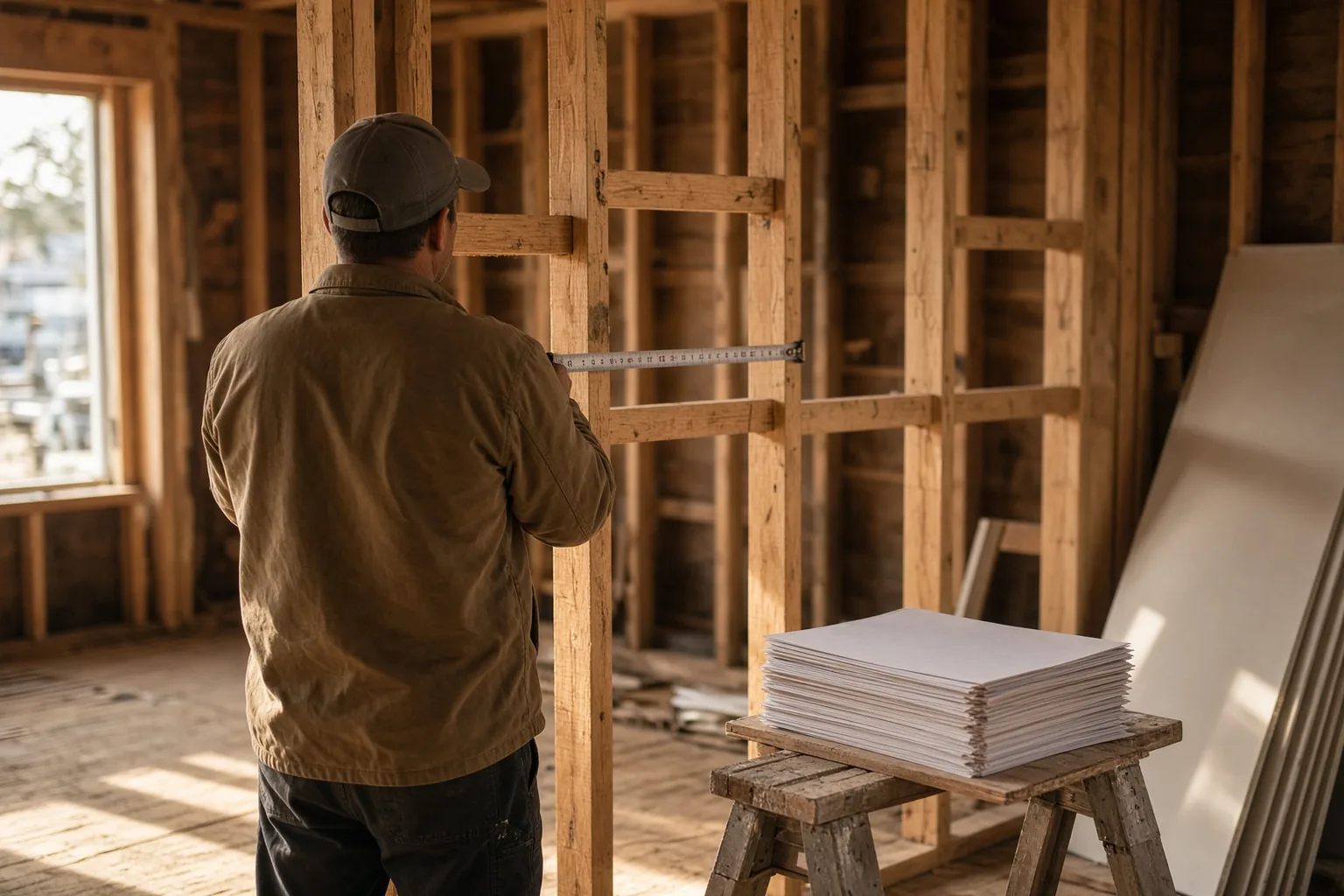
The method is a quantity takeoff from the building itself. The expert walks the site with the drawings and the billing table, counts fixtures, doors and windows, measures areas of drywall, tile, roofing and paint, and lengths of pipe, duct or wiring that are visible. Each measured quantity is recorded with its location so that the other side can check it.
Percentage billing needs a different test. A pay application that says the electrical work is 80 percent complete can be checked against what is installed, what has passed inspection and what remains on the drawings. The expert states the measured percentage and how it was computed.
Materials stored on site or off site are counted separately. The expert lists what is physically present, matches it with delivery records and states whether the material is incorporated in the work or only stored. Work that is not yet in place is reported as such, without guessing at its value.
The report keeps measured facts apart from opinions. A line can be measured and match the bill, be measured and fall short, or be impossible to measure without opening the work. The expert labels each line, because the court will weigh measured shortfalls and unverified items differently.
How does the expert price the work that was actually done?
At the prices the parties agreed: the contract unit prices or the line amounts in the price breakdown, and the prices in signed change orders. Work outside the contract and change orders is listed separately with the pricing source stated.
Once quantities are fixed, pricing follows the contract. Where the contract has unit prices, the measured quantity times the unit price gives the earned amount. Where it has a lump sum split into lines, the expert applies the measured percentage of each line to that line's amount. Signed change orders are priced at their own terms.
Extra work without a signed change order raises a separate question. The expert does not decide whether the owner ordered it; that is a contract question for the court. The expert can state what the extra work is, how much of it is in place and what it would cost at the contract's unit prices or at another stated price source, so that the court has a number for each answer it may reach.
The result is a reconciliation: billed amount, earned amount on the expert's measurement, and the difference for each line, with totals. Credits for work deleted from the scope, and backcharges that the owner claims, are shown as separate lines and not netted against the overbilling.
When does an inflated claim of lien become fraudulent in Florida?
When the lienor willfully exaggerates the amount, willfully includes work not performed or materials not furnished, or prepares the claim with willful and gross negligence. A minor mistake or a good faith dispute over the amount is not enough.
Section 713.31(2)(a) sets out the three forms: willful exaggeration of the amount for which the lien is claimed, willful inclusion of a claim for work not performed or materials not furnished for the property, and compilation of the claim with such willful and gross negligence as to amount to a willful exaggeration.
Section 713.31(2)(b) draws the line on the other side. A minor mistake or error in a claim of lien, or a good faith dispute as to the amount due, does not constitute a willful exaggeration that operates to defeat an otherwise valid lien.
The expert's measurement feeds both sides of that line. A small difference spread across many lines, or a dispute over how to read a change order, looks like the cases that subsection (2)(b) protects. A lien that includes whole items absent from the site, or materials that delivery records show never arrived, matches the language of subsection (2)(a). The court makes that call.
What happens to a lien that the court finds fraudulent?
It is unenforceable and the lienor loses its lien right on the property. The owner may recover damages, attorney's fees and punitive damages capped at the difference between the amount claimed and the amount due.
Under section 713.31(2)(b), a showing that the lien is fraudulent is a complete defense to an action to enforce it. The court declares the lien unenforceable, and the lienor forfeits any right to a lien on that property.
Section 713.31(2)(c) gives the owner a damages action, which may be filed on its own, joined with a summons to show cause under section 713.21, or raised as a counterclaim or cross-claim. The prevailing party recovers reasonable attorney's fees and costs. A lienor that does not prevail is also liable for court costs, clerk's fees, a reasonable attorney's fee and costs for services in securing the discharge of the lien, the premium for a bond given to obtain the discharge, interest on money deposited to discharge the lien, and punitive damages in an amount not exceeding the difference between the amount the lienor claimed to be due or to become due and the amount actually due or to become due.
Section 713.31(3) makes willfully filing a fraudulent lien a felony of the third degree. When a contractor, subcontractor or sub-subcontractor is charged, a copy of the charging document goes to the Department of Business and Professional Regulation, which opens an investigation.
The cap on punitive damages is a figure the expert's reconciliation produces: the amount claimed minus the amount due. That is one reason the report gives a total earned amount as well as the list of disputed lines.
How is the expert's quantity opinion tested in court?
Under Rule 702 in federal court the party offering the expert must show that the opinion more likely than not rests on sufficient facts or data and on a reliable application of a reliable method to this project.
Rule 702 of the Federal Rules of Evidence, as amended on December 1, 2023, admits expert testimony if the proponent shows the court that it is more likely than not that the opinion will help the trier of fact, is based on sufficient facts or data, is the product of reliable principles and methods, and applies those methods reliably to the facts of the case. The committee note to the 2023 amendment calls the practice of treating the sufficiency of the basis and the application of the method as weight questions "an incorrect application of Rules 702 and 104(a)."
For a quantity opinion the basis is the measurement record. An expert who counted only some rooms and scaled the result up, or relied on the contractor's own percentages, gives the other side an argument under Rule 702(b) and (d). The 2000 committee note lists as a factor whether the expert has adequately accounted for obvious alternative explanations; in a billing dispute that includes work removed by the owner's later contractor and materials taken off site.
The report itself follows Rule 26(a)(2)(B) in federal court: all opinions with their basis and reasons, the facts or data considered, the exhibits such as the reconciliation table and photographs, the expert's qualifications and publications from the previous 10 years, prior testimony in the previous 4 years, and compensation. State courts apply their own rules, so the request to the expert names the court.
What should an owner do before the work is changed or covered?
Preserve the evidence: photograph the site with dates, keep every pay application, invoice and delivery record, and have the expert measure before a replacement contractor removes or covers anything.
When the owner stops paying and brings in another contractor, each day of new work changes what can be measured. A dated photo record of every room and a measured inspection before the new crew starts keep the evidence that the expert later relies on.
The other side has a stake in the same evidence. Giving the contractor notice of the inspection and a chance to attend, and recording who was present, takes away the argument that the measurement was one-sided. The expert's report then states the date, the attendees, the instruments used and the areas measured.
What does IAE do in a billing dispute with a contractor?
For US courts IAE prepares an expert report on the questions agreed with the client and a review of the opposing construction expert's report, in up to 5 business days after the format and cost are confirmed.
The IAE construction defects page covers where the water came in, whether the work meets the contract and the code, whether the structure is sound and what the repair will cost. For scope and cost the expert lists each damaged element, measures quantities on site or from photos and prices the repair line by line, with defect repair kept apart from upgrades. The expert answers the questions agreed with the client, working from the documents, the photos and the site inspection record. In a billing dispute those questions can be the ones this article describes: billed, installed and earned quantities line by line.
The client sends the contract and change orders, the pay applications, invoices and any claim of lien, delivery records and photographs, and states the questions and the court. The secretariat confirms receipt the same day. Within one business day IAE confirms the format, the cost, the deadline and the specialist from its registry, and the client approves the candidate and the CV before work starts. Cases with tight deadlines have a 48-hour rush.
Every specialist is a member of the public IAE registry and can be verified by Member ID or QR code. The specialist confirms in the document that he or she has no interest in the outcome of the case. An expert report is evidence that the court weighs with the other materials; neither IAE nor the expert guarantees the outcome. IAE is not a law firm and does not advise on case strategy.
Sources
Read also
All articles

A neighbor's grading or paving sends water onto my property: who is responsible, and how does an expert prove the drainage change?
Whether a neighbor answers for water that runs onto your land depends on the surface water rule of the state. California asks whether each owner Sergei Voronin

Roof leaking after a roof replacement: how does an expert prove that the roofer's work caused it?
A roof that leaks a few weeks after it was replaced does not prove by itself that the roofer did bad work. The owner has to show where the waterSergei Voronin
Construction next door damaged my house: how does an expert tie the cracks to the neighboring work?
When excavation, pile driving or underpinning next door is followed by new cracks, tilting floors or sticking doors, the owner has to prove thatSergei VoroninExpert examinations
Ready to discuss your case?
Send the materials: the secretariat will confirm the format, cost, deadline and the specialist within one business day.
