
Expert report review
Defense review of an arson investigator's report: what does a defense fire expert check?
A defense fire expert in an arson prosecution reviews the government's origin and cause opinion, the laboratory results, any canine alert and the investigator's file. In 2010 a federal judge in Massachusetts granted relief to a man convicted of arson because his trial lawyers never moved to exclude the canine and laboratory evidence. In 2015 the Third Circuit affirmed habeas relief for a man convicted in 1990 on fire evidence the prosecution later called invalid.
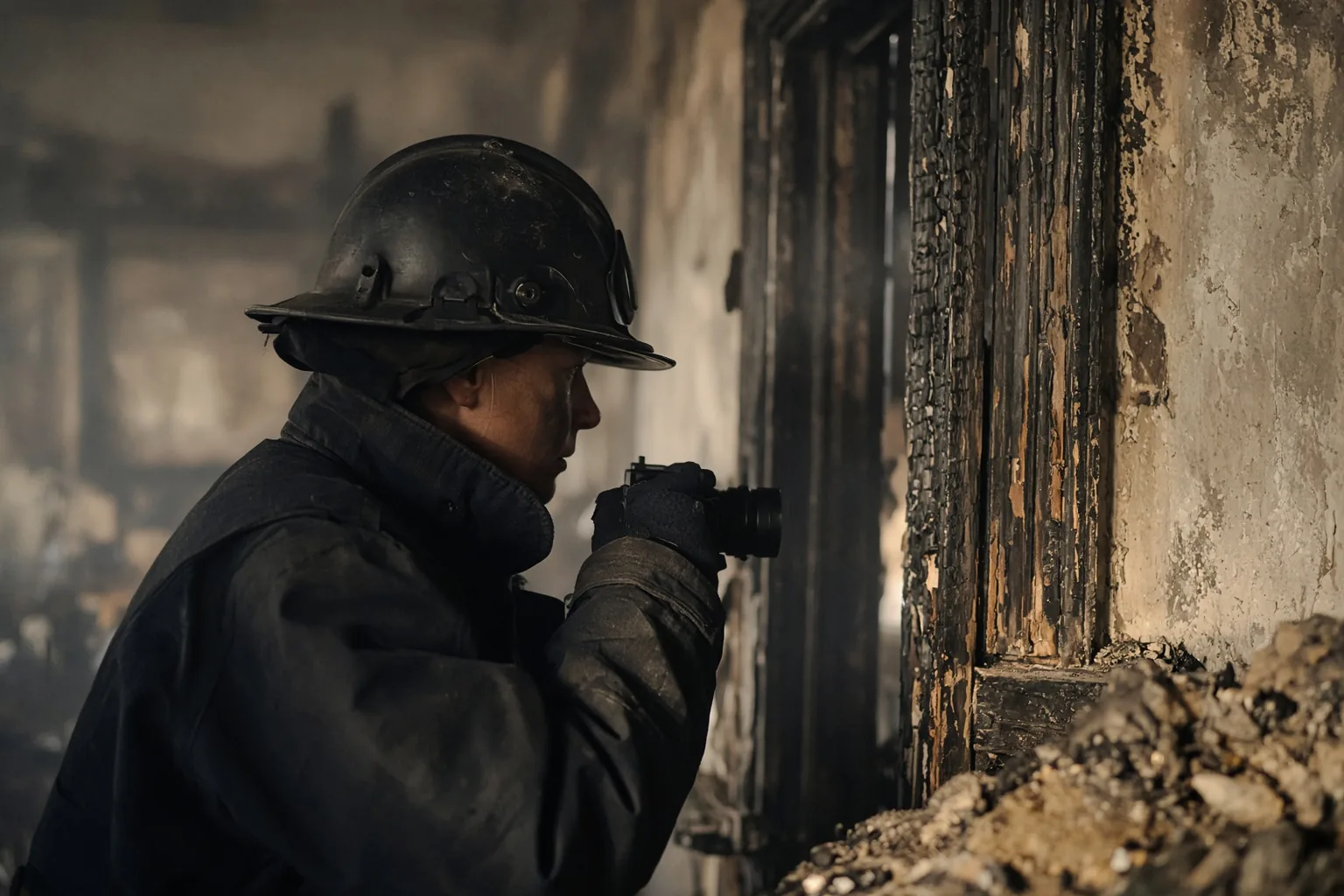
What does a defense fire expert review in an arson prosecution?
The parts that carry the government's arson case: the origin and cause testimony, the laboratory test for an ignitable liquid and any canine alert, each read against the investigator's notes, photographs and samples.
James Hebshie was convicted in June 2006 of arson under 18 U.S.C. § 844(i) and of mail fraud after an April 2001 fire at 32-34 Main Street in Taunton, Massachusetts, and received a mandatory fifteen-year sentence. On November 15, 2010, Judge Gertner of the District of Massachusetts granted his motion under 28 U.S.C. § 2255 in United States v. Hebshie, Criminal No. 02cr10185-NG, on the ground of ineffective assistance of counsel.
The court named three parts of the government's case that counsel should have tested at a Daubert hearing: the cause and origin testimony, the laboratory accelerant test and the canine evidence. It found that without the laboratory test or the canine evidence "there was no other direct evidence of arson."
A defense review takes the same parts in turn. For the origin, the reviewer lists the burn patterns the investigator relied on, the areas he examined and the other potential causes he documented and tested. The Hebshie court had "greater concern about the investigator's failure to document any other potential cause." His report made no mention of the basement, where the defense said the fire had started accidentally. For the laboratory, the reviewer records what was identified, under which classification, and whether a comparison sample was collected. For the canine, the reviewer records where the dog alerted, what was sampled at each spot and what the laboratory found in each sample.
Each point in the review cites the page of the report, the photograph or the sample number it rests on, so that counsel can put it to the investigator at a hearing or at trial.
What must the prosecution hand over about its fire investigation?
On the defendant's request, Rule 16 covers photographs, tangible objects and buildings or places that are material to the defense or will be used at trial, and the results of any scientific test, such as debris analysis.
Rule 16(a)(1)(E) of the Federal Rules of Criminal Procedure requires the government, upon a defendant's request, to permit inspection and copying or photographing of books, papers, documents, data, photographs, tangible objects, buildings or places within its possession, custody or control. One of three conditions must be met: "the item is material to preparing the defense," the government intends to use the item in its case-in-chief at trial, or the item belongs to the defendant or was obtained from him. In a fire case this reaches scene photographs, removed wiring and appliances, debris samples and, while the government controls it, the building.
Rule 16(a)(1)(F) covers the results or reports of any physical or mental examination and of any scientific test or experiment. The item must be within the government's possession, custody or control, the attorney for the government must know, or through due diligence could know, that it exists, and it must be material to preparing the defense or intended for use in the government's case-in-chief. Laboratory reports on fire debris and the results of any test burn fall under this paragraph.
Rule 16(a)(2) does not authorize discovery of reports, memoranda or other internal government documents made by an attorney for the government or other government agent in investigating or prosecuting the case, except as Rule 16(a)(1)(A)-(D), (F) and (G) provide. A defense request therefore names the test results, data and photographs it needs instead of asking only for the investigator's narrative.
The investigator's opinion itself comes under Rule 16(a)(1)(G), rewritten by the 2022 amendment. At the defendant's request the government discloses in writing, for each expert it will call in its case-in-chief or in rebuttal to timely disclosed defense expert testimony, "a complete statement of all opinions" it will elicit, "the bases and reasons for them," the witness's qualifications with publications from the previous 10 years and the cases from the previous 4 years in which the witness testified as an expert. The court sets the time, and it must be sufficiently before trial to give the defendant a fair opportunity to meet the evidence.
Disclosure runs both ways. Under Rule 16(b)(1)(B), once the defendant has requested and received disclosure under (a)(1)(F), the defendant must permit the government to inspect results or reports of tests in the defendant's possession if the defendant intends to use the item in the case-in-chief or intends to call the witness who prepared the report and the report relates to that witness's testimony. A review that the defense neither offers at trial nor sponsors through its author meets neither condition. If the reviewer will testify, Rule 16(b)(1)(C) applies: once the defendant has requested and received the government's expert disclosure, the defendant must, at the government's request, disclose the same contents for expert testimony in the defendant's case-in-chief. Under Rule 16(c), a party who discovers additional evidence or material before or during trial "must promptly disclose its existence" if it is subject to discovery under the rule and the other party previously requested it or the court ordered its production.
Does an indigent arson defendant have a right to a fire expert?
In federal court, yes, through 18 U.S.C. § 3006A(e)(1): counsel applies ex parte, and the court authorizes the expert after finding the services necessary and the defendant financially unable to obtain them.
Section 3006A(e)(1) lets counsel for a person "who is financially unable to obtain investigative, expert, or other services necessary for adequate representation" request them "in an ex parte application." Upon finding, after appropriate inquiry in an ex parte proceeding, "that the services are necessary and that the person is financially unable to obtain them," the court "shall authorize counsel to obtain the services." The government does not take part in that proceeding. Under (e)(2)(A), appointed counsel may also obtain necessary services without prior authorization, subject to later review and to a cost limit written into the statute.
The constitutional rule comes from Ake v. Oklahoma, 470 U.S. 68, decided February 26, 1985, in an opinion by Justice Marshall. When a defendant shows the trial judge that his sanity at the time of the offense will be a significant factor at trial, the State must, at a minimum, assure access to a competent psychiatrist. The Court described its line of cases as identifying the "basic tools of an adequate defense or appeal" and wrote that a criminal trial is fundamentally unfair if the State proceeds against an indigent defendant without making certain that he has access to the "raw materials integral to the building of an effective defense." Ake concerned a psychiatrist; the federal statute covers expert services in general.
Hinton v. Alabama, 571 U.S. 263, decided per curiam on February 24, 2014, turned on firearms and toolmark evidence. Trial counsel believed he could get no more than $1,000 for expert fees, although a 1984 amendment to the Alabama statute allowed reimbursement of "any expenses reasonably incurred in such defense to be approved in advance by the trial court." He hired an expert he himself considered inadequate. The Court called this "a quintessential example of unreasonable performance under Strickland," repeated that "Criminal cases will arise where the only reasonable and available defense strategy requires consultation with experts," vacated the judgment and remanded for reconsideration of whether the deficient performance was prejudicial. The trial judge had told counsel that he could ask for additional experts.
What happened when defense counsel did not challenge the arson evidence?
In Hebshie the court found counsel ineffective. They stipulated to the laboratory result, filed no pretrial motion on expert issues and did not object when the canine handler testified beyond the proper use of canine evidence.
Judge Gertner wrote: "Not a single pretrial motion or proposed jury instruction was filed on expert issues at all." Trial counsel "had been specifically warned about deficiencies in this case by predecessor counsel." Predecessor counsel had hired two forensic experts, John Titus and Michael Higgins; trial counsel kept Titus and did not retain Higgins. Asked at the evidentiary hearing whether there had been a strategic reason not to move to exclude the government's expert testimony, one of the trial lawyers answered: "We did not strategize to allow that in."
The state police laboratory technician classified the sample as a light petroleum distillate, did not identify the substance beyond that and agreed that a comparison sample is the "preferred practice." Defense counsel stipulated to the laboratory results.
On prejudice, the court asked whether there was a reasonable probability of a different outcome under Strickland. It found the motive evidence "not substantial" and wrote: "Without a valid accelerant laboratory test, Domingos' and Millers' opinions that the fire was incendiary was simply not reliable." The court did not decide whether it would have excluded the origin testimony and said that the investigator's burn pattern interpretations likely would have been admitted.
The court found that counsel "did not seek exclusion of any of the proposed expert testimony which was the core of the arson case." A defense review prepared before trial addresses the same points: the basis of each expert opinion the government will offer, the laboratory classification and its comparison samples, and the limits of the canine testimony.
Does an accelerant detection dog's alert prove arson?
Not on its own. The Hebshie court quoted NFPA 921: canine detection should be used in conjunction with, and not in place of, the other fire investigation, to pick samples for laboratory confirmation.
In Hebshie the handler, Lynch, "was permitted to testify that the dog did not alert to anything else on the premises," and he "categorically stated that she was 97 % accurate." He gave that figure without objection. In closing the government argued: "Billy knew what she was smelling for. She indicated an alert on one place and one place alone." The court wrote that Billy, "like the traditional Ouija board, was simply allowed to point to Hebshie as an arsonist."
The opinion quoted NFPA 921, Guide for Fire and Explosion Investigations, on the role of the dog. Canine detection "should be used in conjunction with, and not in place of, the other fire investigation," and its purpose is to select samples with a "higher probability of laboratory confirmation than samples selected without the canine's assistance." The court also quoted the guide's statement that "The collection of comparison samples is especially important" and wrote that the scientific literature "cast doubt on the significance of the dog's failure to alert."
According to the court, counsel should have objected under Rule 403 or Rule 702 of the Federal Rules of Evidence "to all statements that suggested that the alert had any validity beyond helping the fire investigators to choose samples." A review lists every alert location, the sample taken there, its laboratory result and whether a comparison sample of the same material was collected.
Can an arson conviction be reopened after fire science changes?
In some cases. In 2015 the Third Circuit affirmed habeas relief for Han Tak Lee, convicted in 1990, after the prosecution conceded that the basis for its fire evidence was now invalid.
On July 28, 1989, a fire started in the Lee family's cabin at Camp Hebron, a religious retreat in Monroe County, Pennsylvania, and Lee's daughter, Ji Yun Lee, died. At the 1990 trial State Police Fire Marshal Thomas Jones described "patterns of deep charring, alligator charring" and "crazed glass (finely fractured glass)" and found "at least eight separate points of origin located throughout the cabin." Lee was convicted of arson and murder and sentenced to life imprisonment without the possibility of parole.
In Lee v. Glunt, 667 F.3d 397 (3d Cir. 2012), the Third Circuit treated his claim as a due process claim and remanded for discovery and for reconsideration of an evidentiary hearing. Developments in fire science, the panel said, "provided ample reason to question the reliability of the arson investigation." After a hearing, Magistrate Judge Carlson found that the verdict rested on "scientific pillars which have now eroded," and the district court granted relief unless Lee was retried or released within 120 days.
On August 19, 2015, in No. 14-3876, the Third Circuit affirmed. The standard was that "Lee must show that the admission of the fire expert testimony undermined the fundamental fairness of the entire trial." The Commonwealth conceded that, because of scientific developments since the trial, "the basis for all of this evidence is now invalid." A footnote records that at the time of trial "fire scientists incorrectly believed that flashovers were rare," and the court noted that retesting of surviving materials had undermined the reliability of Thomas Pacewicz's gas chromatography testimony.
Texas wrote a route for changed science into its habeas statute. Senate Bill 344, effective September 1, 2013, added Article 11.073 to the Code of Criminal Procedure. It applies to relevant scientific evidence that was not available to the convicted person at trial or that contradicts scientific evidence the state relied on at trial. Relief requires, among other findings, that on a preponderance of the evidence the person would not have been convicted had the evidence been presented. House Bill 3724, effective September 1, 2015, rewrote subsection (d): in deciding whether the evidence could have been found with reasonable diligence, the court considers whether "the field of scientific knowledge, a testifying expert's scientific knowledge, or a scientific method" on which the evidence is based has changed since the trial.
What did the Texas Forensic Science Commission find in the Willingham and Willis arson cases?
In its final report of April 15, 2011 the commission wrote that floor pour patterns once read as near proof of an accelerant have other explanations, and made 17 recommendations, including admissibility hearings in all arson cases.
Cameron Todd Willingham was convicted in Navarro County in August 1992 and sentenced to death for killing his three children by setting fire to their home in Corsicana; the fire department first responded on December 23, 1991. He was executed on February 17, 2004. Ernest Ray Willis was convicted in Pecos County in August 1987 and sentenced to death for killing two women in an arson in Iraan. A federal court granted him relief on August 9, 2004, he was released on October 6, 2004, and the State exonerated him on actual innocence grounds.
The commission's report recorded that investigators once treated floor-level pour patterns as "nearly proof alone" of an accelerant. It explained that "when a fire approaches or surpasses flashover conditions, all of the exposed carpet in the room will ignite," and that "Synthetic carpets and pads melt or decompose to liquid as they burn, producing highly irregular and unpredictable patterns." A V-pattern, in the report's words, "simply points to where something was burning at some stage of the fire." The report also stated: "Most experts believe that it took at least until the mid-1990's for NFPA 921 to be widely accepted."
The State Fire Marshal's Office had said, "we stand by the original investigator's report and conclusions." The commission answered: "This appears to be an untenable position in light of advances in fire science."
Among the 17 recommendations: investigators of the State Fire Marshal's Office should follow NFPA 921; the office should develop standards for re-examining cases, and "If new scientific knowledge develops over time that would materially change the opinions or results in a criminal investigation," the individual or agency has a responsibility to inform the parties involved; judges "should affirmatively exercise their discretion to hold such hearings in all arson cases"; statewide minimum standards for fire investigation reports; and local fire departments and the State Fire Marshal's Office "should preserve originals and forward only copies of documentation."
How does a reviewer check an arson finding for bias?
By separating what the investigator learned about the fire from what he learned about the suspect. An OSAC research need approved in 2021 states that domain irrelevant data can cause errors in origin and cause determinations.
The Organization of Scientific Area Committees for Forensic Science (OSAC), administered by NIST, publishes research needs on the NIST website. The need titled "Effect of Nonrelevant Data on Origin and Cause Determination," from the Fire and Explosion Investigation Subcommittee, was approved on March 10, 2021. It states: "Exposure to domain irrelevant data has the potential to cause errors in the scientific determination of origin and cause." According to the document, separating the duties of examining physical evidence and relevant witness statements from data that has no bearing on origin and cause "could eliminate bias which might affect origin and cause determinations." The need is rated as a major gap in current knowledge.
An earlier OSAC form, "Potential for reducing bias in fire and explosion investigations," was approved by the subcommittee on January 28, 2016 and by the scientific area committee on May 6, 2016. It states: "Previous examples in fire investigations have led to erroneous conclusions and convictions owing to bias." It also states that "NFPA 921 recognizes bias as an issue, but additional research in methodology for reducing bias would be beneficial."
A reviewer builds a timeline from the investigator's file: when he first examined the scene, when he learned of a suspect, a financial motive or an insurance claim, when samples went to the laboratory and when he first wrote down a cause. Each fact in the cause section is then sorted into data about the fire and data about the people involved. A fact of the second kind cited as support for an incendiary finding goes into the review with the page where it appears.
What does IAE do when the defense needs a review of an arson investigator's report?
IAE prepares a review of the opposing fire investigator's report or a fire origin and cause expert report on the client's questions. The signed document is issued within up to 5 business days after the format and cost are confirmed.
IAE's fire origin and cause page lists arson defense together with subrogation, product liability and coverage disputes in US courts. The reviewer lists each hypothesis the investigator considered and checks what data excluded the others, which NFPA 921 edition the investigator applied, and whether wiring, appliances and debris were photographed in place before removal, logged and examined at a joint lab exam with all interested parties notified. The work rests on the scene record, photographs, removed artifacts and witness accounts.
The client sends the report or the case materials, describes what to check and states whether the fire scene still exists. The secretariat confirms receipt the same day. Within one business day IAE confirms the format, the cost, the deadline and the specialist from its registry, and the client approves the candidate and the CV before work starts. The draft is checked for facts, and cases with tight deadlines have a 48-hour rush.
Every specialist is a member of the public IAE registry and passed the council's attestation under the published Criteria Matrix. The Member ID or QR code in the document opens the specialist's category, specialization, attestation date and record status. The specialist confirms in the document that he or she has no interest in the outcome of the case. Materials go through the contact form and are not passed to third parties without the client's consent.
A review is evidence that the court weighs together with the other materials. Neither IAE nor the reviewer guarantees the outcome or influences the decision. IAE is not a law firm and does not advise on case strategy; legal questions are for defense counsel.
Sources
- United States v. Hebshie, Criminal No. 02cr10185-NG (D. Mass. Nov. 15, 2010), Memorandum and Order re: Motion to Vacate Conviction (GovInfo)
- Federal Rules of Criminal Procedure, Rule 16, Discovery and Inspection (LII)
- 18 U.S.C. § 3006A, Adequate representation of defendants (GovInfo, U.S. Code 2020 edition)
- Ake v. Oklahoma, 470 U.S. 68 (1985) (GovInfo, U.S. Reports)
- Hinton v. Alabama, 571 U.S. 263 (2014) (GovInfo, U.S. Reports)
- Han Tak Lee v. Superintendent Houtzdale SCI, No. 14-3876 (3d Cir. Aug. 19, 2015)
- Texas Legislature, S.B. No. 344 (83rd Legislature, 2013), enrolled text adding Article 11.073 to the Code of Criminal Procedure
- Texas Legislature, H.B. No. 3724 (84th Legislature, 2015), enrolled text amending Article 11.073(d) of the Code of Criminal Procedure
- Texas Forensic Science Commission, Final Report on Complaint No. 09.01 (Willingham and Willis), April 15, 2011
- OSAC Research Need: Effect of Nonrelevant Data on Origin and Cause Determination, approved March 10, 2021 (NIST)
- OSAC Research Needs Assessment Form: reducing bias in fire and explosion investigations, approved 2016 (NIST)
- NIST, NIST Launches an Updated Organization of Scientific Area Committees for Forensic Science (October 2020)
Read also
All articles
Clothes dryer fire: how does a reviewer check a report that blames lint, the owner or the dryer's design?
In the dryer fire litigation described below, the reports ended in one of two sentences: the owner let lint build up, or the dryer was built so that Sergei Voronin
Space heater fire: how does a reviewer check a report that blames the heater?
Portable heaters start about 1,100 residential building fires a year in the United States, and in the court cases below the dispute ran betweenSergei Voronin
Unattended cooking fire: how does a reviewer check a report that blames the stove?
Cooking causes about half of all residential building fires in the United States, and in the kitchen fire cases discussed below the dispute ranSergei VoroninExpert report review
Ready to discuss your case?
Send the materials: the secretariat will confirm the format, cost, deadline and the specialist within one business day.
