
Examinations
Does ink dating damage the document?
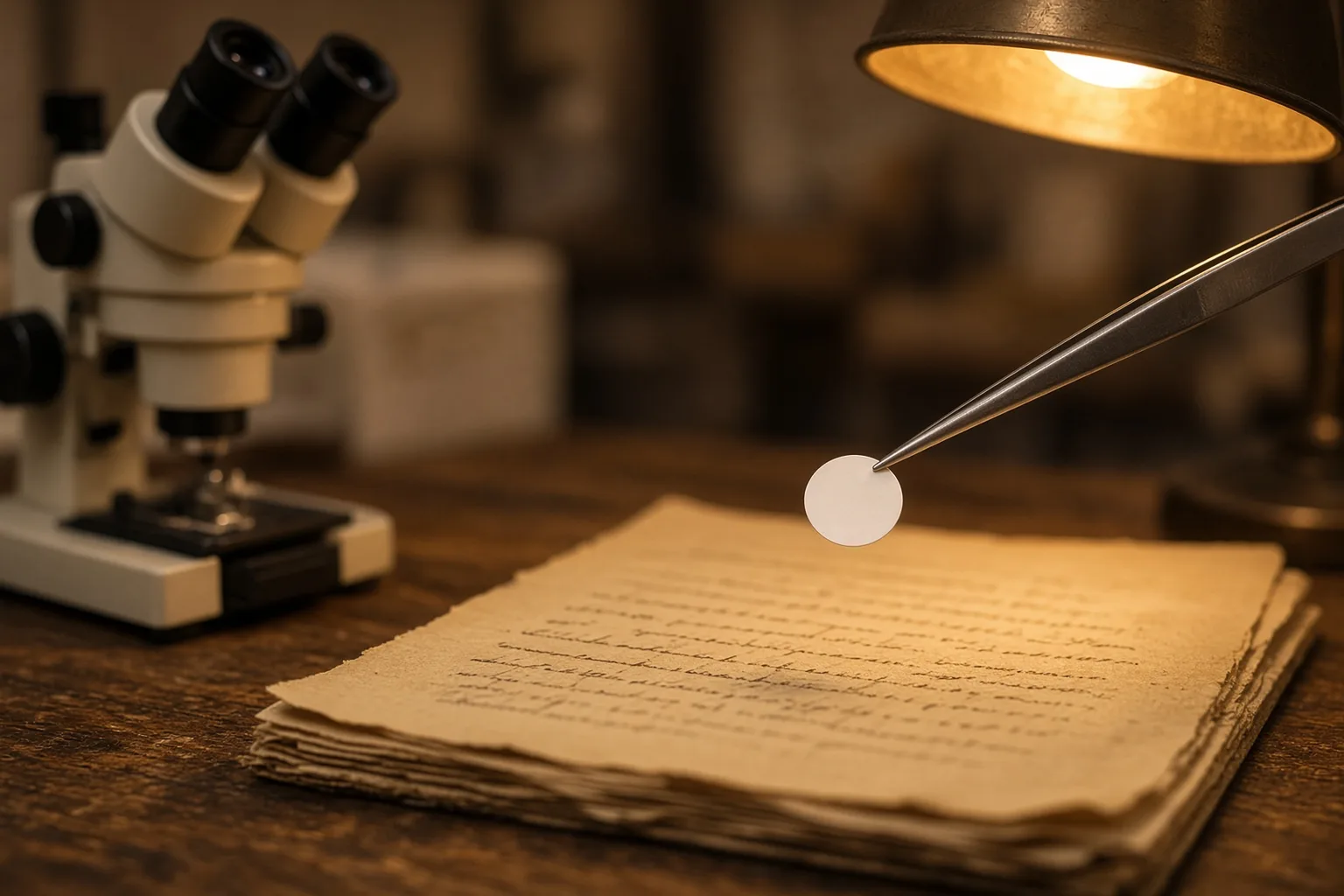
Most chemical ink dating methods remove ink and paper from the document. In a 1996 review, Antonio Cantu of the U.S. Secret Service described solvent extraction tests that take about 10 micro discs of roughly 1 mm or a 10 mm sliver of the entry. A 2015 method from the University of the Basque Country needs a single puncture. In federal civil cases, Rule 34 lets a party test or sample a document on terms the court can set.
Does ink dating damage the document?
Usually, to a small degree. Most chemical methods take ink and paper out of the entry as micro discs, slivers or hole punches. Optical examinations done on the document itself take no sample.
Antonio A. Cantu of the U.S. Secret Service Forensic Services Division reviewed the analytical methods for dating documents in "A Sketch of Analytical Methods for Document Dating Part II," published in the International Journal of Forensic Document Examiners, Vol. 2, No. 3, July/September 1996, pages 192 to 208. Most of the methods he described remove material from the document: micro discs, slivers, hole punches or cut sections of paper carrying the ink.
A copy of the paper sits in a federal court record. It was filed in Ceglia v. Zuckerberg in the Western District of New York, case No. 1:10-cv-00569, as attachment 6 (Exhibit E) to document 263, a reply filed by the plaintiff, Paul D. Ceglia.
Not every examination takes a sample. Cantu wrote that the aging of inks was extensively studied between 1920 and 1940 mostly by in-situ analysis, and that most examinations were limited to optical examinations and chemical spot tests. In-situ means on the document itself, without removing a sample.
How much ink and paper does a dating test remove?
In the methods Cantu reviewed, about 10 micro discs of roughly 1 mm or a sliver of about 10 mm for solvent extraction, about 15 micro discs for one gas chromatography procedure, and quarter-inch samples for micro-infrared work.
Cantu gave the sample sizes method by method. Solvent extraction involved removing either about 10 micro discs, each about 1 mm in diameter, or a sliver of about 10 mm of ink-on-paper from the document. The gas chromatography procedure for volatile components that he attributed to Stewart involved removing about 15 micro discs. In the micro-infrared work he attributed to Humecki, samples of 0.25 inch were removed and extracted in pyridine.
Other methods took the paper as well. For scanning Auger analysis, attributed to McNeil, samples were hole punches obtained with an eight-gauge hollow hypodermic needle. The ion migration method of Mezger and colleagues involved cutting out sections of paper containing the inks and treating them chemically. The heat-aging method attributed to Brunelle removes two samples of an ink entry and subjects one of them to induced aging, so a single test needs two pieces of the same stroke.
The numbers matter for signatures and initials. A signature has a limited length of stroke. Each test that takes a 10 mm sliver uses part of it, and the stroke that is cut out cannot be tested again by another examiner or by another method.
Which examinations leave the document intact?
Optical examination of the inks on the page, and surface techniques still under research that read the ink where it lies. Cantu described the early in-situ tests as limited in what they could tell about age.
Cantu described the limits of the early in-situ methods. Ion migration tests do not work after the ion migration ceases. Results were recorded in words such as "rapid diffusion" and "slight indication of diffusion," and freshness tests based on color change or solubility gave age estimates that he wrote were not as certain as the relative age estimates.
Valery N. Aginsky published "Ink Dating: Comparative Examination of Inks on Documents using Optical and Chemical Methods" in the Journal of the American Society of Questioned Document Examiners, Vol. 16, Issue 1, June 2013, pages 31 to 38. The abstract describes comparison of inks on the same or multiple documents as one of the ink dating approaches and reports microscopic study of writing samples made with 400 ballpoint pens.
Surface methods are under study. A preprint posted on ChemRxiv on February 24, 2025, and not yet peer reviewed, contrasts extraction of ink by plugging, which results in the partial destruction of document samples, with in-situ surface analysis by confocal Raman microscopy and time-of-flight secondary ion mass spectrometry. The authors tracked the degradation of triarylmethane dyes in six pen inks on three paper types. A related ChemRxiv preprint on the same techniques describes a 4-month ageing period and links ink dating to disputes over potential document forgery.
Can the sampled pieces be put back on the document?
For some methods, yes. Cantu described cutting out a section of paper with the ink, treating it chemically and placing it back on the document, and noted that some laboratories secure returned pieces with tape on the back.
In the ion migration method, Cantu wrote, at the end of treatment the section was placed back on the document. A footnote describes the practice of placing the pieces back on the document and securing them with tape on the back, and gives Germany as an example of where some laboratories did this.
A returned piece keeps the paper in one sheet. It does not restore the ink that was extracted or the paper fibers that were cut, and the tape on the back is itself a change to the document. A later examiner who receives the page sees the cut, the tape and the treated section, and needs the first report to learn what was done to that spot and when.
Why are all compared inks sampled on the same day?
Because the comparison depends on equal conditions. Cantu wrote that all inks being compared must be sampled under the same temperature and humidity, and that all sampling and measurements should be done on the same day.
Relative dating compares inks with each other. Cantu stressed comparing inks of the same formula, on the same paper, with the same storage history, with consistent sampling in amount, line quality and timing. He wrote that it is critical to sample all inks being compared under the same temperature and humidity conditions, that paper should reach equal humidity before testing, and that all sampling and measurements should be done on the same day.
Two consequences follow for litigation. A second examiner who samples a month after the first works on a document that has aged a month more and has fewer intact strokes, so the two results are not taken under the same conditions. And when one side's examiner cuts the strokes, the other side loses the chance to sample the same strokes later. Both reasons point to one sampling session, agreed in advance, with both sides' examiners present or with the samples divided.
Who decides whether a document may be sampled in a civil case?
The parties by agreement, or the court. Rule 34 lets a party request to test or sample a document at a reasonable time, place and manner, and Rule 26(c) lets the court set the terms by protective order.
Rule 34(a)(1) of the Federal Rules of Civil Procedure lets a party request that another party produce and permit the requesting party or its representative to inspect, copy, test, or sample designated items in its possession, custody, or control. The request must specify a reasonable time, place, and manner for the inspection and for performing the related acts, and the written response is due within 30 days after being served.
Testing of tangible things is part of the rule's history. The 1970 committee note gives the example of a machine whose operation is the basis of a claim for negligent injury, where it will often be necessary to test its operating parts or to sample and test the products it is producing.
When the parties disagree, the court sets the terms. Rule 26(c)(1)(B) lets it issue a protective order specifying terms, including time and place or the allocation of expenses, for the disclosure or discovery. Rule 26(b)(1) limits discovery to nonprivileged matter relevant to a claim or defense and proportional to the needs of the case. A request to cut several strokes out of the only original of a disputed contract is weighed against those factors.
What should the sampling terms cover?
Which entries are sampled, how many samples of what size, who takes them and where, whether compared inks are sampled in one session, whether pieces are returned, and who keeps the extracts and the data.
The method sets most of the terms. If the examiner plans solvent extraction, the terms state the number of micro discs or the length of the sliver for each entry. If the method needs two samples of the same stroke, as heat aging does, the terms say so. If the pieces are returned to the document, the terms say how they are fixed.
The comparison sets the rest. Because Cantu required the compared inks to be sampled under the same conditions and on the same day, the terms name every entry in the comparison and fix one date and place. Rule 34(b)(1)(B) already asks for a reasonable time, place and manner, so the request can carry these details from the start.
The record of the session goes into the expert report. Rule 26(a)(2)(B) requires the facts or data the examiner considered and the exhibits used to support the opinions. For a dating opinion, those facts include where each sample was taken, its size and the date it was taken.
Is there a less damaging method, and how accurate is it?
Datink, developed at the University of the Basque Country, needs a single puncture and tracks the evaporation of one solvent. The university's release gives a margin of about 20 percent for documents written up to five years earlier.
The method was published by I. San Román, L. Bartolomé, M. L. Alonso, R. M. Alonso and M. Ezcurra as "DATINK pilot study: An effective methodology for ballpoint pen ink dating in questioned documents" in Analytica Chimica Acta, 2015, volume 892, pages 105 to 114. The university's release of November 2, 2015 states that the document to be dated is sampled using a single puncture.
Datink follows 2-phenoxyethanol, a solvent that the release says is present in 80 percent of the inks in ballpoint pens of this type, as it evaporates from the ink line. Samples were left to age naturally, without artificial aging. The release gives an approximation margin of about 20 percent: a document written about 1,500 days earlier is dated within roughly 300 days either way.
The release compares the method with traditional ones that need a large quantity of sample and artificial aging, and calls the result less damaging and less intrusive. Co-author Luis Bartolomé described the method as a very useful tool to date contracts, settlements, wills or other documents, and the release calls the method a pilot experience that requires further in-depth research on the limits of its applicability to different inks and makes of ballpoint pens.
How will the court test a dating opinion?
Under Rule 702, the proponent must show that it is more likely than not that the opinion rests on sufficient facts or data and on reliable methods reliably applied. The opinion must stay within what the method supports.
Rule 702 of the Federal Rules of Evidence lets a qualified expert testify if the proponent shows the court that it is more likely than not that the expert's knowledge will help the trier of fact, that the testimony is based on sufficient facts or data, that it is the product of reliable principles and methods, and that the methods were reliably applied to the facts of the case. The 2023 committee note states that each expert opinion must stay within the bounds of what can be concluded from a reliable application of the expert's basis and methodology.
For ink dating, the bounds come from the method. A journal abstract in the Journal of Forensic Sciences for January 1992 states that methods for dating fountain pen inks covered the period 1937 through 1990, and that relative-age solvent extraction methods for ballpoint inks covered 1979 through 1990. The same abstract states that government agencies at all levels and lawyers in the private sector use the dating of inks to establish the authentic or fraudulent nature of questioned documents. A report that gives a date outside the range or margin of its method goes beyond its basis.
What does IAE do when the age of a document is disputed?
An examiner from the IAE registry prepares a report on your questions about the document or a review of the opposing examiner's report, in up to 5 business days after the format and cost are confirmed.
The IAE forensic document examination page lists questions about inserted or replaced pages, erased or overwritten entries, stamp impressions and how the document was printed. On dating, the page states that ANSI/ASB Standard 011 (2022) includes comparing typewriting, printing, paper, watermarks and ink with an appropriate reference collection to determine age, and that questions about the sequence of preparation and dating can require more than one type of examination.
IAE confirms the questions and the handling of the original with you before work starts, including whether any sampling is planned. Send the original or the best available copy, the questions and, if testing is already under discussion, the proposed terms or the court's order. The secretariat confirms receipt the same day, and within one business day IAE confirms the format, the cost, the deadline and the examiner from the registry; you approve the candidate and the CV.
The document is issued in up to 5 business days after the format and cost are confirmed, with a 48-hour rush for tight deadlines. The examiner confirms in the document that he or she has no interest in the outcome and can be verified by Member ID or QR code. The court weighs the report with the other evidence; neither IAE nor the examiner guarantees the outcome, and IAE is not a law firm.
Sources
- Cantu A. A., A Sketch of Analytical Methods for Document Dating Part II, International Journal of Forensic Document Examiners, Vol. 2, No. 3, 1996, pp. 192-208, filed as Doc. 263-6 in Ceglia v. Zuckerberg, W.D.N.Y. No. 1:10-cv-00569 (Justia PDF)
- University of the Basque Country, release on the Datink ballpoint ink dating method, November 2, 2015 (ScienceDaily)
- ChemRxiv preprint, In situ profiling of pen ink degradation on paper using Raman spectroscopy and ToF-SIMS, February 24, 2025
- ChemRxiv preprint: related study of triarylmethane dye degradation in pen inks by Raman spectroscopy and ToF-SIMS, 4-month ageing period
- Aginsky V. N., Ink Dating: Comparative Examination of Inks on Documents using Optical and Chemical Methods, Journal of the American Society of Questioned Document Examiners, Vol. 16, Issue 1, 2013
- NCJRS abstract, Journal of Forensic Sciences, Vol. 37, Issue 1, January 1992, pp. 113-124, on ink dating techniques
- Federal Rules of Civil Procedure, Rule 34, with committee notes (LII, Cornell Law School)
- Federal Rules of Civil Procedure, Rule 26, Duty to Disclose; General Provisions Governing Discovery (LII, Cornell Law School)
- Federal Rules of Evidence, Rule 702, Testimony by Expert Witnesses, with the 2023 committee note (LII, Cornell Law School)
- Ceglia v. Zuckerberg et al, W.D.N.Y. No. 1:10-cv-00569, docket entry 263 and its attachments (Justia)
Read also
All articles
What can you ask a forensic document examiner, and what should you send with the document?
A forensic document examiner answers questions about how a document was made and what was done to it afterwards: whether an entry was added, a page Sergei Voronin
Burned, soaked or torn: what can a document examiner recover from a damaged document?
A document that went through a fire, a flood or a shredder is often still readable in part. Forensic document examiners work with charredSergei Voronin
Same pen or a different pen: what can a document examiner tell from the ink?
A document examiner can often show that two entries were written with different inks, and that settles that two pens were used. The reverse isSergei VoroninExpert examinations
Ready to discuss your case?
Send the materials: the secretariat will confirm the format, cost, deadline and the specialist within one business day.
