
Examinations
Signed on a signature pad: can a handwriting expert examine an electronic handwritten signature?
A signature written with a stylus on a pad or tablet is still handwriting, and a handwriting examiner can compare it with known signatures. The image on the screen or in the PDF is the weak part of that evidence: ANSI/ASB Standard 070 warns that such images may show poor quality and distortion. The strength lies in the data the pad recorded, the position, timing and force of the stylus, and the examination needs that data.
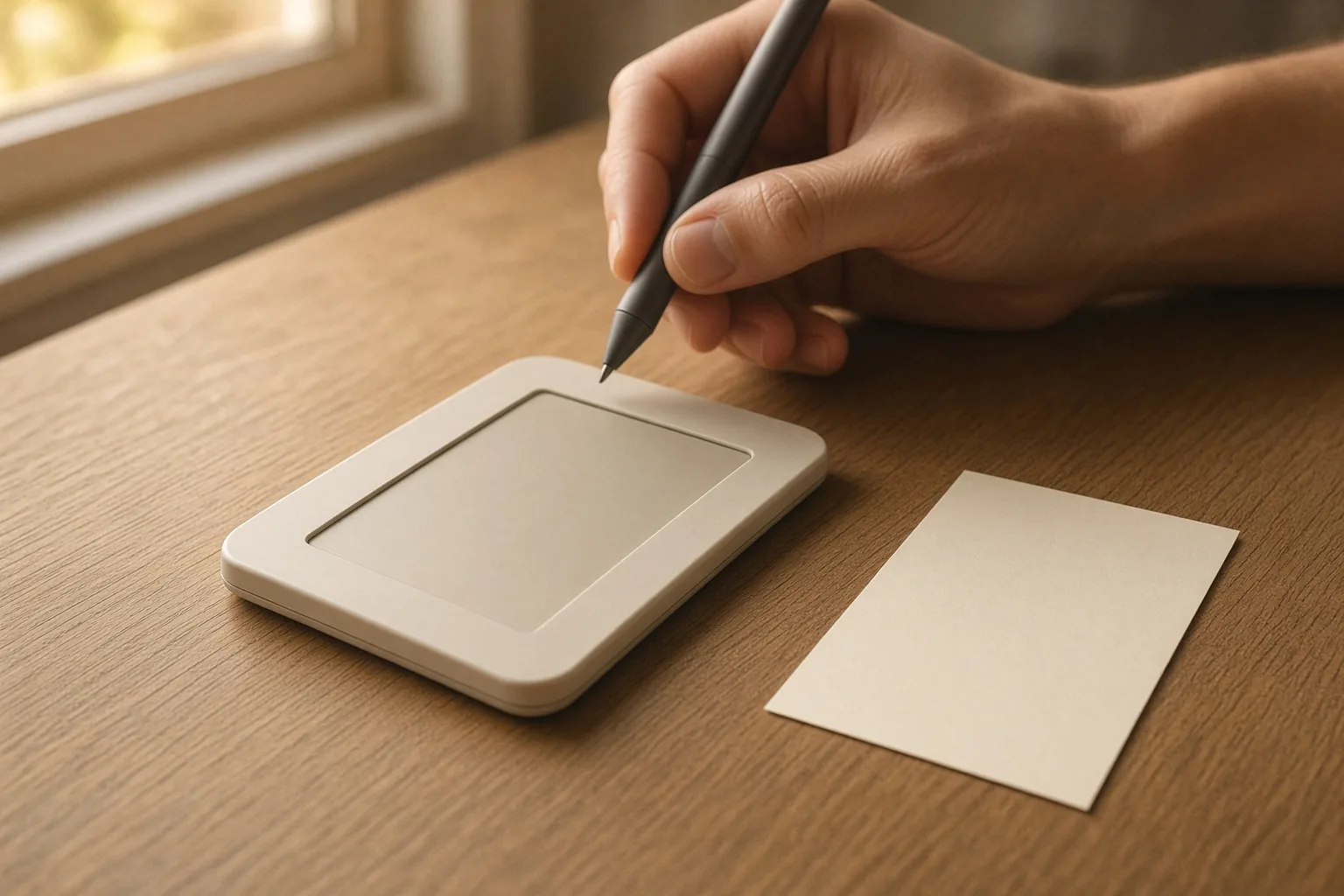
Can a handwriting expert examine a signature written on a signature pad?
Yes, with limits. Standard 070 says pictorial images of digitally captured signatures are evaluated generally under its procedures, but the images may show poor quality and distortion, and the underlying data needs its own examination.
Section 6.5.2.2 of ANSI/ASB Standard 070 (2022) states that "The evaluation of pictorial images from digitally captured signatures (DCS, also known as electronically captured signatures)" generally follows the procedures of the standard. It adds: "However, the pictorial characteristics of such images may exhibit poor quality and distortion." The examination of the data used to create those signatures, the X and Y position of the stylus tip, the timing of execution and the exercised force, "may prove useful, but is beyond the scope of this document."
The examiner therefore has two objects. One is the picture, which can be compared with known signatures in the usual way, with the limits of a picture. The other is the record of how the signature was made, which carries the speed and pressure that a picture loses.
Is a signature-pad signature the same as an electronic signature in law?
It is one kind of electronic signature. The federal E-SIGN Act defines an electronic signature broadly, as a sound, symbol or process attached to a record with intent to sign, so a typed name or a click also qualifies.
Under 15 U.S.C. § 7006(5), an electronic signature is "an electronic sound, symbol, or process, attached to or logically associated with a contract or other record" and "executed or adopted by a person with the intent to sign the record." An electronic record, under § 7006(4), is a record created, generated, sent, communicated, received or stored by electronic means.
Only some of these signatures involve handwriting. A typed name, a checkbox or a click-through gives a handwriting examiner nothing to compare; disputes over them turn on logs, accounts and authentication, which belong to digital forensics. A signature drawn with a stylus or a finger is handwriting recorded by a machine, and it falls within the examiner's field.
What does a signature pad record?
Depending on the system, the position of the stylus over time, the timing of each stroke and the force applied. From these, specialized software can show pressure and velocity that a paper signature reveals only indirectly.
Standard 070 lists the data as the X and Y position of the stylus tip, timing of execution and exercised force (section 6.5.2.2). At the 2021 meeting of the American Academy of Forensic Sciences, Niko Kalantzis, with Samiah Ibrahim and Timothy Campbell, gave a workshop on digitally captured signatures, describing quantitative insight into features of signatures such as pressure and velocity that were previously approached only qualitatively.
A paper signature shows speed and pressure through the shape of the line, its width and the groove in the paper, and the examiner infers them. A pad that records them as numbers gives a measured version of the same features, if the system stored them and the file can be read.
Why is the image of the signature not enough?
Because the image is a rendering of the data, often at low resolution, and it hides the features that separate fluent writing from careful imitation. Research also warns that not every system produces reliable data.
Standard 070 warns that the pictorial characteristics may exhibit poor quality and distortion. When the evidence is only a picture in a PDF or a screenshot, the details the examiner relies on, such as the shape of stroke endings and the quality of the line, depend on how that picture was rendered from the recorded data.
Heidi H. Harralson, in "Forensic document examination of electronically captured signatures" (Digital Evidence and Electronic Signature Law Review, volume 9, 2012), found that not all systems produce reliable information to support forensic opinions, and that examiners were failing to understand the need to analyze the digital data.
An opinion based only on the picture should therefore state that limit. A conclusion of the same strength as one based on an original ink signature needs more than the picture.
Is there a standard for examining digitally captured signatures?
Not yet a published one in the United States. The OSAC research need of 2025 states there are no published standards on digitally captured signatures; ASB Standard 197 is under development, and European examiners have a best practice manual.
The Forensic Document Examination Subcommittee of the Organization of Scientific Area Committees lists "Limitations of Digitally Captured Signatures (DCS) in Forensic Document Examinations" as a research need (version 4 of March 21, 2025, rank medium). It states that there are no current published standards on DCS and that ASB Standard 197, for examining DCS, is under development. It notes that DCS is less widely adopted in the United States than in Europe, where most of the research comes from, and that the European Network of Forensic Handwriting Experts (ENFHEX) has produced a large body of work, including an appendix to its Best Practice Manual (September 2022) on examinations of DCS and handwritten entries.
The research need lists the open questions: which DCS data is relevant to examiners and how it should be collected and preserved, where document examination ends and digital evidence analysis begins, how DCS can be examined within a body of known writing, and whether DCS alone could support a conclusion. A separate OSAC proposed draft standard, OSAC 2026-N-1022, covers the use of digital image capture and file storage technology in forensic document examination and is still under development.
Can a pad signature be compared with signatures written on paper?
Yes, but the capture method limits comparability. Standard 070 names capture methods, writing instruments and writing surfaces among the features that limit comparison, and research has studied how DCS features differ from pen-and-paper ones.
Section 6.5.2.1 of Standard 070 lists among the features limiting comparability "capture methods, writing instruments, and writing surfaces."
The OSAC research need cites studies on the point, among them Heckeroth and Boywitt (2017) on whether handwritten electronic signatures are suitable for examining authenticity, Heckeroth and co-authors (2020) on features in DCS and pen-and-paper signatures, and Zimmer and co-authors (2021) on the challenges of comparing DCS registered with different software and hardware. For a party, the practical consequence is that a disputed pad signature is compared directly with other signatures captured on the same kind of system.
Can a signature pad be used to take known samples?
Yes. Laboratories already use digitizing devices to collect comparison material, and one device records a signature on paper and digitally at the same time.
At the 2021 Academy meeting Kalantzis described a Wacom clipboard that captures a signature in A4 paper form and digitally at once, producing a paper copy and a PDF together, and argued that DCS can improve pen-and-paper cases by providing comparison samples.
A 2026 article in the Journal of the American Society of Questioned Document Examiners (volume 27, issue 1) by George Chrysanthou, Stavros Nicolaou, Andreas Neophytou, Maria Pafiti and Nikolaos Kalantzis describes how the Handwriting Examination Laboratory of the Cyprus Police adopted DCS technology, including to collect samples used as comparison material.
What should you request for the examination of a pad signature?
The native data file from the signing system, information on the device and software, the record of when and how the signature was captured, and known signatures made on the same kind of system.
The questions in the OSAC research need, which data is relevant and how it should be collected and preserved, translate into a list for the request. If the signing platform belongs to the other side or a third party, the request goes to them.
- The native signature data file, in addition to the PDF or the screenshot, with the recorded stylus positions, timing and force if the system stores them.
- The make and model of the pad or tablet and the name and version of the capture software.
- The system record of when, where and on which device the signature was captured.
- Other signatures of the same person captured on the same system, and signatures on paper from the same period.
- A description of how the data was exported and kept since the signing.
What does IAE do when a signature made on a pad or tablet is disputed?
An examiner from the IAE registry prepares a report on your questions about the questioned signature, or a review of the opposing examiner's report, in up to 5 business days after the format and cost are confirmed.
The IAE handwriting page covers whether the person named on a will, contract or check signed it and whether the signature shows signs of simulation or tracing. Under ANSI/ASB Standard 070 (2022) the examiner checks whether questioned and known writing are originals and comparable, then weighs similarities and differences in combination. IAE frames the questions around the questioned signature and the known writing you have.
Send a description of the signing system, the files you hold and the known signatures through the form on the contact page; the service page has a "Request a quote" button. You approve the examiner and the CV before work starts, and cases with tight deadlines have a 48-hour rush.
Registry members passed the collegial attestation of the council under the published Criteria Matrix, and the Member ID in the report can be checked by QR code. The examiner confirms in the document that he or she has no interest in the outcome, and materials are not passed to third parties without your consent. The court weighs the report with the other evidence; neither IAE nor the examiner guarantees the outcome, and IAE is not a law firm.
Sources
- ANSI/ASB Standard 070, Standard for Examination of Handwritten Items, First Edition 2022
- OSAC Forensic Document Examination Subcommittee, R&D need: Limitations of Digitally Captured Signatures (DCS) in Forensic Document Examinations (NIST)
- OSAC 2026-N-1022, Standard for the Use of Digital Image Capture and File Storage Technology in Forensic Document Examination (proposed draft, NIST)
- Harralson H. H., Forensic document examination of electronically captured signatures, Digital Evidence and Electronic Signature Law Review, vol. 9, 2012
- Kalantzis N., The Use of Digitally Captured Signature (DCS) Technology in Everyday Casework, AAFS 2021, J12
- Kalantzis N., Ibrahim S., Campbell T., A Complete Introduction to Digitally Captured Signatures (DCS), AAFS 2021, W01
- Chrysanthou G. et al., Taking Advantage of Digitally-Captured-Signature (DCS) Technology for Everyday Casework, JASQDE, 2026, 27(1)
- 15 U.S.C. § 7006, Definitions (Electronic Signatures in Global and National Commerce Act) (LII, Cornell Law School)
Read also
All articles
Can a notarized signature be challenged as forged, and what does the handwriting examiner have to show?
A notary's stamp does not make a signature unchallengeable, but it changes the proof. In New York a certificate of acknowledgment raises Sergei Voronin
Block capitals: can a handwriting expert identify who hand printed a note or a form?
Anonymous notes, address labels and filled-in forms are often written in block capitals, and the writer may expect capitals to hide his or herSergei Voronin
How much does a handwriting expert cost, and who pays for the examination?
The cost of a handwriting examination depends on the work it requires: how many signatures are questioned, how much known writing has to be sortedSergei VoroninExpert examinations
Ready to discuss your case?
Send the materials: the secretariat will confirm the format, cost, deadline and the specialist within one business day.
