
Examinations
How much does a handwriting expert cost, and who pays for the examination?
The cost of a handwriting examination depends on the work it requires: how many signatures are questioned, how much known writing has to be sorted and compared, whether originals are available, and whether the examiner must also sit for a deposition and testify. In a US case each side pays its own examiner, the side that deposes the other's examiner pays for that time, and the winner usually cannot shift the examiner's fee to the loser as costs.
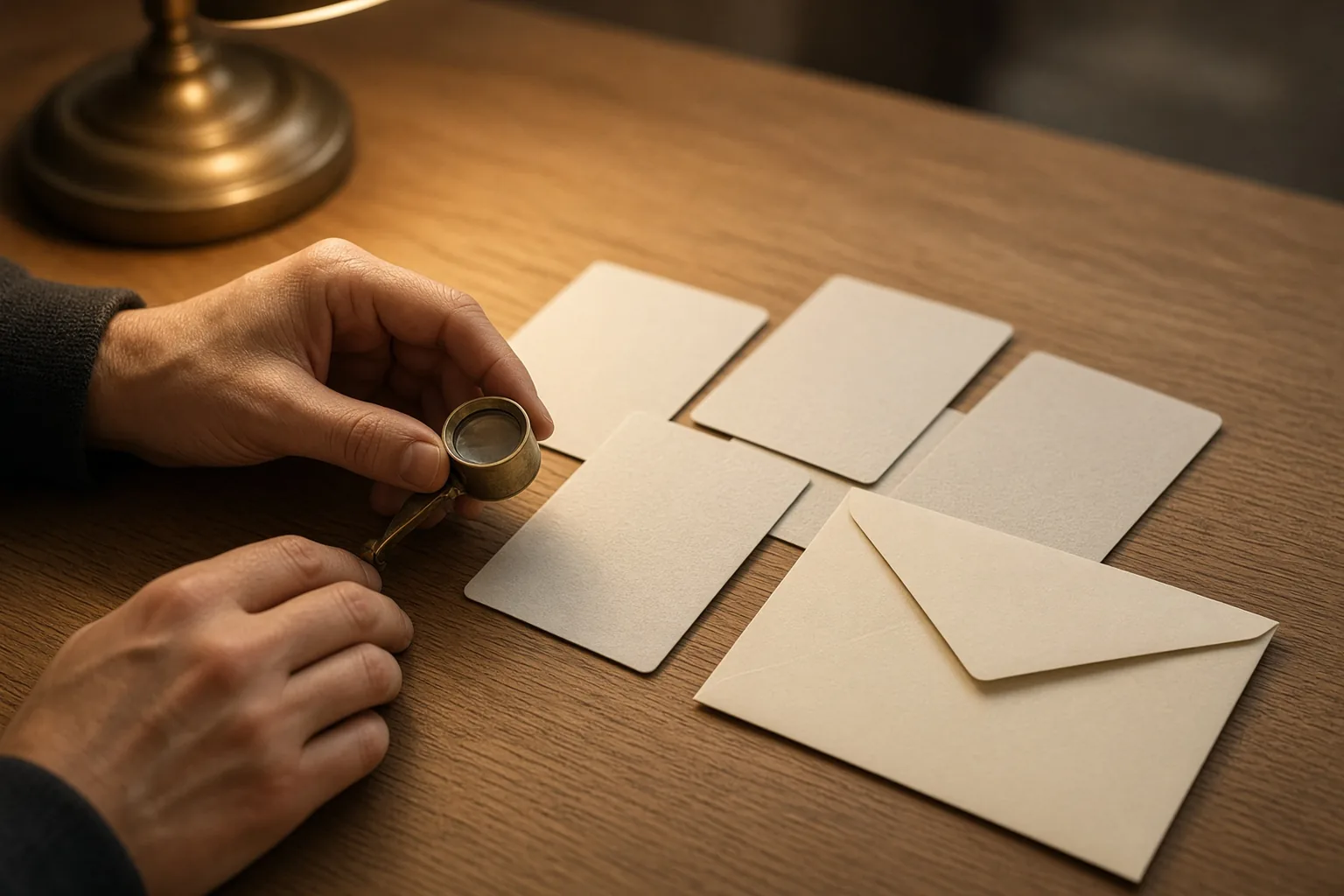
How much does a handwriting expert cost?
There is no fixed price for a handwriting examination. The fee follows the volume of work, which the examiner can judge only after seeing the questioned items and the known writing, so a quote comes after the materials.
The procedures of ANSI/ASB Standard 070, the 2022 standard for examination of handwritten items, include an evaluation of "the sufficiency of the material." That step decides the size of the job. One questioned signature with twenty contemporaneous original signatures of the same type is a different task from a contract with initials on every page, a set of photocopied checks and a box of mixed known writing collected by the client.
A quote therefore needs the documents, or good images of them, and a statement of the question. The examiner can then say what can be examined, what is missing and which format of work the case needs: a short preliminary opinion, a full report or a report with testimony.
The fee also depends on what happens after the report. A deposition, trial testimony and travel are separate blocks of time, and in federal practice the report itself must disclose the compensation, as the sections below set out.
What makes a handwriting examination take more work?
More questioned items, more known writing to sort, copies instead of originals, signs of simulation that need closer study, and known writing that does not match the questioned item in type or date.
Standard 070 sets out the steps that take the time. Under section 6.3.2 the examiner determines whether each questioned item is original writing, and if the original is not submitted, evaluates the quality of the reproduction. Section 6.3.6 looks for slow writing, such as lifts, stops and hesitations, section 6.3.7 for distortion, and section 6.3.8 for indicia of simulation and tracing, including guide lines and unnatural similarity between several questioned items.
Known writing is work of its own. Section 6.4.3 has the examiner group the specimens and resolve inconsistencies within each group, and warns that specimens collected only by a stakeholder may miss part of the writer's range of variation. Section 6.5.2 lists type of writing and lack of contemporaneousness among the features that limit comparability. An unsorted pile of documents written over several decades takes longer to examine than a dated set chosen to match the questioned item.
The comparison itself is not a single look. Section 6.7 requires the examiner to consider alternative interpretations, and section 6.8.1 says a conclusion rests on a combination of characteristics, not on any one of them. Each questioned signature goes through these steps separately.
Who pays the handwriting examiner in a US civil case?
The party that retains the examiner. The fee is disclosed: a testifying expert's report must state the compensation for the study and testimony, and communications about compensation are open to discovery.
Rule 26(a)(2)(B)(vi) of the Federal Rules of Civil Procedure lists among the contents of a retained expert's report "a statement of the compensation to be paid for the study and testimony in the case." Rule 26(b)(4)(C) protects communications between counsel and the expert, except to the extent that they "relate to compensation for the expert's study or testimony."
The other side will therefore see what your examiner charges and can ask about it at deposition. The same is true in reverse: the opposing examiner's report tells you how the other side's examination was paid for.
Who pays when the other side deposes your examiner?
The party taking the deposition. Unless manifest injustice would result, Rule 26(b)(4)(E)(i) requires the party seeking discovery to pay the expert a reasonable fee for the time spent responding.
Under Rule 26(b)(4)(A) any expert whose opinions may be presented at trial may be deposed after the report is provided. Rule 26(b)(4)(E)(i) then requires the party seeking discovery to "pay the expert a reasonable fee for time spent in responding to discovery under Rule 26(b)(4)(A) or (D)", unless manifest injustice would result.
The engagement letter should say how preparation for a deposition is billed and which part of the time the deposing party is asked to pay. A deposition that runs a full day is a cost for the side that asked for it.
Can the winning party recover the handwriting expert's fee as costs?
Usually not beyond the statutory witness fee. The Supreme Court held in 1987 that federal courts are bound by the limits of 28 U.S.C. sections 1821 and 1920 absent a contract or explicit statutory authority.
In Crawford Fitting Co. v. J.T. Gibbons, Inc., 482 U.S. 437, decided June 15, 1987 in an opinion by Chief Justice Rehnquist, the Court held that "a federal court is bound by the limit of § 1821(b), absent contract or explicit statutory authority to the contrary." At the time, section 1821(b) provided an attendance fee of $30 per day. The Court concluded that "federal courts are bound by the limitations set out in 28 U.S.C. § 1821 and § 1920."
The opinion noted one category without that cap: section 1920(6) permits taxing the compensation of court-appointed experts. A party's own retained examiner is paid by that party, whatever the outcome, unless a contract or a specific statute shifts the fee.
This matters for budgeting. A party that plans to recover the examiner's fee from the other side should look for a contract clause or a fee-shifting statute that applies to the claim, before counting on it.
Who pays a court-appointed handwriting expert?
Under Rule 706, the court sets reasonable compensation. In most civil cases the parties pay it in the proportion and at the time the court directs; in criminal cases it comes from funds provided by law.
Rule 706(a) of the Federal Rules of Evidence lets the court, on its own motion or a party's, appoint an expert the parties agree on or one of its own choosing, if the expert consents. Under Rule 706(b) the expert must advise the parties of any findings, may be deposed by any party and may be called and cross-examined by any party.
Rule 706(c) states: "The expert is entitled to a reasonable compensation, as set by the court." In a criminal case or a civil case involving just compensation under the Fifth Amendment, it is paid from any funds provided by law; in any other civil case, by the parties in the proportion and at the time that the court directs, and the compensation is then charged like other costs. Rule 706(d) permits the court to tell the jury that the court appointed the expert, and Rule 706(e) keeps each party's right to call its own examiner.
What should you ask before retaining a handwriting examiner?
Ask what the quote covers, what is billed separately, what the examiner needs from you and what happens if the material turns out to be insufficient for a conclusion.
The answers fix the budget better than an hourly rate alone. These questions cover the usual gaps.
- Does the quote cover a written report, or only an examination and an oral opinion?
- Are deposition preparation, deposition time, trial testimony and travel billed separately?
- How many questioned items and how many known writing specimens does the quote assume?
- Will the examiner need the originals, and who arranges and pays for access to them?
- What happens to the fee if the material is not sufficient for a conclusion?
- When is payment due, and is the examiner paid regardless of the opinion reached?
How can a party keep the examination within budget?
By sending a sorted set of materials: the questioned originals, known writing of the same type and period with its source and date, and a precise question. Sorting done by counsel saves the examiner's hours.
Each step of Standard 070 takes less time when the material is prepared. A list that gives, for each known specimen, the document, its date and where the original is kept lets the examiner check comparability under section 6.5.2 without first reconstructing the file. Originals avoid the evaluation of reproductions under section 6.3.2 and the limits that come with copies.
A narrow question also saves time. "Did the person named sign page 4" is a smaller task than "examine all signatures in the file". If the dispute turns on one signature, the request should say so.
How does IAE quote and deliver a handwriting examination?
IAE confirms the format, the cost, the deadline and the examiner within one business day after receiving the materials. The document is issued in up to 5 business days after the format and cost are confirmed.
The IAE handwriting page covers whether the person named on a will, contract or check signed it and whether the signature shows signs of simulation or tracing. For federal and state cases the examiner prepares a report on your questions or a review of the opposing handwriting examiner's report. The page does not list prices: the cost is confirmed for each case after the materials are seen.
Send the questioned document or its best available copy, the known writing with a note on the source and date of each item, and the questions, through the form on the contact page; the service page has a "Request a quote" button. The secretariat confirms receipt the same day and, within one business day, the format, the cost, the deadline and the examiner from the registry. You approve the candidate and the CV before work starts, and cases with tight deadlines have a 48-hour rush.
Registry members passed the collegial attestation of the council under the published Criteria Matrix, and the Member ID in the report can be checked by QR code. The examiner confirms in the document that he or she has no interest in the outcome, and materials are not passed to third parties without your consent. The court weighs the report with the other evidence; neither IAE nor the examiner guarantees the outcome, and IAE is not a law firm and does not advise on case strategy.
Sources
- ANSI/ASB Standard 070, Standard for Examination of Handwritten Items, First Edition 2022
- Federal Rules of Civil Procedure, Rule 26 (LII, Cornell Law School)
- Crawford Fitting Co. v. J.T. Gibbons, Inc., 482 U.S. 437 (1987) (LII, Cornell Law School)
- Federal Rules of Evidence, Rule 706, Court-Appointed Expert Witnesses (LII, Cornell Law School)
Read also
All articles
Can a notarized signature be challenged as forged, and what does the handwriting examiner have to show?
A notary's stamp does not make a signature unchallengeable, but it changes the proof. In New York a certificate of acknowledgment raises Sergei Voronin
Block capitals: can a handwriting expert identify who hand printed a note or a form?
Anonymous notes, address labels and filled-in forms are often written in block capitals, and the writer may expect capitals to hide his or herSergei Voronin
Signed on a signature pad: can a handwriting expert examine an electronic handwritten signature?
A signature written with a stylus on a pad or tablet is still handwriting, and a handwriting examiner can compare it with known signatures. The imageSergei VoroninExpert examinations
Ready to discuss your case?
Send the materials: the secretariat will confirm the format, cost, deadline and the specialist within one business day.
