
Examinations
Block capitals: can a handwriting expert identify who hand printed a note or a form?
Anonymous notes, address labels and filled-in forms are often written in block capitals, and the writer may expect capitals to hide his or her handwriting. ANSI/ASB Standard 070 lists hand printing as a type of handwriting, and a 2016 blind study of 53 examiners found 2.28 percent of their calls on block printing inaccurate. Several federal courts have still excluded hand printing opinions.
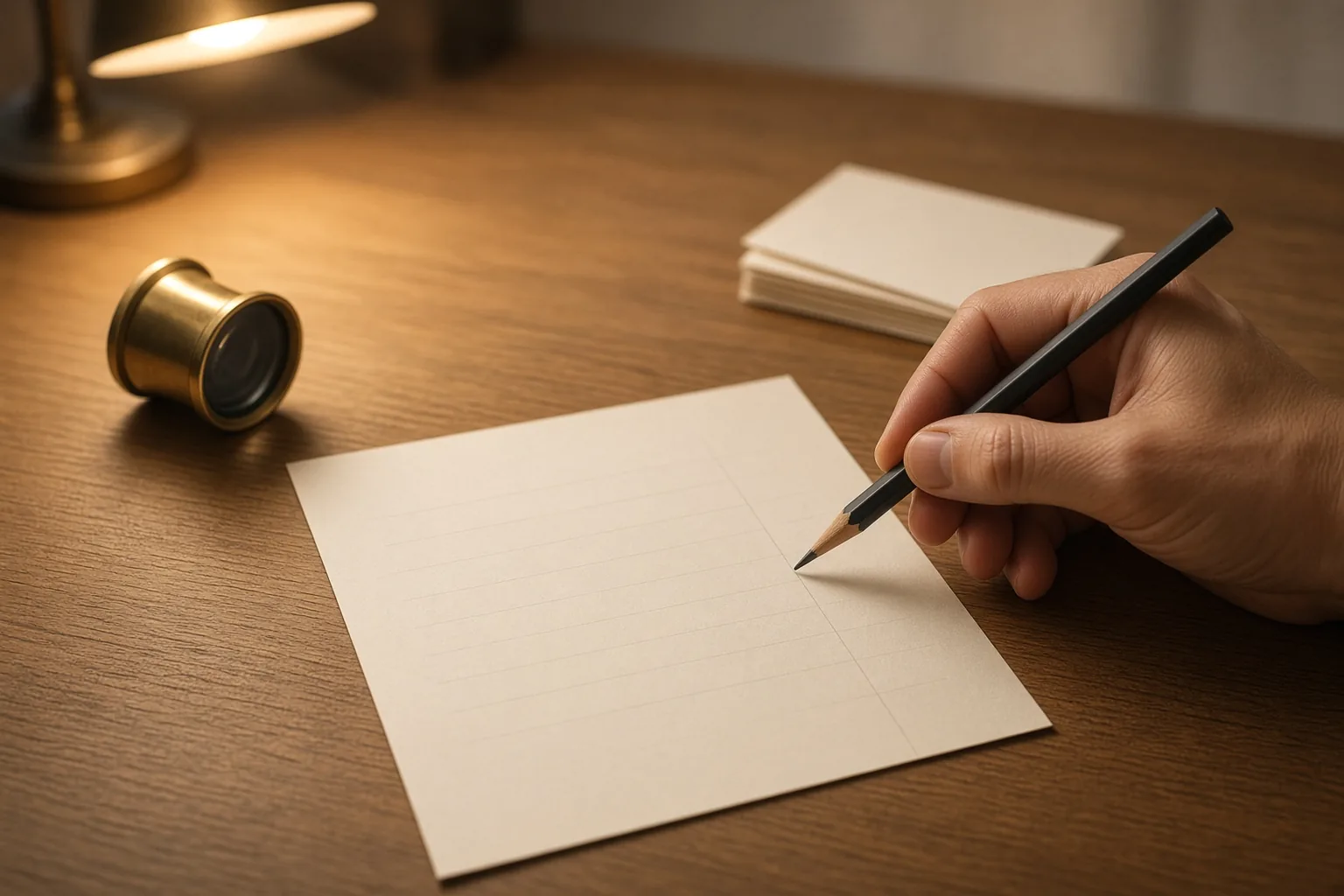
Can a handwriting examiner identify the writer of block capitals?
Yes, when there is enough questioned printing and comparable known printing. Examiners use the same method as for cursive writing, and the quantity and comparability of the material decide how strong the conclusion can be.
Hand printing is formed by the same hand and the same learned habits as cursive writing: the order and direction of strokes, the construction of each letter, proportions, spacing, alignment to a line and pen pressure. Block capitals remove the connections between letters, so the examiner works with the shape and construction of separate letters and numerals rather than with joins.
Linda Mitchell and Mara Merlino tested this in a blind study published in the Journal of the American Society of Questioned Document Examiners in 2016. Fifty-three qualified examiners each received 25 questioned writings in block letters, every case with samples from three possible writers, and rated each possible writer on a nine-point scale. The authors reported a reliability rate "with only 2.28% of calls inaccurate." Fifty-two of the 53 participants said they used the same methods for printing as for cursive.
The study answered a gap that courts had pointed to. Its earlier presentation at the American Academy of Forensic Sciences meeting in 2015 cited a Wisconsin federal ruling that hand printing techniques "have not been adequately tested and found reliable when applied to hand printing."
Do the examination standards treat hand printing as handwriting?
Yes. ANSI/ASB Standard 070 (2022) lists hand printing with cursive writing, numerals, symbols and signatures as types of writing and requires mixed writing to be split into groups of one type. The earlier SWGDOC standard names hand printing too.
Sections 6.3.4(a) and 6.4.3(a) of ANSI/ASB Standard 070, Standard for Examination of Handwritten Items, approved by the ASB in April 2022 and by ANSI in October 2022, use the list "hand printing, cursive writing, numerals, symbols, or combinations thereof, and signatures." Where a document contains more than one type, the examiner separates the writing into groups of a single type before comparing.
The SWGDOC Standard for Examination of Handwritten Items, version 2013-1, from which Standard 070 was developed according to its foreword, defines a handwritten item in section 3.3.6 as "an item bearing something written by hand (for example, cursive writing, hand printing, signatures)." Its Note 1 states that "handwriting" and "handwritten" are generic terms.
For a form filled in partly in capitals and partly in cursive, with a signature at the bottom, the examiner reports three comparisons: the capitals against known capitals, the cursive against known cursive and the signature against known signatures. A report that compares the capitals on a form with cursive letters in a known letter departs from the grouping rule.
What known writing does a hand printing comparison need?
Known hand printing of the same kind: block capitals for block capitals, with the same letters where possible, written close in time to the questioned item. Standard 070 lists the type of writing among limits on comparability.
Section 6.5.2.1 of Standard 070 states: "Features limiting comparability may include the type of writing, noncontemporaneousness, dissimilarities in text content," and section 6.5.2.3 requires the examiner to request additional known writing when the bodies of writing are not comparable. Section 7.11.1 of the SWGDOC standard said the same: discontinue the comparison and "request comparable known writing, if appropriate."
Many people print only on forms, envelopes and labels, so collected samples come from the same sources: job applications, shipping labels, workshop notes, forms filed with agencies. Requested samples are taken by dictating the text of the questioned item, or text with the same letters, in capitals, several times. In United States v. Saelee the government examiner compared the questioned address labels with 28 exemplars of the defendant's known printing.
The questioned item also has to contain enough letters. The court in Saelee noted that the questioned printing was a very small quantity and that this could reduce accuracy. A note of five words in capitals gives fewer repeated letters than a page, and the examiner states that limitation in the report.
Why have courts treated hand printing opinions differently from cursive?
Because some courts found too little testing of hand printing identification before 2016. A review presented at AAFS in 2019 found that such testimony had been admitted, excluded and limited in different federal districts.
Karen Nobles of Forensic Document Services in Pensacola reviewed the case law in "The Admissibility of Hand Printing Identification in the United States Courts," presented at the AAFS meeting in 2019. She found no case before Daubert in which hand printing testimony was excluded. After Daubert, she wrote, testimony "about hand printing identification has been randomly admitted, excluded, and limited," and when admissibility is challenged "the testimony of the handwriting expert is generally limited, or even excluded."
Without a challenge, the review found, examiners testify to hand printing identifications "as routinely as any other examination." Most courts treated hand printing and cursive alike because the methodology of comparison is the same. The cases that set hand printing apart are the ones a party facing such an opinion reads first.
What happened in United States v. Saelee?
The District of Alaska excluded the examiner's hand printing comparison in 2001. The court found no evidence that the claim had been tested and noted proficiency tests in which few examiners reached the right answer on hand printing.
The questioned writing was the "from" and "to" printing on address labels of candy bars that had been mailed and returned. The examiner compared it with 28 exemplars of the defendant's printing. Judge Holland granted the defense motion in limine and held that the government had not shown the testimony reliable under Rule 702.
The court wrote that the examiner "offered no evidence that this claim has been tested in any manner," that "there is little known about the error rates of forensic document examiners," and that the technique "appears to be entirely subjective." It cited Collaborative Testing Service results, including a hand printing test with 13 percent correct answers, and concluded that the testimony "is as likely to mislead a jury as to assist it."
Saelee predates both the 2016 blind study and Standard 070. A party relying on a hand printing opinion today answers the Saelee questions with that research and with the examiner's own records of method and limitations.
Does it matter where the writer learned to print?
It can. In United States v. Fujii (N.D. Ill. 2000) the court excluded a hand printing identification because the writers had learned English printing in Japan and no study addressed such writers.
The questioned writing was hand printed immigration forms submitted at John F. Kennedy International Airport in December 1999. The writers were native Japanese speakers who had been taught English printing in Japan. A defense affidavit from the director of an English as a Second Language program stated that "Japanese-trained writers also tend to write English characters in a very uniform manner."
Judge Gottschall granted the motion to exclude "at least in the peculiar circumstances of this case." The court wrote that it "has no idea whether there is a recognized and accepted expertise in identifying handprinted documents," that neither the government's examiner nor the defense witness was aware of any studies of writers trained abroad, and that there was "no evidence in the record" that the examiner had such expertise "or has even considered the problem."
Uniform school models reduce the individual variation that identification depends on. When the writer learned to print in another country or another alphabet, the report should say whether the examiner considered the copybook the writer was taught and which features depart from it.
What limits the conclusion in a hand printing case?
Small quantity, missing letters, simplified or disguised printing, non-original documents and known writing of another type or period. Standard 070 requires each limitation to be documented and the basis of each conclusion reported.
Section 5.2 of the SWGDOC standard lists limitations arising from "limited quantity or comparability, or condition of the items submitted," including "absent characters, dissimilarities, or limited individualizing characteristics." Note 6 to section 7.12.4 names simplification and a "deliberate attempt at disguise or auto-forgery" as factors to consider. Block capitals invite both: a writer who wants to hide can slow down and print plain letters.
Section 6.6 of Standard 070 provides that "limitations shall also be documented if present" and requires the conclusions for each set of comparisons to be reported with their bases. The conclusion scale itself comes from the terminology the laboratory uses; the SWGDOC handwriting standard refers to the SWGDOC Terminology for Expressing Conclusions. With little questioned printing, a qualified conclusion is often the strongest the material supports.
What should a party send for a hand printing examination?
The original questioned item, known hand printing of the person in the same style and from the same period, any requested exemplars with the conditions in which they were taken, and a note on where the writer learned to write.
Originals give the examiner stroke order, pressure and line quality that copies lose. Where only a scan exists, the report states that limitation. The usual set of materials is short.
- Send the original questioned note, label or form, or the best available copy if the original is held by another party.
- Add collected known printing in block capitals from documents of the same period, with a statement of where each document came from.
- Add requested exemplars, if any, with the text dictated, the number of repetitions and the date.
- Add known cursive writing and signatures, if the questioned item contains those types too.
- Describe the writer's schooling, including the country and language in which he or she learned to print.
What does IAE do when a hand printed document is disputed?
An examiner from the IAE registry prepares a report on your questions about the questioned writing, or a review of the opposing examiner's report, in up to 5 business days after the format and cost are confirmed.
The IAE handwriting page covers whether the person named on a will, contract or check signed it and whether the signature shows signs of simulation or tracing. Under ANSI/ASB Standard 070 (2022) the examiner checks whether questioned and known writing are originals and comparable, then weighs similarities and differences in combination. IAE frames the questions around the questioned writing and the known writing you have.
Send the questioned item and the known writing through the form on the contact page; the service page has a "Request a quote" button. You approve the examiner and the CV before work starts, and cases with tight deadlines have a 48-hour rush.
Registry members passed the collegial attestation of the council under the published Criteria Matrix, and the Member ID in the report can be checked by QR code. The examiner confirms in the document that he or she has no interest in the outcome, and materials are not passed to third parties without your consent. The court weighs the report with the other evidence; neither IAE nor the examiner guarantees the outcome, and IAE is not a law firm.
Sources
- ANSI/ASB Standard 070, Standard for Examination of Handwritten Items, First Edition 2022 (AAFS Standards Board)
- SWGDOC Standard for Examination of Handwritten Items (E01-13), version 2013-1
- Mitchell L. L., Merlino M. A Blind Study on the Reliability of Hand Printing Identification by Forensic Document Examiners. Journal of the American Society of Questioned Document Examiners 19(1):25-31 (2016)
- Mitchell L. L., Merlino M. L. The Reliability of Hand Printing Identification by the Forensic Document Examiner. AAFS Proceedings 2015, J27
- Nobles K. J. The Admissibility of Hand Printing Identification in the United States Courts. AAFS Proceedings 2019, J25
- United States v. Saelee, 162 F. Supp. 2d 1097 (D. Alaska 2001) (Justia)
- United States v. Fujii, 152 F. Supp. 2d 939 (N.D. Ill. 2000) (Justia)
Read also
All articles
Can a notarized signature be challenged as forged, and what does the handwriting examiner have to show?
A notary's stamp does not make a signature unchallengeable, but it changes the proof. In New York a certificate of acknowledgment raises Sergei Voronin
Signed on a signature pad: can a handwriting expert examine an electronic handwritten signature?
A signature written with a stylus on a pad or tablet is still handwriting, and a handwriting examiner can compare it with known signatures. The imageSergei Voronin
How much does a handwriting expert cost, and who pays for the examination?
The cost of a handwriting examination depends on the work it requires: how many signatures are questioned, how much known writing has to be sortedSergei VoroninExpert examinations
Ready to discuss your case?
Send the materials: the secretariat will confirm the format, cost, deadline and the specialist within one business day.
