
Expert report review
Area of origin in the opposing fire report: how does a reviewer check it?
A cause opinion in a fire report stands on the area of origin: an ignition source can be named only where the fire began. A reviewer checks which kinds of origin data the investigator used, whether the fire patterns were read with flashover and suppression in mind, and whether competing areas were tested. Courts have admitted an origin opinion and barred the cause opinion built on it.
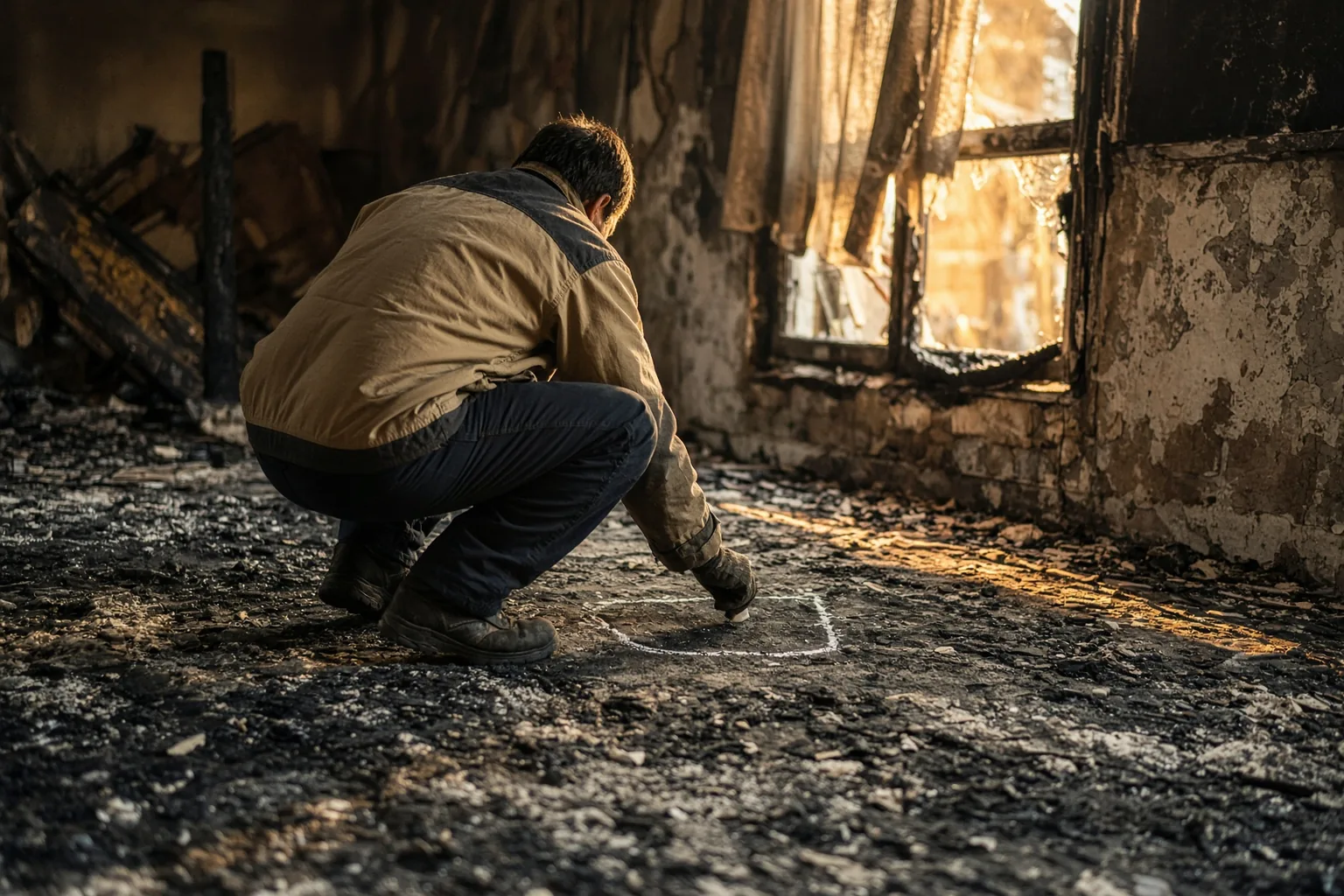
Why does the review start with the area of origin?
Because the cause is sought at the origin. NFPA 921 defines the point of origin as the location within the area of origin where a heat source, a fuel and an oxidizing agent first interact.
In State v. Ordonez-Lima the Superior Court of New Jersey, Law Division, Mercer County quoted NFPA 921 (2021 edition), section 3.3.149: a point of origin is "The physical location within the area of origin where a heat source, a fuel, and an oxidizing agent first interact." The court, in an opinion of March 21, 2024, allowed the State's investigator to testify that the area of origin was the porch and the point of origin was "in the area of the doorsill." It barred his opinions that the fire was incendiary and that all accidental causes were eliminated.
The same split appears in Goens v. Southern Union Co. (W.D. Mo. June 23, 2010). The plaintiffs' fire investigator could testify about the area of origin and a water heater malfunction but not about the mechanism of failure, which he had taken from an engineer.
Origin and cause are separate opinions, and each needs its own basis. The reviewer treats the origin opinion first: if the area is wider than the report admits, every ignition source inside the wider area has to be considered again.
What kinds of data does an origin determination rest on?
Witness and electronic data, fire patterns, arc mapping and fire dynamics. A New Jersey court relied on these four categories from NFPA 921 in 2025 when it tested an arson investigator's origin work.
In State v. Caneiro, decided on July 24, 2025 by Judge Marc C. Lemieux of the Superior Court of New Jersey in Monmouth County, the court relied on NFPA 921's four categories of origin information: witness and electronic data, fire patterns, arc mapping and fire dynamics. It quoted section 4.1, under which the methodology "should rely on the use of a systematic approach and attention to all relevant details," and section 14.1.3: "there should be no presumption as to information's relevance, accuracy or reliability without such an evaluation."
The State's investigator, Detective Joseph Cordoma of the Monmouth County Prosecutor's Office, placed the origin in one area, a basement storage closet, which showed the heaviest fire damage and low burns. The investigation involved the county fire marshal, the state fire marshal, ATF and the prosecutor's office. Arc mapping found no arc artifacts and did not inform either side's opinion. The defense expert agreed with the area of origin.
For each origin opinion the reviewer lists which of the four categories the investigator used, what each contributed and where they disagree. An origin resting on one category alone, with the others missing or contradicting it, is the first point of the review.
How can flashover affect the reading of fire patterns?
After flashover and full room involvement, patterns can record the later stage of the fire. In Caneiro the defense expert testified that the patterns could not tell a slow smoldering fire from a fast one.
In Caneiro the defense expert, Christopher B. Wood of FireLink, LLC, said two hypotheses fit the evidence: a slow fire with a long incipient or smoldering phase, or a fast fire that reached flashover and full room involvement. He testified that "there is no doubt that the storage closet fire progressed post-flashover to full room involvement," that full room involvement can occur within three to five minutes, and that the fire patterns could not distinguish the two.
The State's investigator had described "alligator charring" on beams and "gradual charring" on the closet studs, which he read as indicating "a slow type of emerging fire." The court found that he had considered the fast-fire alternative, and held that "the presence of competing hypotheses does not render Detective Cordoma's conclusions inadmissible." The dispute went to the jury as a matter of weight.
In that case the dispute concerned the speed of the fire, not the closet as its origin. The question carries over to origin work: where a room went to full involvement, the reviewer asks whether the report explains which patterns formed before flashover and which after, and why the ones it relies on mark the origin.
What can burn patterns establish about the origin, and where do experts disagree?
Patterns narrow the area where burning began, and two investigators can read one scene differently. In Travelers v. Volunteers of America experts placed the origin on a patio and in a bedroom, and the jury was left to choose.
Travelers Casualty Insurance Co. of America v. Volunteers of America Kentucky, Inc. concerned a fire in an apartment complex in Lexington. On August 21, 2012, the Eastern District of Kentucky ruled on motions to exclude four experts. The defense expert placed the origin on the patio, citing a "clear 'V' pattern originating at the base of the wall," a plug in an outside receptacle and a loose cord. He also argued that the trash can next to the bed was not consumed as expected: the plastic bag stayed pliable, the label on an ibuprofen bottle was not charred and a cigarette wrapper label was readable.
The plaintiff's experts placed the origin along a bedroom wall and attributed the fire to discarded smoking materials in that trash can. The court found that all the experts followed NFPA 921 but "disagree about the relevance and veracity of disputed facts," and held that such disputes go "to the weight of the testimony, not its admissibility." Both motions were denied.
Courts also look at how the patterns were exposed. In Depositors Insurance Co. v. Hall's Restaurant, Inc. (E.D. Mo. Mar. 26, 2014, No. 4:12CV1717 SNLJ) the investigator "removed debris in order to view burn and char patterns," "observed an irregularly shaped fire pattern within the area of fire origin," and placed the origin "at floor level in the center of the main dining room." The motion there attacked the lack of a comparison debris sample and the method used to identify the ignition source, not the origin, and it was denied.
Can video, alarm and call records test the origin and the timeline?
Yes. In Caneiro the court credited the investigator's use of camera footage, a 911 call and neighbors' accounts, and said that excluding relevant non-scene information made the defense expert's timeline less reliable.
The court in Caneiro found the investigator's rate-of-spread opinion "clearly reliable" and credited his use of Wyze camera footage, the 3:33 a.m. 911 call and information from neighbors and interviews. The defense expert had limited his analysis to physical evidence at the scene and treated the 911 call as irrelevant. The court said that his exclusion of that data "arguably renders his opinion less reliable" and that "It defies logic to exclude relevant non-scene information when establishing the fire's timeline."
The reverse also holds: electronic data that place the first smoke or flame away from the claimed origin require an explanation in the report. In Travelers the defense expert relied in part on the occupant's account of seeing fire above the patio door and on the fact that she was not injured.
Under Rule 34(a)(1) a party may request to "inspect, copy, test, or sample" designated items, and the request "may specify the form or forms in which electronically stored information is to be produced." Camera files, alarm panel logs and call records are requested in native form with their time settings, so the reviewer can place them on one timeline with the fire patterns.
What should the report say if the data do not single out one origin?
That the origin, or the cause, remains undetermined. NFPA 921, as quoted in Travelers, says that if no hypothesis can withstand examination by deductive reasoning, the issue should be considered undetermined.
The Travelers opinion quotes NFPA 921 on testing: the scientific method "should be applied in every case," hypotheses are tested "until all feasible hypotheses have been tested against the data," and "If no hypothesis can withstand an examination by deductive reasoning, the issue should be considered undetermined."
The defense expert in Caneiro put the same principle in his own words: "when multiple hypotheses fit the known facts and none can be eliminated through testing, then no single hypothesis can be presented as definitive." The court there found that the investigator had tested the alternative. In a review the question is whether the opposing report records that test for each competing area of origin, with the data that excluded it.
An origin narrower than the data allow carries the error into the cause. If the patterns support a room but not a corner, a cause opinion that names an appliance in the corner rests on more than the origin data support.
Does a departure from NFPA 921 make the origin opinion inadmissible?
Not by itself. Courts have treated departures as matters of weight when the investigator explained them, while the 2023 note to Rule 702 rejects the view that a sufficient basis is always a question of weight.
Travelers quotes the guide: "Deviations from these procedures, however, are not necessarily wrong or inferior but need to be justified." The court limited its gatekeeping to "principles and methodology, not on the conclusions that they generate."
In United States v. Idaho County Light and Power Cooperative Association, Inc. (D. Idaho Feb. 7, 2020) both sides agreed that the Forest Service investigator purported to apply NFPA 921, and the court held that the alleged departures "go to the weight to be accorded to her opinion regarding the point of origin of the fire." Her report recorded "micro burn indicators consisting of grass stems, protected fuel around rocks and staining on the rocks." In Depositors the court noted that the Eighth Circuit has "not held NFPA 921 is the only reliable way to investigate a fire."
The 2023 committee note to Rule 702 puts the burden on the proponent to show it is "more likely than not that the proffered testimony meets the admissibility requirements," and rejects the view that "arguments about the sufficiency of an expert's basis always go to weight and not admissibility." An origin opinion without documented patterns, a diagram or an account of flashover is open to that objection, whichever guide the investigator followed.
What does a review of an origin determination contain?
The origin claimed, the data behind it with photograph and diagram references, the alternatives the report tested and did not test, and an assessment of whether the area named is as narrow as the data allow.
Rule 26(a)(2)(B) requires the opposing report to state "the facts or data considered by the witness in forming them" and "any exhibits that will be used to summarize or support them." Scene diagrams, photographs and pattern maps are such exhibits. Their absence is itself a finding of the review.
The review sets out each point in the same order, so the court can follow it against the opposing report.
- The review states the area and the point of origin the opposing report names and the page where it does so.
- It lists the data in each of the four categories the report relies on, with photograph and diagram numbers.
- It records whether the report addresses flashover, ventilation openings and suppression in reading the patterns.
- It names every other area that the data leave open and whether the report tested it.
- It compares the origin with witness, camera, alarm and call records and their times.
- It states whether the area named is narrower than the data support, and which ignition sources the wider area would add.
What does IAE do when the area of origin in the opposing fire report is disputed?
IAE prepares reviews of the opposing investigator's report for subrogation, product liability, arson defense and coverage disputes in US courts, and expert reports on the client's questions. Up to 5 business days.
The review lists each hypothesis the opposing investigator considered, checks what data excluded the others and which NFPA 921 edition was applied, and traces every artifact to its examination. For an expert report on the client's questions, the investigator maps char depth, burn patterns on walls and ceilings and arc sites on branch circuits to narrow the area where burning began.
The client sends the opposing report with its exhibits and states whether the fire scene still exists. The secretariat confirms receipt the same day. Within one business day IAE confirms the format, the cost, the deadline and the specialist from its registry, and the client approves the candidate and the CV before work starts. The signed review is issued within up to 5 business days once the format and cost are confirmed; cases with tight deadlines have a 48-hour rush.
Every specialist is a member of the public IAE registry and passed the council's attestation under the published Criteria Matrix; the Member ID or QR code in the document opens the specialist's record. The specialist confirms in the document that he or she has no interest in the outcome. Materials are not passed to third parties without the client's consent. A review is evidence the court weighs with the other materials; neither IAE nor the reviewer guarantees the outcome, and IAE is not a law firm.
Sources
- State v. Caneiro, Ind. No. 19-02-283 (N.J. Super. Ct., Monmouth County, July 24, 2025), findings and conclusions on defendant's motion to preclude arson expert testimony
- State v. Ordonez-Lima, Ind. No. 22-03-0196-I (N.J. Super. Ct. Law Div., Mercer County, Mar. 21, 2024)
- Travelers Casualty Insurance Co. of America v. Volunteers of America Kentucky, Inc., No. 5:10-301-KKC, memorandum opinion and order (E.D. Ky. Aug. 21, 2012)
- Depositors Insurance Co. v. Hall's Restaurant, Inc., No. 4:12CV1717 SNLJ, memorandum and order, Doc. 30 (E.D. Mo. Mar. 26, 2014) (Justia indexes the file under 1:14-cv-00034)
- United States v. Idaho County Light and Power Cooperative Association, Inc., No. 3:17-cv-00391-CWD (D. Idaho Feb. 7, 2020) (GovInfo)
- Goens v. Southern Union Co., No. 09-0422-CV-W-FJG (W.D. Mo. June 23, 2010)
- Federal Rules of Evidence, Rule 702, with committee notes (LII)
- Federal Rules of Civil Procedure, Rule 26 (LII)
- Federal Rules of Civil Procedure, Rule 34 (LII)
Read also
All articles
Clothes dryer fire: how does a reviewer check a report that blames lint, the owner or the dryer's design?
In the dryer fire litigation described below, the reports ended in one of two sentences: the owner let lint build up, or the dryer was built so that Sergei Voronin
Space heater fire: how does a reviewer check a report that blames the heater?
Portable heaters start about 1,100 residential building fires a year in the United States, and in the court cases below the dispute ran betweenSergei Voronin
Unattended cooking fire: how does a reviewer check a report that blames the stove?
Cooking causes about half of all residential building fires in the United States, and in the kitchen fire cases discussed below the dispute ranSergei VoroninExpert report review
Ready to discuss your case?
Send the materials: the secretariat will confirm the format, cost, deadline and the specialist within one business day.
