
Examinations
Can a handwriting expert identify initials or a short signature?
Initials and short signatures can be examined, but they give the examiner less writing to compare. A 2018 abstract for the American Academy of Forensic Sciences called initials condensed signatures, examined by the signature method and valued by the number of letters and their complexity. ANSI/ASB Standard 070 lists quantity and complexity among the limitations an examiner records. In a 2018 New York lease case the court credited an examiner who compared 41 known initials with the questioned ones.
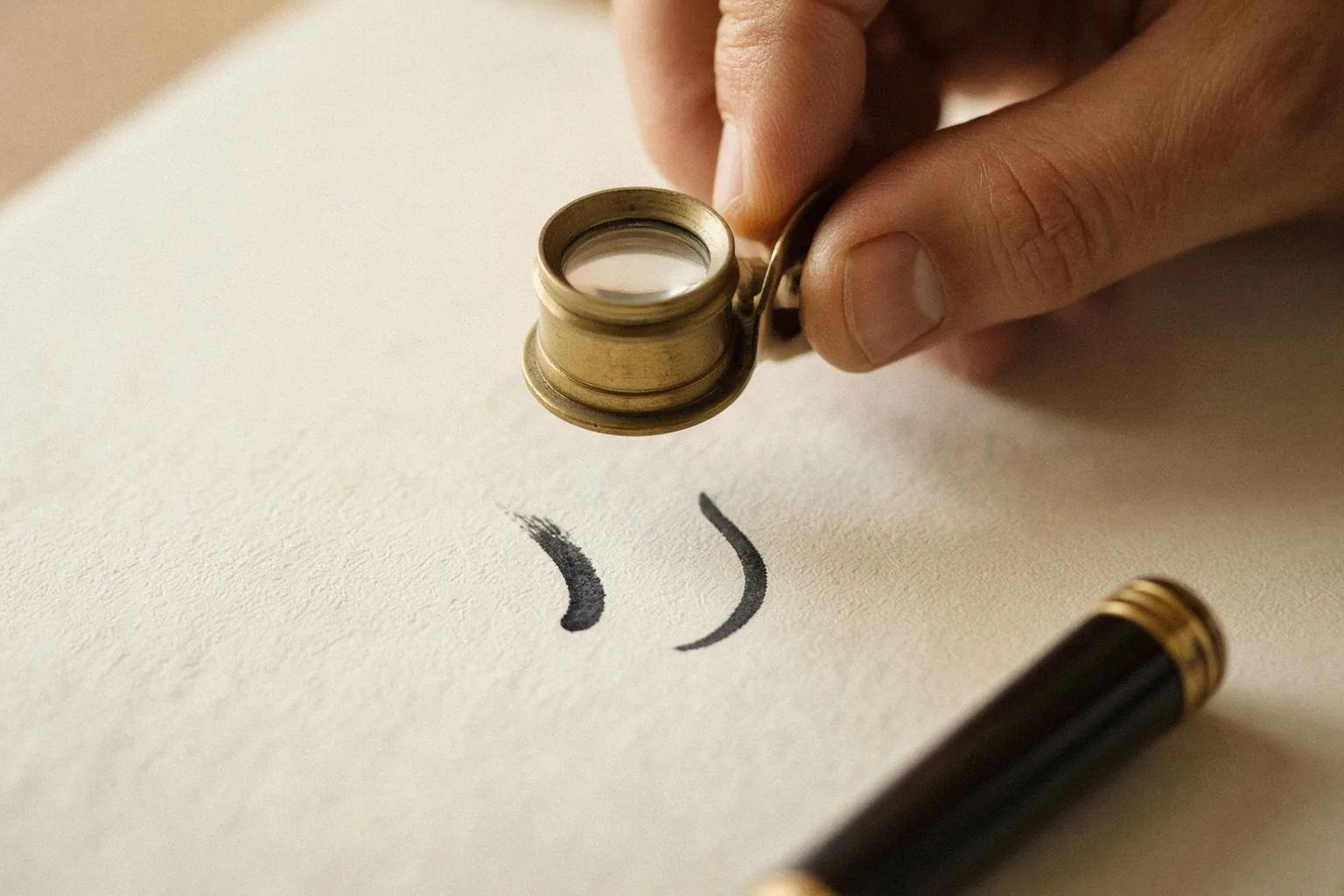
Can a handwriting examiner identify who wrote a set of initials?
Sometimes. Examiners apply the signature method to initials, and the number of letters and their complexity decide how far an opinion can go. Simple initials with few features may support only a weak opinion or none at all.
Jane A. Lewis presented the abstract "Initials: Value for Identification" to the Questioned Documents section at the 2018 meeting of the American Academy of Forensic Sciences (AAFS). She wrote: "Initials are condensed signatures." Forensic document examiners "use the same methodology in examining initials as they do for signatures," and "the number of letters in a group of initials and their complexity will determine their value for identification." According to the same abstract, initials can follow the capital letters of the person's signature closely or be built in a different way.
ANSI/ASB Standard 070, the Standard for Examination of Handwritten Items (ASB approved April 2022, ANSI approved October 2022), treats the amount of writing as a limitation. Section 4.2.1 lists "the quantity, complexity, or comparability of the writing submitted" and "absent or insufficient characteristics" among the factors that can interfere with the procedures. Section 4.2 says limitations "should be noted and recorded," and under section 6.5.3.2 the examiner "shall evaluate the quantity and quality of writing" on the questioned side, the known side or both.
Section 6.8.1 states that a conclusion "is not based solely upon any one characteristic, but rather on the combination of characteristics within the set of writing in conjunction with any limitations that may be present." Two capital letters give a smaller combination than a full name written in cursive. A reviewer of a report on initials checks how many characters the examiner had, which features carried the opinion and whether the limitations were written down.
Why are initials and short signatures harder to examine than a full signature?
They contain fewer letters and strokes, and simple forms are easier for another person to copy. Standard 070 has the examiner assess how easily the questioned writing could be simulated before deciding whether it is suitable for comparison.
Section 6.3.4(c) of Standard 070 makes complexity a separate step of the analysis. The examiner shall "assess the perceived ease or difficulty with which the questioned writing could be simulated by another writer for purposes of determining the suitability of the questioned writing for comparison purposes." The factors to consider are "speed, skill, style, construction, changes of directions, retracings, pen lifts, level of stylization, and degree of repetitive movements or shapes." A pair of block capitals has fewer pen lifts, changes of direction and retracings than a cursive name, so fewer of these factors can be measured.
The Center for Statistics and Applications in Forensic Evidence (CSAFE) reported a study, published in Law, Probability and Risk, that used 123 participant signatures to test whether complexity changes the comparison. CSAFE summarized the result: "Document examiners tend to make stronger and more reliable conclusions when comparing high complexity signatures."
The Forensic Document Examination Subcommittee of the Organization of Scientific Area Committees (OSAC) lists the same question as a research need. Its statement Comparability and complexity in handwriting and hand printing (version 4, March 21, 2025, approved June 9, 2025, rank medium) notes that writing may be classified as cursive, printed, mixed, complex or simplistic, and adds: "This includes initials and signatures as well." OSAC asks for a study of the level of complexity needed for a reliable and verifiable conclusion and expects that "error rates could possibly go down and the range of opinions given by different examiners could be narrowed."
Ted M. Burkes of the FBI Laboratory and Ronald N. Morris described a case at the 2013 AAFS meeting in which the questioned signatures were "nothing more than a sawtooth style of writing with virtually no significant characteristics." The comparison with the known signatures ended as inconclusive.
What known writing does the examiner need for questioned initials?
Known initials written in the ordinary course of business, from about the same years and on similar documents. Guidance of the American Society of Questioned Document Examiners pairs signatures with signatures and initials with initials and sets no fixed number.
A guidance document on known handwriting specimens published on the site of the American Society of Questioned Document Examiners (ASQDE) says that known writing should match the form of the questioned writing, so signatures are compared with signatures and initials with initials. It states: "There is no set number of specimens or type of specimen that will accomplish this goal to a specific degree of confidence." For a conclusion that the person did not write the item, the same text says the question "cannot be reliably assessed with but a handful of specimens."
On timing, the ASQDE text cites Hilton for the view that specimens dated within two to three years of the questioned writing are contemporaneous. Specimens dated before and after the questioned item can bracket its date. Known writing should also be made with similar writing materials, meaning the same type of instrument and surface.
Standard 070 sets the same test from the examiner's side. Under section 6.5.2.1, "features limiting comparability may include the type of writing, noncontemporaneousness, dissimilarities in text content, capture methods, writing instruments, and writing surfaces." Under section 6.5.2.3, when questioned and known writing are not comparable, "the examiner shall request additional known writing per laboratory policy." A set of full signatures sent for comparison with two-letter initials differs in type and text content, which are the first two features on that list.
In the New York lease case discussed below, the landlord's examiner worked from 41 known examples of the landlord's initials taken from check ledgers, canceled checks and lease agreements, some of them witnessed and notarized by the landlord's attorney. The opposing examiner used the signatures on four canceled checks.
Can initials be compared with the person's full signature?
With caution. Two studies of 50 writers each found shared features between full signatures and initials in most people, while some writers formed their initials in a different style. A New York court rejected that comparison in a lease case.
Bhoopesh Kumar Sharma, Pooja Prakash and Sharon Ann Philip of Amity University Dubai compared full and initial signatures of 50 adult men written with ballpoint pens (International Journal of Engineering and Advanced Technology, vol. 8, issue 6, August 2019). They found recurring features in both forms: letter formation, connecting strokes, pen lifts and pauses, slant, alignment and terminal dots. Their conclusion was that comparing the two forms can assist author identification to an extent. When a writer uses completely different characters in the full signature and in the initials, the authors found it difficult to confirm or refute authenticity.
Komal Saini, Amandeep Kaur and Manpreet Kaur studied 50 participants, among them army officers, police officers, teachers and research scholars (Indian Journal of Physical Anthropology and Human Genetics, vol. 41, no. 1, 2022, pp. 61-69). For most participants the initials were "exactly duplicate, but shortened forms of full signatures." Pen lifts appeared in the full signatures of 31 participants and in the initials of 8. Letter forms differed in the initials of 24 participants, with complete changes in 16. People who wrote initials only occasionally produced initials closer to their full signature than regular users. The authors recommend collecting known signatures and known initials.
In Rufrano v. Yovino the landlord's examiner testified that comparing initials with signatures would taint the examination and that four signatures were not a sufficient basis. The court credited his statement that "comparing initials to initials is the only proper way to conduct such examination." It also accepted his explanation that the letters in a signature are not placed side by side as they are in initials.
How did a New York court weigh two examiners on initials in a lease?
In Rufrano v. Yovino (2018) the Civil Court of the City of New York credited the examiner who studied the original under a microscope against 41 known initials, and found three of four initials on the lease forged.
Dr. Frederick Rufrano, co-owner of 498 Graham Street in Brooklyn, sought possession from Michael Yovino, who ran a social club there. The parties disputed a seven-year lease signed in December 2013. Judge Katherine A. Levine decided the case on August 23, 2018 (docket 051182-KLT-2015). Four sets of the initials "F.R." on the first page were questioned. Three of them stood next to Yovino's name, next to a handwritten term splitting the rent into two parts, and under the words "social club."
The landlord's examiner, Picciochi, had more than 30 years in the field, 20 of them in the NYPD Crime Laboratory, a Master of Science in forensic science and certification by the American Board of Forensic Document Examiners. He examined the original lease under a microscope, analyzed each questioned set of initials on its own, then studied the 41 known examples and compared them side by side, following the SWGDOC procedure and looking at letter formation, stroke order, curvature and balance. He concluded "to a high degree of probability" that three sets were written by someone else and that the fourth was Rufrano's.
The tenant's examiner, Baggett, enlarged the documents 200 percent on a copy machine, measured them with a ruler and did not use a microscope. He compared the initials with the four check signatures and with Rufrano's printing in paragraph 28 of the lease, and testified that Rufrano wrote all four sets of initials. He admitted that he usually prefers six to ten exemplars.
The court found Picciochi's methodology "much more reliable" and held that three of the four initials on the first page were forged. It treated the terms Yovino had added as a counteroffer that Rufrano never accepted, found no meeting of the minds and no valid lease, and granted Rufrano a judgment of possession and a warrant of eviction.
Does it matter that the same initials appear several times in one document?
Yes. Each questioned item is examined, and the results can differ on one page. A 2018 Russian method examines a group of 5-10 short signatures from one document together and can establish that the whole group is not genuine.
Standard 070 starts the analysis by sorting the questioned writing. Section 6.3.4(a) tells the examiner to separate it into groups of single types of writing, such as hand printing, cursive writing, numerals and signatures. Under section 6.3.4(b), if a group shows inconsistencies "suggestive of multiple writers," the examiner divides it into consistent sub-groups. Initials on every page of a contract are one group only if they are internally consistent.
In Rufrano the examiner analyzed each of the four sets of initials separately. Three sets on the same page were attributed to another writer and the fourth to the landlord.
A. V. Smirnov of the Russian Federal Centre of Forensic Science of the Ministry of Justice published a quantitative method for groups of short and simple signatures (Theory and Practice of Forensic Science, 2018, vol. 13, no. 4, pp. 100-110). The group must consist of 5-10 questioned signatures, in the first place made on one document; larger groups are split. The examiner needs at least 20 comparable known signatures, at least half of them free or conditionally free, that is, written outside the examination rather than on request, or at least 30 collected signatures when the known writing is not comparable in composition. The known signatures should be made within a year of the date of the questioned document, unless the examiner confirms that the signature has not changed.
In Smirnov's experiment with 17 writers and 170 questioned signatures, the second stage, which looks at the group as a whole, produced or improved a decision for 67 signatures, more than 39 percent. The method establishes only that all signatures in the group are not genuine. It does not establish that one person made them, and when non-genuineness is not established, the method gives no conclusion about the group.
Can the examiner say who forged the initials?
Rarely. Standard 070 notes that the drawn nature of many simulations limits their comparability with known writing. In a 2003 skill trial, 18 of 20 examiners gave only inconclusive authorship opinions on the simulated signatures.
Standard 070 records the problem in section 4.2.2: "The drawn nature of many handwritten simulations and tracings can limit their comparability with known writing." Under section 6.3.8 the examiner checks the questioned writing for indicia of simulation and tracing, which is a different question from naming the person who made it.
Bryan Found and Doug Rogers reported a profiling trial in the Journal of the American Society of Questioned Document Examiners (2003, pp. 72-81). Twenty government examiners gave opinions on questioned signatures of four kinds: genuine, disguised, simulated and auto-simulated. The abstract counts 250 of them, and the materials section 260. The examiners recognized simulated signatures as simulated in 95 percent of instances, and the error rate for authorship opinions was 0.04 percent. On authorship, "Eighteen examiners were 100% inconclusive regarding the authorship of the questioned simulated signatures." The inconclusive rate was 99.5 percent for auto-simulations, against 11.4 percent for disguised and 1.2 percent for genuine signatures.
Smirnov's method for short signatures has the same limit: it can show that the group was not written by the person named, and leaves open who wrote it. The identity of the person who made the initials has to come from other evidence.
What conclusions can a report on limited writing contain?
Often a qualified opinion or no conclusion. The SWGDOC scale has nine levels, with "indications" for writing with few significant features and "no conclusion" where significant limiting factors are present.
The SWGDOC Standard Terminology for Expressing Conclusions of Forensic Document Examiners (ver. 2013-2) runs through identification, strong probability, probable, indications and no conclusion, then the matching negative levels down to elimination. Identification is "the highest degree of confidence expressed by document examiners in handwriting comparisons." Indications applies when "a body of writing has few features which are of significance for handwriting comparison purposes." No conclusion "is the zero point of the confidence scale" and is used when there are significantly limiting factors, such as disguise or a lack of comparable writing. The opposite term, indications did not, is described as "a very weak opinion."
Standard 070 does not set its own scale. Section 6.8.3 sends the examiner to "professional Forensic Document Examination organizations and published standards" for generally accepted phrases. A reviewer therefore checks which scale the report uses before reading a "probable" or an "indications" opinion.
A 1990 article in the Journal of Forensic Sciences (vol. 35, no. 4, pp. 938-946), abstracted by NCJRS, gave three reasons why examiners often can neither identify nor eliminate a writer. Comparisons usually involve open sets, where it is not known whether a match exists. "The quality and quantity of the evidence may be inadequate." And "the lack of similarity between the questioned and known samples is not a sufficient basis for concluding that they came from different sources."
Will a court admit an opinion about initials or a short signature?
Courts decide case by case. One federal court let an examiner describe similarities and differences but not name the writer, and the largest recent error-rate study of handwriting examiners left signatures out.
In United States v. Hidalgo, 229 F. Supp. 2d 961 (D. Ariz. 2002), Judge Martone excluded "expert opinion testimony that the handwriting on the questioned documents is in fact the handwriting of a defendant" and ruled that an examiner may not "testify as to identity in terms of probabilities." The examiner could testify to the mechanics and characteristics of handwriting and the methodology, and "could point out to the jury things that the jury might not see on its own." It was "left to the jury to make the ultimate finding of identity or non-identity."
The FBI Laboratory announced a handwriting study in the Proceedings of the National Academy of Sciences with more than 80 examiners and more than 7,000 comparisons. An abstract by the study team for the 2021 AAFS meeting reported "7,213 trials from 86 handwriting examiners on 180 distinct comparisons" and stated that "this study was limited to the comparison of handwritten documents and did not include the comparisons of signatures." Error rates from that study do not describe signatures or initials.
Signature work has its own studies. A National Institute of Justice report by Mara Merlino (NCJ 248565, January 2014) on forensic signature identification states that its findings "provide significant empirical support for the validity and reliability of the foundations and methods of forensic document examination." The trial by Found and Rogers described above used signatures only. Neither source sets an error rate for two-letter initials.
Two reports that disagree may rest on different material. Burkes and Morris, in the 2013 AAFS case, concluded that "only reports based on exactly the same evidence can be compared with each other." In Rufrano one examiner had 41 known initials and the original under a microscope, the other had four check signatures and photocopy enlargements.
What does IAE do when initials or a short signature are disputed?
An examiner from the IAE registry prepares a report on your questions about the questioned initials or signature, or a review of the opposing examiner's report, in up to 5 business days after the format and cost are confirmed.
The IAE handwriting page lists the questions the examiner answers: whether the person named on a will, contract or check signed it, and whether the signature shows signs of simulation or tracing. Questions are framed around the questioned signature or entry and the known writing the client has. Under ANSI/ASB Standard 070 the examiner checks whether questioned and known writing are originals and comparable, then weighs similarities and differences together. On known writing the page asks for original known writing of the same type and from about the same period as the questioned item.
For initials, send the original document or its best available copy, the known initials and signatures with a note on where each item came from and its date, and the questions. Materials go through the form on the contact page or to info@iaexperts.com; the service page has a "Request a quote" button. The secretariat confirms receipt the same day and, within one business day, the format, the cost, the deadline and the examiner from the registry. You approve the candidate and the CV before work starts. Cases with tight deadlines have a 48-hour rush.
Registry members passed the collegial attestation of the council under the published Criteria Matrix, and the Member ID in the report can be checked by QR code. The examiner confirms in the document that he or she has no interest in the outcome, and materials are not passed to third parties without your consent. The service page notes that since December 1, 2023, the party offering a handwriting opinion must show the court it is more likely than not that the opinion rests on sufficient facts or data and a reliable method reliably applied. The court weighs the report with the other evidence; neither IAE nor the examiner guarantees the outcome, and IAE is not a law firm and does not advise on case strategy.
Sources
- Jane A. Lewis, J13 Initials: Value for Identification, AAFS 2018 Annual Meeting, Questioned Documents section (abstract)
- ANSI/ASB Standard 070, Standard for Examination of Handwritten Items, First Edition, 2022 (AAFS Standards Board)
- OSAC Forensic Document Examination Subcommittee, R&D need: Comparability and complexity in handwriting and hand printing, version 4, 2025 (NIST)
- CSAFE, summary of a study on signature complexity and examiner conclusions (Law, Probability and Risk)
- Ted M. Burkes, Ronald N. Morris, J5 The Case of Different Documents and Different Conclusions, AAFS 2013 (abstract)
- American Society of Questioned Document Examiners, guidance on known handwriting specimens (PDF)
- Rufrano v. Yovino, Civil Court of the City of New York, No. 051182-KLT-2015, August 23, 2018 (FindLaw)
- B. K. Sharma, P. Prakash, S. A. Philip, Exploring the Similarities between Complete and Initial Signatures of an Individual for the Purpose of Author Identification, IJEAT, vol. 8, issue 6, 2019
- K. Saini, A. Kaur, M. Kaur, Forensic Comparison of Full Signatures with Initials, Indian Journal of Physical Anthropology and Human Genetics, vol. 41, no. 1, 2022, pp. 61-69
- A. V. Smirnov, A Quantitative Procedure for Multi-Object Investigation of Short and Simple Signatures, Theory and Practice of Forensic Science, 2018, vol. 13, no. 4, pp. 100-110, DOI 10.30764/1819-2785-2018-13-4-100-110 (in Russian)
- Bryan Found, Doug Rogers, The Initial Profiling Trial of a Program to Characterize Forensic Handwriting Examiners' Skill, JASQDE, 2003, pp. 72-81
- SWGDOC Standard Terminology for Expressing Conclusions of Forensic Document Examiners, ver. 2013-2 (NIST)
- NCJRS abstract NCJ 125051, Journal of Forensic Sciences, vol. 35, no. 4, July 1990, pp. 938-946
- United States v. Hidalgo, 229 F. Supp. 2d 961 (D. Ariz. 2002) (Justia)
- L. Eisenhart, R. A. Hicklin et al., J1 The Accuracy and Reliability of Forensic Handwriting Examiner Decisions, AAFS 2021 (abstract)
- FBI, FBI Laboratory Publishes Major Handwriting Analysis Study (press release)
- Mara Merlino, Validity, Reliability, Accuracy, and Bias in Forensic Signature Identification, NCJ 248565, 2014 (NCJRS abstract)
Read also
All articles
Can a notarized signature be challenged as forged, and what does the handwriting examiner have to show?
A notary's stamp does not make a signature unchallengeable, but it changes the proof. In New York a certificate of acknowledgment raises Sergei Voronin
Block capitals: can a handwriting expert identify who hand printed a note or a form?
Anonymous notes, address labels and filled-in forms are often written in block capitals, and the writer may expect capitals to hide his or herSergei Voronin
Signed on a signature pad: can a handwriting expert examine an electronic handwritten signature?
A signature written with a stylus on a pad or tablet is still handwriting, and a handwriting examiner can compare it with known signatures. The imageSergei VoroninExpert examinations
Ready to discuss your case?
Send the materials: the secretariat will confirm the format, cost, deadline and the specialist within one business day.
