
Examinations
Can a handwriting expert examine a photocopy of a signature?
A handwriting examiner can work from a photocopy, but the copy sets the limits of the work. ANSI/ASB Standard 070 tells the examiner to request the original first and names ten features a reproduction can hide, among them pressure, hesitations and artifacts of cut and paste. California appellate courts upheld handwriting opinions that relied on photostats in People v. Norwoods and Smith v. Bank of America (1961). Rules 1003 and 1004 decide separately whether the copy comes into evidence.
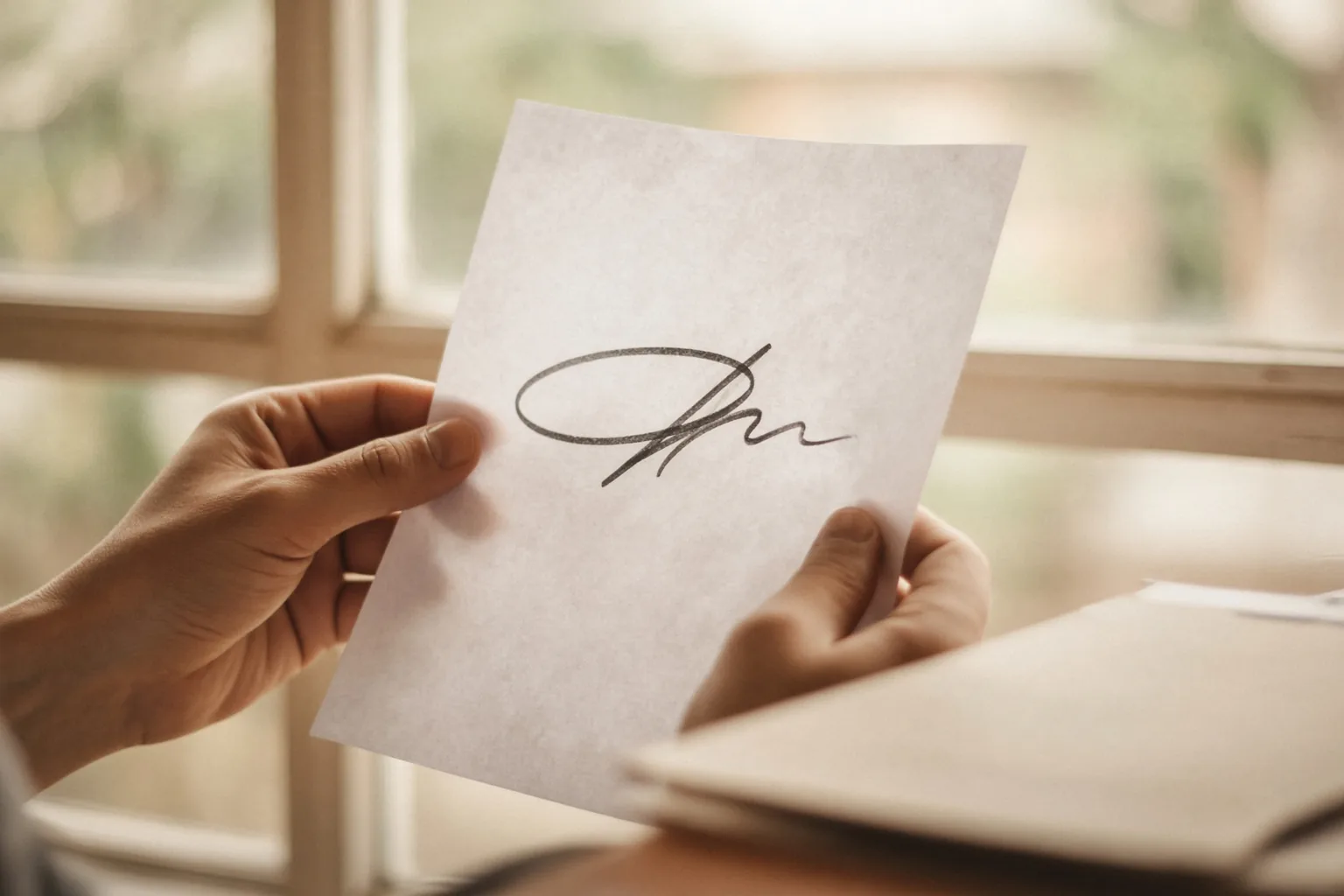
Can a handwriting examiner work from a photocopy?
Yes. ANSI/ASB Standard 070 states that the absence of original writing does not preclude the examination. It still tells the examiner to request the original and to stop and report if the copy is too unclear for comparison.
Standard 070, the Standard for Examination of Handwritten Items, was approved by the Academy Standards Board in April 2022 and by ANSI in October 2022. Section 6.3.2 reads: "The examiner shall determine whether the questioned writing is original writing. If it is not original writing, request the original." When no original arrives, the examiner evaluates the quality of the reproduction. If the writing "has not been reproduced with sufficient clarity for meaningful analysis or comparison purposes," the examiner "shall discontinue these procedures and report accordingly." The note to the section adds that "examination of the original writing is preferable."
Public crime laboratories give the same instruction to the agencies that send them evidence. The Florida Department of Law Enforcement writes that "we can examine machine copies of either the questioned or known documents," that "when originals can be obtained, they should be submitted" and that a party sending copies should "submit the best quality available." The Virginia Department of Forensic Science answers the photocopy question "In a word" with a yes and adds: "Original handwritten documents are always the best evidence."
The copy goes into the record as a limitation. Section 4.2 says limitations "should be noted and recorded," section 4.2.1 puts "the submission of non-original documents" first among them, and section 6.6 states that limitations "shall also be documented if present." A report on a copied signature therefore names the item the examiner actually saw: a paper copy, a fax, a scan or a printout of a scan.
What can an examiner still compare on a good copy?
The general form of the signature. In Efremenko's 2019 study of 456 copies, size, spacing, slant, direction of movements and the baseline usually passed into copies without distortion, while particular features were distorted.
N. V. Efremenko of the Academy of the Ministry of Internal Affairs of Belarus published the study in the Bulletin of Polotsk State University (Series D, 2019, No. 6, pp. 189-195). Staff of the Scientific and Practical Center of the State Forensic Examination Committee of Belarus prepared the experimental set: 456 copies carrying 2,848 handwritten entries and 4,136 signatures, made on different devices and in different modes.
Particular features, such as the shapes and directions of individual movements, the type of connection between strokes, their sequence and the position of starting and ending points, came out distorted. Straight elements could turn wavy, and a break between two strokes could look like a continuous connection. Features in large parts of the signature held up better than those in small parts, and the relative direction and relative length of movements were preserved.
A copy can also keep the outline needed to overlay two questioned signatures. In People v. Norwoods, a California prosecution under Penal Code section 474 over forged telegram messages, with a receipt dated September 1947, examiner Sherwood Morrell worked from photostatic copies and enlargements he had made from the original receipt and authorization. With glass gauges he found nearly all points of the two signatures aligned, with a slight difference in the ending strokes of the "r" and the "n," and testified that "no one can write his signature exactly alike in all respects on two occasions." Standard 070 section 6.5.6.1 has the examiner evaluate "evidence of exact replication among multiple writings indicative of duplication by electronic or other means," and the note to section 6.5.6 warns that "distortion due to copying or reproduction of an intermediate model may also preclude an exact overlay."
Can a copy hide a signature pasted from another document?
Yes. Section 6.3.3 tells the examiner to look for characteristics of duplication such as cut and paste manipulation, and the same standard lists artifacts of cut and paste alterations among the things a reproduction may hide.
Section 6.3.3 directs the examiner to check the questioned writing for "characteristics of duplication, such as those of cut and paste manipulation, by electronic or other means." Section 4.2.2 adds "duplications of handwriting that can be generated by computer and other means" to what the examiner has to consider. An image of a genuine signature placed on another document carries that person's handwriting features, so a comparison of form alone does not detect it.
Efremenko's experiment tested this risk. Examiners who did not exclude montage or technical forgery still gave categorical conclusions, and that produced an erroneous finding. The article states that a failure to find signs of montage on a copy does not mean the document was not assembled, and it recommends answering the montage question on a copy with a finding that it cannot be resolved, with the reasons set out in the report.
How the copy itself was produced is a separate examination. The Virginia Department of Forensic Science can examine photocopied documents "in an effort to identify the source machine used to produce them." The Georgia Bureau of Investigation writes that "it is often possible to determine the type of process used to make a copy" and whether a specific machine made it, and asks for at least six copies made with the lid down and no document, six more with a sheet of paper on the glass, and the make, model, serial number and location of the copier. Efremenko's algorithm assigns this step to a joint examination with a document examiner when the handwriting examiner lacks that qualification.
Can the known signatures be photocopies too?
Yes, with the same limits. Section 6.4.2 tells the examiner to check whether known writing is original, to evaluate copies for quality and, when originals and copies arrive together, to evaluate the known writings as a group.
Under section 6.4.2, "If no original known writing is submitted, the examiner shall evaluate the quality of the submitted reproduction." When original and non-original known writings are both submitted, "the examiner shall evaluate the known writings as a group." If the known writing is unclear and "neither the original nor better copies are available," the examiner may discontinue and report.
Federal law lets the comparison happen once the known writing is proved. Under 28 U.S.C. § 1731, "The admitted or proved handwriting of any person shall be admissible, for purposes of comparison," to determine whether other handwriting attributed to that person is genuine. Federal Rule of Evidence 901(b)(3) provides for "a comparison with an authenticated specimen by an expert witness or the trier of fact."
Laboratory guidance treats copied known writing as a supplement. The Georgia Bureau of Investigation tells investigators: "In true name cases, always supplement the request/dictated signatures with copies of driver's license signatures." The Virginia Department of Forensic Science requires that "Known samples must be comparable to the questioned material" and that "The source of the known writing must be provable and it must be admissible in a court of law."
In Smith v. Bank of America, decided by the California Court of Appeal on January 30, 1961 (Civ. No. 19188), the examiner compared the original promissory note dated July 28, 1937 with photostats of two signatures of the late attorney Ernest Torregano on documents filed in federal court. He made no photographs, enlargements or microscopic examination of the questioned signature, said that "in some cases photostats are not adequate for comparison" and found them sufficient here because "It isn't even a close imitation of the genuine handwriting." The court affirmed the finding that the decedent did not sign the note.
Will a court admit a photocopy of the questioned document?
Usually, under the federal rules. Rule 1003 admits a duplicate like the original unless a genuine question is raised about the original's authenticity or admission would be unfair. Rule 1004 covers lost and unobtainable originals.
Rule 1001(e) defines a duplicate as "a counterpart produced by a mechanical, photographic, chemical, electronic or other equivalent process or technique that accurately reproduces the original." Under Rule 1001(d) an original includes "any counterpart intended to have the same effect by the person who executed or issued it," so a contract signed in two counterparts has two originals.
Rule 1003 reads: "A duplicate is admissible to the same extent as the original unless a genuine question is raised about the original's authenticity or the circumstances make it unfair to admit the duplicate." A party that claims forgery argues that the first exception applies, and the court decides whether the copy may stand in for the original or whether the original, or a ground under Rule 1004, is needed.
Rule 1004 admits other evidence of the content of a writing if "all the originals are lost or destroyed, and not by the proponent acting in bad faith," if "an original cannot be obtained by any available judicial process," if the opposing party controlled the original, was put on notice that it would be a subject of proof and "fails to produce it," or if the writing "is not closely related to a controlling issue."
People v. Norwoods shows the same reasoning under California law. The defendant had the originals last; he gave them to his attorney, they passed through the district attorney to the examiner and back, and at trial he said he did not know where they were. The Court of Appeal held that "The originals, and their unavailability, were sufficiently accounted for by the appellant, who last had possession of them," that the photostats were "adequately identified as facsimiles of the questioned signatures" and that the examiner's testimony "seems clearly admissible."
What if the signature is on a check that survives only as a substitute check?
Under 12 U.S.C. § 5003(b), a substitute check is the legal equivalent of the original if it accurately represents both sides and bears the required legend. For the examiner it is still a reproduction under Standard 070.
Under 12 U.S.C. § 5003(a), a person may deposit, present or send for collection or return a substitute check without an agreement with the recipient, as long as a bank has made the warranties in section 5004. Section 5003(b) provides that "A substitute check shall be the legal equivalent of the original check for all purposes" if it "accurately represents all of the information on the front and back of the original check as of the time the original check was truncated" and bears the legend: "This is a legal copy of your check. You can use it the same way you would use the original check."
Legal equivalence settles what the check says and who may rely on it. It does not restore the ink line. A substitute check is a print made from an image, so every item in the note to section 6.3.2 applies to the drawer's signature on it. If the paper check still exists, the examiner's request for the original under section 6.3.2 covers it.
Signatures written on electronic signature pads at a store or a bank counter are a different object. Section 6.5.2.2 of Standard 070 deals with pictorial images of digitally captured signatures and warns that "the pictorial characteristics of such images may exhibit poor quality and distortion."
How can a party get the original to the examiner?
Through discovery. Rule 34 lets a party request designated documents from another party, with a written response due within 30 days, and Rule 34(c) points to Rule 45 subpoenas for nonparties such as banks.
Rule 34(a)(1)(A) covers "any designated documents or electronically stored information," including writings and images. Under Rule 34(b)(2)(A), "The party to whom the request is directed must respond in writing within 30 days after being served." Rule 34(c) states: "As provided in Rule 45, a nonparty may be compelled to produce documents and tangible things or to permit an inspection." The request can name the original signed page as the item to be inspected.
Originals go to the examiner with as little handling as possible. The Georgia Bureau of Investigation instructs that "All documents should be handled as little as possible and must not be folded, creased, or stapled." When the original cannot be had, the Florida Department of Law Enforcement asks for copies of "the best quality available."
The record of who held the original also matters later. In Norwoods the court traced each transfer of the documents among the defendant, his attorney, the district attorney and the examiner before it admitted the photostats. Rule 1004(c) turns on the same facts: whether the opposing party had control of the original and "was at that time put on notice, by pleadings or otherwise," that the original would be a subject of proof. A written request that names the original puts that notice on record.
What conclusion can a report based on a copy reach?
One limited by the copy. Standard 070 bases conclusions on the combination of characteristics together with any limitations. Efremenko advised against categorical identifications from copies when the montage question has no categorical answer, and allowed categorical eliminations.
Section 6.8.1 provides that "A conclusion is not based solely upon any one characteristic" and that it rests on the combination of characteristics "in conjunction with any limitations that may be present." Section 6.6 requires that "The bases and reasons for the conclusion(s) and opinion(s) shall be included in the examiner's documentation." A copy is one of those limitations, so the report says how it narrowed the opinion.
Efremenko drew practical rules from the experiment. When the montage question cannot be answered categorically, examiners should not give categorical positive conclusions that the named person wrote the signature. The recommendation does not extend to categorical negative conclusions. The montage risk explains the difference: a pasted image of a genuine signature matches the named person's writing, while a signature that differs from all of that person's known writing cannot be such an image.
The article's model wording also includes an alternative finding: the signature was written by the named person or was assembled by computer montage from one of that person's original signatures. Another model wording reports that the question of authorship cannot be resolved because the copy is of poor quality. Each of them states which question the copy left open.
What does IAE do when only a copy of the signed document is available?
An IAE examiner prepares a report on whether the person named on the document signed it and whether the signature shows signs of simulation or tracing. The signed PDF is issued in up to 5 business days.
The IAE handwriting and signature service covers wills, contracts and checks in federal and state cases: a report on the client's questions or a review of the opposing handwriting examiner's report. Under Standard 070 the examiner checks whether questioned and known writing are originals and comparable, then weighs similarities and differences together. The questions are framed around the questioned signature and the known writing the client has.
The client sends the questioned document or its best copy, the known signatures with their sources and dates, information on where the original is kept and a description of the task, through the Request a quote button on the service page. The secretariat confirms receipt the same day. Within one business day IAE confirms the format, the cost, the deadline and the specialist from its registry, and the client approves the candidate and the CV before work starts. The signed PDF is issued in up to 5 business days after the format and cost are confirmed, with a 48-hour rush for tight deadlines.
Every specialist is a member of the public IAE registry, can be verified by Member ID or QR code and confirms in the document that he or she has no interest in the outcome. Materials are not passed to third parties without the client's consent. A report is evidence that the court weighs with the rest of the record. Neither IAE nor the examiner guarantees the outcome, and IAE is not a law firm and does not advise on case strategy.
Sources
- ANSI/ASB Standard 070, Standard for Examination of Handwritten Items, First Edition, 2022 (Academy Standards Board)
- Florida Department of Law Enforcement, Document Examination submission FAQ
- Virginia Department of Forensic Science, Questioned Documents section
- Georgia Bureau of Investigation, Division of Forensic Sciences, Questioned Documents
- N. V. Efremenko, Study of signature images on copies of documents made with copying equipment, Bulletin of Polotsk State University, Series D, 2019, No. 6, pp. 189-195 (in Russian)
- People v. Norwoods, California Court of Appeal, 100 Cal. App. 2d (Justia)
- Smith v. Bank of America National Trust and Savings Association, California Court of Appeal, January 30, 1961 (Justia)
- Federal Rule of Evidence 1001, Definitions That Apply to This Article (LII)
- Federal Rule of Evidence 1003, Admissibility of Duplicates (LII)
- Federal Rule of Evidence 1004, Admissibility of Other Evidence of Content (LII)
- Federal Rule of Evidence 901, Authenticating or Identifying Evidence (LII)
- 28 U.S.C. § 1731, Handwriting (Justia, 2020)
- 12 U.S.C. § 5003, General provisions governing substitute checks (Office of the Law Revision Counsel)
- Federal Rule of Civil Procedure 34, Producing Documents and Tangible Things (LII)
Read also
All articles
Can a notarized signature be challenged as forged, and what does the handwriting examiner have to show?
A notary's stamp does not make a signature unchallengeable, but it changes the proof. In New York a certificate of acknowledgment raises Sergei Voronin
Block capitals: can a handwriting expert identify who hand printed a note or a form?
Anonymous notes, address labels and filled-in forms are often written in block capitals, and the writer may expect capitals to hide his or herSergei Voronin
Signed on a signature pad: can a handwriting expert examine an electronic handwritten signature?
A signature written with a stylus on a pad or tablet is still handwriting, and a handwriting examiner can compare it with known signatures. The imageSergei VoroninExpert examinations
Ready to discuss your case?
Send the materials: the secretariat will confirm the format, cost, deadline and the specialist within one business day.
