
Examinations
How do you prove poor workmanship by a contractor, and what does the expert compare the work against?
A homeowner proves poor workmanship by showing what the contract or the trade required, what the contractor actually built and how the gap caused the damage. In 2022 the North Carolina Court of Appeals held that a homeowner's workmanship claim needed "at least some expert evidence," and on April 1, 2026, the Iowa Court of Appeals affirmed summary judgment against an owner who offered no expert testimony on how a pipe broke.
What counts as poor workmanship in a lawsuit against a contractor?
Work that departs from the contract documents or, where they are silent, from the standard of the trade. The Supreme Court of Texas defined good and workmanlike work by what people capable of judging such work consider proficient.
The contract comes first. Plans, specifications, the scope of work, change orders and the installation instructions the specifications adopt tell the expert what the contractor promised. A departure from those documents can be measured: a slab thinner than specified, a flashing detail that differs from the drawing, a product other than the one the owner paid for.
Where the documents say nothing, courts apply an implied standard. In Melody Home Manufacturing Co. v. Barnes, decided on November 4, 1987, the Supreme Court of Texas defined good and workmanlike as "that quality of work performed by one who has the knowledge, training, or experience necessary for the successful practice of a trade or occupation and performed in a manner generally considered proficient by those capable of judging such work."
The same court held that an implied warranty to repair or modify existing tangible goods or property in a good and workmanlike manner is available to consumers suing under the Texas Deceptive Trade Practices Act, and that this warranty "may not be waived or disclaimed."
The definition also sets the expert's task. The people "capable of judging such work" are those trained in the trade, so an opinion on whether a roof, a tile floor or an HVAC installation was proficient has to come from someone who does or supervises that kind of work.
Do you need an expert to prove that the work was defective?
Appellate courts in North Carolina and Iowa have required one. North Carolina's court said a homeowner's workmanship claim needed at least some expert evidence; Iowa's applied the rule that causation beyond a layperson's understanding requires expert testimony.
Dan King Plumbing Heating & Air, LLC installed an HVAC system in a house, and its plumbing work passed final inspection on December 4, 2017. The case was heard in Mecklenburg County, North Carolina. The contractor sued in August 2018 for money owed. The homeowner counterclaimed for breach of contract, unfair trade practices, fraud and breach of the implied warranty of workmanship.
At the first trial the jury found for the homeowner on his breach of contract claims and awarded $15,572. Both sides appealed. In its first decision, reported at 281 N.C. App. 312 (2022), the Court of Appeals agreed with the contractor that "at least some expert evidence must be presented to sustain a claim such as this" and ordered a new trial on the workmanship claim. The homeowner had offered no expert testimony, only his own lay testimony, which the court found inadequate as a matter of law. On April 2, 2024, in No. COA23-752, the court affirmed the trial judge's order for that new trial.
In Novick v. Hellwig Electric, LLC, No. 25-0765, the owner had hired an electrical contractor in 2013 to move a large wire between subpanels. About two years later the house began to smell, and in 2017 the odor returned much stronger. When the garage ceiling was torn out, a broken PVC pipe was found with an electrical wire very tight against it. The owner sued in October 2022, with a claim for breach of the implied warranty of workmanlike construction among others. He offered no expert testimony on how the pipe broke. He designated two friends as non-retained experts, and both admitted they had no expertise in plumbing or electrical work.
The Iowa Court of Appeals affirmed summary judgment for the contractor. It quoted the rule that "questions of causation which are beyond the understanding of a layperson require expert testimony" and held that the wire lying over the pipe was "insufficient to establish causation."
The two cases turned on different elements. In North Carolina no expert testified that the plumbing work was not performed in a workmanlike manner, and the homeowner's verdict on that claim was set aside for a new trial. In Iowa the missing proof was the link between the contractor's work and the damage. An expert report covers both: what proficient work looks like and why this defect caused this loss.
What does the expert compare the finished work against?
Against the contract documents, the installation instructions they adopt, the building code that applied to the job and the practice of the trade. Each finding names the requirement, its source and the measured departure.
A report that a court can test pairs every defect with a written requirement. For each item the expert records the location, the requirement and where it comes from, what was found, how it was measured or tested, and the photograph or sample that documents it. A list of complaints without that pairing gives the other side nothing to check and the judge nothing to weigh.
The expert also separates what the contractor built from what happened later. Section 27.003(a)(2) of the Texas Property Code lists damage a contractor is not liable for: damage caused by the negligence of someone other than the contractor or its agents, employees or subcontractors; by another person's failure to mitigate, maintain or give timely notice; by "normal wear, tear, or deterioration"; by normal cracking or shrinkage cracking due to drying or settlement of construction components within the tolerance of building standards; and by the contractor's reliance on written information from official government records that was false or inaccurate when the contractor could not reasonably have known it.
Section 27.003(a)(1) states the other half of the test. A contractor is liable only to the extent a defective condition proximately causes actual physical damage to the residence, an actual failure or lack of capability of a building component to perform its intended function or purpose, or a verifiable danger to the safety of the occupants. A report written for a Texas residential case therefore ties each defect to one of those three results and explains why the listed exclusions do not account for it.
What happens during the expert's site inspection?
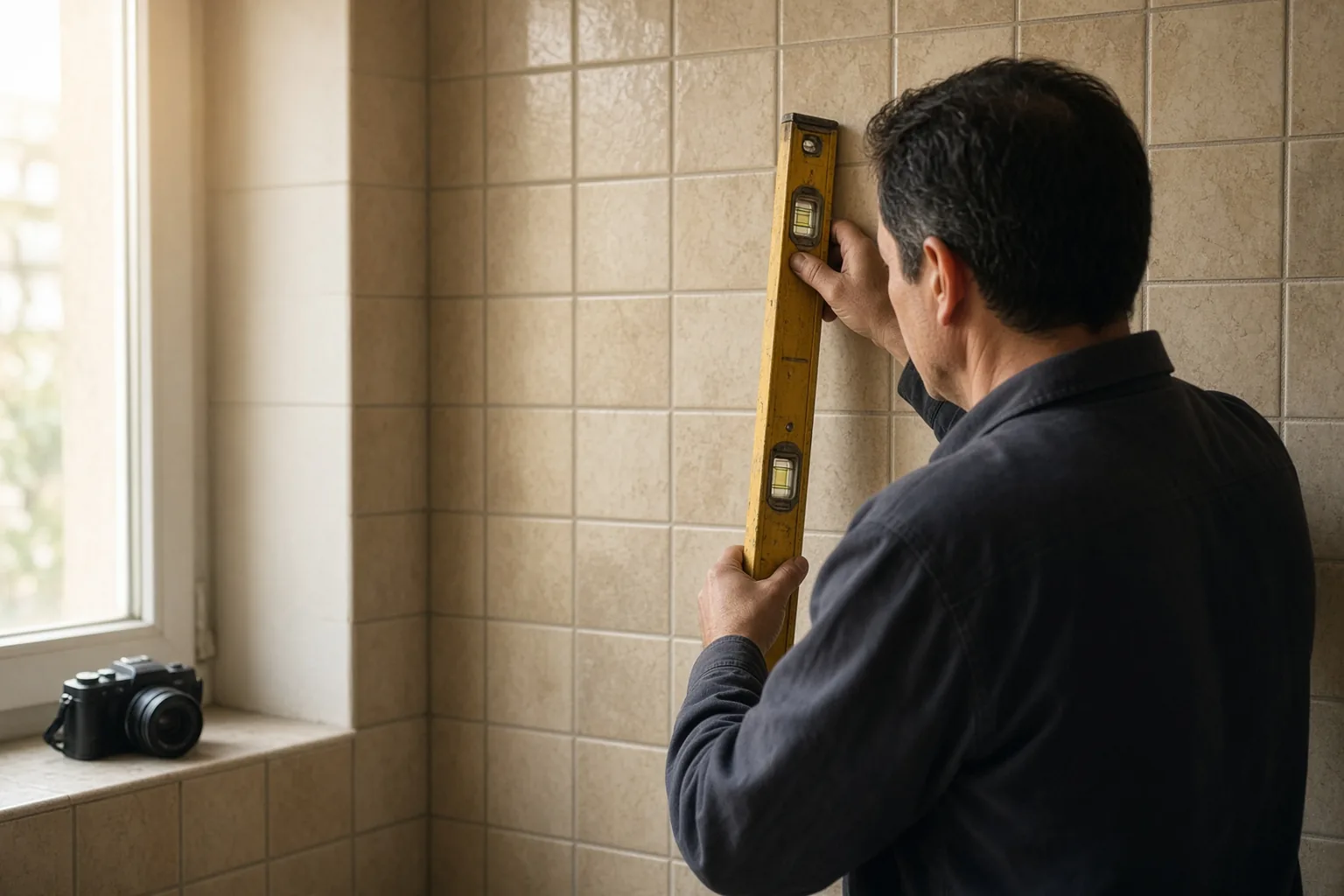
The expert measures, photographs and, where needed, opens finishes or takes samples, recording each location so the other side can repeat the check. Destructive steps are planned in advance because they change the evidence.
The first visit fixes what the expert can measure, and the openings fix what the expert can see behind the finishes. Readings of level, plumb and flatness, moisture readings, material thickness and fastener spacing turn a complaint into numbers. Lifting tile, opening a wall or cutting a core shows concealed work, but each opening destroys part of what is being examined, so the expert records the condition before, during and after.
When the other side controls the building, entry goes through discovery. Federal Rule of Civil Procedure 34(a)(2) lets a party demand entry onto designated land or other property possessed or controlled by the responding party in order to "inspect, measure, survey, photograph, test, or sample the property or any designated object or operation on it." The responding party must answer in writing within 30 days after being served.
Repairs made before the inspection remove evidence. If a failed shower or a leaking roof has to be fixed before trial, the condition is recorded first, removed materials are kept and the repair invoice names who did the work. In a Texas residential claim those records go to the contractor before suit under section 27.004 of the Property Code.
Does the contractor get to inspect before the lawsuit?
In Texas, yes. Section 27.004 of the Property Code requires written notice at least 60 days before suit, gives the contractor a 35-day period with up to three inspections and 60 days to offer a settlement.
The notice goes by certified mail, return receipt requested, to the contractor's last known address. It must specify "in reasonable detail the construction defects that are the subject of the complaint." During the 35-day period after the contractor receives the notice, the contractor may inspect on written request, and "the contractor shall be given the opportunity to conduct up to three inspections."
The claimant must give the contractor "any evidence that depicts the nature and cause of the defect" and the repairs needed to remedy it, including "any expert reports, photographs, and video or audio recordings" if they are discoverable under Rule 192 of the Texas Rules of Civil Procedure. An owner's expert report written before the notice therefore reaches the contractor before any lawsuit, and the contractor's own inspector looks at the same conditions.
Not later than the 60th day after receiving the notice, the contractor may make a written offer of settlement. The parties weigh that offer against the expert's list of defects and the repair each one needs, so a report that prices each defect separately gives both sides the same basis for the negotiation.
Which repair costs can the owner recover, and how does the expert support them?
In a Texas residential case, the reasonable cost of repairs necessary to cure the defect, damaged goods, engineering and consulting fees, temporary housing, lost market value for structural failures, attorney's fees and arbitration costs.
Except as subsection (e) provides, section 27.004(g) limits the economic damages a claimant may recover in an action under chapter 27 to seven items proximately caused by a construction defect: the reasonable cost of repairs necessary to cure any construction defect; the reasonable and necessary cost of replacing or repairing damaged goods in the residence; reasonable and necessary engineering and consulting fees; the reasonable expenses of temporary housing reasonably necessary during the repair period; the reduction in current market value, if any, after the defect is repaired if the defect is a structural failure; reasonable and necessary attorney's fees; and arbitration filing fees and the claimant's share of arbitrator compensation.
The words "necessary to cure" limit the estimate. A scope that replaces a whole roof to fix one failed valley, or upgrades materials beyond the contract, invites the answer that part of the cost cures nothing the contractor did. The expert lists each defect, the repair that cures it, and the quantity and unit price behind each line, and keeps upgrades on a separate line.
Engineering and consulting fees appear in the same list. In a Texas residential case the cost of the expert's investigation is itself a damages item, subject to the same "reasonable and necessary" test, so the expert's own time records belong in the file.
How does a federal court test a workmanship opinion under Rule 702?
The party offering the expert must show the court that it is more likely than not that the opinion rests on sufficient facts or data and on reliable methods reliably applied to this building.
Rule 702 of the Federal Rules of Evidence has four conditions: specialized knowledge that will help the trier of fact, testimony based on sufficient facts or data, testimony that is the product of reliable principles and methods, and an opinion that applies those principles and methods reliably to the facts of the case. The proponent carries the burden on each condition under the more-likely-than-not standard.
Two committee notes bear on workmanship cases. The 2000 note lists this factor: "Whether the expert has adequately accounted for obvious alternative explanations." In a defect case the alternatives are often the ones the Texas statute names: other trades, the owner's maintenance, normal wear and settlement within tolerance. The 2023 note says "each expert opinion must stay within the bounds of what can be concluded from a reliable application of the expert's basis and methodology." An expert who opened one bathroom can describe that bathroom; an opinion about every bathroom in the building needs a basis that reaches them.
State courts apply their own evidence rules. In the North Carolina and Iowa cases the owners had no expert at all: one had his verdict on the workmanship claim set aside for a new trial, the other lost on summary judgment. In federal court the next question is whether the expert's method holds up for each opinion in the report.
What does IAE do when a workmanship dispute needs an expert?
IAE prepares an expert report on the questions agreed with the client about defects and code, scope and repair cost, and water intrusion. The signed document is issued in up to 5 business days.
For defective work, the expert documents cracks, deflection, settlement and failed finishes, then compares the work with the plans, the specifications and the code edition in force at permit. For scope and cost, the expert lists each damaged element, measures quantities on site or from photos and prices the repair line by line, with defect repair kept apart from upgrades. The expert answers the questions agreed with the client, working from the documents, the photos and the site inspection record.
The client sends the materials and describes the task, and the secretariat confirms receipt the same day. Within one business day IAE confirms the format, the cost, the deadline and the specialist from its registry, and the client approves the candidate and the CV before work starts. The signed PDF is issued in up to 5 business days, and a 48-hour rush is available for cases with tight deadlines.
Every specialist is a member of the public IAE registry and can be verified by Member ID or QR code. The specialist confirms in the document that he or she has no interest in the outcome of the case. IAE is not a law firm and does not advise on case strategy; legal questions are for the client's attorney. A report is evidence that the court weighs with the rest of the record, and neither IAE nor the expert guarantees the outcome.
Sources
- Melody Home Mfg. Co. v. Barnes, 741 S.W.2d 349 (Tex. 1987), No. C-5508, decided November 4, 1987
- Dan King Plumbing Heating & Air, LLC v. Harrison, No. COA23-752 (N.C. Ct. App. Apr. 2, 2024)
- Novick v. Hellwig Electric, LLC, No. 25-0765 (Iowa Ct. App. Apr. 1, 2026)
- Texas Property Code section 27.003, Liability (Justia, 2025 Texas Statutes)
- Texas Property Code section 27.004, Notice and Offer of Settlement (Justia, 2023 Texas Statutes)
- Federal Rules of Evidence, Rule 702, Testimony by Expert Witnesses, with committee notes (LII, Cornell Law School)
- Federal Rules of Civil Procedure, Rule 34 (LII, Cornell Law School)
Read also
All articles

A neighbor's grading or paving sends water onto my property: who is responsible, and how does an expert prove the drainage change?
Whether a neighbor answers for water that runs onto your land depends on the surface water rule of the state. California asks whether each owner Sergei Voronin
Roof leaking after a roof replacement: how does an expert prove that the roofer's work caused it?
A roof that leaks a few weeks after it was replaced does not prove by itself that the roofer did bad work. The owner has to show where the waterSergei Voronin
Construction next door damaged my house: how does an expert tie the cracks to the neighboring work?
When excavation, pile driving or underpinning next door is followed by new cracks, tilting floors or sticking doors, the owner has to prove thatSergei VoroninExpert examinations
Ready to discuss your case?
Send the materials: the secretariat will confirm the format, cost, deadline and the specialist within one business day.
