
Examinations
Can a forensic examiner identify the printer or copier that made a document?
A forensic document examiner can often tell whether a page was printed with toner or inkjet and narrow it to a make or model; linking it to one machine needs marks the device left on the page and pages known to come from that device. The SWGDOC standards of 2013 for toner and inkjet documents set the procedure, and many color laser printers add tracking dots that can carry a serial number.
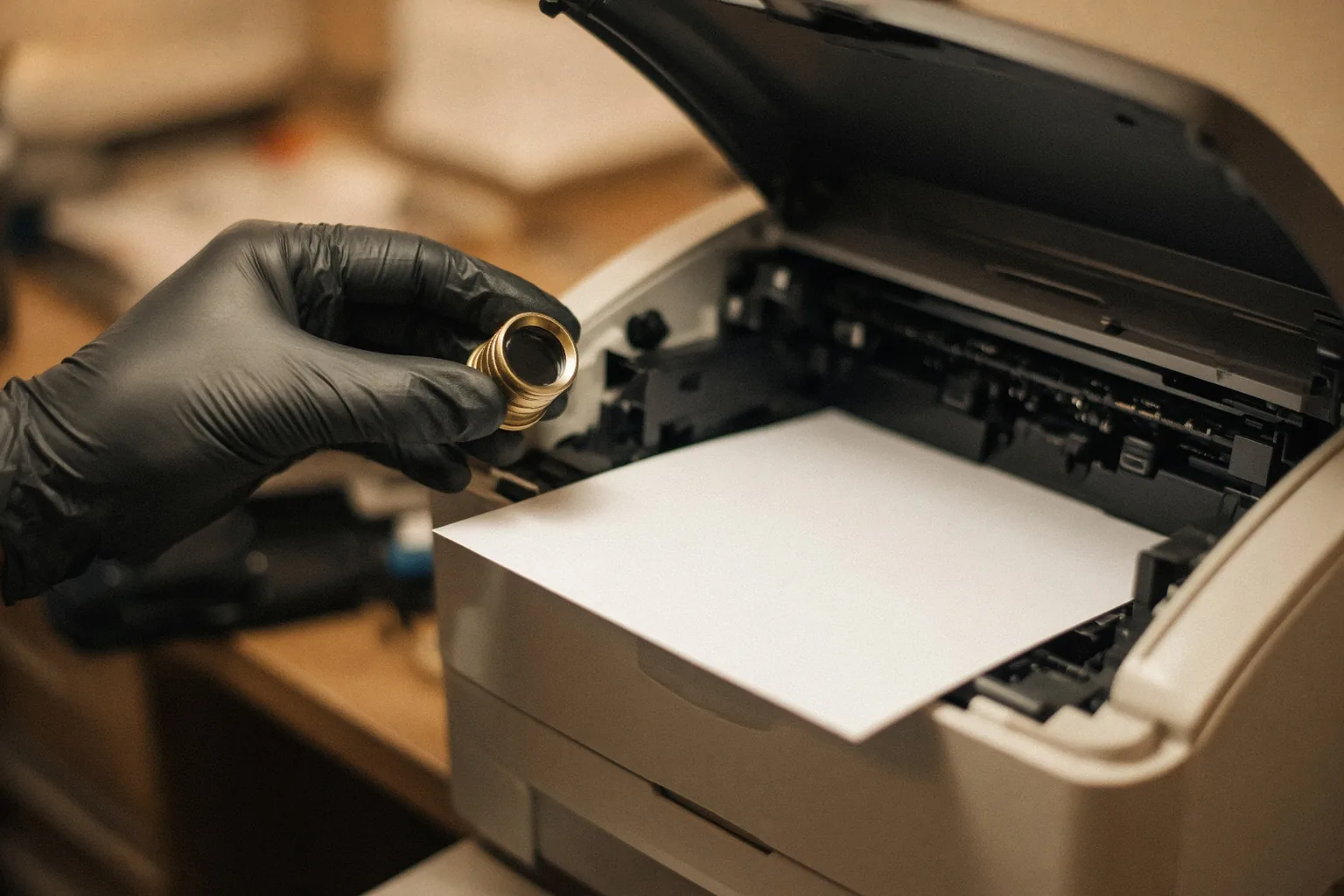
Can a forensic document examiner identify the printer that made a document?
Sometimes. The SWGDOC standards for toner and inkjet documents let an examiner decide whether two documents came from one device, whether a particular device made a document, or which make and model made it.
Two standards of the Scientific Working Group for Forensic Document Examination (SWGDOC), both version 2013-1 and both published on the NIST website, cover machine-printed documents. The Standard for Examination of Documents Produced with Toner Technology applies to "photocopiers, printers, facsimile devices, and multifunction devices using toner technology" (section 1.6). The Standard for Examination of Documents Produced with Liquid Ink Jet Technology covers the same four kinds of devices when they use inkjet technology. Section 4.1 of each standard names three questions an examiner can answer: whether documents came from the same device, whether a particular device created a document, and the make or model of the device.
The SWGDOC Standard for Scope of Work of Forensic Document Examiners lists among typical problems "The identification or elimination of the source of and the output of other mechanical or electronic imaging devices," naming "printers, copying machines, facsimile equipment, and the like" (section 4.2.1.2). ANSI/ASB Standard 011, Scope of Expertise in Forensic Document Examination (1st edition, 2022), lists "source(s) of machine-produced documents" among the key elements of the discipline.
The answer in a given case depends on what the device left on the page and on what the examiner can compare it with. Section 7.4 of the toner standard sorts the work into questioned-to-known comparisons, questioned-to-questioned comparisons and other examinations, such as dating or determining the class of machine. ASTM E2390-06, the earlier ASTM guide on toner documents, is listed on the ASTM store as withdrawn in 2015 with no replacement.
How does an examiner tell a laser print from an inkjet print?
By how the image was formed. Toner devices deposit dry or liquid toner through an electrostatic charge pattern, while inkjet devices place drops of fluid ink. Each SWGDOC standard begins by confirming which technology produced the page.
Under section 7.3 of the toner standard, the examiner first determines whether the questioned document was produced with toner technology; if it was not, the examiner discontinues that procedure and reports. The standard's definitions describe what is looked for. Dry toner is the material that forms the visible record when deposited by an electrostatic charge pattern (3.2.6). In dual-component development the dry toner is mixed with an iron oxide developer (3.2.7), and monocomponent development uses a single-component toner (3.2.22). Liquid toner consists of colorants or carbon suspended in a liquid carrier (3.2.19). The fuser roll is the heated roller that touches the paper and the toner directly (3.2.10), and the imaging drum is the photoreceptive drum of the transfer system (3.2.16).
The inkjet standard does the same in section 7.4. Its definitions separate drop-on-demand and continuous spray devices and, within them, piezoelectric and thermal impulse technologies (3.1.4, 3.1.7, 3.1.17, 3.1.26). It defines banding as uniform density variations or voids in a given color that run in the direction of printhead travel (3.2.1).
Typestyle is examined in both standards. Section 7.11.4 of the toner standard has the examiner identify typestyles where this may assist, for example in dating a document, and section 7.21 of the inkjet standard does the same. A font that a software vendor released after the date printed on a contract is a fact the examiner reports; the conclusion about when the contract was made is left to the court.
Which features point to a make or model?
Class characteristics that every machine of a type shares: paper type, supply system, toner or ink type, mechanical marks and color capability. Unexplained significant differences in them end the comparison with that device.
Section 7.11.5 of the toner standard gives the examples of class characteristics: paper type, paper supply system, toner type, marks caused by mechanics and color capability. If the comparison finds significant unexplained differences at this level, the examiner discontinues and reports. Section 7.22 of the inkjet standard lists ink type and marks caused by the mechanics of the device, and section 7.23 has the examiner classify the device and identify the manufacturer "if possible" with the help of reference resources.
A study presented at the 2010 meeting of the American Academy of Forensic Sciences (abstract J23, Jordan C. Brough) went one step further back. Brough examined whether the software used to print an inkjet document can be determined from its dot patterns under the microscope. In his blind test 70 percent of questioned documents were matched to the correct software and the other 30 percent were narrowed to two options, with no false associations or exclusions reported. His abstract notes that examiners are often able to determine which printer was used but usually cannot say which computer sent the file.
Class evidence narrows the field and does not name a machine. Two offices that bought the same model of laser printer produce pages with the same class characteristics, and only individual marks or embedded codes can separate them. The authors of a 2018 TU Dresden study of printed document forensics wrote in their abstract that, for methods based on intrinsic features, "In most cases, the identification rate only reaches up to the printer model."
Which marks can tie a page to one machine?
Defects acquired in use: wear and damage on the drum or other parts, misalignments, marks that repeat in fixed positions, voids and stray toner. Paper transport rollers and gears can leave their own traces on the sheet.
Section 7.11.6 of the toner standard lists individualizing characteristics: security features, wear and damage defects, misalignments, reproducible marks, voids and extraneous toner transfer. Section 7.11.6.1 deals with marks that recur in fixed positions relative to the edges of the sheet and notes that a mark may not appear on every page. The standard defines pitting as surface defects on the photoreceptor that produce spots or voids in the image (3.2.28), and section 7.10.1 has the examiner note damage on accessible internal parts such as the fuser rollers or the imaging drum.
S.M. Petrov of the Kaliningrad forensic laboratory of the Russian Ministry of Justice described the state of Russian practice in a 2021 article in Theory and Practice of Forensic Science (vol. 16, no. 2). The method in use there compares traces of photoreceptor drum defects. Other approaches, identification by hidden marks or by traces of the paper feed mechanism, had in his words no substantial influence on expert practice.
P.A. Chetverkin and A.V. Efimenko of the Moscow University of the Russian Interior Ministry described paper transport traces in the same journal in 2015 (no. 3, pp. 89-98). They distinguish traces resembling papillary patterns, for which, they write, 8-10 features are enough for a decision; dynamic traces left by the pick-up of the sheet near its edge; traces of gear wheels caused by displacement, play or breakage; and certain visible traces that usually stem from the operating features of a given device. Contamination traces from toner or ink have high identification value because they arise at random, but they do not last long. Their examples include an HP DeskJet 1000, a Kyocera KM-1635, a Samsung ML-2164, a Brother DCP-310CN and an Epson Stylus Photo R300.
What are printer tracking dots, and what do they reveal?
Patterns of small yellow dots that many color laser printers add to printed pages. The Xerox pattern holds a serial number, date and time; in the pattern HP uses, a 2018 study found only make and model.
Researchers at TU Dresden presented the paper Forensic Analysis and Anonymisation of Printed Documents at the 6th ACM Workshop on Information Hiding and Multimedia Security in 2018. Their abstract calls document colour tracking dots "an extrinsic signature embedded in nearly all modern colour laser printers." In the paper they presented the deda toolkit, which extracts, decodes and anonymises the dots and is published on GitHub. The deda documentation says the dots carry "information about the printer and/or the printout itself," such as the serial number, and warns that monochrome pages and inkjet prints might not contain tracking dots.
Peter Buck examined the codes in a 2018 forensics dissertation at Saxion University of Applied Sciences, Reverse Engineering the Machine Identification Code. He writes that the Xerox code, deciphered earlier by the Electronic Frontier Foundation, contains the time and date of printing and the serial number of the printer. In the pattern he calls Reverse-L, used by HP, Kyocera, Lexmark and Ricoh, he found the manufacturer and the printer model and no evidence of the date, the time or a serial number. The encoding of a third pattern, which he calls the Corner pattern, remained unknown.
Buck describes two ways to find the dots: under blue light the yellow dots appear dark and can be viewed with a magnifying glass, and on a high-resolution color scan they show in the blue channel once the red and green channels are removed. Because most patterns carry no date or time, the practical use he describes is to compare the pattern on the questioned page with the pattern printed by a suspect printer.
Section 7.11.6 of the SWGDOC toner standard lists security features among the individualizing characteristics, so a tracking pattern is examined together with the other marks rather than in place of them. A black-and-white page from a monochrome laser printer may carry no pattern at all.
Can software identify the printer from a scan of the page?
In research, only for printers in the training set. Purdue researchers classified pages from 10 laser printers by the texture of the letter e and got 9 right; a printer outside the set is assigned to a known one.
A Purdue University team (A.K. Mikkilineni, P.-J. Chiang, G.N. Ali, G.T.C. Chiu, J.P. Allebach and E.J. Delp) scanned printed pages at 2400 dpi, described every letter "e" by 22 features, 20 of them taken from the gray-level co-occurrence matrix, and classified each letter with a 5-nearest-neighbor classifier, then labelled each document by majority vote. With 10 laser printers, all but one, an Okidata 14e classified as a Minolta 1250W, were classified correctly by majority vote. The authors write in their conclusion: "If the unknown document was printed by a printer which is not included in the classifier training data set, then it will be mistakenly classified as one of the known printers." Their cross-font and cross-size tests gave mixed results.
S.M. Petrov wrote in 2021 that specialized programs for analysing a document image to identify the printing device were absent from Russian practice at that time. He proposed measuring print density on 1200 dpi scans with general tools, ImageJ for pixel values and Fourier analysis in Matlab for horizontal banding, and tested the approach on HP LaserJet 1005, 1010, 1102 and P2015, a Canon LBP 6310 and a Kyocera printer.
These limits matter under Federal Rule of Evidence 702, which requires the proponent to show that testimony "is the product of reliable principles and methods" and that the opinion applies them reliably to the case. A classifier trained on a closed set of printers can pick the closest printer in that set; it cannot exclude a printer it never saw.
What does the examiner need to compare the document with a printer?
The questioned original, the suspect device if it can be obtained, its service records, and pages known to have been printed on it near the questioned date. Without the device, known printouts of that period become the main material.
The SWGDOC toner standard describes the work with a suspect device. The examiner notes the device's condition, requests service records and records pertinent information (7.9); records its capabilities, settings and any internal memory and recovers stored information if possible (7.9.2); and notes debris on external parts such as the platen, the slit glass, collators and the document feeder (7.9.3). Note 2 asks the examiner to consider possible loss of evidence inside the device before taking exemplars, and section 7.9.1 suggests consulting a qualified technician. Exemplars are prepared to suit the device's features and any planned chemical examination of the toner (7.10).
Chetverkin and Efimenko recommend submitting the suspect device whenever possible, so that the examiner can test which features are stable. Experimental printouts are made on paper of different weight, structure and type, with different feed methods and different page fill, without contaminating the sheets. If the device cannot be submitted, the examiner needs comparison samples of undoubted origin that are representative and comparable, together with the period when the questioned document was supposedly made and free samples printed close to that date.
Section 5.3 of the toner standard notes that a multifunction device can print or copy at different resolutions, in color or monochrome, and that output varies across these modes. Known pages printed in the same mode as the questioned page are the closest comparison.
For a printer comparison the package can contain:
- The questioned document in the original; if only a copy exists, the best available reproduction and a note on where the original is.
- The suspect printer, copier or multifunction device, or access to it, with its model and serial number.
- Service records: dates of drum, fuser, roller and cartridge replacement.
- Pages printed on the device in the ordinary course of business before and after the questioned date, with proof of when they were printed.
- Other questioned documents that the other side says came from the same device.
- The questions the examiner is asked to answer.
Why can the marks change between the questioned date and the examination?
Because cartridges and parts are replaced and defects appear and disappear. The SWGDOC standards note that some toner and ink supplies are interchangeable and some are refillable, and contamination traces do not last long.
Note 3 to section 7.11.5 of the toner standard states that some toner supply units are interchangeable among different brands or models of machines and that some units are refillable. Section 5.5 of the inkjet standard says the same of ink supplies. A drum or cartridge that was replaced after the questioned date takes its defects with it, which is why section 7.9 asks for service records.
Chetverkin and Efimenko point out that traces of contamination by toner or ink do not last long, and that the absence of matching features does not prove that the documents came from different devices: the traces may simply not have survived. The questioned page and the known pages are therefore compared for the same period, and the report says which period the known material covers.
Storage and handling also change a page. Section 5.2 of the toner standard warns that prior storage, handling or chemical processing, such as work on latent fingerprints, can obscure features, and recommends examining the document before chemical processing where possible. The same section reminds the examiner that documents may have been manipulated or duplicated, including by computer. If the police or the other side plan to test the page for fingerprints, the order of examinations is agreed first.
How can a party get the other side's printer examined?
In federal civil cases, by a Rule 34 request to inspect, test or sample tangible things in the other party's control, or by a Rule 45 subpoena to a nonparty. The request must set a reasonable time, place and manner.
Rule 34(a)(1) of the Federal Rules of Civil Procedure lets a party serve on any other party a request "to produce and permit the requesting party or its representative to inspect, copy, test, or sample" items in the responding party's possession, custody or control, including "any designated tangible things" under (a)(1)(B). The committee note to the 2006 amendment explains the change: "The current rule is not clear that such testing or sampling is authorized; the amendment expressly permits it." Under Rule 34(b)(1)(B) the request "must specify a reasonable time, place, and manner for the inspection and for performing the related acts."
If the device cannot be moved, Rule 34(a)(2) covers entry onto designated land or other property possessed or controlled by the responding party so that the requesting party may "inspect, measure, survey, photograph, test, or sample the property or any designated object or operation on it." The examiner can then print test pages on site.
A printer owned by a nonparty, for example an employer or a print shop, is reached through Rule 34(c), which refers to Rule 45. Under Rule 45(a)(1)(A)(iii) a subpoena can command a person to produce tangible things in that person's possession, custody or control or to permit inspection of premises, and Rule 45(d)(1) requires the issuing party to take reasonable steps to avoid imposing undue burden or expense on that person.
Note 2 of the inkjet standard warns that collecting exemplars can destroy physical evidence inside the device, such as fragments torn from the questioned document. An inspection protocol agreed before the visit lists who attends, what is photographed before any test page is printed, which paper and modes are used and who keeps the printed exemplars.
Can a photocopy or a fax be traced to the machine that made it?
Yes, if the machine left marks. Both SWGDOC standards cover copiers, fax devices and multifunction devices, and debris on the copier glass or feeder, defect marks and repeated copying leave traces that can be compared.
Section 7.9.3 of the toner standard directs the examiner to the parts of a copier that touch the original: the platen, the slit glass, the collators and the document feeder. Dirt or scratches there can print on every copy in the same position. Note 4 to section 7.11.6.1 adds that copies made on more than one device usually show the distinctive marks of each machine, and that successive copying can cause misregistration.
Note 4 to section 7.24 of the inkjet standard states that a doubled or tripled pattern of dots or marks indicates two or three generations of copies made on the same machine. A page that carries marks of two machines, or a pattern repeated by copying, is evidence that it is a copy and not a first-generation print.
The device is one question and the file is another. Brough's 2010 abstract notes that examiners usually cannot say which computer sent a file to the printer. When the dispute is about which computer created or edited the document, the electronic file and its metadata go to a digital forensic examiner, and the printed page stays with the document examiner.
What conclusions can the report state?
Identification, elimination, a qualified opinion or no conclusion. Under section 8 of the SWGDOC standards, identification requires agreement in significant individualizing characteristics and no significant differences, and every limiting factor is explained.
Section 8 of both SWGDOC standards defines four outcomes. Identification fits when there are no significant differences and the documents agree in significant individualizing characteristics, possibly with limitations (8.3). Elimination fits when significant differences are found at any level of analysis, even if there are similarities (8.4). A qualified opinion is given when limiting factors exist and the similarities or differences are of limited significance, and the limiting factors must be explained (8.5). No conclusion is reported when significant limiting factors prevent a conclusion (8.6). The bases for each conclusion are documented (8.2).
Chetverkin and Efimenko take a similar line for paper transport traces. A categorical positive conclusion is possible only when the matching features are stable, significant and form an individualizing set, and a categorical negative conclusion when stable differences are established; in all other cases the examiner reports that the question cannot be resolved. They add that the forms of conclusions for this kind of examination need further research.
Rule 702 sets the outer limit in federal court. Since the 2023 amendment the proponent must show the court that it is more likely than not that the testimony "is based on sufficient facts or data" and that the opinion applies reliable principles and methods reliably. The committee note states that "each expert opinion must stay within the bounds of what can be concluded from a reliable application of the expert's basis and methodology" and that forensic experts should avoid assertions of absolute or one hundred percent certainty if the methodology is subjective.
What does IAE do when the printing of a document is disputed?
An examiner from the IAE registry prepares a report on your questions, including how the document was printed, or a review of the opposing examiner's report, in up to 5 business days after the format and cost are confirmed.
The IAE page on forensic document examination lists the questions the examiner answers: whether a page was inserted or replaced, an entry erased or overwritten, a stamp impression made by the stamp in question, and how the document was printed. Under ANSI/ASB Standard 011 (2022), the page states, the examiner compares and classifies documents produced by typewriters, fax machines, photocopiers, computer printers and commercial printing. The page also notes that the original is preferred because images and copying processes can mask physical characteristics of a document.
Send the questioned document or its best available copy, a description of the printer or copier and of the known pages you have, and the questions, through the form on the contact page or to info@iaexperts.com; the service page has a "Request a quote" button. IAE confirms the questions and the handling of the original with you before work starts. The secretariat confirms receipt the same day and, within one business day, the format, the cost, the deadline and the examiner from the registry; you approve the candidate and the CV. The document is issued in up to 5 business days after the format and cost are confirmed, and cases with tight deadlines have a 48-hour rush.
Registry members passed the collegial attestation of the council under the published Criteria Matrix, and the Member ID in the report can be checked by QR code. The examiner confirms in the document that he or she has no interest in the outcome, and materials are not passed to third parties without your consent. The court weighs the report with the other evidence; neither IAE nor the examiner guarantees the outcome, and IAE is not a law firm and does not advise on case strategy.
Sources
- SWGDOC Standard for Examination of Documents Produced with Toner Technology, ver. 2013-1 (NIST)
- SWGDOC Standard for Examination of Documents Produced with Liquid Ink Jet Technology, ver. 2013-1 (NIST)
- SWGDOC Standard for Scope of Work of Forensic Document Examiners, ver. 2013-1 (NIST)
- ANSI/ASB Standard 011, Scope of Expertise in Forensic Document Examination, 1st Ed., 2022, factsheet (AAFS)
- ASTM E2390-06, Standard Guide for Examination of Documents Produced with Toner Technology (Withdrawn 2015), ASTM store
- Forensic Analysis and Anonymisation of Printed Documents, 6th ACM Workshop on Information Hiding and Multimedia Security, 2018, DOI 10.1145/3206004.3206019 (CPS-VO record)
- TU Dresden, Document Forensics and Dots project page (deda toolkit)
- deda, tracking dots extraction, decoding and anonymisation toolkit (GitHub, TU Dresden)
- Buck P. Reverse Engineering the Machine Identification Code, Saxion University of Applied Sciences, 13 June 2018
- Mikkilineni A.K., Chiang P.-J., Ali G.N., Chiu G.T.C., Allebach J.P., Delp E.J. Printer Identification Based on Graylevel Co-occurrence Features for Security and Forensic Applications (Purdue University, CERIAS archive)
- Brough J.C. A Method for Determining the Software Used to Print a Questioned Inkjet Document Utilizing Microscopy and Computerized Imaging, AAFS 2010, abstract J23
- Petrov S.M. Using Quantitative Characteristics of Document Images to Identify Laser Printers, Theory and Practice of Forensic Science, 2021, vol. 16, no. 2, pp. 69-88 (CORE)
- Chetverkin P.A., Efimenko A.V. Identification of Office Equipment by Traces of Paper Transport Mechanisms, Theory and Practice of Forensic Science, 2015, no. 3 (39), pp. 89-98 (CORE)
- Federal Rules of Civil Procedure, Rule 34, Producing Documents, Electronically Stored Information, and Tangible Things, with Committee Notes (LII)
- Federal Rules of Civil Procedure, Rule 45, Subpoena (LII)
- Federal Rules of Evidence, Rule 702, Testimony by Expert Witnesses, with Committee Notes (LII)
Read also
All articles
What can you ask a forensic document examiner, and what should you send with the document?
A forensic document examiner answers questions about how a document was made and what was done to it afterwards: whether an entry was added, a page Sergei Voronin
Burned, soaked or torn: what can a document examiner recover from a damaged document?
A document that went through a fire, a flood or a shredder is often still readable in part. Forensic document examiners work with charredSergei Voronin
Same pen or a different pen: what can a document examiner tell from the ink?
A document examiner can often show that two entries were written with different inks, and that settles that two pens were used. The reverse isSergei VoroninExpert examinations
Ready to discuss your case?
Send the materials: the secretariat will confirm the format, cost, deadline and the specialist within one business day.
