
Examinations
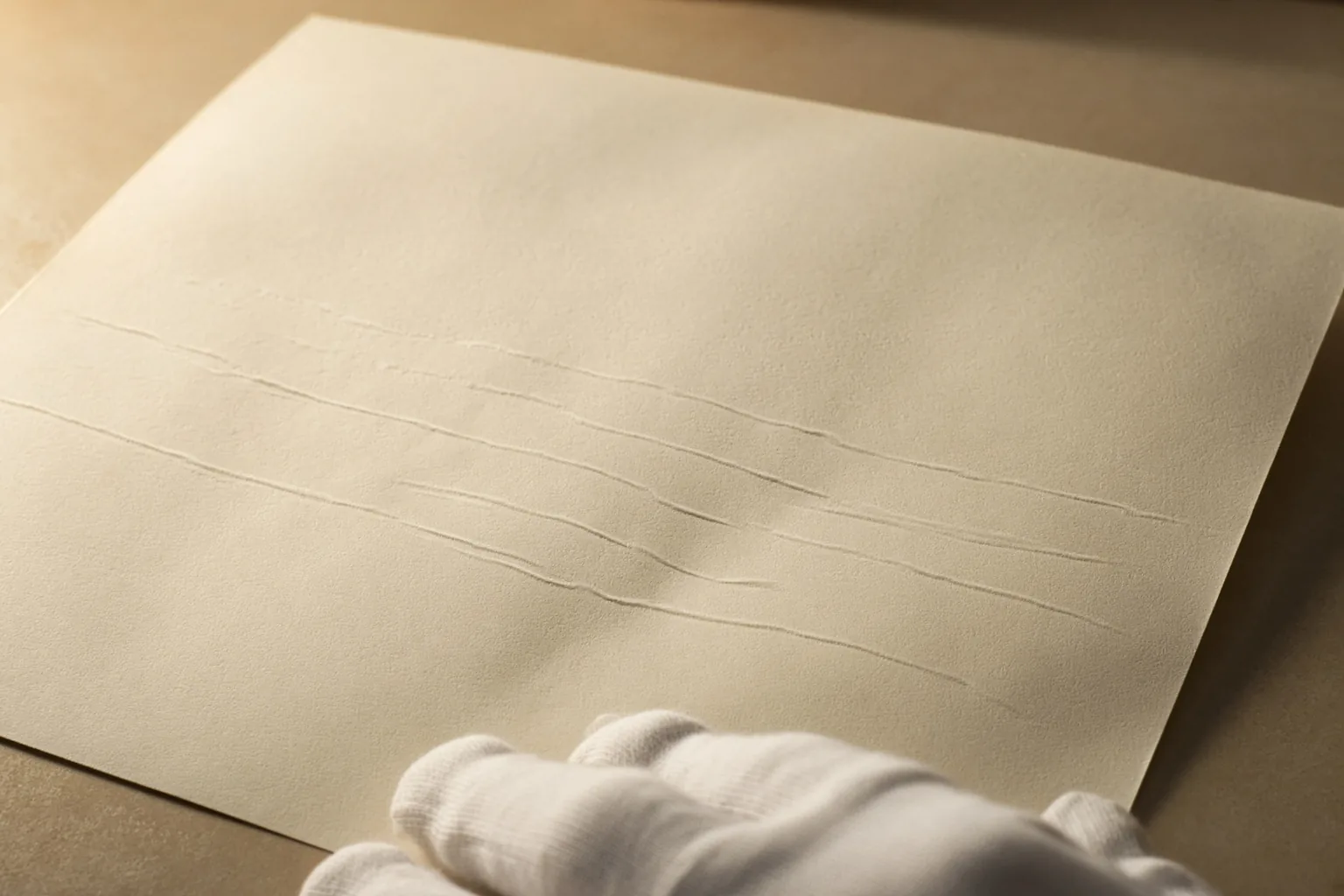
Indented writing: can an examiner read what was written on the sheet above?
Writing presses into the sheets underneath, and a document examiner can often make those invisible indentations readable with low-angle light and an electrostatic detection device. Impressions have been recovered through as many as seven layers of paper and on documents as old as 60 years. They can tie pages to one pad, show the order in which pages were written and reveal notes that never appear in ink, provided the page reaches the examiner before other tests and careless handling.
What is indented writing?
The depressed area on a sheet created by the pressure of writing on another sheet lying on top of it. The indentation carries no ink and is usually invisible in ordinary light.
A guide to questioned documents produced by the National Forensic Science Technology Center under a cooperative agreement with the Bureau of Justice Assistance defines indented writing as "The depressed area on the surface of a document that was created by the pressure of writing." The same guide notes that documents with no visible marks may contain valuable impression evidence if they were underneath other documents when the writing was done.
ANSI/ASB Standard 044, "Standard for Examination of Documents for Indentations" (first edition, 2019), treats indentations as one kind of paper fiber disturbance. According to the Academy Standards Board factsheet on the standard, such disturbances come from the pressure of a writing instrument, erasures, paper tears or contact with other items, and the standard may also apply to marks from fasteners, transport rollers and postal processing.
Detection and decipherment of alterations, obliterations and indentations is listed among the tasks of forensic document examiners in ANSI/ASB Standard 011 (2022), "Scope of Expertise in Forensic Document Examination."
Can indented writing be recovered, and how many sheets down?
Often, yes. The NFSTC guide reports impressions recovered through as many as seven layers of paper and on documents as old as 60 years, if the papers were not mishandled or improperly stored.
The figures come from the NFSTC guide: indented impressions have been recovered through as many as seven layers of paper, and impressions have been visualized on documents as old as 60 years where the papers had not been mishandled or improperly stored.
The limit sits in the same sentence: the figures hold for papers that were not mishandled or improperly stored. The ASB factsheet lists among the limits of Standard 044 that its techniques may not account for variables in how a document was created or handled before it was submitted, and may not cover unusual substrates.
A result therefore depends on the item. The factsheet says the number and type of examinations are flexible and depend on the item, the questions asked, the laboratory's policy and the examiner's judgment.
How does an examiner make indentations visible?
With light at a low angle to the page and with an electrostatic detection device. Standard 044 promotes both, because some indentations show up with one method and not the other.
The SWGDOC Standard for Examination of Altered Documents (version 2013-1) defines side lighting as "illumination from a light source that is at a low angle of incidence, or even parallel, to the surface of the item."
An electrostatic detection device is, in the same standard, "an instrument that uses electrostatic charge as the mechanism to visualize paper fiber disturbances." The NFSTC guide names the electrostatic detection apparatus, or ESDA, as the device most commonly used for document examinations and explains its principle: indented areas of the document carry less negative charge than the surrounding areas.
According to the ASB factsheet, Standard 044 promotes both optical and electrostatic methods because some indentations may not be visible with only one of them. A report that used only one method should say why.
What can indentations show in a dispute?
The text written on a sheet that is no longer there, links between documents or between a document and a person, the order in which pages were written, and information about a document's source and history.
The ASB factsheet lists the potential value of indentation examinations: creating graphic representations of indentations, associating documents with each other or with an individual, providing dating information, determining production sequence, and providing information about a document's source, production or history.
The NFSTC guide gives criminal examples: a bank robbery suspect may have written a hold-up note on top of another sheet, and in one case invisible impressions in a notebook revealed the robbery demand note.
Civil disputes use the same evidence differently. If a receipt dated in March carries the indentations of a letter written in June, the receipt was under the letter when the letter was written. If page 3 of a contract carries the indentations of the signatures written on page 4 and the replacement page 3 does not, the sequence of the sheets is in question. Each of these is a production sequence finding of the kind the standard describes, and each depends on the original sheets.
Why must the document be examined for indentations before other tests?
Because chemical and destructive processes can destroy fiber disturbances. Standard 044 promotes document examination before any chemical or destructive process, and the SWGDOC standard puts destructive tests last.
According to the ASB factsheet, Standard 044 promotes document examination before any chemical or destructive process and discusses coordination with other forensic disciplines.
The SWGDOC standard for altered documents states that examinations should, whenever possible, be conducted before chemical processing (section 5.3). Its procedure lists electrostatic processing (section 7.9) before the decision on destructive examinations (7.12), and section 7.13 says destructive examinations should be performed only after non-destructive methods have been exhausted, with the item documented first (7.13.3) and the submitter consulted (7.13.2).
In a civil case the order is set by agreement or by the court. A protocol for inspecting the original can name the indentation examination as the first step, before any ink sampling or other testing.
What can destroy indentations before the examination?
Handling, writing on the document or on paper laid over it, pressing it flat under other papers, and improper storage. Copies carry none of the evidence, so only the original sheet is useful.
The NFSTC guide ties the age figures to documents that were not mishandled or improperly stored, and the ASB factsheet names handling before submission as a variable the techniques may not account for. A sheet that has been written on, rubbed or pressed under a stack has new fiber disturbances on top of the old ones.
Practical steps follow from that. Keep the original flat in a clean folder, do not write notes on it or on paper on top of it, and do not stamp or mark it. Record who handled the document and when.
A copy cannot replace the sheet. The NFSTC guide lists non-original evidence such as photocopies or faxes among the limits of document examination and notes that every copying process loses a small amount of information. Indentations are a property of the paper itself, and a copier or scanner does not record them as such.
Who should examine a document for indentations?
A forensic document examiner trained in the procedures and the equipment. Standard 011 places indentations within the scope of the discipline, and Standard 044 is written for practitioners with appropriate training.
The ASB factsheet on Standard 044 says the standard can be used by any forensic practitioner with appropriate training in forensic document examination. The factsheet on Standard 011 says the skills of the discipline are learned through a "structured, documented, and systematic apprenticeship program of workplace-supervised learning", supported by continuing professional development.
Standard 044 includes requirements for documenting the examinations and observations, so the examiner's file should show the equipment used and the images that recorded each result.
What should an indentation report contain?
The item examined, the methods and equipment used, what was observed with each method, the images or lifts that record it, the text deciphered and the limits of the result, including what could not be read.
According to the ASB factsheet, Standard 044 includes requirements for documenting the examinations and observations and for the information to include in a report. The SWGDOC altered documents standard requires the item to be documented before destructive techniques are used (section 7.13.3).
The report keeps two kinds of statements apart: what is visible on the image and how the examiner reads it. A partly legible line, a word read from three letters, a date read from two digits are interpretations, and the report should say so. Negative results are results too: if no indentations were found, the report says which methods were used to look for them.
What does IAE do when indentations may answer a question about a document?
An examiner from the IAE registry prepares a report on your questions about the document, including inserted or replaced pages, or a review of the opposing examiner's report, in up to 5 business days.
The IAE forensic document examination page lists the questions the examiner answers: whether a page was inserted or replaced, an entry erased or overwritten, a stamp impression made by the stamp in question, and how the document was printed. Erasures, additions, overwriting and inserted or substituted pages are examined under ANSI/ASB Standard 035 (2020) with side lighting, UV light and infrared methods. IAE frames the questions around the document and the part of it in dispute and confirms the handling of the original with you before work starts.
Send the case materials through the form on the contact page and describe the task. The secretariat confirms receipt the same day and, within one business day, the format, the cost, the deadline and the examiner from the registry; you approve the candidate and the CV before work starts. The document is issued in up to 5 business days after the format and cost are confirmed, and cases with tight deadlines have a 48-hour rush.
Registry members passed the collegial attestation of the council under the published Criteria Matrix, and the Member ID in the report can be checked by QR code. The examiner confirms in the document that he or she has no interest in the outcome, and materials are not passed to third parties without your consent. The court weighs the report with the other evidence; neither IAE nor the examiner guarantees the outcome, and IAE is not a law firm.
Sources
- ANSI/ASB Standard 044, Standard for Examination of Documents for Indentations, First Edition 2019, factsheet (AAFS Academy Standards Board)
- ANSI/ASB Standard 044, Standard for Examination of Documents for Indentations (AAFS)
- National Forensic Science Technology Center, A Simplified Guide to Forensic Document Examination
- SWGDOC Standard for Examination of Altered Documents, version 2013-1
- ANSI/ASB Standard 011, Scope of Expertise in Forensic Document Examination, 2022, factsheet (AAFS Academy Standards Board)
Read also
All articles

What can you ask a forensic document examiner, and what should you send with the document?
A forensic document examiner answers questions about how a document was made and what was done to it afterwards: whether an entry was added, a page Sergei Voronin

Burned, soaked or torn: what can a document examiner recover from a damaged document?
A document that went through a fire, a flood or a shredder is often still readable in part. Forensic document examiners work with charredSergei Voronin
Same pen or a different pen: what can a document examiner tell from the ink?
A document examiner can often show that two entries were written with different inks, and that settles that two pens were used. The reverse isSergei VoroninExpert examinations
Ready to discuss your case?
Send the materials: the secretariat will confirm the format, cost, deadline and the specialist within one business day.
