
Expert witnesses
Machine guarding expert witness: what does the engineer examine when a worker is hurt by an unguarded machine?
When a worker is hurt at the point of operation of a machine, the case usually turns on the guard: how the machine was designed to keep hands out of the danger zone, whether the guard was on it, who removed it and what the machine told the operator. A machine guarding expert examines those facts against OSHA's general machine guarding rule, 29 CFR 1910.212, and the design and warnings of the machine.
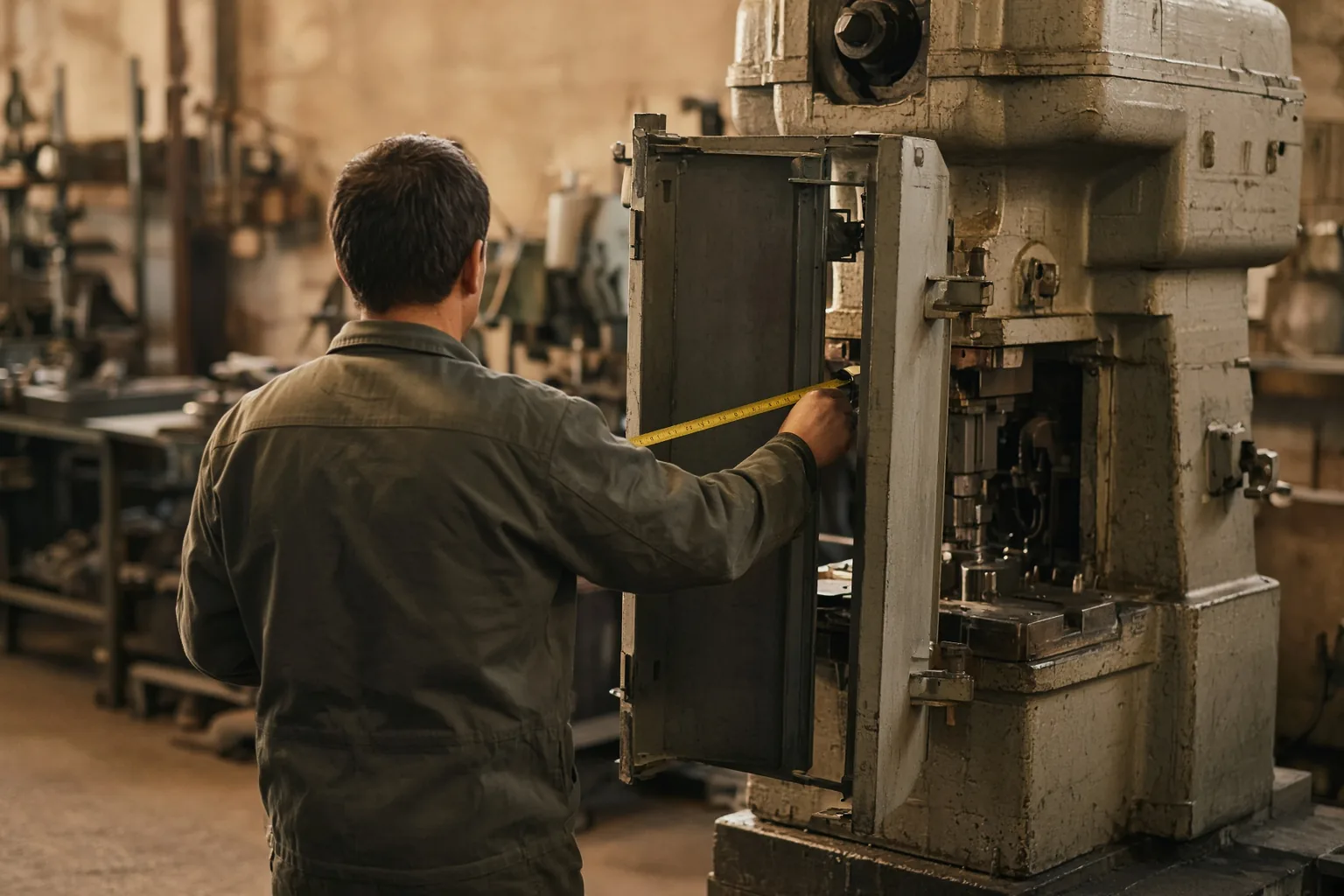
What does a machine guarding expert witness do?
Examines the machine, its point of operation and its guard, reconstructs how the injury happened, determines whether the guard was present, removed or defeated, and evaluates the design and the warnings against the standards for that machine.
Machine injuries happen where the machine works on the material: the blade of a saw, the die of a press, the auger of a grinder, the rollers of a conveyor. The expert, usually a mechanical or safety engineer, examines that area on the actual machine or an exemplar, measures openings and reach distances, and reconstructs the operator's position at the moment of injury.
The guard is the central object. The expert determines what guard the machine had when it left the manufacturer, whether it was fixed or removable, whether it had an interlock that stops the machine when the guard is opened, whether it was on the machine at the time of injury and, if not, when and by whom it was taken off. Maintenance records, purchase records for replacement parts, photographs and testimony of coworkers carry that history.
The warnings come next: what labels the machine carried, what the manual said about the guard, and whether the manufacturer issued later warnings or offered guard kits. In the case discussed below, the manufacturer's knowledge that guards were being removed became the basis of a failure to warn claim that survived a substantial modification defense.
What does OSHA require for machine guarding?
Section 1910.212 requires guarding that protects the operator and other employees from point of operation hazards, guards affixed to the machine where possible, and guards that keep the body out of the danger zone.
Under 29 CFR 1910.212(a)(1), "One or more methods of machine guarding shall be provided to protect the operator and other employees in the machine area from hazards such as those created by point of operation" and the other hazards the section names. The section lists barrier guards, two-hand tripping devices and electronic safety devices as examples. Under (a)(2), "Guards shall be affixed to the machine where possible," and "The guard shall be such that it does not offer an accident hazard in itself."
Subsection (a)(3)(i) defines the area at issue: "Point of operation is the area on a machine where work is actually performed upon the material being processed." Subsection (a)(3)(ii) states: "The point of operation of machines whose operation exposes an employee to injury, shall be guarded." Where no specific standard applies, the guarding device "shall be so designed and constructed as to prevent the operator from having any part of his body in the danger zone during the operating cycle."
Subsection (a)(3)(iii) adds that special hand tools for placing and removing material must permit easy handling of material "without the operator placing a hand in the danger zone," and the section treats such tools as a supplement to guarding, not a replacement. The rule speaks of protecting the operator and other employees, so it describes what the workplace must have; in a suit against the manufacturer, experts use it as a measure of the guarding the machine needed.
What if the employer removed the guard?
In New York the substantial modification rule of Robinson v. Reed-Prentice bars a design defect claim when a third party's alteration caused the injury. A failure to warn claim may still go forward, as Liriano v. Hobart held in 1998.
The New York Court of Appeals restated the rule in Liriano v. Hobart Corp., decided August 31, 1998: "A manufacturer is not liable for injuries caused by substantial alterations to the product by a third party." The rule comes from Robinson v. Reed-Prentice, and it is the usual defense when an employer has taken the guard off a machine.
The facts of Liriano are typical of these cases. Luis Liriano, seventeen, worked in the meat department of Super Associated, a grocery store. In September 1993, while he was feeding meat into a commercial meat grinder with its safety guard removed, his right hand and lower forearm were amputated. Hobart Corporation had made and sold the grinder with an affixed safety guard and without warnings. The guard was intact when Super acquired the grinder and was removed while the grinder was in Super's possession. Hobart knew before the accident that guards were being removed.
For the expert, the modification question is factual: what the machine looked like when it left the manufacturer, what it looked like at the time of injury, who changed it and when. The answer decides whether the design claim survives, and it also feeds the warning claim that Liriano allowed.
Can the manufacturer be liable for failing to warn even if the guard was removed?
Yes, in New York. The Court of Appeals answered a certified question from the Second Circuit that manufacturer liability may exist on a failure to warn theory where the substantial modification defense would bar a design claim.
The Second Circuit asked whether a manufacturer can be liable for failure to warn where the substantial modification defense would preclude a design defect claim. The Court of Appeals, in an opinion by Judge Ciparick, answered yes: "manufacturer liability for failure to warn may exist in cases where the substantial modification defense would preclude liability on a design defect theory." It declined to decide whether liability was barred on the facts, calling that an intensely fact-specific question for the federal court.
The court explained why warnings differ from design. "These concerns are not as strongly implicated in the context of a duty to warn," it wrote, and "it is neither infeasible nor onerous, in some cases, to warn of the dangers of foreseeable modifications." It pointed to "a manufacturer's unique (and superior) position to follow the use and adaptation of its product by consumers," and added: "No material distinction between foreseeable misuse and foreseeable alteration of a product is evident in this context."
The court also noted the limit: a warning may be unnecessary where the injured person "was fully aware of the hazard," though where "reasonable minds might disagree" the question usually goes to the jury. The expert evidence on what the operator knew, what the machine displayed and what the manufacturer knew about guard removal goes to that question.
Does a manufacturer have to warn about a danger as obvious as a meat grinder?
It may. In Liriano (2d Cir. 1999) the court held that the duty to warn is not necessarily removed because a danger is clear: a warning can tell users that guards exist and must be used.
After the Court of Appeals answered, the Second Circuit decided the case on March 9, 1999. It called the sufficiency question "a close one" and resolved it against Hobart, holding that Hobart could not be declared free of a duty to warn as a matter of law. The duty to warn, the court wrote, "is not necessarily obviated merely because a danger is clear."
The court explained what a warning adds. Even if most users know grinders are dangerous, a jury could find that many do not know that guards exist, that they are available, or that the grinder should be used only with them, and a reasonable manufacturer "may have a duty to convey" those facts. On causation, Hobart argued there was no evidence a warning would have changed Liriano's conduct. The court held that because Hobart's negligence tended to cause this kind of injury, "that very causal tendency is evidence enough to establish a prima facie case of cause-in-fact," and the burden shifted to Hobart to rebut it.
For a warnings expert, this sets the content of the opinion. The question is whether the machine should have said it was dangerous, and also whether it should have said that a guard existed, where to get one and that the machine must not run without it. A warnings opinion of that kind is tied to the specific machine and its guard.
How is fault divided between the manufacturer and the employer?
By the jury, on the evidence of who did what. In Liriano the first jury assigned 5 percent of the fault to Hobart and 95 percent to the employer; after a partial retrial the plaintiff was assigned one third.
At the first trial in Liriano the jury assigned 5 percent of the fault to Hobart and 95 percent to Super, the employer that removed the guard. After a partial retrial, the jury assigned Liriano himself one third of the fault. The Second Circuit declined to require a new trial of the split between the two defendants, finding the district court's allocation "amply supported by the record," and affirmed the judgment for Liriano.
Those numbers show what the fault allocation rests on. The employer's share follows from the removal of the guard and from training and supervision. The manufacturer's share follows from the warning it did not give although it knew that guards were being removed. The operator's share follows from what he knew and did. Each share needs facts, and most of them come from the engineer's reconstruction of the machine's history.
Workplace records matter for that reason. Who ordered the guard removed, when it was last seen on the machine, whether replacement guards were ever ordered, what training the operator received, and whether the employer received any warnings or retrofit offers from the manufacturer are facts the expert collects before forming opinions.
What does the engineer examine on the machine and in the records?
The point of operation and its danger zone, the original and current guarding, signs of guard removal or defeat, interlocks, labels and manuals, the manufacturer's later warnings and retrofits, and the employer's maintenance and training records.
On the machine, the engineer documents the point of operation as defined in 1910.212(a)(3)(i), measures openings and reach distances to the danger zone, and identifies the guard design the machine was built with. Mounting holes without bolts, cut brackets, bypassed interlock switches and tool marks show whether a guard was removed and how. The engineer photographs and records the machine before any disassembly.
In the manufacturer's records, the engineer looks for the design of the guard at the time of sale, changes to the guard in later models, field reports of guard removal, warning labels and manual versions, and any retrofit programs. In Liriano, Hobart's knowledge that guards were being removed was part of the record the courts relied on.
In the employer's records, the engineer looks for maintenance logs, parts orders, safety inspections, training materials and any OSHA inspection history. The engineer's report separates the facts about the machine as sold from the facts about the machine as used, because the substantial modification defense and the warning claim turn on that line.
How does IAE find a machine guarding expert?
In the request choose Product liability and name the machine, its maker, the point of operation and whether the guard was present. Within 5 business days IAE sends 2-3 candidates with CVs, rates and prior testimony.
The product liability expert witness page covers defects in vehicles, medical devices, consumer products and industrial equipment and lists 8 specialties, among them product design, failure analysis, human factors, and warnings and instructions. IAE chooses the specialty by the defect theory the firm needs to prove, so the request should say whether the claim is design, warning or both.
The request form asks for the field, the case type, the state and court, the firm's side, the expert disclosure deadline and the parties with their counsel. The form asks not to include privileged or sealed information. Within 1 business day IAE replies whether it can search in that field by the deadline. Each candidate confirms in writing that he or she has no ties to the parties or their counsel.
Within 5 business days the firm receives 2-3 candidates with CVs, hourly rates, testimony in the last 4 years and publications in the last 10 years. Candidate names and CVs come after the $2,000 search fee is paid in advance. If no candidate fits, the second search is free, and if IAE finds no candidates, it refunds the fee. The expert's hourly rate never depends on the outcome of the case or on the content of testimony. IAE is not a law firm; case strategy and the decision to retain an expert stay with the attorney.
Sources
Read also
All articles

State of the art defense in product liability: what must the manufacturer's expert prove about the technology available when the product was made?
The state of the art defense asks what a manufacturer could have known and built on the day the product left its hands, not on the day of the injury Sergei Voronin

Toy injury expert witness: small parts, age grading and ASTM F963 in a children's product case
A toy injury case usually turns on a short list of questions: was the toy meant for a child under three, did any part fit inside the federal smallSergei Voronin
General vs specific causation: which experts does a drug or toxic exposure case need?
In a drug or toxic exposure case the plaintiff proves causation twice. General causation asks whether the substance can cause this kind of injurySergei VoroninExpert witnesses
Need an expert witness for your case?
Describe the question, the case type and the court. Within 5 business days you receive 2-3 candidates with CVs, hourly rates and lists of prior testimony.
