
Examinations
How do you prove that a signature is forged?
A forged signature is proven by comparison: the questioned signature against genuine signatures of the same person from the same period, examined on the original document. Rule 901 of the Federal Rules of Evidence lets an expert or the jury make that comparison with an authenticated specimen. ANSI/ASB Standard 070 lists what an examiner looks for, among them slow writing, guide lines and unnatural similarity between questioned signatures.
What should you do first if you believe your signature was forged?
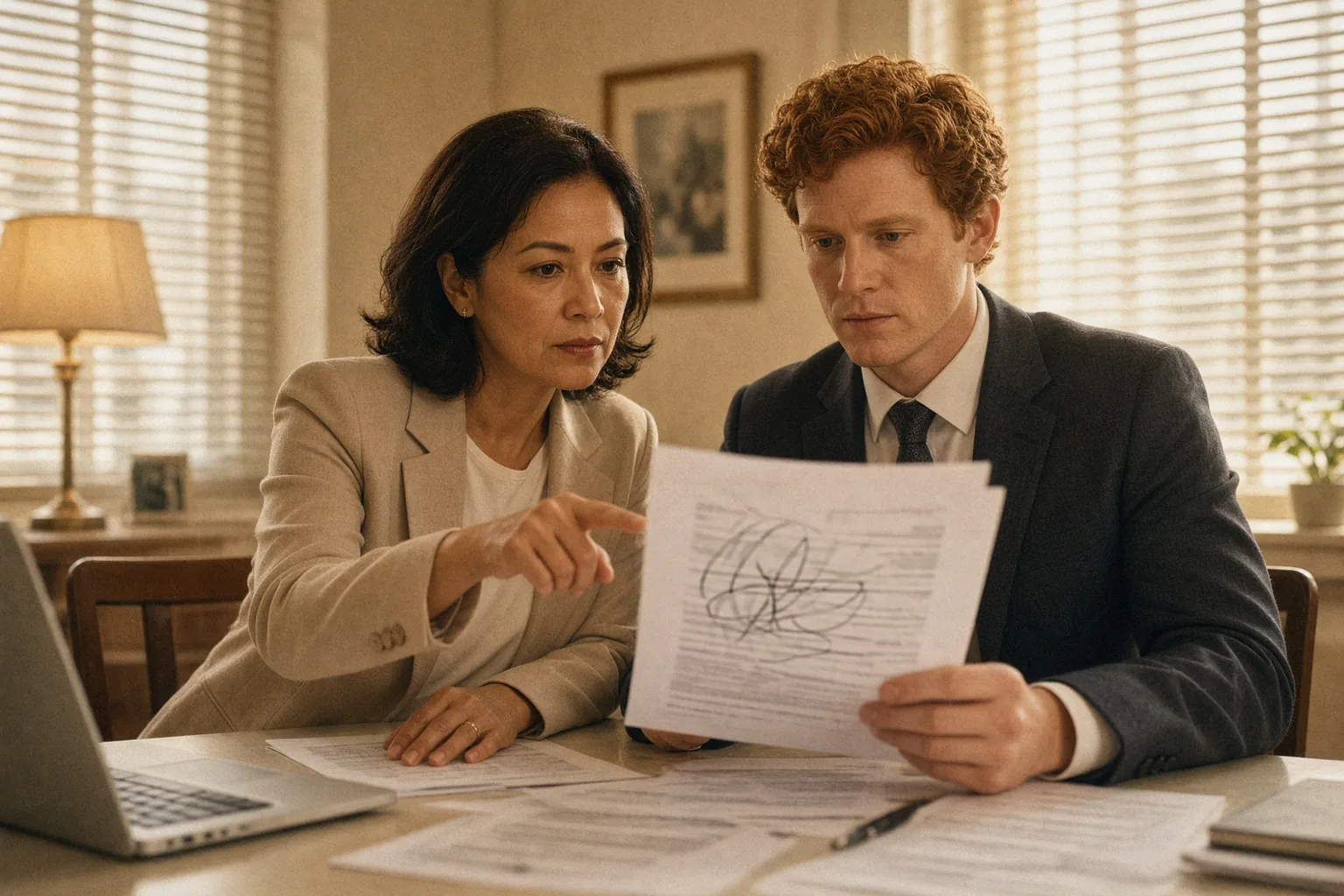
Secure the original document or find out who holds it, collect genuine signatures from about the same period, and deny the signature specifically in the pleadings if the document is a negotiable instrument.
The original carries the evidence a copy loses. ANSI/ASB Standard 070, an American National Standard for examining handwritten items approved in October 2022, says in its note to section 6.3.2 that "examination of the original writing is preferable" because reproductions can hide guide lines, pressure, stroke sequence and erasures. If the other side holds the original, a request for production or a subpoena brings it into the case.
Genuine signatures written in the ordinary course of life are the second step: signed leases, tax returns, bank signature cards, checks, employment papers, letters. Standard 070 calls these specimens "written in the normal course of business" and distinguishes them from samples written at request for comparison. Signatures from about the same period as the questioned one matter, because the standard notes that a lack of contemporaneous writings can hamper the assessment of differences.
For checks and promissory notes, the pleadings decide whether the signature is in issue. Under UCC § 3-308(a), in an action on an instrument the authenticity of each signature "is admitted unless specifically denied in the pleadings." A general denial of the claim does not put the signature in issue.
Who has to prove that the signature is genuine or forged?
The party relying on the document has to authenticate it under Rule 901. On negotiable instruments, once a signature is specifically denied, UCC § 3-308(a) puts the burden of proving validity on the person claiming it.
Rule 901(a) requires the proponent of an item of evidence to "produce evidence sufficient to support a finding that the item is what the proponent claims it is." A contract offered as signed by the defendant must be supported by evidence that the defendant signed it. The person who says the signature is forged answers with contrary evidence, and a handwriting examiner's report is one form of that evidence.
For instruments, UCC § 3-308(a) sets a more detailed rule. If the validity of a signature is denied in the pleadings, "the burden of establishing validity is on the person claiming validity." The signature is still presumed authentic and authorized unless the action is to enforce the liability of a purported signer who is dead or incompetent at the time of trial. Each state enacts the UCC through its own statute, so the state's version of section 3-308 controls.
Both sides can bring handwriting evidence. The party relying on the signature brings witnesses who know the handwriting or an examiner who compared it with genuine samples; the party denying it brings its own examiner or a review of the other side's report.
What evidence can authenticate or disprove a signature?
Testimony of a witness familiar with the handwriting, comparison with authenticated specimens by an expert or by the jury, and circumstantial evidence about how and when the document was signed.
Rule 901(b) lists examples of evidence that satisfies the authentication requirement. Item (2) accepts "a nonexpert's opinion that handwriting is genuine, based on a familiarity with it that was not acquired for the current litigation." A business partner or a relative who has watched the person sign for years can give that opinion. Item (3) accepts "a comparison with an authenticated specimen by an expert witness or the trier of fact."
Federal law adds a rule on the specimens themselves: under 28 U.S.C. § 1731, "the admitted or proved handwriting of any person shall be admissible, for purposes of comparison, to determine genuineness of other handwriting attributed to such person." Every known signature used for comparison has to be admitted by the person or proved by other evidence.
Circumstances count as well. Where was the person on the date of signing? Who prepared the document, who was present, and was a notary involved? Do the signature and the text show different inks or a different order of execution? Those questions go to witnesses, records and, for the document itself, to a document examiner.
What does a handwriting examiner look for in a forged signature?
Signs of slow execution, such as pen lifts, stops, hesitations and patching, guide lines left by tracing, unnatural similarity among several questioned signatures, and features never seen in the person's genuine signatures.
Standard 070 lists indicators of slow writing in section 6.3.6: "lifts, stops, and hesitations of the writing instrument," patching and unvaried pressure. The note to the same section lists varied pen pressure and tapered beginning and ending strokes among the features that may indicate rapid execution. Section 6.3.8 has the examiner check for guide lines or sister lines, for slow execution that suggests simulation or tracing, and for unnatural similarity among multiple questioned items.
The note to 6.3.8 adds a warning: "Some handwritten simulations and tracings might not display significant characteristics of slow execution." A fluent forgery is possible, so the examiner compares form, proportions, connections and movement with the genuine samples as well as checking line quality. Section 6.3.7 covers distortion, which "can be attributable to internal or external factors and can be intentional", for example illness, an awkward writing position or deliberate disguise by the signer.
Under section 6.5.5, a dissimilarity is a feature absent from all the known specimens. A feature that appears in even one genuine specimen is within the writer's repertoire and cannot be counted as a difference. Under 6.8.1 no conclusion rests on a single characteristic.
Which genuine signatures should you collect, and how many?
As many as possible of the same kind of signature from about the same period, from documents whose origin is not disputed. The Florida Department of Law Enforcement suggests 25 or more known signatures for a questioned signature.
Standard 070 lists the features that limit comparability: the type of writing, writings that are not contemporaneous, text content, capture methods, writing instruments and surfaces (6.5.2.1). A full signature on a contract compares poorly with initials on a delivery slip, and a signature from 2010 compares poorly with one from 2025. If comparable known writing is missing, the examiner asks for more (6.5.2.3).
Answering how many known writings are needed, the Florida Department of Law Enforcement suggests "25+ of the questioned signature with strong hand, 1 weak hand" and the same amount of the questioned text for questioned checks.
Standard 070 warns that "known specimens solely collected by a stakeholder may not" cover a writer's full range of variation (6.4.3(c)). A set chosen only by the party who wants a particular answer invites the objection that it omits signatures that look like the questioned one. If the known samples contain inconsistencies that suggest more than one writer, the examiner asks the submitter to authenticate them and, if the question stays unresolved, discontinues work on the affected group (6.4.3(b)).
Can forgery be proven from a photocopy or a scan?
Sometimes, with limits. Standard 070 has the examiner request the original and stop if the reproduction is not clear enough, and Rule 1003 lets a court require the original when its authenticity is genuinely disputed.
Section 6.3.2 of Standard 070 reads: "If it is not original writing, request the original." If no original is submitted, the examiner decides whether the copy is clear enough for the analysis and, if not, discontinues and reports. A copy loses the features that reveal tracing: indentations from a guide, pencil traces under ink, pressure and stroke order.
The Florida Department of Law Enforcement accepts machine copies of questioned or known documents but tells submitters that "Ideally, the original will be the BEST evidence" and that "when originals can be obtained, they should be submitted." A report written from a copy states that limitation.
Rule 1003 admits a duplicate "to the same extent as the original unless a genuine question is raised about the original's authenticity or the circumstances make it unfair to admit the duplicate." A claim that the signature on the original is forged raises that question, and the party making it asks the court to order production of the original for examination.
Can the examiner tell who forged the signature?
Not always. Who wrote a simulation is a separate question from whether the named person signed. Standard 070 directs follow-up work, including whether the model signature is among the submitted writings.
A traced forgery is copied from a real signature. Section 6.5.6 of Standard 070 covers follow-up examinations, among them whether the model used for the simulation or tracing is among the submitted writings. If a genuine signature on another document matches the questioned one in size and shape too closely, that document may be the model.
Naming the forger is a separate question from proving that the named person did not sign. The SWGDOC terminology for document examiners reports conclusions on nine levels between identification and elimination. Standard 070 requires a conclusion for each set of comparisons (6.6), so the comparison with the purported signer and the comparison with a suspected forger get separate conclusions, and the second can be weaker or inconclusive while the first is strong.
Courts limit how examiners state identity conclusions. In United States v. Hidalgo (D. Ariz. 2002) the court barred the examiner from testifying that the maker of the known writing was the maker of the questioned writing and let the examiner describe similarities and differences for the jury to weigh.
How will the court test the handwriting evidence?
Under Rule 702 the party offering the examiner must show that each opinion more likely than not rests on sufficient facts or data and a reliable method reliably applied. Federal courts have admitted, limited and excluded handwriting opinions.
Rule 702 as amended effective December 1, 2023 puts this burden on the proponent. The committee note adds that forensic experts "should avoid assertions of absolute or one hundred percent certainty" if the methodology is subjective and thus potentially subject to error.
In United States v. Prime (W.D. Wash. 2002) the court admitted an examiner's testimony and conclusions. In Almeciga v. Center for Investigative Reporting (S.D.N.Y. 2016) Judge Rakoff excluded a forgery opinion, citing the lack of studies on the reliability of examiners' authorship techniques, error rates he found too high for the task, a subjective method and counsel's statement to the examiner that the release was forged.
A party proving forgery prepares for that test from the start: originals, enough authenticated samples, an examiner who documents each step of Standard 070, and no instructions to the examiner about the answer the client expects.
What does IAE do when a signature is disputed?
An IAE examiner prepares a report on whether the named person signed and whether the signature shows signs of simulation or tracing, or reviews the opposing examiner's report. The document is issued in up to 5 business days.
The handwriting and signatures page covers wills, contracts and checks. Under Standard 070 the examiner checks whether questioned and known writing are originals and comparable, then weighs similarities and differences together. For simulation and tracing the examiner looks for slow writing, guide lines and unnatural similarity between questioned signatures. The questions are framed around the questioned signature or entry and the known writing the client has.
The client sends the questioned document or its best copy, the known signatures with their sources and, where there is one, the opposing report, and describes the task. The secretariat confirms receipt the same day. Within one business day IAE confirms the format, the cost, the deadline and the specialist from its registry, and the client approves the candidate and the CV before work starts. The signed PDF is issued in up to 5 business days after the format and cost are confirmed, with a 48-hour rush for tight deadlines.
Every specialist is a member of the public IAE registry, can be verified by Member ID or QR code and confirms in the document that he or she has no interest in the outcome. A report is evidence that the court weighs with the rest of the record. Neither IAE nor the examiner guarantees the outcome, and IAE is not a law firm and does not advise on case strategy.
Sources
- ANSI/ASB Standard 070, Standard for Examination of Handwritten Items, First Edition, 2022 (AAFS Standards Board)
- Florida Department of Law Enforcement, Document Examination submission FAQ
- Federal Rules of Evidence, Rule 901, Authenticating or Identifying Evidence (LII)
- Federal Rules of Evidence, Rule 1003, Admissibility of Duplicates (LII)
- 28 U.S. Code § 1731, Handwriting (LII)
- Uniform Commercial Code § 3-308, Proof of Signatures and Status as Holder in Due Course (LII)
- SWGDOC Standard Terminology for Expressing Conclusions of Forensic Document Examiners (NIST)
- Federal Rules of Evidence, Rule 702, Testimony by Expert Witnesses, with Committee Notes (LII)
- United States v. Hidalgo, 229 F. Supp. 2d 961 (D. Ariz. 2002) (Justia)
- United States v. Prime, 220 F. Supp. 2d 1203 (W.D. Wash. 2002) (Justia)
- Almeciga v. Center for Investigative Reporting, Inc., 185 F. Supp. 3d 401 (S.D.N.Y. 2016) (Temple University Beasley School of Law copy)
Read also
All articles
Can a notarized signature be challenged as forged, and what does the handwriting examiner have to show?
A notary's stamp does not make a signature unchallengeable, but it changes the proof. In New York a certificate of acknowledgment raises Sergei Voronin
Block capitals: can a handwriting expert identify who hand printed a note or a form?
Anonymous notes, address labels and filled-in forms are often written in block capitals, and the writer may expect capitals to hide his or herSergei Voronin
Signed on a signature pad: can a handwriting expert examine an electronic handwritten signature?
A signature written with a stylus on a pad or tablet is still handwriting, and a handwriting examiner can compare it with known signatures. The imageSergei VoroninExpert examinations
Ready to discuss your case?
Send the materials: the secretariat will confirm the format, cost, deadline and the specialist within one business day.
