
Examinations
What questions should you ask a forensic audio examiner, and what should you send with the recording?
A forensic audio request starts with the type of examination: authentication, enhancement, signal analysis or speaker comparison. SWGDE's Best Practices for Forensic Audio, version 2.5 of June 9, 2022, asks the requester to name the examinations, describe the recorded events and the portions of interest, list each item with its hash value if available, and document the chain of custody. Questions framed that way give the examiner a defined task and the court an opinion it can test.
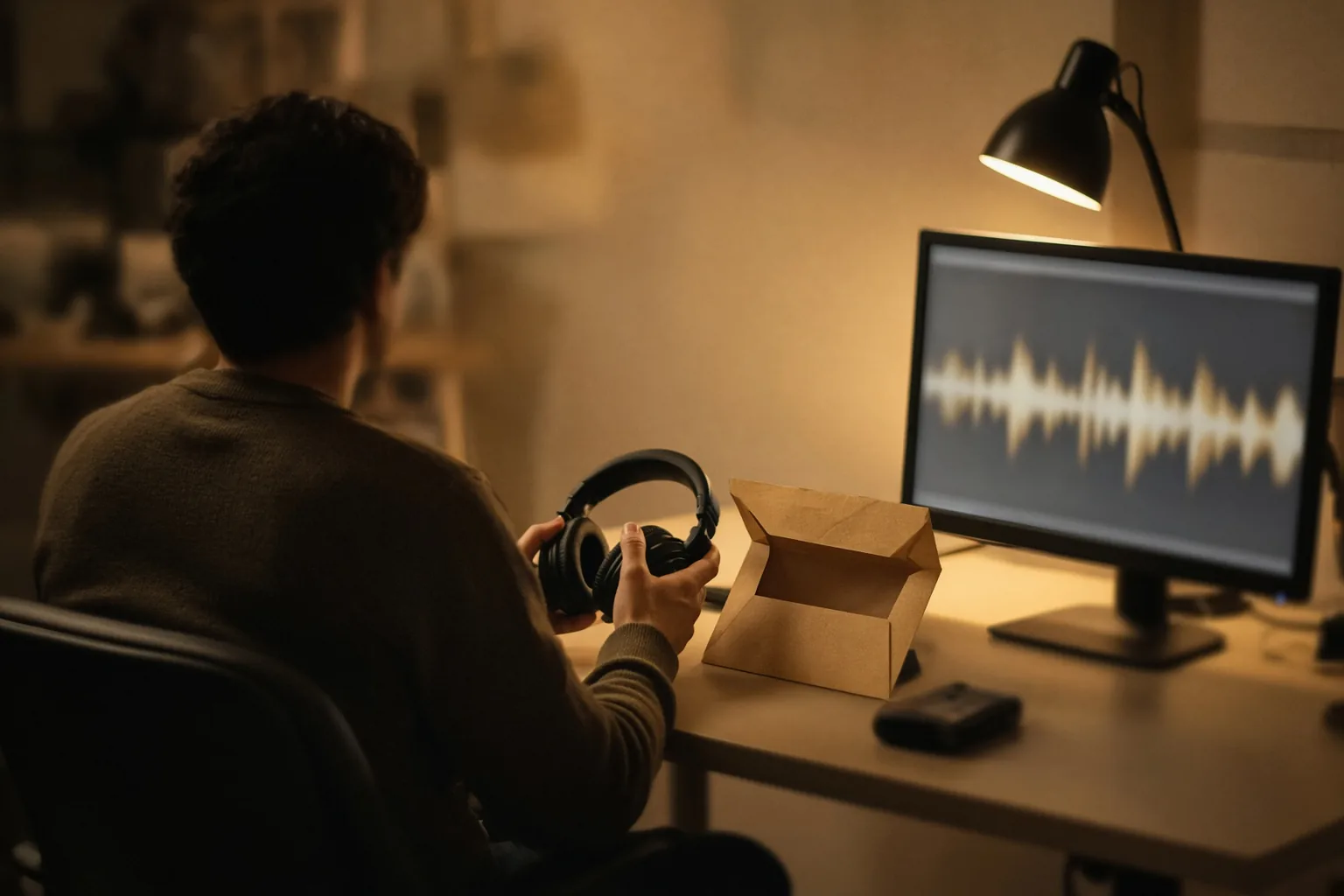
What should a forensic audio request contain?
Who asks and when, the type of examinations, the acoustic events recorded and how they were recorded, the subjects and portions of interest, each evidence item with a unique identifier and hash value if available, and the chain of custody.
Section 5 of the SWGDE Best Practices for Forensic Audio, version 2.5, lists what a request for forensic services should include at a minimum. The requester should "Identify the party requesting the services and the date of the request" and "Identify the type of examinations requested." The requester should "Include necessary details, such as the acoustic events recorded, the method used to record them, subjects of interest, and portions of interest."
The same section asks the requester to "Describe each evidence specimen, including hash values if available, with each item assigned a unique identifier" and to "Document chain of custody to account for all individuals handling and/or processing the evidence, including shipping documentation, tracking numbers, and dates shipped and received." Safety hazards on physical items are listed too.
One instruction in section 5 concerns other disciplines. The requester should "Pay particular attention to whether the request includes examinations by other disciplines" and consult the examiners in those disciplines "to determine an appropriate sequence of examinations and precautions to take." For a phone that also needs fingerprint or digital forensic work, this means the order of examinations is agreed before anyone handles it.
SWGDE is the Scientific Working Group on Digital Evidence. Its documents are not court rules. They describe practice in the field, and an opposing expert can compare the examiner's work with them.
Which questions can a forensic audio examiner answer?
Questions in four groups: whether a recording is consistent with how it is said to have been made, what words or sounds can be made clearer, what an acoustic event was, and, with a subject matter expert, who is speaking.
Section 8 of the SWGDE document describes the examinations. Enhancement, also called clarification, has the goal "to increase the intelligibility of voice information or to improve the signal to noise ratio of a target signal by reducing the effects that mask it." Authentication "seeks to determine if a recording is consistent with the manner in which it is alleged to have been produced."
Acoustical signal analysis "is the application of scientific and engineering principles in the analysis of acoustic events," and "requires an understanding of the mechanisms which produced the acoustic events in question." A question about how many shots were fired, whether a sound came from a car door or a gunshot, or how long a gap lasts belongs here.
Speaker comparison is treated differently. Section 8.5 states: "A subject matter expert should be consulted as speaker comparison and identification go beyond the technical aspects of audio and are considered outside the scope of SWGDE." A request about who is speaking therefore names the expert discipline it needs, and the examiner who prepares the files for that expert says so in the report.
Section 8 also lists video and physical media repair and recovery. A request about a damaged cassette or a corrupted file starts with the recovery question, because nothing else can be examined until the audio is readable.
How should the question about edits be worded?
As a question about consistency with the claimed history of the recording: was this file made on the stated device, at the stated time, in one session, and is it an original? SWGDE defines authentication as that test.
A request that asks the examiner to prove the recording is fake, or to certify that it is genuine, asks for more than the method gives. The SWGDE definition of authentication is a test of consistency "with the manner in which it is alleged to have been produced." The question therefore has to state the manner alleged.
That means the request tells the examiner the claimed history: who made the recording, on what device and application, on what date, whether it was one continuous recording or several, and how the file reached the client. Each of these statements becomes a point the examiner can test.
Section 4.2.2 of the SWGDE document explains why the device matters. "The original recording system contains the audio data in its native format, original modified/access/creation (MAC) time stamps of files, metadata, internal time clock, and the settings of the recorder." If the device is available, the request says so and asks whether test recordings may be made on it.
A workable set of authentication questions reads like this. Is the file an original or a copy, and if a copy, of what? Is the file consistent with having been made on the stated device with the stated application? Is the recording continuous, or are there signs of stops, starts, deletions or insertions? Are the time stamps and metadata consistent with the stated date?
What should an enhancement request specify?
The acoustic events recorded, the region of interest and the target signal. SWGDE's enhancement best practices ask the examiner to determine these, contacting the submitter if necessary, and to work only on a copy.
SWGDE's Best Practices for the Enhancement of Digital Audio, document 20-A-001, version 2.0 of July 25, 2023, was released as a draft for public comment. Its section 2.1 tells the examiner to "determine the acoustic events recorded, region of interest, and target signal", and to contact the submitter "to clarify any issues or to obtain additional information" if necessary.
A useful request therefore gives time ranges in the file, names the voice or sound to be made clearer and says what is in dispute at that point: a name, a number, a phrase. A request for the whole two hours to be cleaned up gives the examiner no target signal.
The draft sets limits that the request should not ask the examiner to cross. "Enhancement may or may not improve the signals of interest," and "The goal of increasing intelligibility or signal quality may not be achievable." The examiner is to work "without creating unwanted artifacts" and to "Avoid over-processing."
The request should also ask for the documentation the draft requires: "Document the processes, settings, and applications used, with their versions" "in sufficient detail to repeat or reproduce the final results." Section 4.4.1 calls for "a final review comparing the result to the unprocessed original."
How should a question about the speaker be framed?
As a comparison of named portions of the questioned recording with known recordings of a named person, sent to a speaker comparison expert. SWGDE places speaker comparison outside its scope and refers it to a subject matter expert.
The question names the person and the portions: does the voice in the questioned recording, at stated time ranges, belong to the person whose known recordings are provided? A question about everyone heard on a two-hour file, without names and time ranges, cannot be answered as a comparison.
The known recordings need their own history. The request says when, where and how each known sample was recorded and how its origin is established, because a comparison across different devices, languages or years has limits that the expert will state.
The request can also ask the expert to state the conclusion on a defined scale and to give the limits of the comparison. That wording matches the 2023 committee note to Rule 702, which says forensic experts should avoid assertions of absolute certainty where the method is subjective.
If the dispute is about what the speaker meant, rather than who spoke or what words were said, the question goes to a linguist. A forensic audio examiner can establish the words; their meaning in context is a separate field.
Can the examiner say whether the person lied or committed the crime?
Not as an audio examiner. Under Rule 704(a) an opinion may embrace an ultimate issue, but in a criminal case Rule 704(b) bars expert opinion on a mental state that is an element of the crime or of a defense.
Rule 704(a) of the Federal Rules of Evidence states: "An opinion is not objectionable just because it embraces an ultimate issue." Rule 704(b) adds the exception: "In a criminal case, an expert witness must not state an opinion about whether the defendant did or did not have a mental state or condition that constitutes an element of the crime charged or of a defense. Those matters are for the trier of fact alone."
For a forensic audio request this sets two boundaries. Questions about the recording, the words and the speaker are technical and may be asked. Questions about intent, truthfulness or guilt are not questions for an audio examiner in any case, and in a criminal case the mental state questions are closed to every expert.
Rule 702 sets the general frame. The proponent must show the court that it is more likely than not that the expert's specialized knowledge "will help the trier of fact to understand the evidence or to determine a fact in issue," that "the testimony is based on sufficient facts or data," and that "the testimony is the product of reliable principles and methods" applied reliably to the facts of the case. A question the method cannot answer produces an opinion that fails at least one of these conditions.
What should be sent with the recording?
The original file or a bit stream duplicate, the recording device if available, its settings, notes on who recorded it and how, the chain of custody and hash values. SWGDE treats a bit stream duplicate as equivalent to the original.
Section 4.1 of the SWGDE Best Practices for Forensic Audio defines the original: "An original digital recording is a bit stream from which the acoustic audio signal can be generated." It follows that "a bit stream duplicate of a recorded file is equivalent to the original." Section 7.1 adds: "To preserve the integrity of a digital original, make a bit stream duplicate to use as a working copy."
A file exported from a messaging application in another format, a recording made by playing the file through a speaker, or a clip cut from a longer file is not a bit stream duplicate. If that is all the client has, the request says so, and the examiner reports what can and cannot be tested on such a file.
The package for such a request contains the original file or its bit stream duplicate with a hash value, the device or the information about it, the account and application used, a short statement of the claimed history, the chain of custody record, the known recordings for a speaker question, any transcript prepared by either side and the opposing expert's report if there is one.
Section 8.1 of the SWGDE document says: "The notes should be detailed enough to allow a comparably trained examiner to explain the results or derive similar conclusions." The request can ask for those notes to be kept and produced with the report.
What does IAE do when a recording needs forensic examination?
IAE prepares an expert report on the client's questions about the speaker, the integrity of the file and the words spoken, or a review of the opposing audio examiner's report. The questions are confirmed with the client before work starts.
IAE frames the questions around the recording: the speaker, the integrity of the file and the words spoken. The client sends the request with the file and its history, and IAE confirms the questions with the client before work starts. The secretariat confirms receipt the same day. Within one business day IAE confirms the format, the cost, the deadline and the specialist from its registry, and the client approves the candidate and the CV before work starts.
The examiner checks the file for edits, compares voices with known recordings and prepares transcripts of disputed conversations, as the questions require. Noise reduction is done on a working copy, with every filter and setting logged. The draft is checked for facts. The signed PDF is issued in up to 5 business days after the format and cost are confirmed. For cases with tight deadlines there is a 48-hour rush.
Every specialist is a member of the public IAE registry and can be verified by Member ID or QR code. The specialist confirms in the document that he or she has no interest in the outcome of the case. IAE is not a law firm and does not advise on case strategy; whether to offer or challenge a recording is a question for the client's attorney. A report is evidence that the court weighs with the rest of the record, and neither IAE nor the examiner guarantees the outcome.
Sources
- SWGDE Best Practices for Forensic Audio, version 2.5 (June 9, 2022)
- SWGDE Best Practices for the Enhancement of Digital Audio, 20-A-001, version 2.0 (July 25, 2023, draft for public comment)
- Federal Rules of Evidence, Rule 704, Opinion on an Ultimate Issue (LII, Cornell Law School)
- Federal Rules of Evidence, Rule 702, Testimony by Expert Witnesses, with committee notes (LII, Cornell Law School)
Read also
All articles

Can a voice recording prove a verbal agreement in court, and what does the recording have to show?
In California all contracts may be oral, except those that a statute requires to be in writing: that is Civil Code section 1622. A recording is Sergei Voronin
Is voice stress analysis admissible in court, and can an audio expert tell from a recording whether someone lied?
Voice stress analysis results are kept from juries as proof that a person lied. In a study funded by the National Institute of Justice, twoSergei Voronin
The court transcript does not match the audio recording: how is the record corrected, and what can a forensic transcript add?
When the official transcript of a federal hearing differs from what the audio recording shows, the transcript is presumed correct until the courtSergei VoroninExpert examinations
Ready to discuss your case?
Send the materials: the secretariat will confirm the format, cost, deadline and the specialist within one business day.
