
Expert report review
The opposing examiner found indented writing with an ESDA: how is that finding reviewed?
An electrostatic detection device can bring up writing that left no ink on the page, such as notes made on a sheet that lay above it. Indentation findings are used to place a page in a pad, to show what was written on a missing sheet, or to argue that a page was written at another time. A reviewer tests such a finding step by step against the procedure the indentation standard sets.
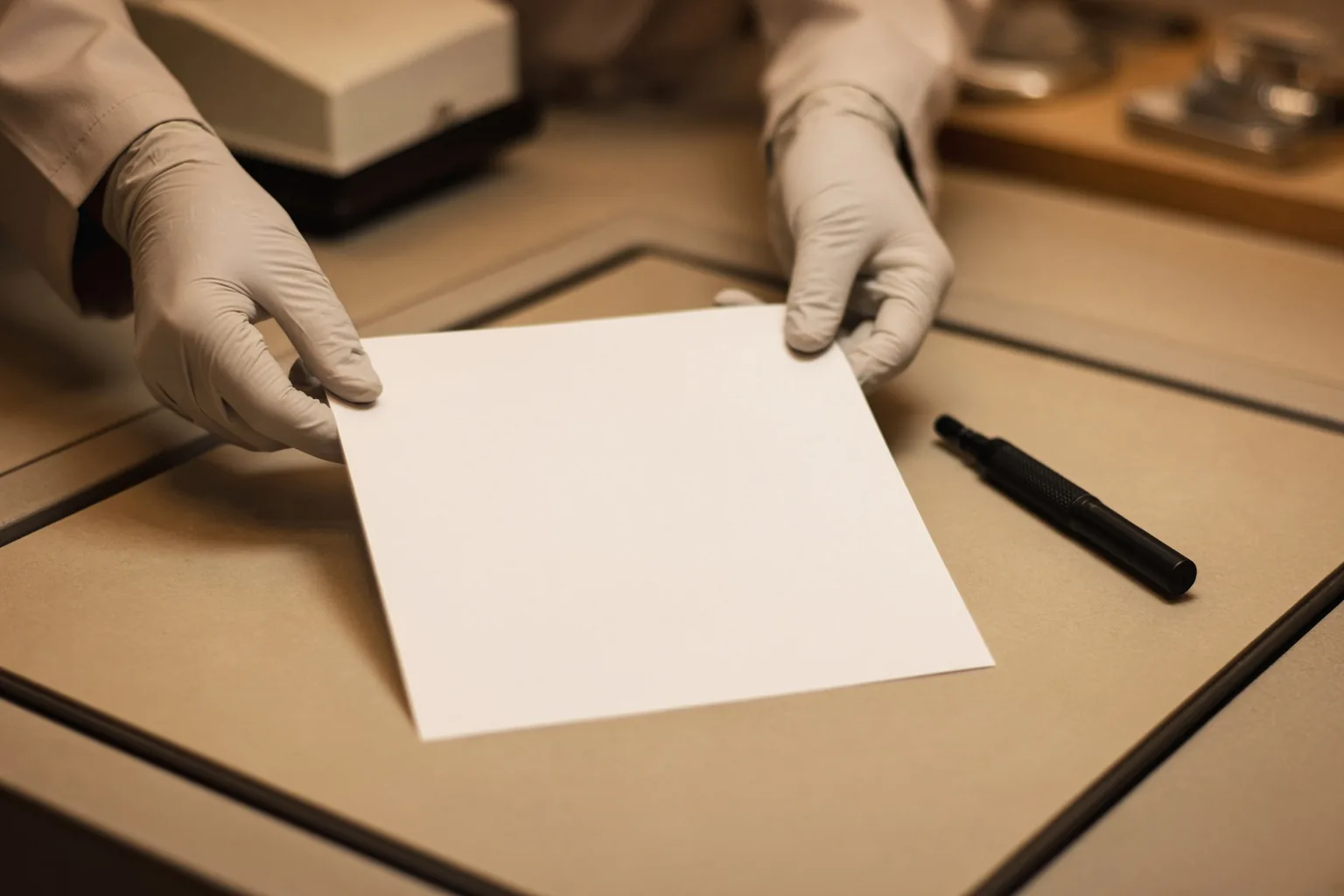
What does an indentation finding claim?
That impressions were observed on the questioned sheet, that some could be deciphered, what text they show and, sometimes, where they came from. The SWGDOC indentation standard lists those four kinds of findings.
The SWGDOC Standard for Indentation Examinations, version 2013-1, defines indentations as "latent or visible impressions in paper or other media" (3.2.4). Section 4.1 explains how they arise: "When sheets of paper are in direct or indirect contact with one another, impressions on the top sheet can produce indentations" on the sheets beneath. Under 4.2.1, pencil writing and single-strike ribbon typing can be partially lifted from a document by the EDD, and under 4.3 fiber disturbances caused by erasures or present in torn paper edges may be visualized using the standard.
Section 8.3 lists what a report may conclude: whether indentations were observed (8.3.1), "Whether decipherable indentations were observed" (8.3.2), the text of deciphered indentations (8.3.3) and information as to the source of indentations (8.3.4).
The reviewer sorts the opposing report into those four parts. A finding that impressions exist is the narrowest. A reading of their text and a statement about the sheet that produced them each need their own support in the notes and lifts.
Which standard governs an indentation examination?
ANSI/ASB Standard 044, Standard for Examination of Documents for Indentations, first edition 2019, which is on the OSAC Registry. The SWGDOC indentation standard of 2013 is marked on the SWGDOC site as superseded by the ASB standard.
The AAFS Standards Board describes Standard 044 as summarizing "commonly accepted techniques, technologies, and procedures used by forensic document examiners" for the examination of documents for indentations. The NIST page of the OSAC Forensic Document Examination Subcommittee lists ANSI/ASB Standard 044-19, 2019, 1st Ed., among the standards on the OSAC Registry, and a second edition, ASB Standard 044-2x, among the documents at a standards developing organization for further development.
The SWGDOC list of published standards marks the SWGDOC Standard for Indentation Examinations (E02-13) as superseded by the ASB standard. The SWGDOC text remains public and sets out the steps in numbered form, and this article follows it.
A report should name the standard and edition the examiner followed. If it names none, the reviewer asks which procedure was used and compares the notes with the published steps.
Were the tests run in the order the standard sets?
The SWGDOC standard says its procedures should be performed in the order given: side lighting first, then a check that the item suits the EDD, then the EDD. It also puts indentation work before any chemical processing.
Section 7.1 reads: "These procedures should be performed in the order given." Under 7.3 the examiner views the item "using side lighting that is directed at the item from various angles and directions", documents any indentations observed (7.3.1), and, if none are seen, documents "the lack of visible indentations" (7.3.2). Under 7.4 the examiner determines whether the item is suitable for EDD examination, and if it is not, discontinues and reports accordingly (7.4.1). Each suitable item is then examined with an EDD (7.5).
The two parts depend on each other. Section 5.3 warns: "All indentations may not be revealed if the optical and EDD portions of the procedure are not conducted." A report that relies on side lighting alone, or on the EDD alone, has skipped one of the two parts that section 5.3 names.
Section 7.2 requires that "Examinations performed, relevant observations, and results shall be documented." The reviewer reads the notes for the sequence: when the side-light examination was done, what it showed, and when the sheet went onto the instrument.
Was the instrument checked on the day of the examination?
The standard requires a control indentation to be developed and recorded on the day of examination, and any problem to be corrected before further use of the instrument. The reviewer asks for that record.
Under section 7.5.1 the EDD "shall be operated utilizing the instructions provided in the operating manual". Under 7.5.2, "A control indentation shall be successfully developed and recorded on the day of examination." If the control fails, the problem "shall be corrected before any further indentation examinations are conducted with that instrument" (7.5.2.1).
Other conditions affect the result as well. Section 5.7 says that conducting an EDD examination without prior humidification of the document may impede the results. Section 5.8 calls for periodic checks of the condition of the glass beads, and section 5.9 says: "Repeated processing with EDD can result in degraded images."
Each of these leaves, or should leave, a trace in the file: the control lift with its date, a note on humidification, the number of passes through the instrument. A report without them gives the reviewer a specific question for deposition.
Could the impressions be secondary impressions rather than writing?
Yes. The standard warns that EDD examination may yield secondary impressions, which it defines as fiber disturbances caused by contact with the embossed side of indentations and not caused by the act of writing.
Section 3.2.8 defines secondary impressions as "fiber disturbances caused by contact with the embossed side of indentations and not caused by the act of writing." Section 5.6 says that "EDD examination may yield secondary impressions as well as primary impressions."
The distinction matters for any finding about sequence or source. A page that was stored against another page carrying indentations can pick up secondary impressions of that text without ever lying under the sheet on which it was written. The reviewer checks whether the report addressed the difference and what in the lift supports calling the impressions primary.
The history of the sheets then becomes part of the review. Which pages were stored together, in what order, and for how long, are questions for the chain of custody records and the people who kept the file.
Was the sheet handled or chemically processed before the EDD examination?
The standard says chemical processing for latent prints generally interferes with indentation results, that indentation examinations should come before any chemical processing, and that items should be handled as little as possible before the EDD.
Section 5.4 of the SWGDOC indentation standard reads: "Chemical processing for latent prints generally interferes with indentation examination results." The same section states: "Indentation examinations should be conducted prior to any chemical processing." Under 5.5, items "should be handled as little as possible prior to EDD examination to prevent contamination".
The SWGDOC Standard for Examination of Altered Documents places EDD processing among the non-destructive steps (7.9), ahead of any destructive technique (7.13). OSAC 2022-N-0035, Standard for On-Scene Collection and Preservation of Document Evidence, version 2.1 of September 18, 2024, says document evidence "shall not be unnecessarily folded, torn, marked, soiled, stamped, or written on" (4.2(f)).
If the laboratory request or the custody log records that the sheet went to latent print processing first, the reviewer sets that fact against both a positive and a negative finding. Writing on the envelope that held the sheet, or a note pressed onto it, can also leave impressions that the examiner then develops.
What does it mean when no indentations were found?
That none were observed or developed under the conditions used. The standard requires the lack of visible indentations and undeveloped results to be documented, and lists conditions under which the EDD may not reveal what is there.
Under section 7.3.2 the examiner documents the lack of visible indentations. Under section 7.7, if no indentations are developed, the results are documented or preserved, or both, according to laboratory policy. The standard contains no rule that turns a negative result into proof that nothing was written on a sheet above.
The limitations in section 5 point the other way. The size, shape, density or condition of an item may make it unsuitable for the EDD portion of the procedure (5.2). Chemical processing for latent prints generally interferes with the results (5.4). Examination without prior humidification may impede them (5.7). Repeated processing can degrade the images (5.9).
A negative finding offered to show that a page was not under another page therefore gets the same questions as a positive one: was the item suitable, was it humidified, was it processed before, how many passes were made, and did the control work that day.
What should the lifts and images show?
Results may be preserved by a lift, lifts are kept under laboratory policy, and results are evaluated and documented. The reviewer compares each lift with the text the report says it reads.
Under section 7.6, "Results of the EDD examination may be preserved by making a lift." Note 1 to section 7.7 says the results should be lifted and evaluated using an appropriate background. Lifts "shall be maintained according to laboratory policy" (7.8), and the examiner evaluates and documents the results (7.9). If indentations or other images are visualized, the examiner conducts other examinations as appropriate (7.10). Section 6.3 lists imaging or other equipment for recording observations among the requirements.
Section 8.2 places the bases and reasons for each conclusion in the examiner's documentation. A report that gives the text of deciphered indentations under 8.3.3 is checked word by word against the lift and the images: which characters are clear, which were inferred, and whether another reading fits the same marks.
Where the report attributes the indentations to a particular sheet under 8.3.4, the reviewer asks for the comparison: the writing on the proposed source page and the lift, side by side, at the same scale.
Which records should the reviewer request?
The notes, the control lift of the day, the lifts and images of the questioned sheet, and the facts or data the examiner considered under Rule 26. Rule 34 reaches the original.
Rule 26(a)(2)(B) requires a retained expert's report to contain "a complete statement of all opinions the witness will express and the basis and reasons for them", "the facts or data considered by the witness in forming them" and "any exhibits that will be used to summarize or support them." Lifts and images used to show the indented text are exhibits of that kind.
Under Rule 26(b)(4)(C), communications between counsel and the expert are protected except to the extent that they identify facts or data that counsel provided and the expert considered, or assumptions that counsel provided and the expert relied on. What the examiner was told about the source sheet, or about what the text should say, falls within that exception when the examiner considered or relied on it.
Rule 34(a)(1) lets a party request the original "to inspect, copy, test, or sample" at a reasonable time, place and manner, so a second EDD examination can be arranged; section 5.9 of the standard warns that repeated processing can degrade images. Under Rule 705 an expert may state an opinion and give the reasons for it without first testifying to the underlying facts or data, and may be required to disclose them on cross-examination.
How does the review reach the court?
As a rebuttal report under Rule 26(a)(2)(D)(ii), due within 30 days after the other side's disclosure, as the basis of a motion under Rule 702, or as confidential work of a consulting expert under Rule 26(b)(4)(D).
Under Rule 26(a)(2)(D)(ii), evidence "intended solely to contradict or rebut evidence on the same subject matter" identified by another party is disclosed "within 30 days after the other party's disclosure." A review that answers an indentation finding addresses the same subject matter.
Rule 702 requires the proponent to show the court that it is more likely than not that the testimony "is based on sufficient facts or data" and "is the product of reliable principles and methods". The committee note to the 2023 amendment adds that "each expert opinion must stay within the bounds of what can be concluded from a reliable application of the expert's basis and methodology." A reading of indented text that goes beyond what the lift carries is tested against that sentence.
If counsel wants the review before deciding whether to call a witness, Rule 26(b)(4)(D) says that facts known and opinions held by an expert retained in anticipation of litigation who is not expected to testify are ordinarily not discoverable.
What does IAE do when the opposing report relies on indented writing?
IAE prepares a review of the opposing questioned document report in up to 5 business days after the format and cost are confirmed; each point cites a page of the report and a standard or rule.
The IAE review page for questioned documents is written for attorneys facing the other side's report on alterations, substituted pages, ink or dating. The reviewer reads the report and the produced file against ANSI/ASB Standards 011 and 035, the SWGDOC ink comparison standard and Rule 26(a)(2)(B). Among the checks the page names are the case notes and images of each examination.
Send the opposing report, the lifts and images that were produced, the laboratory or custody records and the dates of the disclosure schedule through the form on the contact page. IAE confirms the format, cost, deadline and the specialist from the registry within one business day, and you approve the reviewer and the CV before work starts. Cases with tight deadlines have a 48-hour rush.
Registry members passed the collegial attestation of the council under the published Criteria Matrix, and the Member ID in the document can be checked by QR code. The reviewer confirms in the document that he or she has no interest in the outcome, and materials are not passed to third parties without your consent. Neither IAE nor the reviewer guarantees the outcome, and IAE is not a law firm and does not advise on case strategy.
Sources
- SWGDOC Standard for Indentation Examinations (E02-13), ver. 2013-1
- ANSI/ASB Standard 044, Standard for Examination of Documents for Indentations, 1st Ed., 2019 (AAFS Standards Board)
- OSAC Forensic Document Examination Subcommittee, standards list (NIST)
- SWGDOC, published standards list
- SWGDOC Standard for Examination of Altered Documents, ver. 2013-1
- OSAC 2022-N-0035, Standard for On-Scene Collection and Preservation of Document Evidence, version 2.1, 2024 (NIST)
- Federal Rules of Civil Procedure, Rule 26 (LII, Cornell Law School)
- Federal Rules of Civil Procedure, Rule 34 (LII, Cornell Law School)
- Federal Rules of Evidence, Rule 702 (LII, Cornell Law School)
- Federal Rules of Evidence, Rule 705 (LII, Cornell Law School)
Read also
All articles
The government's forensic report says your document is counterfeit: how is it reviewed and rebutted in immigration proceedings?
An asylum file or a benefit application can turn on one sheet of paper: a birth certificate, a church letter, a party card. When a government Sergei Voronin
The opposing examiner says the pages came from different printers: how is that opinion reviewed?
Opinions that a page was printed on a different machine than the rest of a contract often decide substitution claims. The SWGDOC standards for tonerSergei Voronin
The opposing examiner calls the document a forgery: may a document examiner decide that?
A document examiner may testify that a signature is not the writing of the person named, that a page was replaced or that an entry was added. WhetherSergei VoroninExpert report review
Ready to discuss your case?
Send the materials: the secretariat will confirm the format, cost, deadline and the specialist within one business day.
