
Expert report review
Review of the opposing fire investigator's report: what does a rebuttal fire expert need and deliver?
A rebuttal fire expert reads the other side's origin and cause report against the data behind it: scene photographs, the fire department's report, lab results on fire debris and any computer fire model. Federal courts have admitted a fire captain's report as a public record, admitted a defense fire expert who never saw the scene and excluded new testing placed in a rebuttal report.
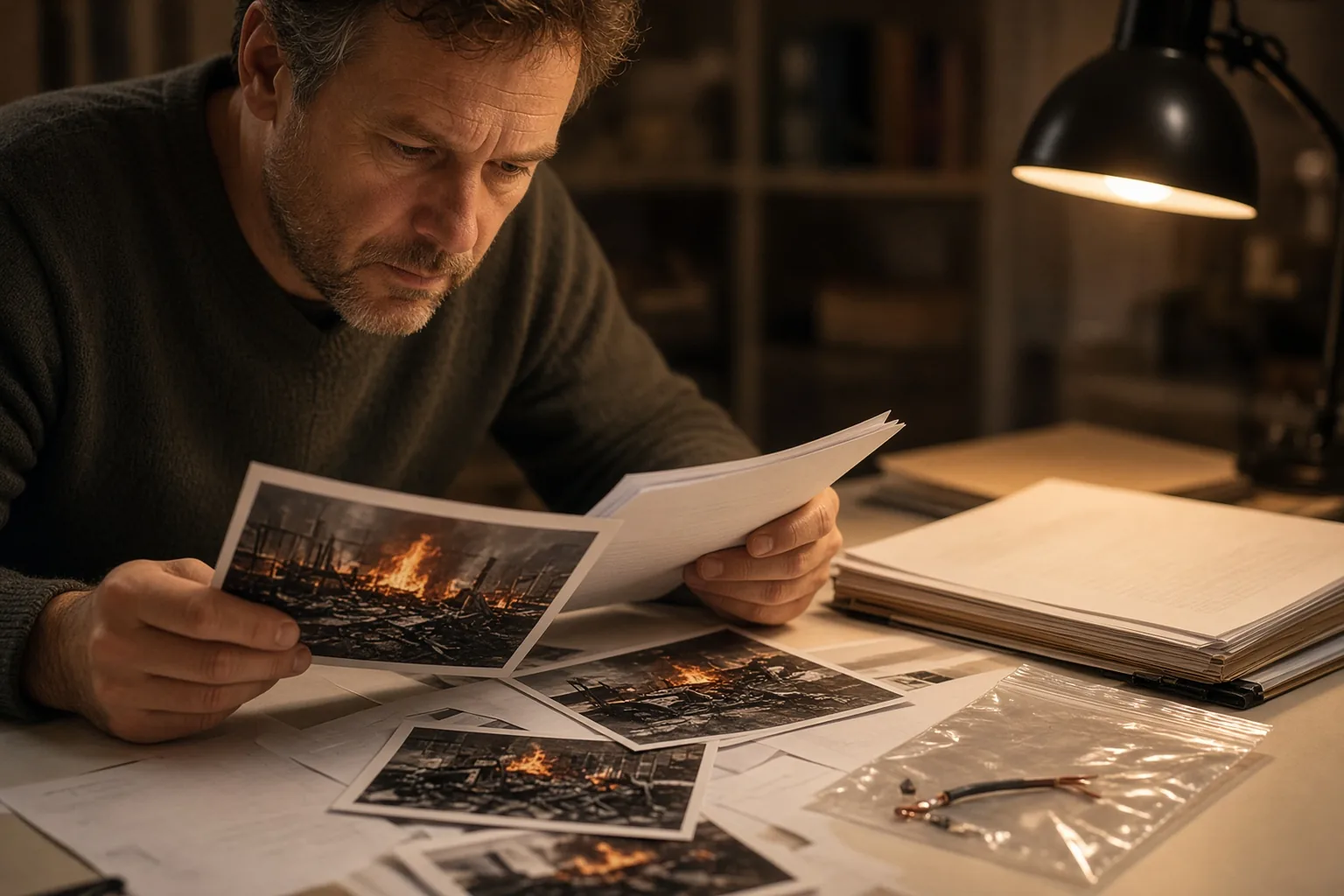
What does a review of the opposing fire report produce?
A written analysis that follows the opposing report step by step: origin, cause, artifacts, lab results and calculations. Each criticism cites the page, photograph or test it rests on.
A fire review takes the opposing report apart in the order the investigator built it. First the origin: which burn patterns, heat and smoke damage and witness accounts placed the fire where the investigator says it began. Then the cause: which ignition sources were in that area, which hypotheses were considered and what test or observation excluded each one. Then the artifacts: what was collected, photographed in place, examined in a lab or lost. The edition of NFPA 921, Guide for Fire and Explosion Investigations, that the investigator cites is recorded at the start, because the review measures the report against that edition.
ASTM E620-18, Standard Practice for Reporting Opinions of Scientific or Technical Experts, is listed by ASTM as active. Its scope covers the information to be contained in formal written technical reports that express the opinions of a scientific or technical expert about items that are or may reasonably be expected to be the subject of criminal or civil litigation. Section 1.2 adds: "If compliance with this practice is claimed, the justifications for any deviations from this practice must be documented." The reviewer notes whether the opposing report claims compliance with E620 or with NFPA 921 and whether each departure is explained.
Counsel decides the form. A review can be a memo with a table of findings or a signed report by a reviewer who will testify. The table is the same in both: the opinion in the opposing report, the data cited for it, the step at which the conclusion leaves the data, and the source that sets the expected practice.
Can the fire department's report come in as evidence of the cause?
In federal civil cases it can. Rule 803(8) admits factual findings from a legally authorized investigation unless the opponent shows a lack of trustworthiness, and the Supreme Court has held that such findings include conclusions and opinions.
Rule 803(8) of the Federal Rules of Evidence excepts from the hearsay rule a record or statement of a public office that sets out, "in a civil case or against the government in a criminal case, factual findings from a legally authorized investigation," if "the opponent does not show that the source of information or other circumstances indicate a lack of trustworthiness." The burden of attacking the report therefore sits with the side the report hurts.
In Beech Aircraft Corp. v. Rainey, decided December 12, 1988, the Supreme Court held that "factually based conclusions or opinions are not on that account excluded from the scope of Rule 803(8)(C)." The report in that case was a Navy investigator's report on the crash of a T-34C training aircraft at Middleton Field, Alabama, on July 13, 1982, which concluded that the accident was most probably caused by the pilots' failure to maintain proper interval. Admission left the other side free to offer evidence contradicting those conclusions or reducing their weight.
Broome v. Dazey Corp., 885 F.2d 871, decided by the Sixth Circuit on September 22, 1989 in an unpublished disposition, applied the rule to a house fire in which Keith Broome's wife and stepson died. Broome's theory was that a Dazey can opener was defective and caused the fire; the fire officials concluded that an electric frying pan left unattended in the kitchen caused the fire. The jury found for Dazey. The court held the fire captain's report properly admitted, noting that Broome had "done nothing to challenge the trustworthiness of the report except to disagree with its analysis and conclusion." It also allowed the officials' testimony under Rule 703 because they went directly to the scene, and wrote that Rule 703 "bars the firemen only from presenting as evidence conclusions based on things they did not see."
The Advisory Committee's 1972 note on Rule 803(8) lists factors for evaluative reports: the timeliness of the investigation, the special skill or experience of the official, whether a hearing was held and the level at which it was conducted, and possible motivation problems. A review of a fire department report answers each of them from the record: when the officer examined the scene, what origin and cause training he has, whether anyone tested his findings, and whether the report was written with a claim or a prosecution in view.
Can the reviewer give an opinion without visiting the fire scene?
Yes, if fire experts would reasonably rely on the data. Rule 703 covers facts the expert was made aware of, and in Travelers a defense expert retained two years after the fire was admitted.
Under Rule 703 an expert's basis is not limited to what the expert saw in person: facts or data the expert was made aware of also count, and inadmissible data may be used if experts in the field would reasonably rely on that kind of data. The advisory committee note on the proposed rules names three sources: the firsthand observation of the witness, presentation at the trial, and presentation of data to the expert outside of court and other than by his own perception.
Travelers Casualty Insurance Co. of America v. Volunteers of America Kentucky, Inc., No. 5:10-301-KKC, was decided by the Eastern District of Kentucky on August 21, 2012. The fire was at the Brookview Apartments in Lexington. Travelers, as subrogee of the owner, claimed that a resident carelessly discarded cigarettes into a plastic trashcan beside her bed; the defense said the fire started on the patio and was caused by an unknown energized electrical device. The defense expert, Robert Russell, "did not interview any witnesses or perform a first person inspection of the site because he was not retained until two years after the fire."
Russell relied on photographs taken by the plaintiff's experts, including a "V" pattern at the base of the patio wall and a plug in an outside receptacle with a loose wire or extension cord, and on his own participation in deconstructing the carpet section that held the melted trashcan. The court held that "the opinions are based on sufficient facts and data, which is all that Fed. R. Evid. 702 requires," and treated the objections as going to the weight of his opinions, not their admissibility.
A desk review can test whether the opposing opinion follows from the photographs and data; it cannot add observations nobody made. Where the scene still exists, the IAE fire page asks the client to say so in the request, because a Rule 34 inspection may still be possible.
How does a reviewer check the lab report on fire debris?
Against the ASTM test method the laboratory cites. The reviewer records the edition, checks whether a liquid was identified or the pattern only resembled one, and reads how the investigator used the result.
ASTM E1618 is the test method for identifying ignitable liquids in fire debris by gas chromatography-mass spectrometry. ASTM lists E1618-25 as active, and the NIST forensic science standards library lists ANSI/ASTM E1618-25 as superseding E1618-19. The 2025 edition is titled Standard Test Method for Identification of Ignitable Liquids in Fire Debris Analysis by Gas Chromatography-Mass Spectrometry, and its scope covers identification based on interpretation of GC-MS data obtained from liquids and extracts recovered from fire debris samples.
Section 5.4 of the 2025 edition notes that in some instances chromatographic patterns are detected that resemble ignitable liquids, but identification is not possible because of the complexity of the fire debris sample. Section 5.1.5 refers to Practice E620 for the requirements on reporting results. A lab report that names a class of liquid without the chromatograms and the comparison data behind the identification gives the reviewer a point.
The 2019 edition, which ASTM now lists as historical, said in section 4.1.1: "The identification of an ignitable liquid residue in a fire scene does not necessarily lead to the conclusion that a fire was incendiary in nature." The review records which edition the laboratory applied and checks whether the cause section of the opposing report treats a lab identification as proof of how the fire was set.
For each sample the reviewer asks where it was taken in relation to the claimed area of origin, what material it was, and whether the laboratory received a sample of the same material from an unburned area for comparison.
What does a rebuttal fire report contain?
Every opinion the reviewer will offer, with its basis and data, each tied to a statement in the opposing report. A report that leaves out an item Rule 26(a)(2)(B) requires invites a motion to strike.
A rebuttal report that lacks a Rule 26 item invites a motion to strike. In Scottsdale Insurance Co. v. Deere & Company, No. 14-1183-JTM (D. Kan. July 14, 2015), a combine fire case, the court found the plaintiff's fire investigator's report deficient under Rule 26 and declined to strike his testimony only because his deposition had cured the prejudice to Deere.
The report also records the edition of NFPA 921, Guide for Fire and Explosion Investigations, that each side used and the edition of every ASTM method a laboratory applied. Where the reviewer works from a different edition than the opposing investigator, the report says why.
A workable structure follows the opposing report. The rebuttal states its scope and the materials reviewed, then takes the opposing origin opinion and the opposing cause opinion in turn: what the investigator concluded, the data he cited, the hypotheses he considered, how each was tested, and where the conclusion goes beyond the data. Each criticism cites the photograph, the page or the test it rests on. The report closes with the reviewer's opinions, each one answering an opinion in the opposing report.
Can a rebuttal fire expert run new tests or offer a new cause?
A rebuttal must contradict or rebut evidence on the same subject matter. In Columbia Grain the court excluded new testing placed in a rebuttal report to support the expert's own earlier theory.
Columbia Grain, Inc. v. Hinrichs Trading, LLC, No. 3:14-CV-115-BLW, was decided by the District of Idaho on October 30, 2015. A fire that began in the defendant's elevator spread to Columbia's elevators and destroyed both. Columbia's expert, Fitz, blamed an overheated bearing and smoldering bean dust, and his original report contained no tests of that theory.
The defense experts answered that the origin could not be fixed closely enough to identify an ignition source, and two earlier investigations, one of them by the fire marshal's office, had left the cause undetermined. Fitz then ran smolder tests and put them in his rebuttal report. The court held that "Rebuttal testimony cannot be used to advance new arguments or new evidence," rejected the testing as supplementation because Rule 26(e) "does not cover failures of omission because the expert did an inadequate or incomplete preparation," and excluded it under Rule 37(c)(1), which bars undisclosed information unless the failure was substantially justified or harmless.
The burden of proof also limits rebuttal. In Pace v. State Farm Fire and Casualty Co., No. 2:23cv19-HSO-BWR (S.D. Miss. Feb. 2, 2024), a property insurance case, the court struck an engineer designated on the rebuttal deadline because "Causation is an essential element of Plaintiff's claim," so the plaintiff's causation testimony belonged in her initial designation. Read with Pace, a subrogating insurer that bears the burden on cause puts its cause opinion in the initial designation, not in rebuttal.
Can a computer fire model support the opposing cause opinion?
A New York court refused to accept it for that purpose in Santos v. State Farm: the defense had not proved that computer fire modeling was generally accepted in fire investigation, as opposed to predicting fire spread.
Santos v. State Farm Fire and Casualty Co., 2010 NY Slip Op 20255, was decided by the Supreme Court of New York, Nassau County, on June 28, 2010. The fire was at the plaintiff's premises in Bethpage, New York, on January 20, 2006. The plaintiff moved to exclude the defense expert, Dr. Jozef Urbas, who had used the NIST Fire Dynamics Simulator, version 4. Defense counsel said he was offered to "apply the computer dynamics to see how the fire would spread," and Dr. Urbas testified that the modeling "essentially verified the hypothesis as to the ignition source or cause of the fire."
Applying the Frye test of general acceptance, the court held that the defendant "failed to meet its burden of proving that its expert's use of computer fire modeling was generally accepted" in the fire investigation community. It wrote that computer fire modeling "may be generally accepted in the scientific community for predicting the course of fires" and may have support in the regulatory and design community. The record put the margin for error at 15% to 20% assuming all conditions are correct, and as high as 80% depending upon the real conditions.
Published validation work covers specific uses. The U.S. Nuclear Regulatory Commission and the Electric Power Research Institute issued NUREG-1824, Verification and Validation of Selected Fire Models for Nuclear Power Plant Applications, with volumes on five models: Fire Dynamics Tools, FIVE-Rev1, CFAST, MAGIC and the Fire Dynamics Simulator. Supplement 1, a final report of November 2016, evaluated the latest versions of the five models with additional test data and reports the results as ranges of accuracies for the model predictions.
A reviewer asks three things of any model in the opposing report: what it was used for (fire spread, timing or cause), which inputs came from the scene record and which were assumed, and whether published validation covers a fire of that size, fuel and geometry. In Santos Dr. Urbas agreed that "garbage-in-garbage-out" applied to his model.
How is the review used at the opposing investigator's deposition?
Counsel builds the outline from the review: each hypothesis, artifact, lab result and calculation it flagged. The deposition is limited to one day of seven hours unless stipulated or ordered, so the review ranks its points.
A testifying investigator can be deposed once his report has been served (Rule 26(b)(4)(A)). The side that takes the deposition pays him a reasonable fee for the time spent responding, unless manifest injustice would result (Rule 26(b)(4)(E)).
The review becomes the outline. For each hypothesis the opposing investigator considered, counsel asks what data excluded it and what test was run; for each artifact, where it was found and what examination it received; for each lab result and calculation, which method, edition and inputs were used. Answers that add new reasons matter because, under Rule 26(e)(2), the duty to supplement a reporting expert's disclosure extends to information given during the deposition, and changes must be disclosed by the time pretrial disclosures under Rule 26(a)(3) are due.
Time is limited. Under Rule 30(d)(1), "Unless otherwise stipulated or ordered by the court, a deposition is limited to 1 day of 7 hours." After the deposition, Rule 30(e)(1) gives the deponent, on request made before the deposition is completed, 30 days after notice that the transcript is available to review it and, if there are changes in form or substance, to sign a statement listing the changes and the reasons for making them. The officer notes in the certificate whether review was requested and attaches the changes. The reviewer reads that statement against the transcript, because a changed answer about a test or an excluded hypothesis is a change in substance.
What does a fire review answer when an insurer denies a claim for arson?
The fire science part: whether the fire was incendiary. Under Louisiana law, as the Fifth Circuit applied it in Kennair, the insurer also has to prove that the insured was responsible, and motive and opportunity carry that part.
Kennair v. State Farm Fire and Casualty Co., No. 94-30356, was decided by the Fifth Circuit on December 27, 1994 in an unpublished opinion. A fire destroyed the Kennairs' home in Buras, Louisiana, and after a two-day bench trial in May 1994 the district court found for the insurer on its arson defense. Under Louisiana law, as the court stated it, the insurer "bears the burden of proving by a preponderance of the evidence" that "(1) the fire was of an incendiary origin, and (2) the plaintiff was responsible for setting the fire," and "may prove its case by circumstantial evidence."
In their brief on appeal the Kennairs did not challenge the finding that the fire was of incendiary origin. The court cited evidence that diesel fuel was used to set the fire and had been scattered throughout the house, testimony of State Farm's accounting expert about the couple's finances, and found that "they had the opportunity to set the fire." It reviewed the arson finding for clear error and affirmed.
Once incendiary origin is conceded, the dispute moves to motive and opportunity, where a fire expert has nothing to add. A review for the insured therefore tests the incendiary finding first: the burn patterns behind it, any lab identification of an ignitable liquid and the edition of the method used, and whether the cause section leans on the insured's finances, which belong to the second element, as support for the first.
What does IAE do when a party needs a review of the opposing fire report?
IAE prepares a review of the opposing fire investigator's report or a fire origin and cause expert report on the client's questions, for subrogation, product liability, arson defense and coverage disputes in US courts.
The IAE fire origin and cause page describes the review. The reviewer lists each hypothesis the investigator considered and checks what data excluded the others, checks which NFPA 921 edition the investigator applied and how each rejected origin and cause hypothesis was ruled out, and checks whether wiring, appliances and debris were photographed in place before removal, logged and examined at a joint lab exam with all interested parties notified. The investigator works from the scene record, photographs, removed artifacts and witness accounts, answering the questions agreed with the client.
The client sends the opposing report with its exhibits and states whether the fire scene still exists. The secretariat confirms receipt the same day. Within one business day IAE confirms the format, the cost, the deadline and the specialist from its registry, and the client approves the candidate and the CV before work starts. The signed document is issued within up to 5 business days after the format and cost are confirmed; cases with tight deadlines have a 48-hour rush.
Every specialist is a member of the public IAE registry and passed the council's attestation under the published Criteria Matrix, and the Member ID or QR code in the document opens the specialist's record. The specialist confirms in the document that he or she has no interest in the outcome of the case. Materials go through the contact form or to info@iaexperts.com and are not passed to third parties without the client's consent. A review is evidence the court weighs with the other materials; neither IAE nor the reviewer guarantees the outcome, and IAE is not a law firm.
Sources
- Federal Rules of Civil Procedure, Rule 26, Duty to Disclose; General Provisions Governing Discovery (LII)
- Federal Rules of Civil Procedure, Rule 34, Producing Documents, Electronically Stored Information, and Tangible Things, or Entering onto Land (LII)
- Federal Rules of Civil Procedure, Rule 37, Failure to Make Disclosures or to Cooperate in Discovery; Sanctions (LII)
- Federal Rules of Evidence, Rule 703, Bases of an Expert's Opinion Testimony, with Committee Notes (LII)
- Travelers Casualty Insurance Co. of America v. Volunteers of America Kentucky, Inc., No. 5:10-301-KKC (E.D. Ky. Aug. 21, 2012) (Justia)
- Columbia Grain, Inc. v. Hinrichs Trading, LLC, No. 3:14-CV-115-BLW (D. Idaho Oct. 30, 2015) (GovInfo)
- Pace v. State Farm Fire and Casualty Co., No. 2:23cv19-HSO-BWR (S.D. Miss. Feb. 2, 2024)
- Scottsdale Insurance Co. v. Deere & Company, No. 14-1183-JTM (D. Kan. July 14, 2015) (Justia)
- Federal Rules of Civil Procedure, Rule 30, Depositions by Oral Examination (LII)
- Federal Rules of Evidence, Rule 803, Exceptions to the Rule Against Hearsay, with Committee Notes (LII)
- Beech Aircraft Corp. v. Rainey, 488 U.S. 153 (1988) (GovInfo, U.S. Reports)
- Broome v. Dazey Corp., 885 F.2d 871 (6th Cir. 1989) (unpublished disposition, Justia)
- Kennair v. State Farm Fire and Casualty Co., No. 94-30356 (5th Cir. Dec. 27, 1994) (unpublished)
- Santos v. State Farm Fire and Casualty Co., 2010 NY Slip Op 20255 (Sup. Ct. Nassau County June 28, 2010)
- ASTM E620-18, Standard Practice for Reporting Opinions of Scientific or Technical Experts
- ASTM E1618-25, Standard Test Method for Identification of Ignitable Liquids in Fire Debris Analysis by Gas Chromatography-Mass Spectrometry
- ASTM E1618-19, Standard Test Method for Ignitable Liquid Residues in Extracts from Fire Debris Samples by Gas Chromatography-Mass Spectrometry (historical)
- NIST Forensic Science Standards Library: ANSI/ASTM E1618-25
- U.S. NRC, NUREG-1824, Verification and Validation of Selected Fire Models for Nuclear Power Plant Applications
- U.S. NRC, NUREG-1824, Supplement 1, Final Report (November 2016)
- NIST Forensic Science Standards Library: NFPA 921, Guide for Fire and Explosion Investigations (revision of the 2024 version)
Read also
All articles
Clothes dryer fire: how does a reviewer check a report that blames lint, the owner or the dryer's design?
In the dryer fire litigation described below, the reports ended in one of two sentences: the owner let lint build up, or the dryer was built so that Sergei Voronin
Space heater fire: how does a reviewer check a report that blames the heater?
Portable heaters start about 1,100 residential building fires a year in the United States, and in the court cases below the dispute ran betweenSergei Voronin
Unattended cooking fire: how does a reviewer check a report that blames the stove?
Cooking causes about half of all residential building fires in the United States, and in the kitchen fire cases discussed below the dispute ranSergei VoroninExpert report review
Ready to discuss your case?
Send the materials: the secretariat will confirm the format, cost, deadline and the specialist within one business day.
