
Expert report review
How do you review the opposing water damage expert's report?
A water damage report usually carries four opinions: where the water came from, what caused the release, when the leak started and how long it ran, and what the repair costs. In insurance disputes the third one often decides coverage, because many property policies exclude continuous or repeated seepage. A reviewer tests each opinion against the data behind it: water bills, rot and corrosion, photographs, the inspection date and what the expert saw in person.
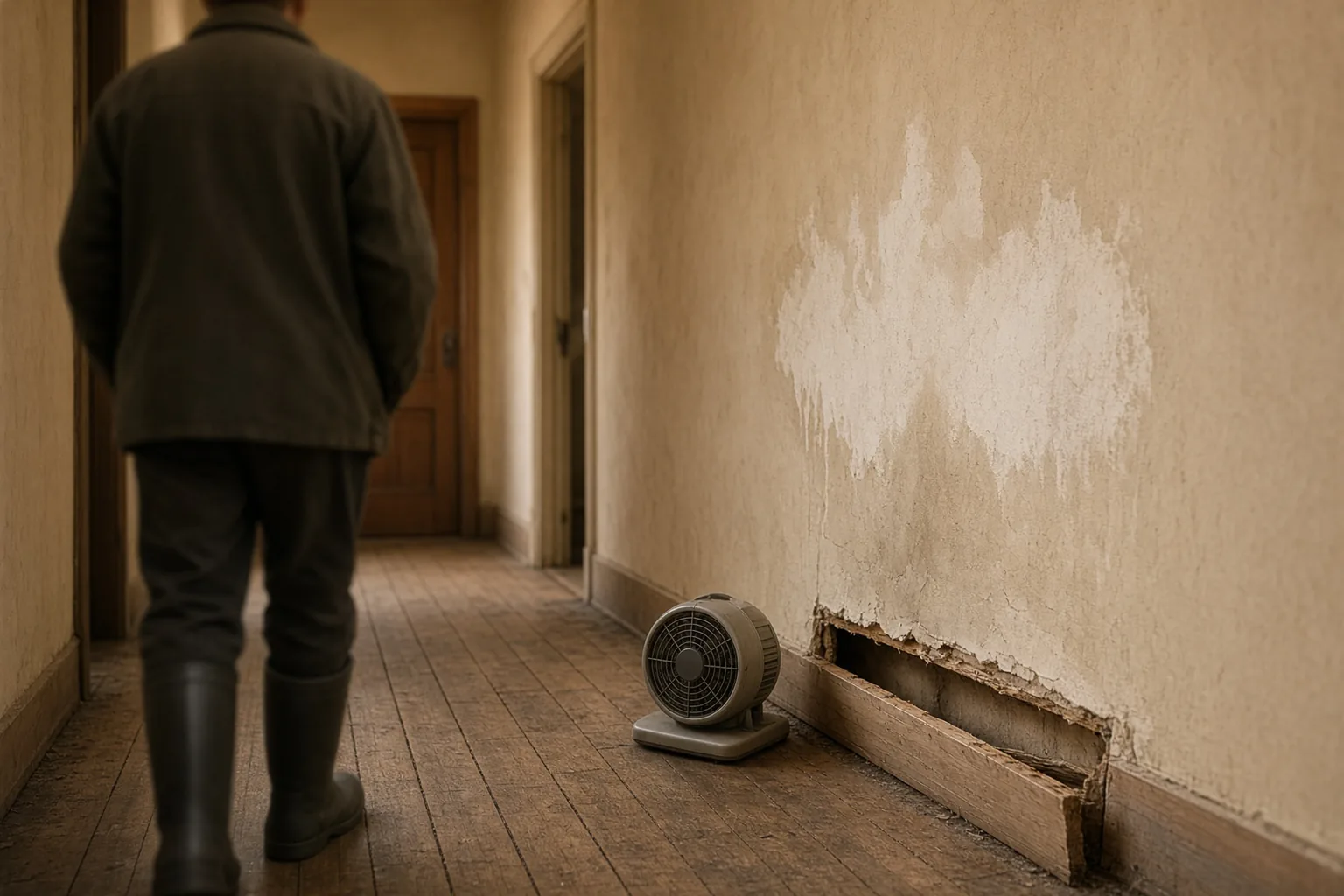
Which opinions in a water damage report does a reviewer test?
Each one separately: where the water came from, what caused the release, when the leak started and how long it ran, the scope of damage and the repair cost. Rule 702 applies opinion by opinion.
Under Rule 702 of the Federal Rules of Evidence, as amended in 2023, the party offering an expert must show the court that it is more likely than not that the expert's knowledge will help the trier of fact, that the testimony is based on sufficient facts or data, that it is the product of reliable principles and methods, and that the expert applied those methods reliably to the facts of the case. The committee note to the 2023 amendment says that many courts had treated the sufficiency of an expert's basis and the application of the method as questions of weight, and calls those rulings an incorrect application of Rules 702 and 104(a).
A water damage report can meet that standard on one opinion and fall short on another. A plumber may identify a failed fitting by examining the part and still have only a guess about when it began to leak. The reviewer lists the opinions one by one and writes next to each the facts or data the expert used, the method that turns those data into the opinion, and the page where the report explains the link.
Rule 26(a)(2)(B) of the Federal Rules of Civil Procedure requires a retained expert's report to contain a complete statement of all opinions and the basis and reasons for them, the facts or data considered, the exhibits, the expert's qualifications with publications from the previous 10 years, the cases in which the expert testified in the previous 4 years, and the compensation. An opinion on duration that appears in the conclusions but has no basis or reasons in the body of the report goes first on the reviewer's list.
Why does the length of a leak decide so many water damage claims?
Many property policies exclude damage from water that leaks continuously or repeatedly over a period of time. The insurer's expert then dates the leak in weeks or months, and the policyholder's expert has to answer that date.
In Hoey v. State Farm Florida Insurance Co., No. 4D07-2750, decided by Florida's Fourth District Court of Appeal on July 16, 2008, the policy excluded loss caused by "continuous or repeated seepage or leakage of water or steam which occurs over a period of time" and which "results in deterioration, corrosion, rust, mold, or wet or dry rot." The dispute was about when a fitting on a toilet supply line began to fail and how long water ran before anyone saw it.
In Brown v. Mid-Century Insurance Co., 215 Cal. App. 4th 841, filed by the California Court of Appeal, Second Appellate District, Division Seven, on April 2, 2013, the policy said that a sudden discharge "does not include a constant or repeating gradual, intermittent or slow release of water." Coverage again depended on how long the water had been escaping, and both sides used experts to answer that question.
Timing also decides cases in which the insurer says the damage began before the policy took effect. Policy wording differs between insurers and between states, so the reviewer starts with the exclusion or condition in the policy at issue and writes down which period the opposing expert has to establish: a minimum number of days, a span of months, or a start before the policy's first day.
How do experts date a leak, and what does the reviewer ask for?
From records and physical signs: water bills that rise over several billing periods, rot, mold and corrosion. The reviewer asks for the bills, photographs and samples behind each sign and checks which dates they cover.
In Hoey, State Farm's expert testified that the leak came from a failed nylon fitting in a toilet supply line. He relied on water bills that showed usage rising gradually and said the leak could have started as early as July, because the rot and mold were consistent with leakage over a period longer than a few weeks. The trial court found that the leak began during the August-September billing period and continued until it was discovered in mid-November. The appellate court affirmed and wrote that the argument against that finding was "utterly without merit."
In Brown, Mid-Century's expert, Claude LeBlanc, concluded that a hole in a copper hot water line had formed as a result of ordinary wear and tear to the pipe, which corroded. He wrote: "This unabated continuous dripping and leaking lasted at least five months until the leak was discovered." He also concluded that the household's monthly water consumption increased during the period water was escaping from the pipe. The house had pervasive, visible mold and moisture on the interior walls of each level.
With bills, the reviewer checks whether the statements in the file cover the months the expert names, whether the increase begins where the expert says the leak began, and whether the report considers any other reason for higher consumption. With rot, mold and corrosion, the reviewer asks what in the report ties the sign to a period of time: a measured depth of decay, a laboratory result, a published rate, or the expert's experience alone.
The last answer is the weak one. In General Electric Co. v. Joiner, 522 U.S. 136, decided December 15, 1997, the Supreme Court held that nothing in Daubert or the Federal Rules of Evidence requires a court to admit opinion evidence "connected to existing data only by the ipse dixit of the expert," and that a court "may conclude that there is simply too great an analytical gap between the data and the opinion proffered."
Does a sudden pipe failure answer the other side's long-term leak opinion?
Not under policy wording like the one in Brown. The court held that the moment a pipe breaks does not make the release sudden when water keeps escaping for months; the length of the discharge controlled.
The Browns' expert, Harvey Kreitenberg, concluded that the pipe "failed suddenly, and ultimately a spray or stream (not drips) of hot water shot through the holes." The court held that his opinion did not create a factual issue on whether the release of water was sudden. It described the policyholders' argument as "the 'metaphysical moment' theory" and rejected it, because a breach that lasts a fraction of a second does not turn a release that continues for months into a sudden one.
The court wrote that "'Sudden' has a temporal element and does not mean a gradual or continuous discharge," and that an average layperson understands that "one to two months" qualifies as a period of time when water is escaping out of a pipe. The trial court had granted Mid-Century's motion for summary judgment, and the Court of Appeal affirmed.
In Brown the policyholders did not dispute that the pipe leaked over a period of one to two months, and their expert addressed only how the pipe broke. A rebuttal under similar wording deals with the evidence of duration itself: the bills, the extent of mold and rot, the dates of the inspections. Brown applied California law to one policy form, and courts in other states read the wording of their own policies, so the reviewer quotes the policy in the case and the decisions of that state.
What if the experts disagree about when the damage began?
The disagreement can go to a jury. In Betancourt v. Citizens, Florida's Third District reversed summary judgment because the homeowners' engineer said the damage could not be placed before the policy began.
Miguel Betancourt v. Citizens Property Insurance Corp., No. 3D23-0923, was decided per curiam by Florida's Third District Court of Appeal on March 12, 2025. The policy period began on October 10, 2018 and ended on October 10, 2019, and, as the court described it, the policy covered direct physical loss and excluded damages occurring before its inception. The water damage in the master bedroom was discovered on or about July 9, 2019.
Citizens' industrial hygienist described "a historic leak associated with a pre-existing shower enclosure/bathtub that occurred for a minimum period of two months." The court noted that he did not opine on whether the water damage preexisted the policy period. The homeowners' engineer wrote that the leak likely occurred before July 9, 2019 unnoticed, and that "it cannot be said with any reasonable degree of engineering certainty that these damages occurred prior to October 10, 2018."
The court held that the engineer's affidavit was sufficient to create a genuine issue of material fact and that the final summary judgment for Citizens was premature. A two-month minimum counted back from a discovery in July 2019 still falls inside a policy period that began in October 2018. A reviewer in such a case writes the policy dates next to every duration the opposing expert gives and checks whether the opinion, taken as written, reaches the date the policy makes decisive.
Can an engineer give a cause opinion after the roof has been replaced?
A federal court in Louisiana admitted one. The engineer inspected after the replacement and relied on a tenant's account of water entering during the storm; the court left the gaps for cross-examination.
2715 Marietta, LLC v. Axis Surplus Insurance Co., No. 22-3292, was decided by Judge Barry W. Ashe of the Eastern District of Louisiana on January 25, 2024. The building had a 30-year-old metal roof. The policy covered direct physical loss or damage caused by or resulting from a windstorm. After Hurricane Ida, Axis denied the roof claim on May 6, 2022, under the wear and tear and rust or corrosion exclusions, and its engineer from Veco Consulting, LLC wrote that the roof "has been leaking sporadically for many years."
The owner's engineer, Michael Gurtler, inspected the property on October 27, 2023, when "the roof had been replaced." He had not observed wind-created openings in the roof and based his opinion on the tenant's eyewitness account of water intrusion during the storm and on his training and experience. Axis argued that he had no reliable basis for his opinions on hurricane damage. The court denied the motion: "Axis's concerns regarding the evidence upon which Gurtler's opinions are based can be addressed through cross-examination and the presentation of countervailing expert testimony." Axis's motion for summary judgment was denied as well.
Rule 703 lets an expert base an opinion on facts or data in the case that the expert "has been made aware of or personally observed." If experts in the field would reasonably rely on that kind of facts or data, they need not be admissible for the opinion to be admitted. A reviewer facing a report like Gurtler's separates what the expert saw from what the expert was told, names the source of each piece of information and lists the physical evidence that no longer existed on the inspection date. That list becomes the outline for the deposition and for cross-examination at trial.
Which materials does the reviewer need from the other side?
Everything the opposing expert considered: dated photographs, moisture readings, laboratory reports, water bills, repair invoices and any assumptions supplied by counsel. Rule 26 makes those facts, data and assumptions discoverable.
Rule 26(a)(2)(B)(ii) requires the report to list the facts or data the expert considered, and Rule 26(a)(2)(B)(iii) requires any exhibits that will be used to summarize or support the opinions. Communications between counsel and a reporting expert are protected by Rule 26(b)(4)(C), with three exceptions: compensation, facts or data that counsel provided and the expert considered, and assumptions that counsel provided and the expert relied on. A date of loss or a discovery date given to the expert by counsel falls under the third exception.
Under Rule 26(b)(4)(A) a party may depose an expert whose opinions may be presented at trial, and if a report is required, the deposition may be conducted only after the report is provided. The party seeking the deposition pays the expert a reasonable fee for the time spent responding, unless manifest injustice would result, under Rule 26(b)(4)(E)(i). Under Rule 26(e)(2) the duty to supplement covers both the report and the deposition testimony, and changes must be disclosed by the time pretrial disclosures under Rule 26(a)(3) are due.
If the damaged property is still in the other side's possession or control, Rule 34(a)(2) lets a party request entry so that it may inspect, measure, survey, photograph, test or sample the property. The written response is due within 30 days after service. A rebuttal report intended solely to contradict or rebut evidence on the same subject matter is due within 30 days after the other party's disclosure under Rule 26(a)(2)(D)(ii), absent a stipulation or a court order.
What does IAE do when the other side has a water damage expert report?
IAE reviews the opposing construction expert's report for US cases and prepares expert reports on the client's questions, including where the water came in and what the repair costs. The signed document is issued within up to 5 business days.
The IAE construction defect page lists the questions its experts answer: where the water came in, whether the work meets the contract and the code, whether the structure is sound and what the repair will cost. For a leak, the expert first checks whether the water came from the roof, plumbing or condensation and then tests the wall; installed windows and doors are tested in place under ASTM E1105-26. For cost, the expert lists each damaged element, measures quantities on site or from photos and prices the repair line by line, with defect repair kept apart from upgrades.
A review answers six questions about the opposing report: whether the method fits the object and the questions and was followed at every stage; whether all objects, materials and questions were examined; whether the conclusions follow from the examination; whether the expert's education, specialty and experience match the subject; whether the report meets the form and procedure of the jurisdiction; and whether the report can be relied on.
The client sends the opposing report with its exhibits and the case materials and describes what to check. The secretariat confirms receipt the same day, and within one business day IAE confirms the format, the cost, the deadline and the specialist from its registry. The client approves the candidate and the CV before work starts. The signed PDF is issued within up to 5 business days after the format and cost are confirmed, and cases with tight deadlines have a 48-hour rush.
Specialists are members of the public IAE registry and passed the council's attestation under the published Criteria Matrix; the Member ID or QR code in the document opens the specialist's record. The specialist confirms in the document that he or she has no interest in the outcome. Materials are not passed to third parties without the client's consent. A review is evidence the court weighs with the other materials; neither IAE nor the reviewer guarantees the outcome, and IAE is not a law firm.
Sources
- Federal Rules of Evidence, Rule 702, Testimony by Expert Witnesses, with Committee Notes (LII)
- Federal Rules of Evidence, Rule 703, Bases of an Expert's Opinion Testimony (LII)
- Federal Rules of Civil Procedure, Rule 26, Duty to Disclose; General Provisions Governing Discovery (LII)
- Federal Rules of Civil Procedure, Rule 34, Producing Documents, Electronically Stored Information, and Tangible Things, or Entering onto Land (LII)
- General Electric Co. v. Joiner, 522 U.S. 136 (1997) (LII)
- Hoey v. State Farm Florida Insurance Co., No. 4D07-2750 (Fla. 4th DCA July 16, 2008) (FindLaw)
- Brown v. Mid-Century Insurance Co., 215 Cal. App. 4th 841 (Cal. Ct. App. Apr. 2, 2013)
- Betancourt v. Citizens Property Insurance Corp., No. 3D23-0923 (Fla. 3d DCA Mar. 12, 2025)
- 2715 Marietta, LLC v. Axis Surplus Insurance Co., No. 22-3292 (E.D. La. Jan. 25, 2024), order and reasons (Justia)
Read also
All articles
Sinkhole claim denied in Florida: how does a reviewer test the insurer's engineering report?
When a Florida insurer denies a sinkhole claim after testing, the denial rests on the report of the engineer or geologist it hired. Sections 627.706 Sergei Voronin

Cast iron pipe claim: what does a reviewer check in the opposing plumbing or engineering expert's report?
In a cast iron pipe dispute the expert's words about cause and duration decide coverage. In State Farm Florida Insurance Co. v. Feltes (Fla. 6th DCASergei Voronin
Window leak expert report: what does a reviewer check in the opposing water test?
A window leak report rests on a water test, and the test decides whether the opinion survives. In 2016 a federal court excluded all window-testingSergei VoroninExpert report review
Ready to discuss your case?
Send the materials: the secretariat will confirm the format, cost, deadline and the specialist within one business day.
