
Examinations
Stamp impression examination: can an examiner tell whether this stamp made the impression?
A forensic document examiner compares a questioned stamp or seal impression with the stamp itself and with known impressions to decide whether they share a source. ANSI/ASB Standard 117 of 2020 sets the procedure for inked stamps, and a SWGDOC standard covers embossed dry seals. The answer depends on the original document, the device and known impressions with reliable dates.
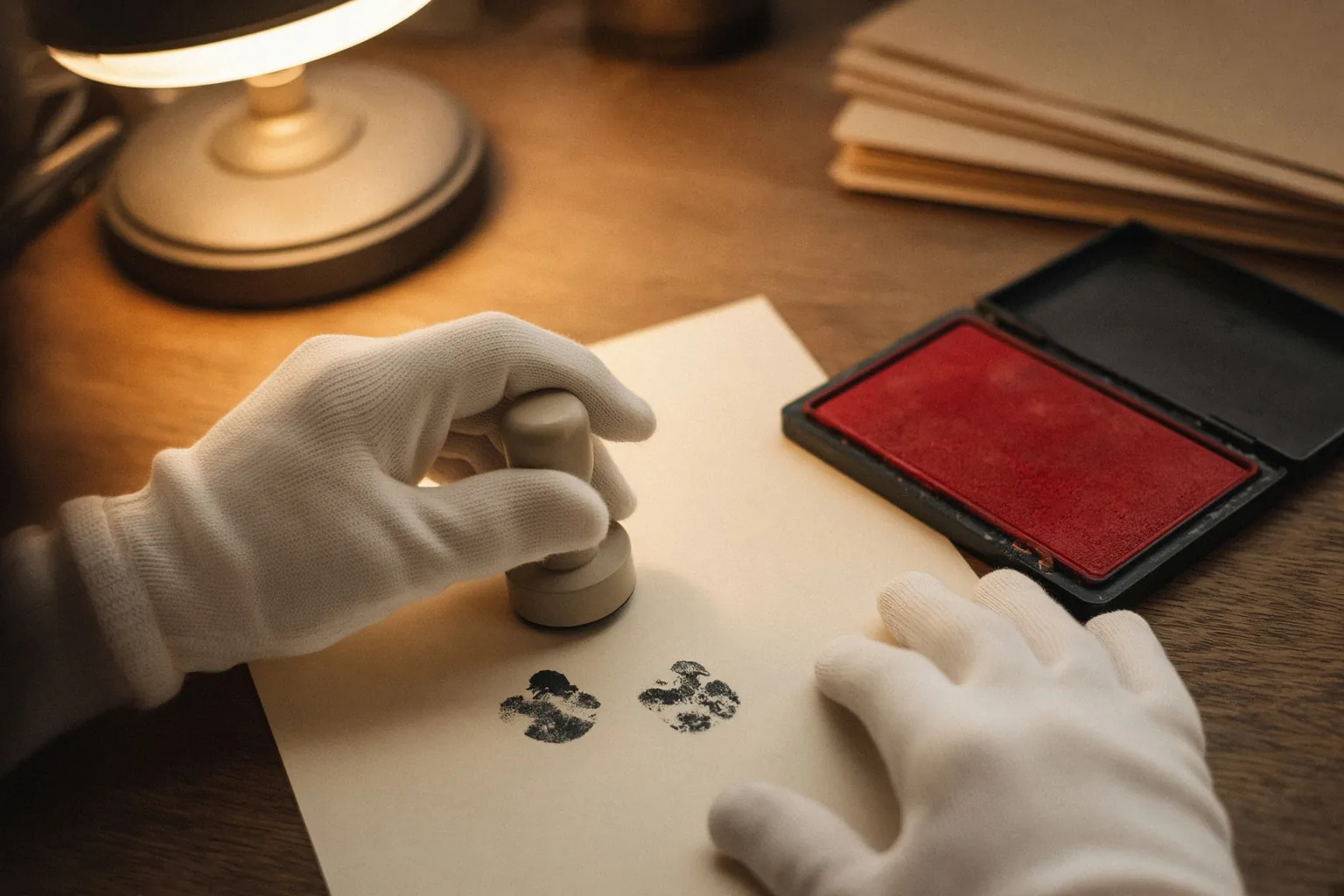
Can a document examiner tell whether a particular stamp made an impression?
Often, yes. ANSI/ASB Standard 117 says that an examiner who follows its procedures can reliably reach an opinion on whether impressions have a common origin or were made by a specific stamping device.
ANSI/ASB Standard 117, Standard for Examination of Stamping Devices and Stamp Impressions, was approved by the AAFS Standards Board in March 2020 and by ANSI in August 2020. It covers "stamp impressions (often referred to as rubber stamp impressions) and stamping devices." Section 4.3.2 states: "By following these procedures, a forensic document examiner can reliably reach an opinion concerning whether two or more impressions have a common origin or if a stamping device impression was created by a specific stamping device."
The FBI Laboratory works under its own procedure, DOC-218-07, Stamped Impressions/Dry Seal Examinations, issued December 16, 2024. Its scope covers "impressions from stamps, dry seals, and other mechanical devices" and notes that stamps and dry seals may be made of rubber, wood, plastic, photo polymers, metals or wax.
Both texts frame the opinion around a device and its impressions: a common origin, or one specific stamp. Who pressed the stamp on a given day is a separate fact, proved by other evidence.
Standard 117 also sets who may do the work. Under section 4.1.2 the examiner needs a knowledge base that includes "the manufacturing processes of materials used in the production and preservation of documents," and the examiner's training must conform to the SWGDOC Standard for Minimum Training Requirements for Forensic Document Examiners of 2013.
What kinds of stamps and seals can be examined?
Standard 117 lists hand stamps, self-inking, pre-inked, rotary die and flat die stamps, made of vulcanized rubber, laser-cut rubber or photopolymer. The FBI procedure and a SWGDOC standard also cover dry seals that emboss paper.
Section 4.3.1 of Standard 117 says stamping devices print commonly used terms such as "copy", "paid" and "x-ray" or provide a facsimile signature. It names the devices: "hand stamp, self-inking stamp, pre-inked stamp, rotary die stamp, and flat die stamp." Depending on the die material, the impression is made with water-based or oil-based ink. The SWGDOC Standard for Examination of Rubber Stamp Impressions defines a rubber stamp as "any of a wide variety of hand printing devices made of many materials not necessarily rubber."
The definitions in section 3 of Standard 117 separate the designs. A hand stamp needs a separate ink pad (3.9). A self-inking stamp sits in a plastic or metal container with a rotating die plate seated against a miniature stamp pad, and the plate rotates to re-ink after each impression (3.23). Section 3.17 describes the pre-inked stamp: "The ink is contained in the die of the stamp; therefore, an ink pad is not required." Gel, salt-leached and flat dies are pre-inked.
The die's manufacture leaves its own traces. Vulcanized rubber is raw rubber pressurized with heat until it is hard enough for a die (3.27). A laser cut die is engraved by laser in pre-vulcanized "laserable rubber" (3.10). Photopolymer is a photosensitive plastic that hardens under ultraviolet light (3.16). Flat dies come from Light Burst Technology, which uses a xenon flash (3.11), or from thermal printing, in which heat closes the micropores of the non-printing area (3.25).
Om Prakash Jasuja, Jatin Kumar Sharma and Jassy Anand collected 50 different types of rubber stamp impressions for a 2022 study in Nowa Kodyfikacja Prawa Karnego. They grouped the devices into self-inking stamps with a built-in pad, pre-inked stamps refilled with oil-based inks, and traditional stamps with a wooden handle.
Can the examiner tell which type of stamp made an impression?
Not with certainty from the impression alone. Jasuja, Sharma and Anand wrote that no definite judgment about the type of stamp can be made from a questioned impression, so the examiner needs the suspected stamp.
The 2022 article reads: "No definite judgment regarding the type of stamp can be made while examining a questioned impression." The authors add that "the document examiner must have the suspected stamp" and that examiners "cannot make assumptions in this regard based on examining the impression."
Lighting carries much of the analysis. In the same study direct light gives even illumination of the area "in order to determine the manufacturing process used to create the die," and oblique light reveals small defects and whether they are permanent or transitory. Standard 117 describes magnification between 2x and 40x for randomly acquired characteristics and instruments for infrared and infrared luminescence examinations (4.3.1). A note to section 4.2.1 lists transmitted illumination, side lighting and vertical incident lighting as useful.
The paper carries information too. A note to section 4.5.11.6 says the substrate may help determine whether the ink was aqueous or oil-based, and tells the examiner to consider whether the surface is porous or non-porous, smooth, textured, flat, round or curved. A non-porous substrate "has no openings to absorb ink and requires an ink that will air dry" (3.15).
How are stamp impressions imitated?
The standards name duplicate stamps made from a matrix board or from an impression of the genuine stamp, and imitations made by electronic or other means. A duplicate copies the defects too, but with smoother edges.
Standard 117 defines a duplicate as "a copy of a genuine stamp" that may be made from a matrix board or from an impression of the genuine stamp (3.5). The SWGDOC rubber stamp standard says in section 5.4 that "a rubber stamp can be manufactured which duplicates the impressions of another stamp" and mentions "various forms of simulations, imitations, and duplicates of rubber stamps." Section 4.5.10.3 of Standard 117 tells the examiner to look at the original questioned impression for characteristics of duplication by electronic or other means.
A duplicate carries the genuine stamp's defects into the forgery, so the examiner looks at how those defects print. The note to section 4.5.10.3 says that in a duplicate stamp impression the cuts, gouges or wear "will reproduce with smooth edges instead of rough and jagged areas in the impression produced from the original stamp."
Section 4.5.12 applies the same test to the known impressions. A comparison set made with a duplicate says nothing about the genuine stamp, so known impressions are checked for smooth-edged defects before they are used.
A missing defect is weighed with care. The note to section 4.5.10.4 explains that an individual characteristic may not reproduce in every impression, because its reproduction depends on its size, shape and location on the die and on the pressure and ink applied.
What should you send to the examiner?
The original document, the stamp with its handle or container, the ink pad of a hand stamp, and known impressions with their dates. Standard 117 calls the original impression preferable and records the stamp's condition before test impressions are made.
Section 4.5.10.1 reads: "Examination of the original stamp impression is preferable, and consideration shall be given to obtaining the original stamp impression, if not submitted." A scan or photocopy can still be examined, but section 4.5.10.2 points to the "inherent limitations associated with examining non-original stamp impressions."
When the stamp arrives, the examiner notes its condition ("clean, dirty, inked, worn, damaged"), the manufacturer's name on the handle or container, whether it is a hand, self-inking or pre-inked stamp, the die material and whether the typeface is raised or flat (4.5.11.1). Under section 4.5.11.4 the examiner considers sampling the ink on the stamping device before taking exemplars.
Test impressions are made on material most similar to the substrate of the questioned item and, if the ink was not submitted, with ink of similar characteristics (4.5.11.6.1 and 4.5.11.6.2). For a self-inking stamp the examiner locks the container so the die stays in printing position (4.5.11.6.4). Standard 117 and the SWGDOC standard both list a stamp pad, stamp pad ink and smooth bond paper among the items for collecting specimens.
Known impressions from ordinary records with reliable dates, such as filed forms, invoices or letters, show how the stamp printed in the period of the questioned document. When the stamp is in the other party's hands, Federal Rule of Civil Procedure 34 lets a party request to "inspect, copy, test, or sample" designated tangible things, and the request "must specify a reasonable time, place, and manner for the inspection and for performing the related acts." The 2006 committee note says issues of burden and intrusiveness raised by requests to test or sample can be addressed under Rules 26(b)(2) and 26(c).
Can a stamp impression show when a document was stamped?
Only indirectly. A stamp acquires defects in use, which Standard 117 calls progressive defects. The FBI procedure for dating documents describes no stamp-based method and refers stamp work to its stamp procedure.
Section 3.18 of Standard 117 defines a progressive defect as "a defect or feature that appears during the use of the stamp and can change with additional usage." Jasuja and his co-authors wrote that unique characteristics of a stamp are more commonly "the effect of use, misuse, wear, and even age of the stamp" than of its manufacture.
Such features give an order of events, not a calendar date. Known impressions taken from documents with reliable dates before and after the questioned date are the material against which the questioned impression is compared, and the report should say where each known impression came from and when it was made.
The FBI Laboratory's procedure DOC-202-10, Age Determination of Documents, issued January 2, 2025, works with physical features such as watermarks, typewriting technology, checkwriter impressions and printing processes, and with reference materials that establish introduction dates. For stamps and seals it refers to DOC-218. Among its limitations are non-original items and a lack of features in the items that would assist in age determination.
Is a stamped signature a signature?
Under the Uniform Commercial Code it can be: section 1-201(b)(37) says signed includes using any symbol executed or adopted with present intention to adopt or accept a writing. The examiner treats it as a stamp impression.
The definition reads: "'Signed' includes using any symbol executed or adopted with present intention to adopt or accept a writing." A rubber stamp with a name or a facsimile of a handwritten signature can meet that definition. The definition turns on the intention to adopt or accept the writing, so the examination answers a narrower question: whether the mark came from a given stamp.
For the examiner the device decides the method. Section 4.3.1 of Standard 117 names a facsimile signature among the uses of stamping devices, so a stamped signature is compared as a stamp impression: class characteristics of the die, randomly acquired defects, ink and pressure. Handwritten items fall under another text, ANSI/ASB Standard 070 of 2022, which sets procedures "for examinations and comparisons involving handwritten items."
The first question in such a case is therefore whether the signature was written with a pen or printed by a device. The answer decides which standard applies and which known material the examiner asks for: handwriting specimens of the person, or the stamp and its impressions.
Does a seal on a contract still have legal effect?
For contracts for the sale of goods in Florida it does not: section 672.203 of the Florida Statutes says a seal does not make the writing a sealed instrument. Whether the seal is genuine is a separate question.
Section 672.203, titled "Seals inoperative," dates back to chapter 65-254 of the Laws of Florida. It provides that affixing a seal to a writing that evidences a contract for sale or an offer to buy or sell goods does not make the writing a sealed instrument, and the law on sealed instruments does not apply to it.
Authenticity is decided separately. In federal court Rule 901(a) of the Federal Rules of Evidence requires the proponent to "produce evidence sufficient to support a finding that the item is what the proponent claims it is." Rule 901(b)(4) lists among the ways to do so "the appearance, contents, substance, internal patterns, or other distinctive characteristics of the item, taken together with all the circumstances." A company stamp or seal on a letter or invoice is one of those characteristics, and a stamp examination tests it.
How is an embossed dry seal examined?
The SWGDOC dry seal standard has the examiner confirm that a dry seal made the impression, compare class characteristics, then wear, damage and embossment variation, and consider a duplicate seal before any identification.
The SWGDOC Standard for Examination of Dry Seal Impressions, version 2013-1, defines a dry seal as "a non-inked mechanical device which embosses a design on paper" and embossment variation as "non-uniformity of the dry seal impression on the paper stock," which can come from how the seal was applied or from defects in the seal. The standard covers comparisons of questioned and known impressions and examinations of questioned items alone.
The standard lists the usual limits: non-original documents, a limited quantity of impressions, distorted or partial impressions and variation in surface texture. Under section 5.3, prior handling or chemical processing, such as latent print treatment, can flatten embossments or stain the paper, so the impression is examined before processing where possible.
The FBI procedure DOC-218-07 lists what the examiner looks for in a dry seal impression: "Embossing of the paper," an impression that may not be uniform, and pressure variation. It calls for a 150-watt tungsten halogen light and a 30-watt transmitted light box or comparable equipment, and for known impressions made with the seal as received, on materials similar to the questioned item, "using varying pressures and/or rolling techniques."
The SWGDOC procedure stops if the impression was not made by a dry seal (7.4). It compares class characteristics first and individualizing characteristics such as wear, damage and embossment variation patterns next (7.13). An identification requires, among other conditions, that the possibility of a duplicate seal has been eliminated (8.3).
How does a stamp opinion come into evidence?
Through Rules 901 and 702. Rule 901(b)(3) permits authentication by an expert's comparison with an authenticated specimen, and Rule 702 requires sufficient facts or data and a reliable application of reliable methods.
Rule 901(b)(3) names "a comparison with an authenticated specimen by an expert witness or the trier of fact." The Advisory Committee's note says the example "sets no higher standard for handwriting specimens and treats all comparison situations alike," with the genuineness of the specimen decided under Rule 104(b). For a stamp, the specimen is the stamp itself or known impressions whose origin is proved.
Rule 702 requires the proponent to show that the testimony "is based on sufficient facts or data" and "is the product of reliable principles and methods," and that the expert's opinion applies those principles and methods reliably to the facts of the case. The committee note to the 2023 amendment states that "each expert opinion must stay within the bounds of what can be concluded from a reliable application of the expert's basis and methodology," and that forensic experts should avoid assertions of absolute or one hundred percent certainty if the methodology is subjective.
The report names the standard the examiner followed. ASTM E2289, Standard Guide for Examination of Rubber Stamp Impressions, is listed on the ASTM store page as withdrawn in 2017 with no replacement. ANSI approved Standard 117 in August 2020.
What does IAE do when a stamp impression is disputed?
An examiner from the IAE registry compares the questioned impression with known impressions and the stamp under Standard 117 and prepares a report on your questions for federal and state cases, in up to 5 business days.
The IAE page on forensic document examination lists the questions the examiner answers: whether a page was inserted or replaced, an entry erased or overwritten, a stamp impression made by the stamp in question, and how the document was printed. Under ANSI/ASB Standard 117 (2020) questioned impressions are compared with known impressions and the stamp: size, type style, wear, damage, inking defects and signs of duplication. The examiner can also prepare a review of the opposing examiner's report.
Send the questions, the document or its best available copy, the stamp or known impressions if you have them, and the court order if an examination has already been ordered. IAE confirms the questions and the handling of the original with you before work starts. The secretariat confirms receipt the same day and, within one business day, the format, the cost, the deadline and the examiner from the registry; you approve the candidate and the CV. The document is issued in up to 5 business days after the format and cost are confirmed, and cases with tight deadlines have a 48-hour rush.
Registry members passed the collegial attestation of the council under the published Criteria Matrix, and the Member ID in the report can be checked by QR code. The examiner confirms in the document that he or she has no interest in the outcome, and materials are not passed to third parties without your consent. The court weighs the report with the other evidence; neither IAE nor the examiner guarantees the outcome, and IAE is not a law firm and does not advise on case strategy.
Sources
- ANSI/ASB Standard 117, Standard for Examination of Stamping Devices and Stamp Impressions, First Edition, 2020 (AAFS Standards Board)
- ANSI/ASB Standard 070, Standard for Examination of Handwritten Items, First Edition, 2022 (AAFS Standards Board)
- SWGDOC Standard for Examination of Rubber Stamp Impressions, ver. 2013-1 (NIST)
- SWGDOC Standard for Examination of Dry Seal Impressions, ver. 2013-1 (NIST)
- FBI Laboratory, Questioned Documents, DOC-218-07, Stamped Impressions/Dry Seal Examinations, issued 12/16/2024
- FBI Laboratory, Questioned Documents, DOC-202-10, Age Determination of Documents, issued 01/02/2025
- Jasuja O.P., Sharma J.K., Anand J. Rubber stamp impressions: A study of defects and their significance in questioned document examination. Nowa Kodyfikacja Prawa Karnego, vol. 64, 2022, DOI 10.19195/2084-5065.64.4
- ASTM E2289-08, Standard Guide for Examination of Rubber Stamp Impressions (Withdrawn 2017), ASTM store page
- Uniform Commercial Code, section 1-201, General Definitions (LII)
- The 2024 Florida Statutes, section 672.203, Seals inoperative (Florida Senate)
- Federal Rules of Evidence, Rule 901, Authenticating or Identifying Evidence, with Committee Notes (LII)
- Federal Rules of Evidence, Rule 702, Testimony by Expert Witnesses, with Committee Notes (LII)
- Federal Rules of Civil Procedure, Rule 34, Producing Documents, Electronically Stored Information, and Tangible Things (LII)
Read also
All articles
What can you ask a forensic document examiner, and what should you send with the document?
A forensic document examiner answers questions about how a document was made and what was done to it afterwards: whether an entry was added, a page Sergei Voronin
Burned, soaked or torn: what can a document examiner recover from a damaged document?
A document that went through a fire, a flood or a shredder is often still readable in part. Forensic document examiners work with charredSergei Voronin
Same pen or a different pen: what can a document examiner tell from the ink?
A document examiner can often show that two entries were written with different inks, and that settles that two pens were used. The reverse isSergei VoroninExpert examinations
Ready to discuss your case?
Send the materials: the secretariat will confirm the format, cost, deadline and the specialist within one business day.
