
Examinations
Signed by hand or reproduced: can an examiner tell an ink signature from a printed, stamped or autopen one?
A document examiner can usually tell a signature written with a pen from one printed, stamped or drawn by a machine, but only on the original page. Toner lies on the paper surface, a facsimile stamp leaves no groove and an inked rim along each stroke, and an autopen repeats one stored signature with even pressure. How a signature was made is a separate question from who wrote it, and the examiner answers it first.
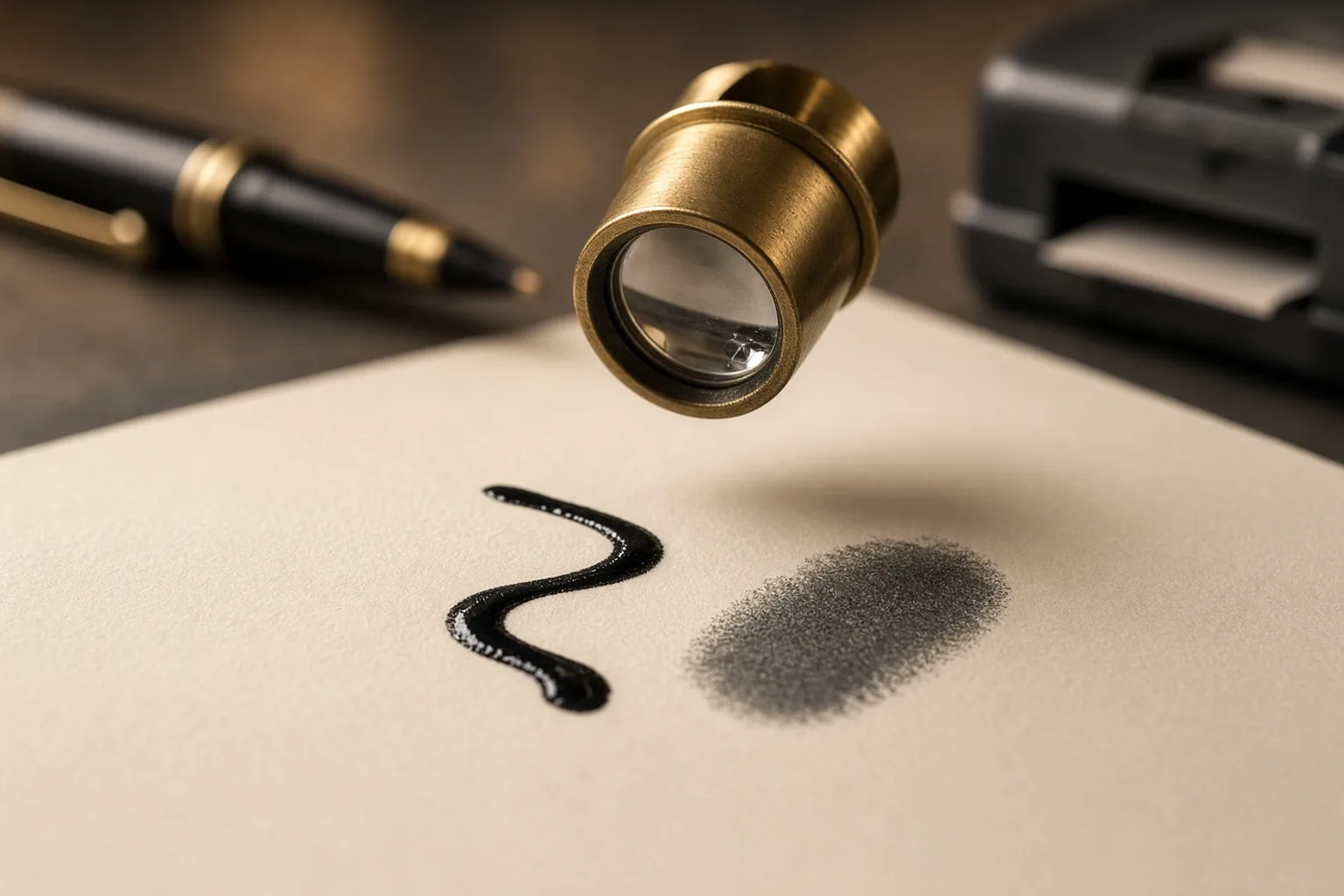
Can a document examiner tell whether a signature was signed by hand?
In most cases, yes, if the original is available. A pen leaves a groove, ink laid along the path of the hand and changing pressure; printers, stamps and plotters leave marks of their own mechanism.
The question here is the method of production. A signature on a contract can be a name written by its owner, a genuine signature reproduced from an image, or a simulation by another person. Each of these calls for a different examination, and the first step decides which one.
ANSI/ASB Standard 070, the standard for examination of handwritten items approved by the Academy Standards Board in April 2022 and by ANSI in October 2022, opens the examination of questioned writing with this step. Section 6.3.2 states: "The examiner shall determine whether the questioned writing is original writing." Section 6.3.3 adds a check for duplication, such as cut-and-paste manipulation, "by electronic or other means."
A ballpoint or gel pen writes under pressure. The point presses a groove into the paper, the ink follows the moving point, and pressure grows and fades within each letter. A device that does not hold a pen puts colorant on the page by another mechanism, and that mechanism is visible under magnification as fused toner, droplets of inkjet ink or ink transferred from the face of a stamp.
N. V. Efremenko of the Academy of the Ministry of Internal Affairs of the Republic of Belarus grouped these features by device in a 2018 article on determining the technical method of execution of a signature, published in the Academy's journal (No. 1 (35), pages 77 to 81). The sections below follow that grouping for printers, stamps and plotters.
What does a printed signature look like under magnification?
A laser print shows a bumpy layer of fused toner with a raster structure, a shine and stray toner specks. An inkjet print shows a dot structure of matte ink soaked into the paper.
In Efremenko's description, strokes made by a laser, or electrophotographic, printer have a bumpy surface formed by sintered toner particles. The image has a raster structure, the strokes shine, and microscopic toner particles lie on the unprinted parts of the page. Strokes made by an inkjet printer have a dot structure, and the colorant has a matte surface and is fixed mainly by soaking into the paper.
None of these features depends on how well the image copies the owner's signature. A scan of a genuine signature printed onto a contract keeps every letter form of the original and still consists of toner or inkjet dots instead of pen ink. A handwriting comparison of such a signature finds agreement with the owner and says nothing about who put the image on the page.
A printed signature also appears in cut-and-paste documents. A signature lifted from one document is placed into a file with new text and the page is printed as a whole. On such a page the signature strokes carry the same toner as the typed lines around them. Standard 070 treats this as duplication under section 6.3.3, and the examination of the printing process belongs to ANSI/ASB Standard 011.
How is a signature made with a facsimile stamp recognized?
By the mechanism of the stamp. The strokes have no relief from a pen point, the ink forms a rim along the edges of each stroke, and the dynamic traces of a writing point are absent.
A facsimile stamp is a die made from an image of a real signature. Efremenko notes that a signature applied with such a die carries two sets of features. The first set matches the genuine signature, because the die was made from one. The second set comes from the mechanism of application and matches the features of stamp and seal impressions: strokes without relief, an inked rim along the edges of the strokes, and no dynamic traces left by the writing unit of a pen.
For this reason a comparison of letter forms alone can mislead. The proportions, connections and slant of a stamped signature belong to the owner, and an examiner who compares only forms will report agreement. The answer comes from the structure of each stroke under the microscope.
Several signatures from one die also repeat each other. Section 6.5.6.1 of Standard 070 requires the examiner to evaluate "exact replication among multiple writings", and section 6.3.8 lists "an unnatural similarity between multiple questioned items" among the indicia of simulation and tracing. Genuine signatures of one writer vary within a range: section 6.4.3 warns that known specimens collected only by a stakeholder can miss part of the writer's full range of variation. Impressions of one die repeat the die.
What is an autopen, and why is it harder to detect?
An autopen moves a real pen along a stored signature, so the ink and the groove are real. The examiner relies on even pressure, the order of strokes and letter forms that superimpose exactly.
At the 2018 annual meeting of the American Academy of Forensic Sciences, Aurora Dumitra, Melvin Shaw and four co-authors presented a study titled "Distinguishing Characteristics of Robotic Writing." Their abstract states that autopen devices, which reproduce an exact copy of a person's signature, have been in use since the 1940s, that "autopen" has become the standard term in document examination for all signature-duplication machines, and that such machines replicate the signatures of government officials and corporate leaders.
The authors compared robotic samples of six people with known genuine writing of the same people, both requested and collected. The robotic samples showed even pen pressure, a variable sequence of up and down strokes and superimposed letter forms, and on these differences the examiners concluded that the writing was not genuine.
The Forensic Document Examination Subcommittee of the Organization of Scientific Area Committees for Forensic Science lists the problem as an open research need. Its document "Detection of Machine Writing versus Human Writing", version 4 of March 21, 2025, approved by the Scientific Area Committee on February 3, 2026 with the rank medium, names the Autopen and the Longpen as devices that replicate a signature or handwriting with an ink pen. It states: "There is limited amount of research and publications on this topic." It asks whether Standard 070 should require the examiner to determine whether writing was produced by a signing machine and whether examiners are trained to tell machine writing from human writing.
The research need cites a workshop by J. Heckeroth, "Signed by hand or signed by machine?", given at the 2025 symposium of the Association of Forensic Document Examiners and the 2025 meeting of the Academy and based on a 2019 project of the German Institute for Questioned Document Examination. A report that rules an autopen in or out should name the signatures it compared, because the comparison rests on a set from the same period.
Can a plotter or a 3D printer imitate pen pressure?
Not fully, in the work published so far. Plotter signatures show undifferentiated pressure and blunt, rounded stroke ends, and a 2022 experiment could not make a 3D printer repeat human pressure completely.
A plotter draws with a pen, so its strokes contain real ink and a real groove. Efremenko divides its features into three groups. The first comes from preparing the image on a computer: smoothing of angular elements and merging of strokes that lie close together. The second comes from fixing the sheet: traces of the glue that held the paper and marks of the pressure rollers. The third comes from the movement of the writing unit: undifferentiated pressure from even force on the pen, blunt starts and ends of strokes with a rounded shape, thickened strokes without pooled ink, and changes of stroke shape and repeated movements where strokes run close.
Nikita Rybalkin of the Tula laboratory of forensic expertise of the Russian Ministry of Justice reviewed signatures made with modern technical means in a 2022 article in the journal Theory and Practice of Forensic Science (volume 17, No. 2, pages 31 to 35). A plotter signature starts from a scan: a program sets reference points and the path of the writing unit, and the plotter then draws the line. In the cases he describes, the only feature that led examiners to a plotter was the absence of pressure gradations in flexing and extending movements of the line.
In an experiment described in the same article, an imitation of a signature was made on a 3D printer, but the pressure could not be repeated fully. Rybalkin recommends that a handwriting examiner and a technical document examiner work on such signatures together.
Does the examiner need the original document?
Yes. The groove, toner on the surface, the inked rim of a stamp and the pressure pattern of a pen exist only on paper. A copy or a scan turns every signature into an image.
Section 6.3.2 of Standard 070 covers the case where the original is not submitted: the examiner evaluates the quality of the reproduction, and the note lists among its limitations the inability to detect guide lines and the type of writing instrument. A question about method of production is a question about the writing instrument, so a copy leaves it open.
The same limit applies to documents that exist only in electronic form. V. E. Yaskina, P. I. Lakeev and L. M. Kruglov wrote in a 2023 article in Theory and Practice of Forensic Science (volume 18, No. 2) on handwriting submitted as scans, photographs or stylus input that such an examination excludes the stage of microscopic study. They add that in such a case the examiner cannot state that the object was made without technical means.
A copy can still be useful at the start. It shows whether the questioned signature superimposes on another signature in the file, and it lets the examiner say what the original will need. The final answer on method comes from the original.
Is a stamped, printed or autopen signature legally a signature?
Often, yes. Under the Uniform Commercial Code a signature is any symbol executed or adopted with present intention to adopt or accept a writing. The dispute then turns on authority and intent.
Section 1-201(b)(37) of the Uniform Commercial Code defines the term: "Signed" includes using any symbol executed or adopted with present intention to adopt or accept a writing. Section 1-201(b)(43) adds that "Writing" includes printing, typewriting, or any other intentional reduction to tangible form.
The Office of Legal Counsel of the Department of Justice reached a similar result for bills in an opinion of July 7, 2005. The headnote states that the President need not personally perform the physical act of affixing his signature to a bill he approves, and that the President may sign a bill within the meaning of Article I, Section 7 of the Constitution by directing a subordinate to affix the President's signature to such a bill, "for example by autopen."
For the examiner this changes the question, not the method. A finding that the signature on a guaranty was stamped does not by itself void the guaranty. It establishes a fact that the parties then argue about: who held the stamp, who was allowed to use it and whether the person named adopted the document. Those questions go to the witnesses and the court.
Which questions should the examiner be asked?
Ask how the signature was made before asking who made it: by hand with a pen, by a printer, by a stamp or by a signing machine, and whether it repeats another known signature exactly.
The order matters because the answer to the first question decides whether a handwriting comparison is worth doing. If the signature is a print of a scanned genuine signature or an impression of a die made from one, the letter forms will match the owner, and the comparison will add nothing about who put the signature on the page. Questions that fit this kind of dispute are these.
- Was the questioned signature written with a handwriting instrument, or reproduced by a printer, a stamp, a plotter or another device?
- If the signature was reproduced, which features of the strokes point to toner, inkjet ink, a stamp die or a machine-held pen?
- Does the questioned signature superimpose on any other signature in the file or among the known signatures?
- Were the signatures on several documents produced by one die or one device?
- If the signature was written by hand, was it written by the person named in the document?
What should you send for the examination?
The original document, other documents with the same signature from the same period, the stamp itself if one exists, and any records on its use. A copy can come first for an initial look.
A set of documents matters more here than in an ordinary signature case. A die or a machine is detected by repetition, and repetition needs at least two items. Contracts, invoices and letters signed in the same month give the examiner material to superimpose, and genuine signatures of the owner from the same period give the range of natural variation.
If a company used a facsimile stamp, the stamp itself can be compared with the questioned signature as with any stamp impression. If the company used an autopen, the records of who loaded the signature and who operated the machine are evidence for the court; the examiner compares the strokes. Describe in the request which documents are disputed and which ones the parties accept as signed by hand.
What does IAE do when a party says a signature was not signed by hand?
An examiner from the IAE registry prepares a report on your questions about the document or a review of the opposing examiner's report, in up to 5 business days after the format and cost are confirmed.
The IAE forensic document examination page lists the questions the examiner answers: whether a page was inserted or replaced, an entry erased or overwritten, a stamp impression made by the stamp in question, and how the document was printed. Under ANSI/ASB Standard 011 (2022) the examiner compares and classifies documents produced by typewriters, fax machines, photocopiers, computer printers and commercial printing, and stamp impressions are compared with known impressions and the stamp under ANSI/ASB Standard 117 (2020). IAE frames the questions around the document and the part of it in dispute.
Send the case materials through the form on the contact page and describe the task. The secretariat confirms receipt the same day and, within one business day, the format, the cost, the deadline and the examiner from the registry; you approve the candidate and the CV before work starts. The question list and the handling of the original are agreed with you in advance. Cases with tight deadlines have a 48-hour rush.
Registry members passed the collegial attestation of the council under the published Criteria Matrix, and the Member ID in the report can be checked by QR code. The examiner confirms in the document that he or she has no interest in the outcome, and materials are not passed to third parties without your consent. The court weighs the report with the other evidence; neither IAE nor the examiner guarantees the outcome, and IAE is not a law firm and does not advise on case strategy.
Sources
- ANSI/ASB Standard 070, Standard for Examination of Handwritten Items, First Edition 2022 (AAFS Academy Standards Board)
- OSAC Forensic Document Examination Subcommittee, R&D need: Detection of Machine Writing versus Human Writing (NIST)
- Dumitra A., Shaw M. et al., Distinguishing Characteristics of Robotic Writing, AAFS 2018 Proceedings, J9
- Office of Legal Counsel, Whether the President May Sign a Bill by Directing That His Signature Be Affixed to It, July 7, 2005 (U.S. Department of Justice)
- Uniform Commercial Code, section 1-201, General Definitions (LII, Cornell Law School)
- Efremenko N. V., Determining the technical method of execution of a signature, Vestnik of the Academy of the MIA of Belarus, 2018, No. 1 (35), pp. 77-81 (in Russian)
- Rybalkin N. A., Problems of forensic examination of handwriting and signatures made with modern technical means, Theory and Practice of Forensic Science, 2022, vol. 17, No. 2, pp. 31-35 (in Russian)
- Yaskina V. E., Lakeev P. I., Kruglov L. M., On examining handwriting submitted in electronic form, Theory and Practice of Forensic Science, 2023, vol. 18, No. 2, pp. 54-61 (in Russian)
Read also
All articles
What can you ask a forensic document examiner, and what should you send with the document?
A forensic document examiner answers questions about how a document was made and what was done to it afterwards: whether an entry was added, a page Sergei Voronin
Burned, soaked or torn: what can a document examiner recover from a damaged document?
A document that went through a fire, a flood or a shredder is often still readable in part. Forensic document examiners work with charredSergei Voronin
Same pen or a different pen: what can a document examiner tell from the ink?
A document examiner can often show that two entries were written with different inks, and that settles that two pens were used. The reverse isSergei VoroninExpert examinations
Ready to discuss your case?
Send the materials: the secretariat will confirm the format, cost, deadline and the specialist within one business day.
