
Expert report review
Sound transmission test in the opposing expert's report: what does a reviewer check?
A sound test in a noise dispute produces a number, and the reviewer's first question is which number it is. The Los Angeles building code, for example, sets laboratory ratings of 50 for walls and floors between dwelling units and field results of 45, and each comes from a different ASTM method. The reviewer checks the method edition, the metric, the rooms, the requirement the result is compared with and whether the report found the source of the noise.
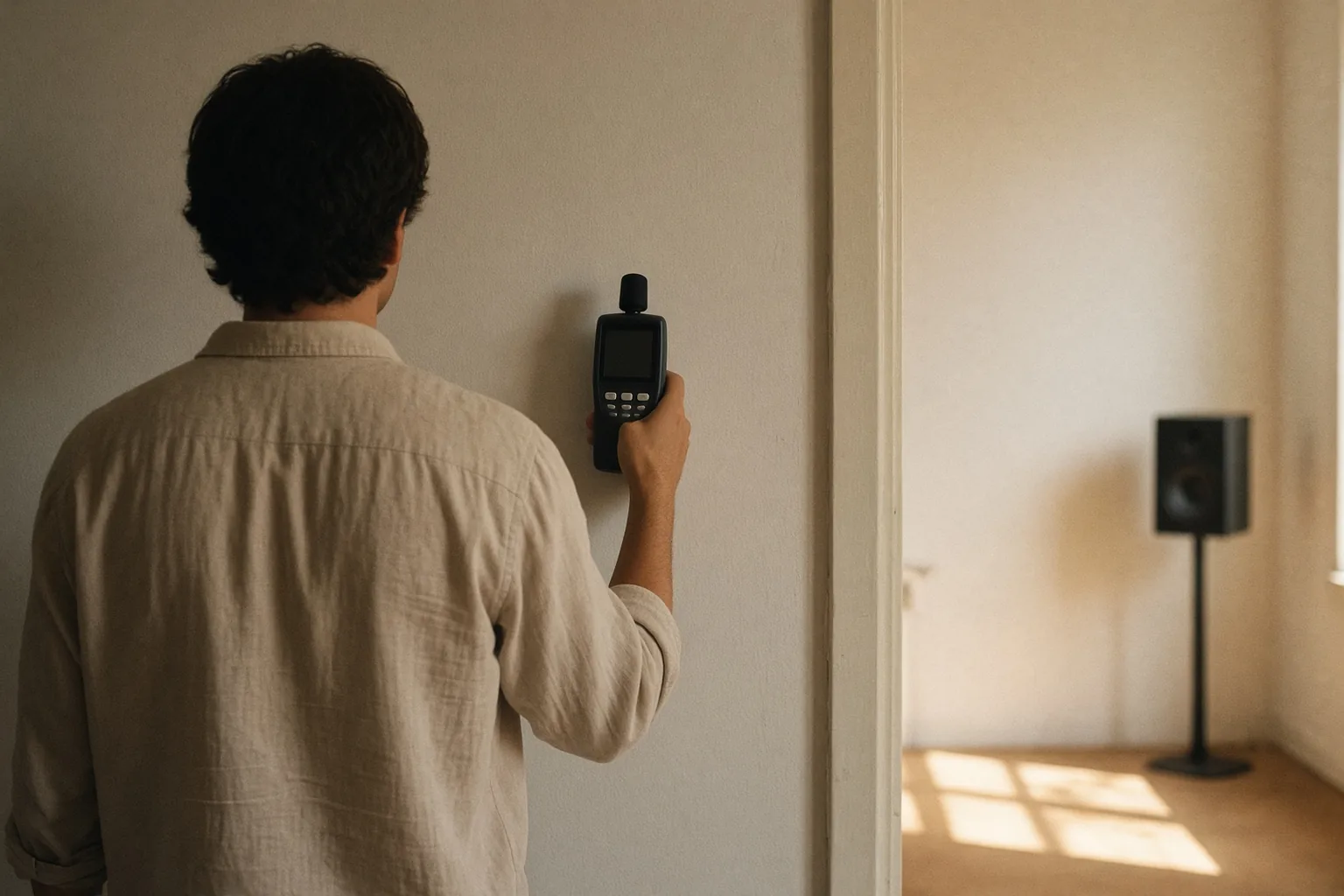
What does a sound transmission test measure?
Airborne sound tests measure how much a wall or floor reduces voices, music and television between rooms. Impact tests measure footfall and other blows on the floor above. Each has laboratory and field versions with different ratings.
Two kinds of noise reach a neighbor. Airborne sound starts in the air of one room and passes through a wall or floor into the next. Impact sound starts as a blow on the structure, usually footsteps on the floor above. Codes rate the two separately, and tests for them follow different ASTM standards.
The Los Angeles Municipal Code shows how the ratings line up. Section 91.1206.10 requires a laboratory sound transmission class (STC) of 50 under ASTM E 90 and E 413 for assemblies between dwelling units, and a field rating of 45 under ASTM E 336 and E 413. Section 91.1206.11 requires a laboratory impact insulation class (IIC) of 50 under ASTM E 492 and E 989, and a field impact rating (FIIC) of 45 under ASTM E 1007 and E 989.
A report that gives only "STC 47" or "IIC 52" without naming the standard and the conditions leaves the reviewer with the first question: was this measured in a laboratory on a sample or in the building on the assembly as built.
Is the report quoting a laboratory rating or a field result?
Laboratory ratings describe an assembly tested in a test chamber; field results describe the building as built, with every side path for sound. Codes set field targets 5 points lower, so mixing the two changes the answer.
Laboratory tests isolate one assembly. Field tests measure what reaches the neighbor through the wall or floor and through every other path in the building. The Los Angeles code accepts laboratory-tested assemblies at plan review (section 91.1206.12) but states a separate field requirement for the finished building.
The field targets are lower: 45 instead of 50 for airborne sound and for impact sound under sections 91.1206.10 and 91.1206.11. An expert who measures 46 in the field and compares it with the laboratory figure of 50 reports a failure that the code does not define. An expert who quotes the manufacturer's laboratory STC for the wall and calls the building compliant has not tested the building at all.
The reviewer marks every number in the report with its origin: laboratory listing, design calculation or field measurement, and checks that each comparison uses the matching requirement.
Which ASTM edition did the expert follow, and do the metric names match it?
The reviewer checks the edition of ASTM E336 named in the report and the metrics it uses. E336-17a uses NIC, NNIC, ATL and ASTC; versions before 2017 had Field and Apparent prefixes. ASTM lists E336-25a as active.
ASTM E336 is the field method for airborne sound attenuation between rooms. The ASTM page for E336-17a describes it as defining "procedures and metrics to assess the sound isolation between two rooms". It names the metrics NR and NIC, NNR and NNIC, and ATL and ASTC, and its Note 4 says that versions of the standard prior to 2017 included TL and STC metrics with prefixes designated as Field (F) or Apparent (A). The same page marks E336-17a as historical and lists E336-25a as active.
The metric names tell the reviewer what was computed. NIC and NNIC describe the isolation between two rooms as a whole; ATL and ASTC describe the apparent performance of the separating partition and include flanking. FSTC is not among the metrics listed for E336-17a. A report that says FSTC but cites the 2017 or a later edition of E336 mixes two vocabularies, and the reviewer asks which calculation was actually done.
Codes cite their own metrics. The Los Angeles code requires a field NIC of 45 for occupied units and a normalized rating of 45 for unoccupied units. The reviewer compares the metric in the report with the metric in the requirement, and the requirement with the edition of the code that applied to the building.
Do the rooms and the building fit the method?
The main E336 procedures apply when both rooms are smaller than 150 cubic meters, and ATL is limited to spaces of at least 25 cubic meters. Results include flanking transmission through the surrounding structure.
The ASTM page for E336-17a states that the main procedures apply when "both room volumes are less than 150 m3", that ATL is limited to spaces of at least 25 m3, and that an annex covers cases where at least one room is 150 m3 or larger. A large open living area or a small closet used as a receiving room raises a question under those limits.
The same page states that ATL and ASTC include both the direct transmission and flanking transmission through the support structure. Sound that travels through a shared slab, a continuous floor or a pipe chase counts in the field result. That is correct for a code check of the building, and it means a low field result does not by itself show that the wall is defective; the path may run around the wall.
The reviewer asks for the room dimensions, the test positions and any steps taken to identify flanking paths. Without them the report cannot separate a defective partition from a defective junction.
Which requirement did the expert compare the result with?
The one that applies to the building, its use and its construction date: the adopted building code, any local amendment, the condominium declaration or rules, or a contract specification. Each sets its own metric and value.
Building codes apply by jurisdiction and by date. The Los Angeles section adopts the California Building Code section 1206 by reference with local additions, and section 91.1206.8 notes that local governments may modify the requirements by ordinance. The reviewer identifies the code edition in force when the building was permitted.
Code sections have scope limits. Under section 91.1206.9.1 impact insulation is not required over nonhabitable rooms or spaces not designed for occupancy, such as garages, mechanical rooms or storage areas. Entrance doors from interior corridors need an STC of at least 26 under section 91.1206.10, and where corridor wall field tests are impractical the composite wall and door must reach an NIC or NNIC of 30. A report that applies the dwelling unit floor requirement over a garage, or the wall requirement to a corridor door, compares the result with the wrong line.
Private requirements can be stricter than the code. In the Ontario case below, a condominium rule from 2011 set its own sound standards, which an acoustical consultant hired by the corporation described as "extremely stringent." The reviewer reads the report against the requirement the claim actually relies on.
What if the expert logged noise events instead of testing the assembly?
Then the report measures the noise that occurred, not the performance of the wall or floor, and its conclusions depend on the benchmark chosen. In Friedlander the tribunal dismissed a noise claim that relied on such logging.
Friedlander v. York Condominium Corporation No. 427, decided by Ontario's Condominium Authority Tribunal on October 12, 2022 (2022 ONCAT 110), turned on several acoustical reports. Thornton Tomasetti tested the floor-ceiling assembly in August 2021 and measured an FIIC of 57. Soft dB, in a report dated June 2, 2022, recorded 135 sound events in the applicant's bedroom over 24 hours, with a duration of 1 hour and 11 minutes, with levels up to 31 dBA and 45 dBC, and compared them with benchmarks from the WHO, CMHC and ASHRAE. It found the WHO sleep-related limits and CMHC recommendations exceeded and the ASHRAE limits met.
Thornton Tomasetti answered in a peer review dated July 18, 2022. According to the decision, it argued that the Soft dB report did not identify the source of the 135 recorded sound events, that the WHO guideline applies over an 8-hour nighttime period while Soft dB presented hourly results, and that the CMHC standard "is almost always unattainable in urban areas." None of the consultants testified, so the tribunal worked from their written reports.
The tribunal found that the evidence did not show unreasonable noise and dismissed the application without costs or damages. It relied on Thornton Tomasetti's assessment of the WHO guideline. The case is Canadian, but the review points are general: what the logger recorded, which benchmark it was compared with and why, and whether anyone tied the recorded events to a source.
Does the report identify the source and the path of the noise?
A finding that sound is loud does not say where it comes from. The reviewer checks whether the expert ruled out other sources, such as plumbing, mechanical equipment or flanking paths, before blaming the wall or floor.
The 2000 committee note to Rule 702 lists as a factor whether the expert has adequately accounted for obvious alternative explanations. In a noise case the obvious alternatives are plumbing and drainage, mechanical equipment, elevators, doors closing, and flanking through slabs, ducts or pipe chases. In Friedlander a consultant's follow-up of April 2021 described the slight noise of flushing toilets as normal for any condo building, and the decision records that a lower shower spout identified as a noise source had been capped by March 17, 2021.
Source identification takes its own steps: listening and measuring at different positions, operating suspected equipment while recording, and inspecting junctions. The reviewer lists which of these the expert performed and which conclusions rest on none of them.
Rule 702(d) requires a reliable application of the method to the facts of the case. A report that measured a low field rating and then attributed every complaint to the floor without testing the alternatives stops short of that step.
How does the review reach the court?
As a rebuttal report, as deposition questions or as support for a Rule 702 motion. A rebuttal report on the same subject is due within 30 days after the other side's disclosure unless the court orders otherwise.
Under Rule 26(a)(2)(D)(ii), evidence intended solely to contradict or rebut evidence on the same subject identified by another party is disclosed within 30 days after that party's disclosure, absent a stipulation or court order. A review of a sound test fits that description when it stays on the test, its method and its conclusions.
The rebuttal expert's report follows Rule 26(a)(2)(B): opinions with their basis and reasons, the facts or data considered, exhibits, qualifications with publications from the previous 10 years, testimony from the previous 4 years and compensation.
Under Rule 702 as amended on December 1, 2023, the party offering the acoustical expert must show the court that it is more likely than not that the opinion rests on sufficient facts or data and a reliable application of reliable methods. The 2023 committee note calls the treatment of those questions as matters of weight "an incorrect application of Rules 702 and 104(a)." A review that ties each defect in the test to the rule gives counsel the grounds for that motion.
What does IAE do when the other side relies on a sound test?
IAE prepares a review of the opposing construction expert's report and a rebuttal report for US cases. The reviewer tests each opinion against its data; delivery takes up to 5 business days after the format and cost are confirmed.
The IAE page on reviews of construction expert reports is written for attorneys facing the other side's construction expert. The reviewer reads the opposing report with its exhibits and the data the expert considered, and ties each point to a rule or a standard. The products are a review of the opposing expert report, a rebuttal expert report and deposition questions.
The client sends the opposing report with its exhibits, the raw test data and room dimensions if disclosed, the applicable code or condominium rule and the deadlines, and describes what to check. The secretariat confirms receipt the same day. Within one business day IAE confirms the format, the cost, the deadline and the specialist from its registry, and the client approves the candidate and the CV before work starts. Cases with tight deadlines have a 48-hour rush.
Every specialist is a member of the public IAE registry and can be verified by Member ID or QR code. The specialist confirms in the document that he or she has no interest in the outcome of the case. A review is evidence that the court weighs with the other materials; neither IAE nor the reviewer guarantees the outcome. IAE is not a law firm and does not advise on case strategy.
Sources
- Los Angeles Municipal Code, Sec. 91.1206, Sound Transmission (American Legal Publishing)
- ASTM E336-17a, Standard Test Method for Measurement of Airborne Sound Attenuation between Rooms in Buildings, standard page (ASTM)
- Friedlander v. York Condominium Corporation No. 427, 2022 ONCAT 110, decision of October 12, 2022 (Condominium Authority Tribunal)
- Federal Rules of Evidence, Rule 702, with committee notes (uscode.house.gov)
- Federal Rules of Civil Procedure, Rule 26 (LII, Cornell Law School)
Read also
All articles
Sinkhole claim denied in Florida: how does a reviewer test the insurer's engineering report?
When a Florida insurer denies a sinkhole claim after testing, the denial rests on the report of the engineer or geologist it hired. Sections 627.706 Sergei Voronin
Cast iron pipe claim: what does a reviewer check in the opposing plumbing or engineering expert's report?
In a cast iron pipe dispute the expert's words about cause and duration decide coverage. In State Farm Florida Insurance Co. v. Feltes (Fla. 6th DCASergei Voronin
Window leak expert report: what does a reviewer check in the opposing water test?
A window leak report rests on a water test, and the test decides whether the opinion survives. In 2016 a federal court excluded all window-testingSergei VoroninExpert report review
Ready to discuss your case?
Send the materials: the secretariat will confirm the format, cost, deadline and the specialist within one business day.
